
SLIDE 1
Personality
Part 1/3
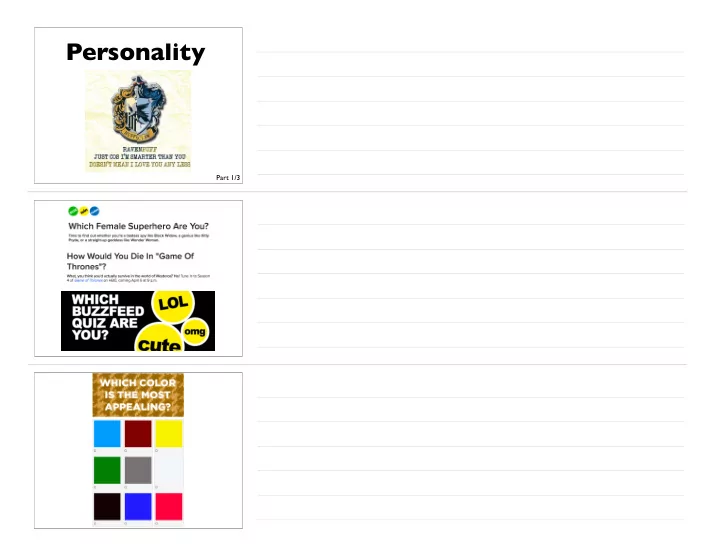
Personality Part 1/3 200 million per month! How does the mind work? - - PowerPoint PPT Presentation
Personality Part 1/3 200 million per month! How does the mind work? How does Jacks Jasmines Jabaris Jills Jans Jacobs mind work? Personality a persons characteristic style of behaving, thinking,
Part 1/3
“How does the mind work?” “How does… mind work?” Jack’s Jill’s Jacob’s Jabari’s Jasmine’s Jan’s
a person’s characteristic style
interacting with others
Humans
Jack Jill Jacob Jabari Jasmine Jan … …
Personality Traits
Humans
Jack Jill Jacob Jabari Jasmine Jan … …
Sociality Persistence Creativity
Humans
Jack Jill Jacob Jabari Jasmine Jan … …
Open- Mindedness Loyalty Focus
What are personality traits, and (how) can we measure them? How do we differ, and why? How much of how we behave is inherent to us (vs. to social situations, education, upbringing, culture)?
Reliability Validity Test-Retest
It is important to see this blot as two human figures, usually females or clowns. If you don’t, it’s seen as a sign that you have trouble relating to people. You may give other responses as well, such as “cave entrance” (the triangular white space between the two figures) and “butterfly” (the red “vagina”, bottom center)
being anxious right now
(but maybe not later)
being an anxious person
(in general)
50%
different type upon retaking the test!
weakly predicts good managers, teammates, etc.
Openness to Experience Conscientiousness Extraversion Agreeableness Neuroticism (“emotional stability”)
Openness to Experience Conscientiousness Extraversion Agreeableness Neuroticism
Openness to Experience Conscientiousness Extraversion Agreeableness Neuroticism
“I am easily distracted”
Openness to Experience Conscientiousness Extraversion Agreeableness Neuroticism
“I remain calm in tense situations”
Openness to Experience Conscientiousness Extraversion Agreeableness Neuroticism
“I am generally trusting of
Openness to Experience Conscientiousness Extraversion Agreeableness Neuroticism
Openness to Experience Conscientiousness Extraversion Agreeableness Neuroticism
Not 2? Not 18,000?
Up next: Part 2/3
Part 2/3
(“identical”)
(“fraternal”)
the proportion of trait variation that is explained by genetic variation
eye color heart disease # of eyes ~1 ~.5 ~0
Heritability ≠ how “genetic” is trait X in some person Heritability = how “genetic” are differences in trait X across people
vs
(i.e., heritability > 0)
Big 5 Politics Sexual Orientation Aggression Achievement Religiosity Intelligence
Really? Nothing? Yes, nothing.
A tempting (but fallacious) argument
(i.e. differences in X can be explained by differences in genes)
explained by differences in genes
therefore… good water, light, soil bad water, light, soil Heritability: High Heritability: High group differences entirely environmental
A tempting (but fallacious) argument
(differences in plant height can be explained by differences in genes)
are explained by differences in genes
therefore…
Big 5 Politics Sexual Orientation Aggression Achievement Religiosity Intelligence
(i.e., heritability > 0)
Up next: Part 3/3
Part 3/3
Nature Nurture Personality Personality Behavior Personality Situation Behavior
inherently bad people? inherently good people? Henry
Henry
You’re going somewhere very important, aren’t you? Yes you are…
Henry
Henry
% answering yes 25 50 75 100 21 Sheridan & King (1972)
Subjects shown a (real) “cute fluffy puppy” Asked to watch the puppy complete a task, and shock it if it got the wrong answer Each wrong answer increases voltage, up to 450 V Course credit earned upon arrival, no obligation to continue
% who shocked puppy 25 50 75 100 77 Sheridan & King (1972)
Subjects shown a (real) “cute fluffy puppy” Asked to watch the puppy complete a task, and shock it if it got the wrong answer Each wrong answer increases voltage, up to 450 V Course credit earned upon arrival, no obligation to continue
(70% deliver the shock)
Personality Situation Behavior