Personal Factors Make a Difference! Research from more than 1,000 - - PDF document

personal factors make a difference
SMART_READER_LITE
LIVE PREVIEW

Personal Factors Make a Difference! Research from more than 1,000 - - PDF document

11/2/2014 Using the CLEI to Help Students and Measure Success in College ! Presented By Dorinda J. Lambert, Ph.D. Director Counseling Services Kansas State University Personal Factors Make a Difference! Research from more than 1,000


slide-1
SLIDE 1

11/2/2014 1

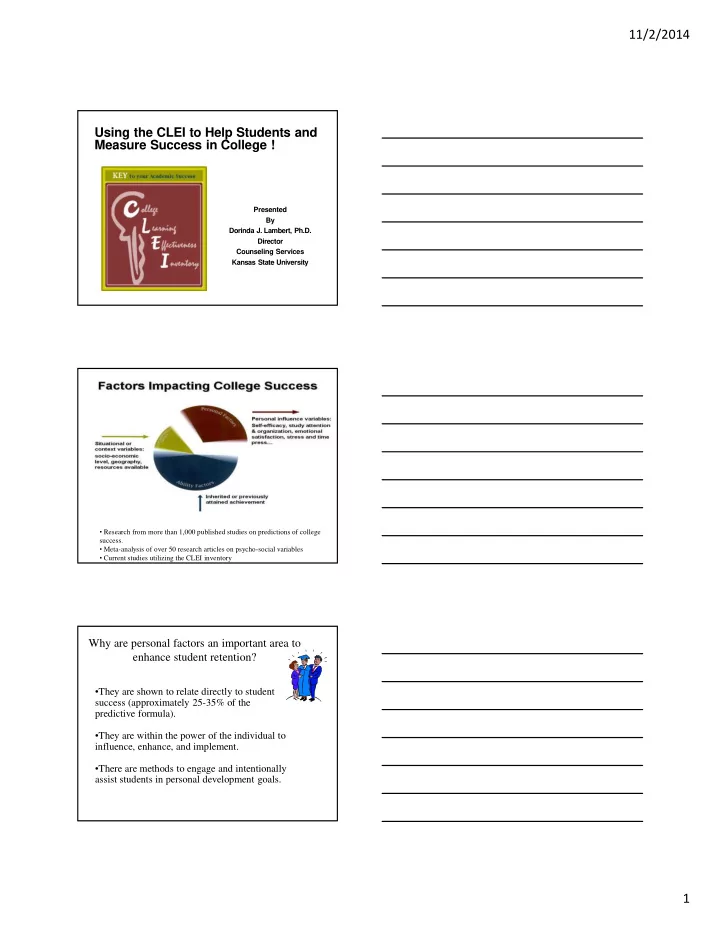
Using the CLEI to Help Students and Measure Success in College !

Presented By Dorinda J. Lambert, Ph.D. Director Counseling Services Kansas State University

Personal Factors Make a Difference!

  • Research from more than 1,000 published studies on predictions of college

success.

  • Meta-analysis of over 50 research articles on psycho-social variables
  • Current studies utilizing the CLEI inventory

Why are personal factors an important area to enhance student retention?

  • They are shown to relate directly to student

success (approximately 25-35% of the predictive formula).

  • They are within the power of the individual to

influence, enhance, and implement.

  • There are methods to engage and intentionally

assist students in personal development goals.

slide-2
SLIDE 2

11/2/2014 2

KSU Studies on Personal Factors

STEPS:

  • Identify and define the key personal variables
  • Utilize or develop an accurate assessment tool
  • Apply assessment results to intervention strategies
  • Utilize best learning principles to target change
  • Track and measure outcome results

TASKS COMPLETED:

  • Developed the CLEI, HBA, and KPIRS
  • Factor analysis, validation, confirmatory studies
  • Created intervention packages including manuals,

workbooks, and on-line delivery systems

  • Reported through 7 refereed journals
  • Several more outcome measurement studies in progress
  • Started with requests for assistance with

at-risk students

  • Inductive practice experience provided

from task force of 8 practitioners.

  • Based upon Russell & Petrie model (1992)
  • Reviewed meta analysis and key studies of

the field (Robbins et.al. 2004)

  • Revised with 4 versions of CLEI (1998 to

present)

Development of the CLEI

  • 1. Identify their strengths and weakness through

accurate assessment using the CLEI.

  • 2. Note the implications for how they can improve, gain

resources, make changes.

  • 3. Develop a plan for what they can do and how they

can do it and include a way for them to monitor and achieve their plan.: using the CLEI workbook/program for change.

  • 4. Measure and evaluate their outcomes: re-administer

the CLEI.e.

You Help Students to Actively Plan for their Success and Measure Progress:

slide-3
SLIDE 3

11/2/2014 3

Identifying Strength & Weakness

  • The Six KEYS -
  • 1. Academic Self-Efficacy
  • 2. Organization & Attention to Study
  • 3. Stress & Time Press
  • 4. Involvement with College Activity
  • 5. Emotional Satisfaction
  • 6. Class Communication

** Research indicates that The Six Keys are significant predictors

  • f 1st Year GPA and Life Satisfaction level among KSU freshmen.

VIDEO ABOUT THE CLEI FOR STUDENTS

For longer version of video go to: http://www.k-state.edu/counseling/faculty/clei.html

T-Scores are based on the mean scores from a normative sample of college undergraduates (N=879)

C L E I Profile Example

slide-4
SLIDE 4

11/2/2014 4

The Six KEYS Items on this scale measure expression of confidence in academic ability, awareness of effort toward study, and expectation for success in college attainment. High scorers expect to succeed and accomplish important

  • utcome goals.

Low scorers feel uncertain about possible achievement and what the future may hold.

If this is an area for change, the student may benefit from:

 Taking more time to identify strengths  Learning how to counter negative thoughts with positive and more realistic

  • nes

 Learning to set goals based on strengths

The Six KEYS High scorers are likely to use effective organizational planning and time management skills to achieve academic success. Low scorers are more likely to avoid planning strategies and lack focus of attention in providing self-direction.

slide-5
SLIDE 5

11/2/2014 5

If this is an area for change, the student may benefit from:

 Identifying one’slearning style  Finding better ways to organize one’s learning space  Re-evaluating one’s use of time to find better balance  Actually altering how to schedule one’s time

The Six KEYS This scale measures how students handle time pressures, environmental concerns, and the academic demands that impact academic study. High scorers manage the pressures of academics while feeling less overwhelmed, procrastinating less, and/or avoiding tasks less Low scorers experience more academically related stress and do not believe they can handle the academic demands they experience.

If this is an area for change, the student may benefit from:

 Learning how to balance demands and self-care  Addressing any pattern of procrastination  Understanding and changing test anxiety  Improving overall skills for stress management

slide-6
SLIDE 6

11/2/2014 6

The Six KEYS Involvement as defined by this scale measures one’s belonging to organizations and participation in activities. High scorers belong to many

  • rganizations and often

participate in formal and/or informal campus activities. Low scorers are more socially isolated, and are less likely to participate or engage in campus activities

If this is an area for change, the student may benefit from:

 Evaluating and understanding one’s level of engagement  Deciding why and how to modify the level

  • f involvement

 Linking involvements with overall goals

The Six KEYS This scale measures emotional response and degree of interest in academic life and the campus educational environment. High scorers express encouragement, interest, and positive anticipation for academic life and their educational environment. Low scorers are more likely to express discouragement, negative reactions, and feel overwhelmed with academic life and their educational environment.

slide-7
SLIDE 7

11/2/2014 7

If this is an area for change, the student may benefit from:

 Identifying ways to increase one’s happiness  Taking charge of ways to increase life satisfaction  Increasing one’s ability to determine

  • wn goals

 Addressing habits that get in the way of success

The Six KEYS This scale measures both verbal and non-verbal efforts to engage in class activity. High scorers are assertive and active with oral communication in-class and with their instructors. Low scorers may experience uncertainty and reluctance in expressing and asserting their ideas in class and with their instructors.

If this is an area for change, the student may benefit from:

 Developing better communication skills  Learning how focus in class affects communication and connections  Identifying effective behaviors & attitudes for positive classroom participation

slide-8
SLIDE 8

11/2/2014 8

Working To Strengthen the Six KEYS

K-State Students Can Use the CLEI Workbook at

https://www.universitylifecafe.k-state.edu/clei/

CASE STUDY: CLEI Usage at a Four - Year Private College 2008- 09

http://www.k-cat.org/docs/Case Study CLEI 2008-09 4yr Private College.pdf

Research Abstract

Krumrei, E., Newton, F.B., Kim, E. & Wilcox, D. “Psychosocial Factors Predicting First-Year College Student Success”. Journal of College Student Development, 54 (3), May/June, 2013. This study makes use of a model of college success that involves students achieving academic goals and life satisfaction. Hierarchical regressions examined the role of six psychosocial factors for college success among 579 first-year college

  • students. Academic self-efficacy predicted end-of-year GPA even when controlling

first semester GPA. In addition, 1st semester GPA fully mediated links between five psychosocial factors (organization and attention to study, stress and time management, involvement with college activity, emotional satisfaction with academics, and class communication) and end-of-year GPA. Stress and time management skills, involvement with college activity, and emotional satisfaction with academics were each predictive of life satisfaction. We explore how formulating interventions on the basis of psychosocial factors offers an avenue for students to address specific attitudes, emotions, and behaviors that relate to college success. Link for copy: http://psychologyprogress.com/psychosocial-factors-predicting-first- year-college-student-success/

slide-9
SLIDE 9

11/2/2014 9

For more information and lists of research articles go to: http://www.k-cat.org/

COUNSELING SERVICES KANSAS STATE UNIVERSITY

232 ENGLISH/COUNSELING SERVICES BUILDING 785-532-6927 http://www.k-state.edu/counseling

Our Hours

Office Hours during academic semesters: Monday and Thursday 8am-7pm Tuesday, Wednesday, Friday 8am-5pm Phone: 785-532-6927

Our Services

 Consultations  Clinical Services for Students  Online Resources

slide-10
SLIDE 10

11/2/2014 10

Check out our website at http://www.k-state.edu/counseling Particularly the links for Services for Students Online Resources including our online workshops and stress management resources and University Life Café at http://www.universitylifecafe.k-state.edu