PEP talk TM Weight Management: Talking to Your Overweight Patients - - PDF document

pep talk tm weight management talking to your overweight
SMART_READER_LITE
LIVE PREVIEW

PEP talk TM Weight Management: Talking to Your Overweight Patients - - PDF document

PEP talk TM Weight Management: Talking to Your Overweight Patients About Weight Loss Therapies Best Practices Pearls Evaluate and Measure : PEP talk TM Weight Management: Body Mass Index (BMI) Talking to Your Overweight Patients Waist


slide-1
SLIDE 1

PEPtalkTM Weight Management: Talking to Your Overweight Patients About Weight Loss Therapies 1

PEPtalkTM Weight Management: Talking to Your Overweight Patients About Weight Loss Therapies

Primary Care Decision-Making for Success

Scott Kahan, MD, MPH, FTOS Director, National Center for Weight and Wellness Clinical Director, Strategies to Overcome and Prevent (STOP) Obesity Alliance George Washington University Milken Institute of Public Health Washington, DC Paul P. Doghramji, MD, FAAFP Family Physician Collegeville Family Practice Medical Director of Health Services Ursinus College Collegeville, PA

Best Practices Pearls

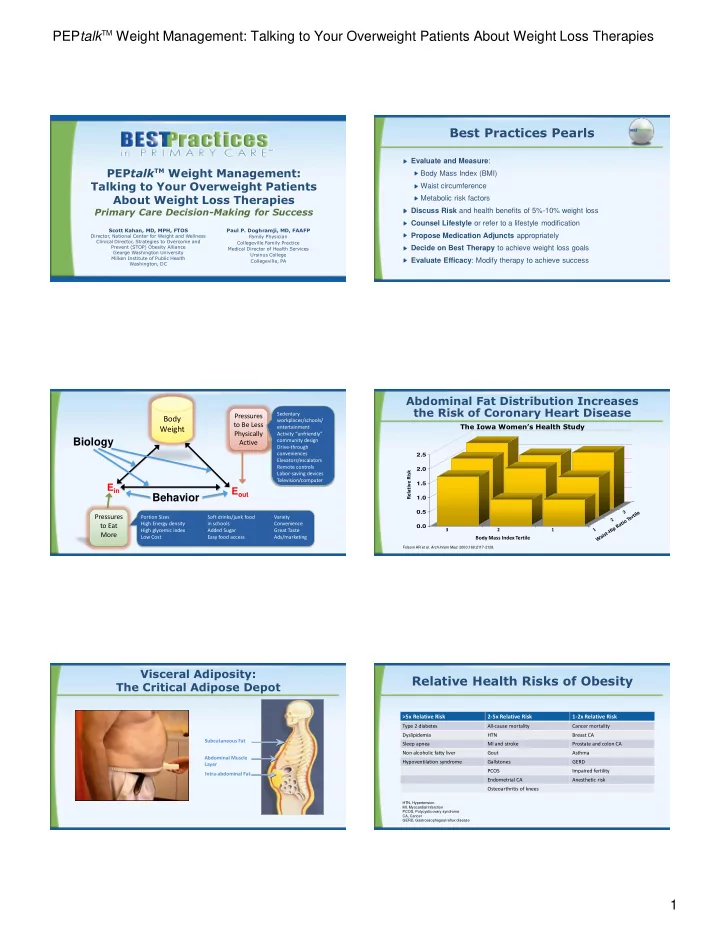
Evaluate and Measure: Body Mass Index (BMI) Waist circumference Metabolic risk factors Discuss Risk and health benefits of 5%-10% weight loss Counsel Lifestyle or refer to a lifestyle modification Propose Medication Adjuncts appropriately Decide on Best Therapy to achieve weight loss goals Evaluate Efficacy: Modify therapy to achieve success

Body Weight

Pressures to Eat More Pressures to Be Less Physically Active

Biology Behavior

Ein Eout

Portion Sizes Soft drinks/junk food Variety High Energy density in schools Convenience High glycemic index Added Sugar Great Taste Low Cost Easy food access Ads/marketing Sedentary workplaces/schools/ entertainment Activity “unfriendly” community design Drive-through conveniences Elevators/escalators Remote controls Labor-saving devices Television/computer 0.0 0.5 1.0 1.5 2.0 2.5

Folsom AR et al. Arch Intern Med. 2000;160:2117-2128.

Body Mass Index Tertile 3 2 1 Relative Risk

Abdominal Fat Distribution Increases the Risk of Coronary Heart Disease

The Iowa Women’s Health Study

Subcutaneous Fat Abdominal Muscle Layer Intra-abdominal Fat

Visceral Adiposity: The Critical Adipose Depot

Relative Health Risks of Obesity

>5x Relative Risk 2-5x Relative Risk 1-2x Relative Risk Type 2 diabetes All-cause mortality Cancer mortality Dyslipidemia HTN Breast CA Sleep apnea MI and stroke Prostate and colon CA Non alcoholic fatty liver Gout Asthma Hypoventilation syndrome Gallstones GERD PCOS Impaired fertility Endometrial CA Anesthetic risk Osteoarthritis of knees

HTN, Hypertension MI, Myocardial Infarction PCOS, Polycystic ovary syndrome CA, Cancer GERD, Gastroesophageal reflux disease

slide-2
SLIDE 2

PEPtalkTM Weight Management: Talking to Your Overweight Patients About Weight Loss Therapies 2

Evaluate and Measure Weight– related Health Risk in Patients

2013 AHA/ACC/TOS Guidelines Screen all patients with BMI at least annually and more frequently, depending on risk factors Use waist circumference measure as a risk factor Identify high risk patients who need to lose weight

BMI ≥30 kg/m2 BMI ≥25 kg/m2 with at least one risk factor

↑ waist circumference (≥40 inches in men, ≥35 inches in women)

Jensen MD, et al. 2013 AHA/ACC/TOS Guideline. J Am Coll Cardiol. 2014;63(25 Pt B):2985-3023. AHA, American Heart Association ACC, American College of Cardiology TOS, The Obesity Society

Meaningful Weight Loss is Goal

  • 3.0%
  • 5.0%
  • 10.0%

Improvements in glycemic parameters, reduction of risk for developing diabetes Greater improvements in above parameters Greater improvements in glycemic parameters; improvement blood pressure, HDL, and triglycerides Even greater improvements in above parameters

  • 15.0%

Note: Improvement in urinary stress incontinence observed at 5% weight loss and sleep apnea at 10% weight loss

Jensen MD, et al. 2013 AHA/ACC/TOS Guideline. J Am Coll Cardiol. 2014;63(25 Pt B):2985-3023.

Counsel Patients on Lifestyle Modifications

With or without obesity-related CV factors (NIH, AHA, ACCF, ADA)

Patient success linked to provider suggestions!!!

Prescribe a diet

To achieve reduced caloric intake Refer to professional or evidence-based program

Increase physical activity Lifestyle Intervention Program

Powell-Wiley TM, et al. Obesity. 2012; 20;849-855. NIH, National Institute of Health AHA, American Heart Association ACCF, The American College of Cardiology Foundation ADA, American Diabetes Association

Evaluate for Weight Related Complications

2013 AHA/ACC/TOS Guidelines and ACE Guidelines

Measure obesity-associated health risks

Glucose, A1c Blood pressure Lipids Biomechanical problems, joint pain Sleep apnea Depression Cancer history Stroke Kidney failure

Heart attack or heart failure Blood vessel damage (arteriosclerosis) Being overweight can lead to high blood pressure and related complications Look AHEAD Research Group. Arch Intern Med. 2010;170:1566-1575.

How Much Weight Does the State-of-the-Art Lifestyle Intervention Produce?

  • 0.63
  • 0.93
  • 0.92
  • 1.01

0.00

  • 8.5
  • 6.35
  • 5.04
  • 4.66
  • 9
  • 8
  • 7
  • 6
  • 5
  • 4
  • 3
  • 2
  • 1

Year 0 Year 1 Year 2 Year 3 Year 4

Mean weight loss (%) from baseline by year

Diabetes support and education ILI, Intenstive lifestyle intervention

% Weight change

P<.0001

Look AHEAD 1-year Data: Impact of Weight Loss on Glycemic Measures

Change in HbA1c (%) 0.0

  • 0.4
  • 0.6
  • 1.0
  • 0.2
  • 0.8

Weight loss category Change in fasting glucose (mg/dL)

  • 20
  • 30
  • 50
  • 10
  • 40

Weight loss category 0.0

  • 1.0
  • 1.5
  • 2.5
  • 0.5
  • 2.0

(mmol/L) Data presented as adjusted least square means and 95% CIs. Stable weight defined as ±2% of baseline weight. P<0.0001 vs. baseline for all weight categories. Wing RR, et al. Diabetes Care. 2011;34:1481-1486.

slide-3
SLIDE 3

PEPtalkTM Weight Management: Talking to Your Overweight Patients About Weight Loss Therapies 3

Data presented as adjusted least square means and 95% CIs. Stable weight defined as ±2% of baseline weight. P<0.0001 vs baseline for all weight categories, unless specified otherwise.

Look AHEAD 1-year Data: Modest Weight Loss (5%–10%) Improved CVD Markers

Change in blood pressure (mm Hg) Diastolic Systolic

  • 4
  • 6
  • 14
  • 2
  • 12
  • 10
  • 8

Weight loss category

  • 100

Change in triglycerides (mg/dL) 20

  • 20
  • 40
  • 80
  • 60

Weight loss category

0.2

  • 0.2
  • 0.4
  • 0.10

0.0

  • 0.8
  • 0.6

(mmol/L) LDL, P=0.3614 Change in HDL and LDL (mg/dL) 8

  • 4
  • 12

4

  • 8

HDL LDL

Weight loss category

0.2 0.1 0.0

  • 0.1
  • 0.2

(mmol/L) Wing RR, et al. Diabetes Care. 2011;34:1481-1486.

Prescribe a Reduced Calorie Diet

Reduce calories 500-750 kcal/day Women

1200-1500 kcal/day or 800 cal x wt. in lbs

Men

1500-1800 kcal/day or 1000 cal x wt. in lbs

Composition not so important: if evidence-based considering patient’s preferences and health status Commercial programs (eg. Jenny Craig, Weight Watchers) can produce weight loss

Diet Composition Comparison: Weight Change From Baseline

  • 5
  • 4.5
  • 4
  • 3.5
  • 3
  • 2.5
  • 2
  • 1.5
  • 1
  • 0.5

Protein Fat Carb High Low High-low: (P=0.22) High-low: (P=0.94) Weight Loss (Kg) High- low (P=0.42)

Sacks, Bray et al NEJM 2008.

Exercise Recommendations

For General Health

Moderate intensity physical activity or equivalent*

150 minutes/week

Resistance training

Moderate or high intensity 2 or more days a week

Weight Loss and Maintenance

150 to 250 minutes per week moderate intensity 250 minutes or more per week for maintenance

*Defined as activities that are strenuous enough to burn three to six times as much energy per minute as an individual would burn when sitting quietly,

  • r 3 to 6 MET

s (Metabolic equivalents). Vigorous-intensity activities burn more than 6 MET s.

Comprehensive Lifestyle Program

6 months or more 12 months for weight maintenance “Gold standard” is onsite group or individual sessions with trained interventionist Electronically delivered or telephone-based valuable if gold-standard not available

Propose and Review Patient Treatment Options

For patients who struggle, intensification of behavioral treatment is appropriate Medications are appropriate for patients with BMI ≥30 or ≥27 with a comorbidity Bariatric surgery with BMI ≥40 or ≥35 plus a comorbidity Intensification of treatment should match the severity of complications!

Jensen MD, et al. 2013 AHA/ACC/TOS Guideline. J Am Coll Cardiol. 2014;63(25 Pt B):2985-3023.

slide-4
SLIDE 4

PEPtalkTM Weight Management: Talking to Your Overweight Patients About Weight Loss Therapies 4

Why Do We Need Drugs for Weight Loss?

Address some pathophysiological problems Adherence to healthy eating plan Achieve meaningful weight loss Produce more weight loss – greater health benefits Early weight loss = more success Sustain weight loss

Why does weight gain occur after intentional weight loss?

Theory: to lose 1 lb, create a deficit of 3500 Kcals Reality: weight loss slows after the first few weeks “Metabolic adaptation” Reduced weight triggers decrease in leptin, decrease in satiety signals, increase in hunger signals, decrease in T3, decrease in metabolic rate 10% reduction 250 to 225 lbs

Weight stable 225 lbs 2250 kcal/day, basal 2000 kcal/day, basal

Efficacy and Safety of Currently Available Treatments

Lifestyle1 Gastric Band3 Gastric Bypass3 0% 5% 10% 15% 20% 25% 30% 35% Weight Loss

  • 1. Jensen et al., Circulation. Published Online Nov 12, 2013.
  • 2. CourcoulasAP et al. JAMA, November 2013
  • 3. LABS consortium. N Engl J Med 2009;361:445-54.
  • 4. Colman et al. N Engl J Med 2012; 367:1577-1579.

Perioperative DVT, thromboembolism or death2 1% for gastric band 5% for bypass Meds + Lifestyle4 Weight loss at 3 years3 16% for gastric band 33% for bypass2

Obesity Guidelines Recommendation 5 Grade A (Strong)

Advise your patients with BMI ≥35 and a co-morbidity or ≥40 that bariatric surgery may be an appropriate option to improve health and offer referral to an experienced bariatric surgeon for consultation and evaluation

What Do Prescribers Look for in Choosing a Medication for Weight Loss

Reasonable tolerability profile Acceptable safety profile Contraindications Mechanism of action Efficacy

Meds Don’t Work on Their Own

Important to Use Medication as an Adjunct to Lifestyle Counseling

  • Lifestyle-modification alone
  • Combined therapy
  • Sibutramine alone
  • Sibutramine + brief therapy

Mean weight loss, kg N=224 5.0 ± 7.4 6.7 ± 7.9 7.5 ± 8.0 12.1 ± 9.8 Wadden TA, et al. NEJM. 2005;353:2111–2120. 2 4 6 8 10 12

14 16 3 6 10 18 40 52

Weeks Weight loss (kg)

slide-5
SLIDE 5

PEPtalkTM Weight Management: Talking to Your Overweight Patients About Weight Loss Therapies 5

Food Intake is Not a Cognitive Function

Central Nervous System

Homeostatic system: hunger and satiety Reward system: over-rides to produce food intake even in absence of hunger

Peripheral Signals

Leptin from fat GLP-1, GIP, PYY , OXM, from small intestine Pancreatic polypeptide, amylin, insulin from pancreas Ghrelin from stomach

GLP-1, Glucogen-like peptide 1; GIP, Gastric inhibitory polypeptide; PYY, Peptide YY; OXM, oxyntomodulin

What can weight loss medications do?

Help struggling patients achieve health benefits Serve as adjunct to lifestyle modifications Achieve greater meaningful weight loss Achieve weight loss early to promote long-term success

Older Available Pharmacotherapies

Agents Action Approval, Availability Phentermine

  • Central noradrenergic agent
  • Schedule II–IV
  • Approved, 1959
  • #1 seller in US
  • 3-month prescribing limit

Orlistat (Xenical; Alli)

  • Peripheral pancreatic lipase

inhibitor

  • Blocks fat absorption
  • Not scheduled
  • Approved, 1999
  • Available in US, EU
  • Available OTC or prescription

Kushner RF. Expert Opin Pharmacother. 2008;9:1339-1350.

  • Phentermine. [prescribing information]. Sellersville, PA: T

eva Pharmaceuticals. http://www.accessdata.fda.gov/drugsatfda_docs/label/2012/085128s065lbl.pdf Orlistat [prescribing information]. San Francisco, CA: Genentech;2013. http://www.gene.com/download/pdf/xenical_prescribing.pdf Orlistat [package insert]. Moon T

  • wnship, PA. GlaxoSmithKline, 2011.

4-Year RCT of Orlistat as an Adjunct to Lifestyle for the Prevention of Type 2 Diabetes in Obese At-Risk Patients

T

  • rgerson JS, et al. Diabetes Care. 2004;27:155–161.

“DPP-type” intervention: –3.0 kg Orlistat + “DPP-type” intervention: –5.8 kg

DPP, Diabetes Prevention Program

Orlistat In Practice

Indications and Dose Approved by FDA, 1999

Approved in adolescents Dosing: Rx: 120 mg TID with each meal OTC: 60 mg TID with each meal Advise patients: Nutritionally balanced, reduced- calorie diet; approximately 30% of calories from fat Take a multivitamin containing fat- soluble vitamins at bedtime

Contraindications and Warnings Contraindications:

Pregnancy, chronic malabsorption syndrome, cholestasis Warnings: Decrease cyclosporine exposure, rare cases of severe liver injury, increased levels of urinary oxalate GI AEs: Oily spotting, flatus with discharge, fecal urgency, fatty/oily stool, oily evacuation, increased defecation and fecal incontinence

Orlistat [prescribing information]. San Francisco, CA: Genentech;2013. http://www.gene.com/download/pdf/xenical_prescribing.pdf Orlistat [package insert]. Moon T

  • wnship, PA. GlaxoSmithKline, 2011.

Newer Medications Available in US

Kushner RF. Expert Opin Pharmacother. 2008;9:1339–1350. Phentermine/topiramate ER [prescribing information]. Mountain View, CA: Vivus Inc.,2012. https://www.qsymia.com/pdf/prescribing-information.pdf Lorcaserin hydrochloride [package insert]. Woodcliff Lake, NJ: Eisai Inc.; 2012. http://www.belviq.com/documents/Belviq_Prescribing_information.pdf

Agents Action Approval, Availability

Lorcaserin

  • 5-HT2C serotonin agonist
  • Little affinity for other

serotonergic receptors

  • Approved, summer 2012

Phentermine/ Topiramate ER

  • Sympathomimetic
  • Anticonvulsant (GABA receptor

modulation, carbonic anhydrase inhibition, glutamate antagonism)

  • Approved, summer 2012
slide-6
SLIDE 6

PEPtalkTM Weight Management: Talking to Your Overweight Patients About Weight Loss Therapies 6

Lorcaserin 10 mg Bid: BLOOM Study Weight Change Over Two Years

Smith SR, et al. NEJM. 2010;363:245-256..

Lorcaserin in yr 1, placebo in yr 2 (N=275) Placebo yr 1 and 2 (N=684) 102 98 96 90 Body Weight (Kg) Study Week 8 16 24 32 40 48 56 92 94 100 Lorcaserin in yr 1 and 2 (N=564) 64 72 80 88 96 104 Year 1 Year 2

Populations are ITT (LOCF). Bars indicate standard errors

Effect of Lorcaserin on Blood Pressure, Lipids in Obese Adults After 1 Year

*P<0.05

S B P D B P

  • 2 .0
  • 1 .5
  • 1 .0
  • 0 .5

0 .0 T C L D L -C H D L -C T rig lyc e rid e s

  • 8
  • 6
  • 4
  • 2

2 4 6 C h a n g e (% )

Change (mm Hg) * * * * * Placebo Lorcaserin 10 mg BID

Adapted from: Smith SR, et al. NEJM. 2010;363:245-256.

  • 0 .5 0
  • 0 .2 5

0 .0 0 0 .2 5

  • 0 .5 0
  • 0 .2 5

0 .0 0 0 .2 5

  • 6
  • 4
  • 2

2

  • 6
  • 4
  • 2

2

Effect of Lorcaserin on Glycemic Parameters in Obese Adults After 1 Year

****P≤0.001 HbA1c (%) HOMA-IR

**** ****

Change (mg/dL) Change (µU/mL) Change (%) Change Fasting Glucose (mg/dL) Fasting Insulin (µU/mL)

**** ****

HOMA-IR, Homeostasis model of assessment-insulin resistance; The homeostatic model assessment (HOMA) is a method used to quantify insulin resistance and beta-cell function

Placebo Lorcaserin 10 mg BID

Adapted from: Smith SR, et al. NEJM. 2010;363:245-256..

Effect of Lorcaserin in Patients with T2DM: BLOOM-DM Study

  • 0.4
  • 0.9
  • 1
  • 1.2
  • 1
  • 0.8
  • 0.6
  • 0.4
  • 0.2

LS Mean A1C (%) Baseline Mean A1C (%) 8.0 8.1 8.1 Placebo (n=248) Lorcaserin 10 mg BID (n=251) Lorcaserin 10 mg QD (n=93)

Change in HbA1C Decreasing Use in Diabetes Medications

Patients Decreasing Use of Antidiabetic Agents (%) † Placebo (n=248) Lorcaserin 10 mg BID (n=251) Lorcaserin 10 mg QD (n=95) *P<0.001 vs placebo

†P=0.087 vs placebo

* *

  • 11.7
  • 17.1
  • 23.4
  • 25
  • 20
  • 15
  • 10
  • 5

Adapted from: O’Neil PM, et al. Obesity. 2012;20:1426-1436.

Lorcaserin: Common Adverse Events Reported

Lorcaserin hydrochloride [package insert]. Woodcliff Lake, NJ: Eisai Inc.; 2012. http://www.belviq.com/documents/Belviq_Prescribing_information.pdf

Adverse Event N (%) Lorcaserin (N=3195) Placebo (N=3185) Headache 537 (16.8) 321 (10.1) Dizziness 270 (8.5) 122 (3.8) Nausea 264 (8.3) 170 (5.3) Constipation 186 (5.8) 125 (3.9) Fatigue 229 (7.2) 114 (3.6) Dry mouth 169 (5.3) 74 (2.3)

Lorcaserin in Practice

Pregnancy Category X (as are all obesity meds) Label carries warnings about valvular heart disease Label advises use with caution in patients taking SSRIs, SNRIs, MAOIs, other serotonergic drugs Not studied in patients taking antidepressants - use with caution Generally good tolerability

slide-7
SLIDE 7

PEPtalkTM Weight Management: Talking to Your Overweight Patients About Weight Loss Therapies 7

Newer Medications Available in US

Kushner RF. Expert Opin Pharmacother. 2008;9:1339–1350. Phentermine/topiramate ER [prescribing information]. Mountain View, CA: Vivus Inc.,2012. https://www.qsymia.com/pdf/prescribing-information.pdf Lorcaserin hydrochloride [package insert]. Woodcliff Lake, NJ: Eisai Inc.; 2012. http://www.belviq.com/documents/Belviq_Prescribing_information.pdf

Agents Action Approval, Availability Lorcaserin

  • 5-HT2C serotonin agonist
  • Little affinity for other

serotonergic receptors

  • Approved, summer 2012

Phentermine/ Topiramate ER

  • Sympathomimetic
  • Anticonvulsant (GABA receptor

modulation, carbonic anhydrase inhibition, glutamate antagonism)

  • Approved, summer 2012

Effect of Phentermine/Topiramate Extended Release on Weight Loss in Obese Adults Over 2 Years: SEQUEL

Garvey WT , et al. Am J Clin Nutr. 2012;95:297–308.

  • 10.5%*

–12 –14 –16 –10 –8 –6 –4 –2

Weeks

LS mean weight loss (%)

8 12 16 20 24 28 32 36 40 44 48 52 56 60 64 68 72 76 80 84 88 92 96 100 104 108 LOCF

  • 1.8%
  • 9.3%*

*p<0.0001 vs. placebo Placebo PHEN/TPM ER 7.5/46 PHEN/TPM ER 15/92 Results are for the completer population; presented as least-squares mean (95% CI). Data to the right are for the ITT LOCF population. PHEN/TPM ER, phentermine/topiramate combination therapy ITT , intent to treat LOCF, last observation carried forward

Effect of Phentermine/Topiramate ER on Blood Pressure and Lipid Levels After 56 Weeks

Gadde KM, et al. Lancet. 2011;377:1341-1352. All P values are vs. placebo. SBP DBP

  • 8
  • 6
  • 4
  • 2

2

Change (mm Hg)

TC LDL-C HDL-C Triglycerides

  • 15
  • 10
  • 5

5 10

Change (%)

*P<0.05

* * * * * * * * * *

Data are presented from the intention-to-treat analysis with LOCF. Least-squares means ± 95% CI

Placebo Phentermine 7.5 mg plus topiramate 46.0 mg Phentermine 15.0 mg plus topiramate 92.0 mg

Effects of Phentermine/Topiramate ER in Patients with T2DM: 2 years of treatment

  • 0.04
  • 0.42
  • 0.23
  • 0.5
  • 0.4
  • 0.3
  • 0.2
  • 0.1

*Percent increase minus percent decrease.

‡ P=0.013 for between-group differences.

LS Mean A1C (%) Baseline Mean A1C (%) 6.9 7.3 6.9 Placebo (n=55) Phen/Top 7.5/46 mg (n=26) Phen/Top 15/92 mg (n=64) 7.1 1.9 1 2 3 4 5 6 7 8 Placebo (n=227) Phen/Top 7.5/46 mg (n=153) Phen/Top 15/92 mg (n=295)

Change in A1C Change in Diabetes Medications

Patients With Net Change* in Diabetes Medications (%) ‡ ‡

Garvey WT , et al. Am J Clin Nutr. 2012;95:297–308.

Phentermine/Topiramate ER: EQUIP and CONQUER ─ Most Commonly Reported TEAEs

Adverse Event (%) (N=3749) Placebo N=1561 PHEN/TPM ER 3.75g/23mg PHEN/TPM ER 75mg/46mg PHEN/TPM ER 15mg/92mg Paresthesia 1.9 4.2 13.7 19.9 Dry mouth 2.8 6.7 13.5 19.1 Constipation 6.1 7.9 15.1 16.1 Upper respiratory tract infection 12.8 15.8 12.2 13.5 Headache 9.3 10.4 7.0 10.6 Dysgeusia 1.1 1.3 7.4 9.4 Nasopharyngitis 8.0 12.5 10.6 9.4 Insomnia 4.7 5.0 5.8 9.4 Dizziness 3.4 2.9 7.2 8.6 Sinusitis 6.3 7.5 6.8 7.8

Nausea 4.4 5.8 3.6 7.2 Back pain 5.1 5.4 5.6 6.6 Fatigue 4.3 5.0 4.4 5.9 Blurred vision 3.5 6.3 4.0 5.4 Diarrhea 4.9 5.0 6.4 5.6 Phentermine and topiramate extended-release [package insert]. Mountain View, CA : Vivus; 2012.

Safety Issues with Phentermine/Topiramate ER

Contraindications: Pregnancy, Glaucoma, Hyperthyroidism, monoamine

  • xidase inhibitors

Warnings

 Fetal toxicity-cleft palate  Increased heart rate  Suicide, mood and sleep disorders  Acute myopia and glaucoma  Cognitive impairment  Metabolic acidosis  Creatinine elevations  Hypoglycemia with diabetes meds

Voluntary REMS program in place; pregnancy testing for those of childbearing potential advised before and during use

Phentermine and topiramate extended-release [package insert]. Mountain View, CA : Vivus; 2012. REMS, Risk Evaluation and Mitigation Strategy

slide-8
SLIDE 8

PEPtalkTM Weight Management: Talking to Your Overweight Patients About Weight Loss Therapies 8

Phentermine/Topiramate ER in Practice

Initially titrate: 3.75/23 mg → 7.5/46 mg

Option to escalate to 15/92 mg with low weight loss response

Contraindications

Pregnancy Glaucoma Hyperthyroidism Monoamine oxidase inhibitors

Newest Medication Available in US

Naltrexone HCl/bupropion HCl [package insert]. Deerfield, IL; T akeda Pharmaceuticals Intl. Inc. 2014;http://general.takedapharm.com/content/file.aspx?filetypecode=CONTRAVEPI&cacheRandomizer=4d4eef65-d8eb-4031-b265-d89ba4bdcb0b

Agents Action Approval, Availability Naltrexone HCl/bupropion HCl

  • Opioid antagonist
  • Neuronal reuptake inhibitor of

dopamine and norepinephrine

  • Just Approved, September 2014

Naltrexone SR/Bupropion SR Body Weight Change

Greenway FL, et al for the COR-I Study Group. Lancet. 2010;376(9741):595-605.

Categorical Weight Loss with Naltrexone + Bupropion SR at 56 weeks

* p<0.0001 compared with placebo p=0.0099 for naltrexone 32mg plus bupropion compared with naltrexone 16mg plus bupropion Greenway FL, et al for the COR-I Study Group. Lancet. 2010;376:595-605.

Changes in Weight in 56-Week Trials with Naltrexone HCl and Bupropion HCl

56 week trials NB = Naltrexone 32mg/ Bupropion 360mg COR I

N=538 NB, 536 Placebo

COR-BMOD

N=565 NB, 196 Placebo

COR-Diabetes

N=321 NB, 166 Placebo

10 20 30 40 50 60 NB Placebo

Naltrexone HCl and bupropion HCl Extended-Release tablets-Initial US Approval [Package Insert]; T akeda Pharmaceutical International, Inc.;Deerfield, IL % of Patients >= 5% and 10% Weight Loss

Naltrexone HCl and Bupropion HCl Metabolic Risk Factor Change

Naltrexone HCl and bupropion HCl Extended-Release tablets-Initial US Approval [Package Insert]; T akeda Pharmaceutical International, Inc.;Deerfield, IL *Statistically significant vs placebo (p<0.001) based on the pre-specified closed testing procedure method for controlling Type I error. N=265 Naltrexone/Buproprion, N= 159 placebo

  • 15
  • 10
  • 5

5 10 * NB Placebo

slide-9
SLIDE 9

PEPtalkTM Weight Management: Talking to Your Overweight Patients About Weight Loss Therapies 9

Naltrexone SR/Bupropion SR with Intensive Behavioral Modification

Weight Loss at Week 56

NB32, naltrexone SR 32 mg/d + bupropion SR 360 mg/d Wadden TA, et al. Obesity. 2011;19:110-120.

10 20 30 40 50 60 70 ≥5% ≥10% ≥15% Participants (%) Placebo NB32

Naltrexone SR/Buproprion SR Common Adverse Events

Contrave 32mg/360mg (n=2545) Placebo (n=1515) Nausea 32.5% 6.7% Constipation 19.2% 7.2% Headache 17.6% 10.4% Vomiting 10.7% 2.9% Dizziness 9.9% 3.4% Insomnia

9.2% 5.9%

Dry mouth 8.1% 2.3%

Naltrexone HCl/bupropion HCl [package insert]. Deerfield, IL; T akeda Pharmaceuticals Intl. Inc. 2014;http://general.takedapharm.com/content/file.aspx?filetypecode=CONTRAVEPI&cacheRandomizer=4d4eef65-d8eb-4031-b265-d89ba4bdcb0b

Naltrexone HCL/Bupropion HCL in Practice

Use Dose escalation required up to 4 week period Bupropion, antidepressant (Wellbutrin), requires monitoring for worsening and emergence of suicidal thoughts Contraindicated in uncontrolled HTN, seizures, chronic opioid use, and pregnancy Light Study Nearly 9000 overweight/obese patients with CVD risk factors Rule out excess cardiovascular risk in overweight and obese receiving NB Interim analysis found no differences in SBP, DBP, Heart rate

Pending FDA Approval

Agents Action Approval, Availability Liraglutide 3 mg

  • GLP-1 Receptor agonist
  • Augments insulin secretion during

hyperglycemia, suppresses appetite, and delays gastric emptying

  • FDA-approved in 2010 for diabetes

(1.8 mg/day)

  • FDA AdCom voted 14-1 in favor of

approval of high-dose (3.0 mg/day) for

  • besity on September 11, 2014
  • October 20th final FDA review

Scale Liraglutide Maintenance Study

Wadden TA, et al. Int J Obes (Lond). 2013;37:1443-1451.

Liraglutide with Diet/ Exercise at 2 years

10 20 30 40 50 60 5% or more 10% or more liraglutide Placebo Adverse Events, % Placebo (n=98) Liraglutide 3.0 (n=93) Constipation 12.2 18.3 Diarrhea 10.2 15.1 Dyspepsia 3.1 8.6 Nausea 7.1 48.4 Vomiting 2.0 12.9 Psychiatric 5.1 12.9 Liraglutide 2.4/3.0, liraglutide 2.4 mg and 3.0 mg pooled

Astrup A, et al for the NN8022-1807 Investigators. Int J Obesity. 2012;36:843-854.

slide-10
SLIDE 10

PEPtalkTM Weight Management: Talking to Your Overweight Patients About Weight Loss Therapies 10

Liraglutide in the Treatment of Obesity- Off Label

Astrup A, et al. Lancet. 2009;374:1606-1616.

Shared Decision-Making Process

Provider Educates

  • Medical information
  • Patient-friendly
  • Uses Aid

Patient Shares

  • Concerns, values,

preferences

Decision Mutual

  • Care plan
  • Follow-up

Weight Management Aids SDM Process

Animated, patient friendly medical information

Therapeutic options Risks vs benefits Side effects

Interactive to solicit patient concerns, values, preferences Integrates patient responses into a printed Action Plan to aid discussion and document SDM process

Unique Patient Weight Management Action Plan

Best Practices Pearls

Evaluate and Measure: Body Mass Index (BMI) Waist circumference Metabolic risk factors Discuss Risk and health benefits of 5%-10% weight loss Counsel Lifestyle or refer to a lifestyle modification Propose Medication Adjuncts appropriately Decide on Best Therapy to achieve weight loss goals Evaluate Efficacy: Modify therapy to achieve success