Patent Infringement: Proving Royalty Damages Amid Increased Court - - PowerPoint PPT Presentation

patent infringement proving royalty damages amid
SMART_READER_LITE
LIVE PREVIEW

Patent Infringement: Proving Royalty Damages Amid Increased Court - - PowerPoint PPT Presentation

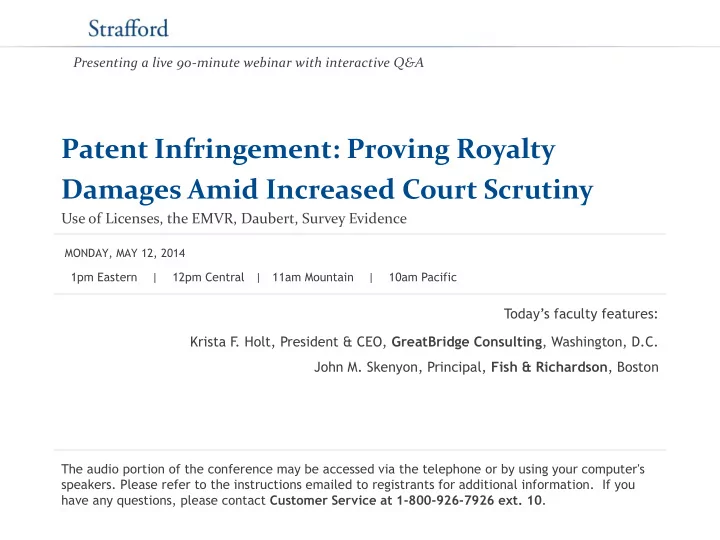
Presenting a live 90-minute webinar with interactive Q&A Patent Infringement: Proving Royalty Damages Amid Increased Court Scrutiny Use of Licenses, the EMVR, Daubert, Survey Evidence MONDAY, MAY 12, 2014 1pm Eastern | 12pm Central


slide-1
SLIDE 1

Patent Infringement: Proving Royalty Damages Amid Increased Court Scrutiny

Use of Licenses, the EMVR, Daubert, Survey Evidence

Today’s faculty features:

1pm Eastern | 12pm Central | 11am Mountain | 10am Pacific

The audio portion of the conference may be accessed via the telephone or by using your computer's

  • speakers. Please refer to the instructions emailed to registrants for additional information. If you

have any questions, please contact Customer Service at 1-800-926-7926 ext. 10.

MONDAY, MAY 12, 2014

Presenting a live 90-minute webinar with interactive Q&A Krista F . Holt, President & CEO, GreatBridge Consulting, Washington, D.C. John M. Skenyon, Principal, Fish & Richardson, Boston

slide-2
SLIDE 2

Sound Quality If you are listening via your computer speakers, please note that the quality

  • f your sound will vary depending on the speed and quality of your internet

connection. If the sound quality is not satisfactory, you may listen via the phone: dial 1-888-601-3873 and enter your PIN when prompted. Otherwise, please send us a chat or e-mail sound@straffordpub.com immediately so we can address the problem. If you dialed in and have any difficulties during the call, press *0 for assistance. Viewing Quality To maximize your screen, press the F11 key on your keyboard. To exit full screen, press the F11 key again.

FOR LIVE EVENT ONLY

slide-3
SLIDE 3

For CLE purposes, please let us know how many people are listening at your location by completing each of the following steps:

  • In the chat box, type (1) your company name and (2) the number of

attendees at your location

  • Click the word balloon button to send

FOR LIVE EVENT ONLY

slide-4
SLIDE 4

Reasonable Royalty Damages Daubert, Evidence and Pitfalls

May 12, 2014 John M. Skenyon Fish & Richardson P.C. skenyon@fr.com

4

slide-5
SLIDE 5

5

slide-6
SLIDE 6

6

slide-7
SLIDE 7

7

Daubert Challenges

  • Apple v Motorola
  • Daubert challenges only relate to “methodology”
  • Fact issues go to weight not admissibility
  • But Federal Circuit affirms Daubert challenges based on

“bad evidence” not “bad methodology”

  • ePlus, Inc. v Lawson Software, 700 F.3rd 509 (Fed. Cir, 2012)
  • District court’s exclusion of expert affirmed
  • Fact issues re licenses relied on by expert
  • Federal Circuit rejects damages awards on appeal on same

“bad evidence”

slide-8
SLIDE 8

Georgia-Pacific v. U.S. Plywood (The most famous case no one has read)

  • Georgia-Pacific is not a damages “methodology” itself
  • 15 factors which are a non-exclusive list of possible relevant

evidence as to reasonable royalty damages under the “willing licensor-willing licensee” methodology

  • But the “evidence” often becomes the “methodology”
  • CAFC focus is always on the underlying “evidence”
  • “Bad evidence” equals “bad methodology”

8

slide-9
SLIDE 9

Only Two Georgia-Pacific Factors Deal With Licenses

  • Most (but not all) “bad evidence” problems relate to the

experts use of licenses

  • Georgia-Pacific factor 1:
  • “The royalties received by the patent owner for licensing the patent

in suit, proving or tending to prove an established royalty”

  • Georgia-Pacific factor 2:
  • “The rates paid by [the infringer] for use of other patents

comparable to the patent-in-suit”

9

slide-10
SLIDE 10

No Georgia-Pacific Factor Deals With Third Party Licenses

  • Georgia-Pacific factors 1 and 2
  • Incorrectly used to rely on licenses between companies not involved in

the lawsuit

  • Georgia-Pacific held third party licenses to be irrelevant
  • “Bare data as to royalty rate and cursory information to the nature of a

particular [third party] license (is) gravely deficient in probative value”

  • n the issue of reasonable royalty damages.

Georgia-Pacific v U.S. Plywood, 318 F.Supp. 1116, 1140

10

slide-11
SLIDE 11

The CAFC Starts Looking Closely At “Licensing Evidence”

  • Lucent v Gateway, 580 F.3rd 1301 (Fed. Cir. 2009)
  • Damages award vacated
  • No evidence that the licenses relied on by expert involved

similar technology to patented invention

  • ResQNet.com v Lansa, 594 F.3rd 860 (Fed. Cir.

2010)

  • Damages award vacated
  • No evidence that the licenses relied on involved similar

technology to patented technology

  • The patentee’s expert relied on bundled licenses not including the

patent-in-suit as “evidence” under GP factor 1.

11

slide-12
SLIDE 12

More “Licensing Evidence” Problems

  • Laser Dynamics v Quanta, 694 F.3rd 51 (Fed. Cir. 2012)
  • Damages award vacated
  • Running royalty not supported by lump sum licenses without

additional proof

  • Wordtech v Integrated Net., 609 F.3rd 1308 (Fed. Cir.

2010)

  • Damages award vacated
  • Lump sum award is not supported by lump sum licenses without

proof relating to: 1) number of licensed products anticipated by actual lump sum licenses; 2) the nature of those products; 3) how the lump sum was calculated

12

slide-13
SLIDE 13

The CAFC and Daubert

  • Power Integrations v Fairchild, 711 F.3rd 1348 (Fed. Cir.

2013)

  • District court abused its discretion in admitting testimony of

patentee’s damages expert

  • Laser Dynamics v Quanta, 694 F.3rd 51 (Fed. Cir. 2012)
  • Prohibits patentee’s expert from testifying on running royalty theory
  • n remand
  • ePlus, Inc. v Lawson Software, 700 F.3rd 509 (Fed. Cir,

2012)

  • District court’s exclusion of expert affirmed
  • Licenses relied on were for multiple patents including cross licenses
  • Licenses relied on pre-dated the hypothetical negotiation date by years
  • Licenses relied on were in settlement of litigation

13

slide-14
SLIDE 14

CONFIDENTIAL AND PROPRIETARY

Patent Infringement:

Proving Royalty Damages Amid Increased Court Scrutiny

May 12, 2014 Krista Holt

14

slide-15
SLIDE 15

Confidential And Proprietary For Illustrative Purposes Please See Disclaimer Language

Agenda

  • 1. Daubert Risks and Opportunities
  • 2. Apple v. Motorola
  • 3. Patent Surveys
  • 4. Recent Patent Survey Case Law

15

slide-16
SLIDE 16

Confidential And Proprietary For Illustrative Purposes Please See Disclaimer Language

Daubert Risks and Opportunities

Guidelines The following are guidelines for admitting scientific expert testimony:

  • Testimony must be based upon sufficient facts or data
  • Testimony must be the product of reliable principles and

methods

  • The witness must apply the principles and methods

reliably to the facts of the case

16

slide-17
SLIDE 17

Confidential And Proprietary For Illustrative Purposes Please See Disclaimer Language

Daubert Risks and Opportunities

Success Rates of Daubert/ Rule 702 Challenges

17

Source: PwC Daubert Challenges to Financial Experts, 2012

slide-18
SLIDE 18

Confidential And Proprietary For Illustrative Purposes Please See Disclaimer Language

Success Rate of Daubert Challenges To Financial Expert Witnesses, By Case Type (2000-2012)

18

Daubert Risks and Opportunities

Financial Expert Witness Daubert Success Rate

Source: PWC, “Daubert challenges to financial experts: A Yearly Study Of Trends and Outcomes”

slide-19
SLIDE 19

Confidential And Proprietary For Illustrative Purposes Please See Disclaimer Language

Agenda

  • 1. Daubert Risks and Opportunities
  • 2. Apple v. Motorola
  • 3. Patent Surveys
  • 4. Recent Patent Survey Case Law

19

slide-20
SLIDE 20

Confidential And Proprietary For Illustrative Purposes Please See Disclaimer Language 20

  • After concluding that neither party’s damages experts had presented

competent evidence from which the trier of fact could estimate the value of a reasonable royalty, Judge Posner ruled that there is no entitlement to sue for nominal (past) damages for patent infringement.

  • In addition, he concluded that neither party was entitled to an injunction,

because (among other things) each claimed that its damages were ascertainable (and in Motorola’s case, that its patents were standard- essential), and if so, an ongoing royalty would suffice

  • However, the parties’ failure to present competent evidence as to the amount
  • f such a royalty meant that they were not entitled to recover a prospective

royalty.

Apple v. Motorola (No.1:11-cv-08540)(N.D. IL.)

Apple v. Motorola

Judge Posner’s Decision in Apple v. Motorola, Inc.

slide-21
SLIDE 21

Confidential And Proprietary For Illustrative Purposes Please See Disclaimer Language 21

Apple v. Motorola

The “Hypothetical Consulting Engagement”

Defendant’s Expectations in “Hypothetical Engagement”

  • Would Not Rely on Patent Holder’s Employees/Consultants
  • Biased
  • Would Not Rely on Defendant’s Employees/Consultants
  • Wouldn’t Pay the Consultant for What I Already Know
  • Reasonable Degree of Certainty
  • All Options Considered
slide-22
SLIDE 22

Confidential And Proprietary For Illustrative Purposes Please See Disclaimer Language 22

Apple v. Motorola

The “Hypothetical Consulting Engagement”

Implications in Litigation Context

  • Cannot Rely on Fact Witnesses
  • Cannot Utilize Findings of Other Experts
  • Posner’s Hypothetical Seems to Assume a Single Expert
  • Jack of All Trades = Master at None?
  • How to Judge “Same Approach” Outside Litigation Context?
  • Hypothetical is Atypical
  • What is the Standard?
  • What Could Experts Do to Prove They Meet the Standard?
slide-23
SLIDE 23

Confidential And Proprietary For Illustrative Purposes Please See Disclaimer Language 23

Apple v. Motorola

Other Implications of Daubert Ruling

Identical Claim Construction

  • Scope of Claim Limited in Pre-Trial Conference
  • Expert’s Opinion Submitted Earlier
  • Invalidated Because it Relied Upon Broader Claim Scope
  • Not Allowed to Resubmit Report Because of Faulty Methodology
slide-24
SLIDE 24

Confidential And Proprietary For Illustrative Purposes Please See Disclaimer Language 24

Federal Circuit reversed and remanded the exclusion of Apple’s and Motorola’s damages experts:

  • Reversal of exclusion of Apple’s damages expert’s testimony for Apple’s

patents

  • Affirmation of exclusion of Motorola’s damages expert testimony relying
  • n Motorola’s licensing expert’s testimony; reversal of exclusion of

remainder of Motorola’s damages expert testimony

Apple v. Motorola

Reversal of Judge Posner’s Ruling on Damages

slide-25
SLIDE 25

Confidential And Proprietary For Illustrative Purposes Please See Disclaimer Language 25

Apple v. Motorola

Emphasis on Rules 702 & 703 of Federal Rules of Evidence

  • Circuit ruling points to Federal Rules of Evidence as the

benchmark to determine admissibility of evidence, together with established case law

  • When applying proper standard for admitting expert

testimony, the focus “must be solely on principles and methodology, not on the conclusions that they generate.”

509 U.S. at 595. In Kumho Tire Co. v. Carmichael, 526 U.S. 137 (1999)

slide-26
SLIDE 26

Confidential And Proprietary For Illustrative Purposes Please See Disclaimer Language 26

Apple v. Motorola

Emphasis on Rules 702 & 703 of Federal Rules of Evidence

Rule 702 states:

A witness who is qualified as an expert by knowledge, skill, experience, training, or education may testify in the form of an opinion or otherwise if: (a) the expert’s scientific, technical or other specialized knowledge will help the trier of fact to understand the evidence or to determine a fact in issue; (b) the testimony is based on sufficient facts or data; (c) the testimony is the product of reliable principles and methods; and (d) the expert has reliably applied the principles and methods to the facts of the case.

slide-27
SLIDE 27

Confidential And Proprietary For Illustrative Purposes Please See Disclaimer Language 27

Apple v. Motorola

CAFC Affirms Expert’s Methodology

“…Expert’s methodology is not inherently unsound; rather, it is ‘the product of reliable principles and methods.’ … [expert] began with an existing product containing features he contended were similar to the asserted features… next [expert] attempted to isolate the value of these similar features by valuing other, non-claimed features of the [device] and subtracting this value… To reach a reasonable royalty, [expert] then compared his resulting royalty to related licenses and rationalized the price differences… in all [expert’s] testimony was the product of reliable principles and methods. Apple, Inc. et al. v. Motorola Inc. et al. Fed. Cir. (April 25, 2014)

slide-28
SLIDE 28

Confidential And Proprietary For Illustrative Purposes Please See Disclaimer Language 28

Apple v. Motorola

Emphasis on Rules 702 & 703 of Federal Rules of Evidence

Rule 703 states:

An expert may base an opinion on facts or data in the case that the expert has been made aware of or personally observed. If experts in the particular field would reasonably rely on those kinds of facts or data in forming an opinion on the subject, they need not be admissible for the opinion to be admitted. But if the facts or data would otherwise be inadmissible, the proponent of the opinion may disclose them to the jury only if their probative value in helping the jury evaluate the opinion substantially outweighs their prejudicial effect.

slide-29
SLIDE 29

Confidential And Proprietary For Illustrative Purposes Please See Disclaimer Language 29

Apple v. Motorola

CAFC Affirms Reliance on Other Experts

The district court had also excluded Apple’s damages evidence because Apple’s expert relied upon information provided by a technical expert hired by Apple, based on a hypothetical conversation Court of Appeals disagreed: “The district court’s decision states a rule that neither exists nor is it correct. Experts routinely rely upon other experts hired by the party they represent for expertise outside of their field” Rule 703 explicitly allows an expert to rely on information he has been made aware of “if experts in the particular field would reasonably rely on those kinds of facts or data in forming an opinion on the subject.” Fed.R. Evid. 703

slide-30
SLIDE 30

Confidential And Proprietary For Illustrative Purposes Please See Disclaimer Language 30

Apple v. Motorola

Additional Implications of Ruling – Partial Exclusions

CAFC affirmed only the exclusion of Motorola’s damages testimony that was based on Motorola’s licensing expert, but reversed the district court’s exclusion of the remainder of the Motorola damages expert testimony.

“[Motorola’s damages expert] incorporated [Motorola’s licensing expert’s] into her own when she relied on his proposed testimony to opine that the first few patents from a given portfolio would typically command 40%-50%

  • f the entire portfolio rate… here, where a potentially reliable theory is not

tied to the facts of the case, the expert testimony is inadmissible.”

slide-31
SLIDE 31

Confidential And Proprietary For Illustrative Purposes Please See Disclaimer Language 31

Apple v. Motorola

Additional Implications of Ruling - Admissibility

“That a party may choose to pursue one course of proving damages over another does not render its expert’s damages testimony inadmissible. Nor is there a requirement that a patentee value every potential non-infringing alternative in

  • rder for its damages testimony to be admissible.
slide-32
SLIDE 32

Confidential And Proprietary For Illustrative Purposes Please See Disclaimer Language 32

Apple v. Motorola

Results of Applying the Federal Rules

“… the district court based its damages analysis on an incorrect claim construction.” “…the district court erred by not considering the full scope of the asserted claims, questioning the conclusions of Apple’s expert, and substituting its

  • wn opinion, rather than focusing on the reliability of the principles and

methods used or the sufficiency of the facts and data relied upon.”

slide-33
SLIDE 33

Confidential And Proprietary For Illustrative Purposes Please See Disclaimer Language 33

Apple v. Motorola

Additional Implications of Ruling - Summary Judgment

District court had agreed with Motorola that “Apple was not entitled to damages because there was ‘no evidence upon which Apple may rely to reliably establish or measure any amount of damages’ for the infringement to the ‘647 patent.” Court of appeals disagreed: “…A finding that a royalty estimate may suffer from factual flaws does not, by itself, support the legal conclusion that zero is a reasonable royalty.” “If a patentee’s evidence fails to support its specific royalty estimate, the fact finder is still required to determine what royalty is supported by the record.”

slide-34
SLIDE 34

Confidential And Proprietary For Illustrative Purposes Please See Disclaimer Language 34

Apple v. Motorola

Additional Implications of Ruling – FRAND Licensing

District court had decided that injunctions are per se unavailable for SEPs:

“By committing to license its patents on FRAND terms, Motorola committed to license the ’898 to anyone willing to pay a FRAND royalty and thus implicitly acknowledged that a royalty is adequate compensation for a license to use that patent.”

slide-35
SLIDE 35

Confidential And Proprietary For Illustrative Purposes Please See Disclaimer Language 35

Apple v. Motorola

Additional Implications of Ruling – FRAND Licensing

Court of Appeals disagrees with this reasoning: “While Motorola’s FRAND commitments are certainly criteria relevant to its entitlement to an injunction, we see no reason to create ... a separate rule or analytical framework for addressing injunctions for FRAND- committed patents. The framework laid out by the Supreme Court in eBay, as interpreted by subsequent decisions of this court, provides ample strength and flexibility for addressing the unique aspects of FRAND committed patents and industry standards in general.”

slide-36
SLIDE 36

Confidential And Proprietary For Illustrative Purposes Please See Disclaimer Language 36

Apple v. Motorola

Additional Implications of Ruling – FRAND Licensing

But affirms decision to grant summary judgment that Motorola is not entitled to an injunction on different grounds:

“Motorola’s FRAND commitments, which have yielded many license agreements encompassing the ’898 patent, strongly suggest that money damages are adequate to fully compensate Motorola for any infringement.” “…Motorola has not demonstrated that Apple’s infringement has caused it irreparable harm.”

slide-37
SLIDE 37

Confidential And Proprietary For Illustrative Purposes Please See Disclaimer Language 37

Apple v. Motorola

Additional Implications of Ruling – FRAND Licensing

But affirms decision to grant summary judgment that Motorola is not entitled to an injunction on different grounds:

“Motorola argues that Apple has refused to accept its initial licensing offer and stalled negotiations. However, the record reflects that negotiations have been ongoing, and there is no evidence that Apple has been, for example, unilaterally refusing to agree to a deal.”

slide-38
SLIDE 38

Entire Market Value Rule

  • Entire Market Value Rule:
  • Can obtain damages on entire product even though patent only

covers a part of the entire product

  • Can obtain damages on unpatented items if patented item and

unpatented items are physically part of the same machine or constitute a functional unit

  • Rite-Hite Corp v Kelley, 56 F.3rd 1538 (Fed. Cir. 1995) (en banc)

∙ But the patented feature must be the basis for the customer demand for the

entire product

38

slide-39
SLIDE 39

The CAFC Looks Closely At EMVR Support

  • Lucent v Gateway, 580 F.3rd 1301 (Fed. Cir. 2009)
  • Damages award vacated because no evidence “patent related feature”

was basis of “customer demand” for the entire product

  • Uniloc v Microsoft, 632 F.3rd 1292 (Fed. Cir. 2011)
  • Damages award vacated because no evidence of “customer demand”
  • Imonex v W.H. Munzprufer, 408 F.3rd 1374 (Fed. Cir. 2005)
  • Affirmed district court’s exclusion of EMVR because no evidence of

“customer demand”

  • LaserDynamics v Quanta, 694 F. 3rd 51 (Fed. Cir. 2012)
  • Affirmed district court’s exclusion of EMVR because no evidence of

“customer demand”

39

slide-40
SLIDE 40

The CAFC Sees Other EMVR Problems

  • Marine Polymer v Hemcon, 672 F.3rd 1350 (Fed. Cir. 2012)
  • Even if the parties agree the EMVR applies, the Federal Circuit still

looks at the “customer demand” evidence

  • LaserDynamics v Quanta, 694 F.3rd 51 (Fed. Cir. 2012
  • A patentee’s tactic is to use the EMVR to get the infringer’s total

sales figures before the jury. The jury thinks any “royalty” is reasonable in view of the total sales figures

  • The CAFC holds here that disclosure of overall sales figures

cannot help but skew the damages for the jury

40

slide-41
SLIDE 41

Problems With Multiple Patents

  • Verizon v Vontage, 503 F.3rd 1295 (Fed. Cir. 2007);

Accentra v Staples, 500 Fed. Appx. 922 (Fed. Cir. 2013)

  • In multiple patent cases, the damages issue gets remanded if

some patents are thrown out on appeal, but only a single damages amount was awarded

  • Alexsam v IDT, 715 F.3rd 1336 (Fed. Cir. 2013)
  • In cases with multiple infringing products, the damages issue

gets remanded when some products are found not to infringe

41

slide-42
SLIDE 42

Problems With Multiple Patents

  • Separate verdicts?
  • Separate analysis for each patent?
  • Are the patents “related” in the USPTO sense?
  • If not:
  • Same hypothetical negotiation date?
  • Same Georgia-Pacific factors?
  • Same valuation?
  • Same license evidence?

42

slide-43
SLIDE 43

CAFC’s Comments Can Create Problems

  • ResQNet.com v Lansa, 594 F.3rd 860 (Fed. Cir. 2010)
  • CAFC merely said that the one settlement license for the patent-in-

suit in that case seemed far more relevant than the bundled licenses (not including the patent) that the patentee’s expert relied on.

  • This comment is erroneously later cited by several district courts as

holding that settlement agreements involving the patent-in-suit are the most relevant to reasonable royalty damages

  • This was not a holding in ResQNet
  • The CAFC did not rely on the settlement license in that case
  • The CAFC in LaserDynamics v Quanta, 694 F.3rd 51 (Fed. Cir. 2012) correctly

described this portion of ResQNet as being “limited” in scope and circumstances, and held that the settlement agreement in its case was the “least relevant” and it was an abuse of the district court’s discretion to admit it

43

slide-44
SLIDE 44

Licenses In Settlement of Litigation

  • Rule 408 of the Federal Rules of Evidence
  • Evidence offering to compromise a claim is not admissible to

prove the amount of the claim

  • CAFC usually finds such settlement agreements have

little weight (only a few listed here):

  • Deere v Intern. Harvester, 710 F.2nd 1551 (Fed. Cir. 1983)
  • Hanson v Alpine Valley, 718 F.2nd 1082 (Fed. Cir. 1983)
  • Laser Dynamics v Quanta, 694 F.3rd 51 (Fed. Cir. 2012)
  • Whitserve v Computer Packages, 694 F.3rd 10 (Fed. Cir.

2012)

44

slide-45
SLIDE 45

The Use Of Benchmarks?

  • i4i Limited v Microsoft, 589 F.3rd 831 (Fed. Cir. 2010)
  • The patentee’s expert relied on:
  • An expensive third-party “benchmark” stand-alone product with many

features to set the defendant’s projected profit on a feature of WORD

  • A survey with 46 responses
  • The “25% rule” resulting in a $96/unit royalty
  • Adjustment for GP factors to $98/unit royalty
  • The CAFC affirms saying that the patentee’s damages expert

relied on Georgia-Pacific but the royalty rate was really set before that

  • CAFC now cites to this case as “approving benchmarks”

45

slide-46
SLIDE 46
  • Uniloc v Microsoft, 632 F.3rd 1292 (Fed. Cir. 2011)
  • It is inadmissible under Daubert and the Federal Rules of

Evidence

  • Whitserve v Computer Packages, 694 F.3rd 10 (Fed. Cir.

2012); Energy v William Demant, 697 F.3rd 1342 (Fed.

  • Cir. 2012)
  • “Rule” is inadmissible
  • Douglas Dynamics v Buyers Products, 717 F.3rd 1336

(Fed. Cir. 2013)

  • District court’s damages award based on the “rule” vacated

The 25% Rule Is Really Dead

46

slide-47
SLIDE 47

Practical Suggestions

  • Daubert challenges are very important even if unsuccessful

at the district court level

  • There are two types of challenges
  • The evidence being relied on by the other side’s expert is not

relevant without additional, specific evidence

  • The evidence being relied on is inadmissible

47

slide-48
SLIDE 48

Practical Suggestions

  • Always challenge the use of licenses if the other side has not

provided:

  • Evidence the technology is the same
  • Evidence the parties are in the same position
  • Evidence the format of your damages contention (e.g., lump sum)

matches up with your evidence

  • Always challenge EMVR, if there is no solid proof that

customer demand for the overall product is based on the patented feature.

  • Always challenge any use of the 25% rule

48

slide-49
SLIDE 49

Confidential And Proprietary For Illustrative Purposes Please See Disclaimer Language

Agenda

  • 1. Daubert Risks and Opportunities
  • 2. Apple v. Motorola
  • 3. Patent Surveys
  • 4. Recent Patent Survey Case Law

49

slide-50
SLIDE 50

Confidential And Proprietary For Illustrative Purposes Please See Disclaimer Language 50

Patent Surveys

Use of Surveys Endorsed

Use of Survey Data Endorsed

“[C]onsumer surveys designed to determine the value of a particular feature or property of a consumer product are a common and acceptable form of evidence in patent cases. Such a survey might well have dispelled the uncertainty . . .” “[Apple’s expert] has provided no evidence on which to base an estimate of a reasonable royalty for that program, let alone for the subprogram applicable only to the Kindle application. So far as it appears, the only evidence that could be provided would be consumer‐survey evidence; it is much too late for Apple to be permitted to conduct a survey.” “[Apple’s expert] provided no estimate of how many such ignorant consumers there are, still another question that could be answered within the limits of tolerable uncertainty by a competently designed and administered consumer survey.” Apple, Inc. v. Motorola, Inc., 2012 WL 1959560 (N.D. Ill. May 22, 2012)

slide-51
SLIDE 51

Confidential And Proprietary For Illustrative Purposes Please See Disclaimer Language

Patent Surveys

Use of Surveys Endorsed

“In sum, Cornell did not provide any more evidence for its consumer demand argument than the type of evidence this court found insufficient during [plaintiff’s expert’s] Daubert hearing…. Cornell did not offer any customer surveys or other data to back these predictive claims.” “Simply put, Cornell’s failure to connect consumer demand …to the claimed invention…undermined any argument for applicability of the entire market value rule.”

Cornell v. Hewlett-Packard, N.D.N.Y. (2009) Judge Rader sitting by designation

51

slide-52
SLIDE 52

Confidential And Proprietary For Illustrative Purposes Please See Disclaimer Language

Patent Surveys

Use of Surveys Endorsed

Use of survey endorsed during discovery stage:

  • Pacing Technologies requested that a survey of Garmin’s customers

be used to gather information regarding how Garmin customers interacted with the Garmin website and used the allegedly infringing patented feature.

  • Garmin expressed privacy concerns, among others. However,

Magistrate Judge McCurine, Jr. reasoned that, since the survey would yield information that only Garmin’s customers possessed, the survey would be allowable.

Pacing Technologies, LLC v. Garmin International, Inc., et. al., 3-12-cv-01067 (CASD June 28, 2013, Order) (McCurine, M.J.)

52

slide-53
SLIDE 53

Confidential And Proprietary For Illustrative Purposes Please See Disclaimer Language

Patent Surveys

Used To Address Patent Issues

Surveys Could Potentially Be Used To Assess:

  • Panduit Factor #1 - Demand
  • Is the patented feature the main driver of sales?
  • Is the patented feature even known to customers?
  • What concessions (distance, price, etc.) would customers be willing to accept

to obtain the patented feature?

  • Panduit Factor #2 - Alternatives
  • What do customers consider to be alternatives to the patented product or

feature?

  • Do customers consider these alternatives to be acceptable? If so, under what

circumstances? If not, why not?

  • Which product(s) would customers purchase if the infringing device was not

available?

  • What are the price sensitivities of demand for the patented product and any

alternatives?

53

slide-54
SLIDE 54

Confidential And Proprietary For Illustrative Purposes Please See Disclaimer Language

Patent Surveys

Used To Address Patent Issues

Surveys Could Potentially Be Used To Assess:

  • Panduit Factor #3 - Marketing Capacity
  • Are the defendant’s customers aware of the plaintiff’s products?
  • Do customers consider the plaintiff’s and the defendant’s products to be

comparable? On what basis?

  • What do customers consider to be the distinguishing features of the two

parties’ products?

  • Would customers buy from either the plaintiff or the defendant? If not,

why not?

54

slide-55
SLIDE 55

Confidential And Proprietary For Illustrative Purposes Please See Disclaimer Language

Patent Surveys

Used To Address Patent Issues

Potential Questions Addressed Through Surveys May Include:

  • Georgia-Pacific Factor #5:
  • Do customers consider the plaintiff and the defendant (as well as third-

party alternative providers) to be competitors for their business?

  • Georgia-Pacific Factor #6:
  • Are purchasers of the patented product influenced to buy other (non-

patented) products from the same seller as a result of purchasing the patented product?

  • Georgia-Pacific Factor #8:
  • What are the usage rates of this product?
  • How much more would customers be willing to pay for the patented

feature?

55

slide-56
SLIDE 56

Confidential And Proprietary For Illustrative Purposes Please See Disclaimer Language

Patent Surveys

Used To Address Patent Issues

Potential Questions Addressed Through Surveys May Include:

  • Georgia-Pacific Factor #9:
  • What products do customers consider to be similar in purpose to the

patented product?

  • How do previous products compare to the patented product?
  • Do customers consider those similar products to be acceptable alternatives?
  • Georgia-Pacific Factor #10:
  • What benefits do customers perceive from the use of the patented

products?

  • Which of the benefits identified by customers do they associate with the

patented feature?

56

slide-57
SLIDE 57

Confidential And Proprietary For Illustrative Purposes Please See Disclaimer Language

Patent Surveys

Used To Address Patent Issues

Potential Questions Addressed Through Surveys May Include:

  • Georgia-Pacific Factor #13:
  • Would customers be willing to purchase the alleged infringer’s product

without the feature? If so, would a price concession be necessary?

  • What features other than the patented feature are important to the

customer?

  • What are the relative weights of importance of those features?
  • What do customers say about the value of the patented feature compared

with other features identified as important to the purchase decision?

  • What relative impact does each of the features have on the customers’

purchase decision?

57

slide-58
SLIDE 58

Confidential And Proprietary For Illustrative Purposes Please See Disclaimer Language

Agenda

  • 1. Daubert Risks and Opportunities
  • 2. Apple v. Motorola
  • 3. Patent Surveys
  • 4. Recent Patent Survey Case Law

58

slide-59
SLIDE 59

Confidential And Proprietary For Illustrative Purposes Please See Disclaimer Language 59

Patent Surveys

Types Of Surveys And Their Applications

Usage Survey

  • Determines the extent to which a patented attribute might be used

Demand Survey

  • Determines the extent to which consumers demand the patented feature and

would not buy the product without that feature

Conjoint Survey

  • Determines consumer preferences by means of selecting between product

combinations possessing (or not) patented features and other marketable features

  • Can include price as a feature, which can be used to determine relative value

between different features

slide-60
SLIDE 60

Confidential And Proprietary For Illustrative Purposes Please See Disclaimer Language

Patent Surveys

Use Of A Choice Based Conjoint Survey in Litigation

  • The court granted defendant's motion to exclude plaintiff's

damages expert's use of another expert's conjoint analysis to determine market share.

  • Consumer surveys are not “inherently unreliable,” but may

become so when the experts (as in this case) “artificially forced” the participants or the data to a desired outcome. Oracle America, Inc. v. Google, Inc., 2012 WL 850705 (N.D.

  • Cal. Mar. 13, 2012)

60

slide-61
SLIDE 61

Confidential And Proprietary For Illustrative Purposes Please See Disclaimer Language

Patent Surveys

Use Of A Choice Based Conjoint Survey in Litigation

Specifically, the court stated –

"[Plaintiff's expert] had no reasonable criteria for choosing

the four non-patented features to test; instead, he picked a low number to force participants to focus on the patented functionalities, warping what would have been their real-world

  • considerations. . . If the conjoint analysis had been expanded

to test more features that were important to smartphone buyers (instead of the four non-patented features selected for litigation purposes), then the study participants may not have placed implicit attributes on the limited number of features tested.”

Oracle America, Inc. v. Google, Inc. (Order on March 1, 2012)

61

slide-62
SLIDE 62

Confidential And Proprietary For Illustrative Purposes Please See Disclaimer Language

Patent Surveys

Use Of A Choice Based Conjoint Survey In Litigation

Interpreting a CBC Survey: Willingness to Pay v. Demand

“The Court agrees with Samsung that evidence of ‘the price premium over the base price Samsung consumers are willing to pay for the patented features,’ PX30, is not the same as evidence that consumers will buy a Samsung phone instead of an Apple phone because it contains that feature.” “… the survey does not measure willingness to pay for products; it measures willingness to pay for features within a particular product amongst consumers who have already purchased the particular product… To establish a causal nexus, Apple would need to show not just that there is demand for the patented features, but that the patented features are important drivers of consumer demand for the infringing products."

Apple Inc. v. Samsung Electronics Co. Ltd. et al, CV-01846-LHK (N.D. Cal. Dec. 17, 2012)

62

slide-63
SLIDE 63

Confidential And Proprietary For Illustrative Purposes Please See Disclaimer Language

Patent Surveys

Use Of A Choice Based Conjoint Survey In Litigation

In the TV Interactive Data Corp. v. Sony Corp. case, conjoint analysis was used to estimate the “market’s willingness to pay” (MWTP) for plaintiff’s patented technology as an incremental benefit in defendant’s accused products.

  • The estimated MWTP was used as a baseline by plaintiff’s other expert in

his calculation of a reasonable royalty rate.

  • Criticisms in Daubert motion deemed survey “fundamentally flawed and

unreliable,” but Court ruled that defendant’s criticisms were more appropriate for jury consideration. TV Interactive Data Corp. v. Sony Corp., No. 3:10-cv-00475-JCS, 2013 WL 942473

(N.D. Cal. March 11, 2013)

63

slide-64
SLIDE 64

Confidential And Proprietary For Illustrative Purposes Please See Disclaimer Language

Patent Surveys

Use Of A Choice Based Conjoint Survey In Litigation

In the Apple v. Samsung case, a conjoint survey was proffered by the patentee to try to prove there was a nexus between the patent infringement and the irreparable harm, and more specifically to show that the consumers wanted the patented feature. The court found that the survey was not adequate to support the contentions. “Apple must ‘show that the infringing feature drives consumer demand for the accused product.’ ” (quoting Apple II, 695 F.3d at 1375) (emphasis added). “[R]ather than show that a patented feature is the exclusive reason for consumer demand,” however, “Apple must show some connection between the patented feature and demand for Samsung's products.” Apple v. Samsung, 2014 WL 976898 (N.D.Cal.)

64

slide-65
SLIDE 65

Confidential And Proprietary For Illustrative Purposes Please See Disclaimer Language

Patent Surveys

Use Of A Choice Based Conjoint Survey In Litigation

The Court concluded that the survey results failed to show the “requisite causal nexus” between Samsung's infringement and Apple's claimed irreparable harm. Criticisms:

  • Survey evaluated relative willingness to pay for features rather than effect on

product prices

  • Limited features in survey provided insufficient information as to whether any

price increase was significant

  • Survey inflates the value of the patented features

However, the court denied Defendants’ subsequent motion to exclude the expert’s survey evidence Apple v. Samsung, 2014 WL 794328, 976898 (N.D.Cal.)

65

slide-66
SLIDE 66

Confidential And Proprietary For Illustrative Purposes Please See Disclaimer Language

Patent Surveys

Demand And Usage Surveys

The survey failed to establish the Entire Market Value Rule rule because it did not prove that the patented technology was the basis of demand for the software and hardware. The survey focused only on the software and ignored the hardware.

Mirror Worlds, LLC v. Apple, Inc., 784 F.Supp.2d 703 (E.D. Tex. 2011)

66

slide-67
SLIDE 67

Confidential And Proprietary For Illustrative Purposes Please See Disclaimer Language

Patent Surveys

Demand And Usage Surveys

“…the surveys do not measure the value of Plaintiff’s technology [Multiband Functionality and small size], but merely measure the perceived consumer value of cell phones with any internal antennas.” “Survey evidence purportedly demonstrating the value of internal antennas not tied directly to Plaintiff’s [patented] technology…must be excluded.” Fractus, S.A. v. Samsung, et al., 2011 6:09- CV-00203-896 (E.D. Tex. Apr. 29, 2011)

67

slide-68
SLIDE 68

Confidential And Proprietary For Illustrative Purposes Please See Disclaimer Language

Patent Surveys

Demand And Usage Surveys

  • Plaintiff’s expert conducted three surveys asking customers and

advertisers to rank each of twenty-one features in order of

  • importance. Each feature’s weighted percentage of importance

was said to represent the demand for Defendant’s product driven by that feature. Among the features were News Feed; Timeline; Like (external); Friend Request; Personal Profile; etc.

  • Based on the survey results, the expert excluded an amount of

revenue attributable to the features not causing Defendant to infringe from the royalty base Rembrandt Social Media, LP v. Facebook, Inc.

  • No. 1:13-cv-158, 2013 WL 6327852

68

slide-69
SLIDE 69

Confidential And Proprietary For Illustrative Purposes Please See Disclaimer Language

Patent Surveys

Demand And Usage Surveys

  • Expert was criticized for calculating the royalty base by using

surveys that did not test for the importance of major revenue- producing features, but the court stated that “ an expert’s reliance upon some facts but not others is not always cause to exclude such testimony under Daubert… “

  • Court concluded that “while the expert may have relied upon

an incomplete list of facts in conducting his consumer surveys, such matters could be brought to a jury’s attention … and expert’s testimony is not excluded on this basis alone” Rembrandt Social Media, LP v. Facebook, Inc.

  • No. 1:13-cv-158, 2013 WL 6327852

69

slide-70
SLIDE 70

Confidential And Proprietary For Illustrative Purposes Please See Disclaimer Language

Patent Surveys

Demand And Usage Surveys

  • Plaintiff’s expert “admitted that his survey was just meant to

determine the features that most drive Facebook’s usage, and that ‘the link between this [usage] data and the revenue question has to be the subject of a separate analysis.’”

  • Plaintiff’s damages expert did not perform this analysis, or

explain why the weighted importance of some features to a user directly correlates to a certain percentage of defendant’s advertising revenue

  • For this and other reasons, the damages expert’s opinion was

excluded in its entirety Rembrandt Social Media, LP v. Facebook, Inc.

  • No. 1:13-cv-158, 2013 WL 6327852

70

slide-71
SLIDE 71

Confidential And Proprietary For Illustrative Purposes Please See Disclaimer Language

Contact Information

71

Krista F. Holt President & CEO GreatBridge Consulting, Inc. 1801 K St NW Suite 1150 Washington, DC 20006 (202) 769-4901 kholt@greatbridgeconsulting.com

slide-72
SLIDE 72

Confidential And Proprietary For Illustrative Purposes Please See Disclaimer Language

Disclaimer – For Illustrative Purposes Only

  • This presentation has been prepared for discussion purposes only in

connection with this educational presentation. Illustrative scenarios were prepared to encourage group participation and discussion. None of the material contained in this presentation represents the views or opinions of GreatBridge Consulting, Inc.

  • This presentation is not intended to be used in litigation. As stated above,

the context of this presentation is educational and not specific to any particular litigation. Because each litigation is specific to its own facts and circumstances it would be unwise and even misleading to take a passage of static words or slides from this presentation and assume that it can be applied to a particular circumstance without applying reasoned judgment to the specific facts and circumstances of the situation.

72