Padlocking the Piggy Bank: 529 Plans, UTMA, and 2503(c) Trust - - PDF document

padlocking the piggy bank 529 plans utma and 2503 c trust
SMART_READER_LITE
LIVE PREVIEW

Padlocking the Piggy Bank: 529 Plans, UTMA, and 2503(c) Trust - - PDF document

Padlocking the Piggy Bank: 529 Plans, UTMA, and 2503(c) Trust Options Padlocking the Piggy Bank: 529 Plans, UTMA, and 2503(c) Trust Options presented by: p y J. Aaron Bennett Carruthers & Roth, P.A. Phone: 336-478-1105 E-mail:


slide-1
SLIDE 1

Padlocking the Piggy Bank: 529 Plans, UTMA, and 2503(c) Trust Options Carruthers & Roth, P.A. 1

Padlocking the Piggy Bank: 529 Plans, UTMA, and 2503(c) Trust Options

presented by: p y

  • J. Aaron Bennett

Carruthers & Roth, P.A. Phone: 336-478-1105 E-mail: jab@crlaw.com

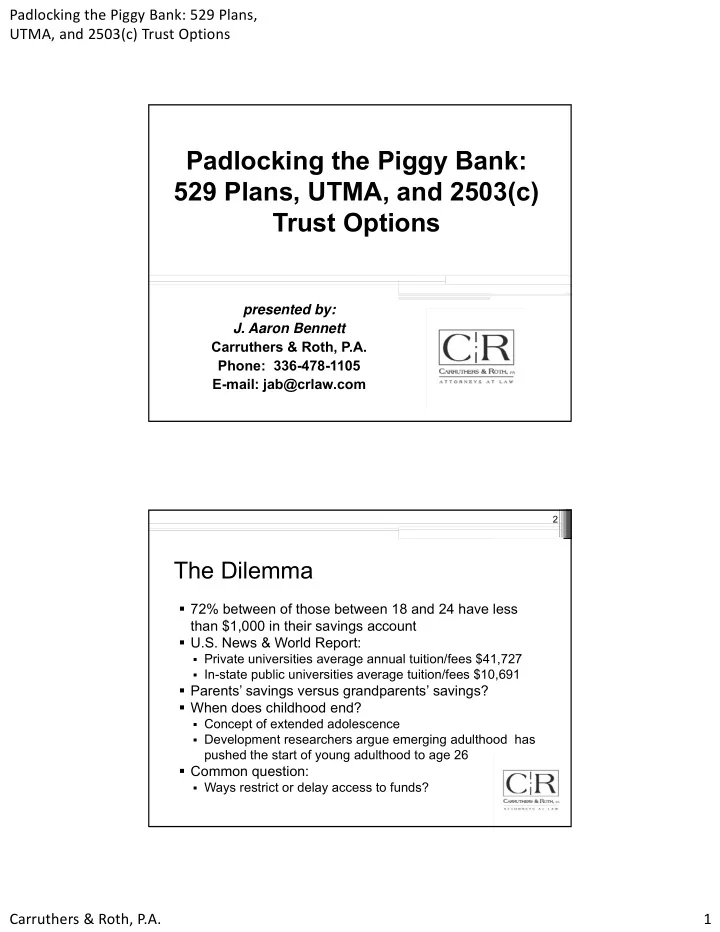
The Dilemma

  • 72% between of those between 18 and 24 have less

2

than $1,000 in their savings account

  • U.S. News & World Report:
  • Private universities average annual tuition/fees $41,727
  • In-state public universities average tuition/fees $10,691
  • Parents’ savings versus grandparents’ savings?
  • When does childhood end?

C t f t d d d l

  • Concept of extended adolescence
  • Development researchers argue emerging adulthood has

pushed the start of young adulthood to age 26

  • Common question:
  • Ways restrict or delay access to funds?
slide-2
SLIDE 2

Padlocking the Piggy Bank: 529 Plans, UTMA, and 2503(c) Trust Options Carruthers & Roth, P.A. 2

Retaining Control of Gifts

  • Account-based funding vehicles:

3

g

  • Custodial accounts (UTMAs)
  • 529 Plans
  • Coverdale Education Savings Accounts
  • Trust-based funding vehicles:
  • 2503(c) Trusts

Health and Education Exclusion Trusts

  • Health and Education Exclusion Trusts
  • Traditional trusts

Custodial Accounts (UTMAs)

  • Avoids difficulties of direct ownership of property by

4

p p p y y a minor

  • Uniform Transfers to Minors Act (“UTMA”)
  • Chapter 33A of the NC General Statutes
  • Adopted in 1987 replacing NC’s Uniform Gift to

Minor’s Act (“UGMA”)

  • Custodian has all rights, powers, and authority over

g , p , y UTMA account

  • One beneficiary, one custodian
  • Irrevocable transfer
  • Must be transferred to beneficiary at age 21
slide-3
SLIDE 3

Padlocking the Piggy Bank: 529 Plans, UTMA, and 2503(c) Trust Options Carruthers & Roth, P.A. 3

Custodial Accounts (UTMAs)

  • Advantages

5

  • Simplicity
  • Transferor can designate successor custodian
  • Value excluded from parent’s gross estate (unless parent

is both donor and custodian)

  • Funds can be used for any purpose, not just higher

education (disadvantage?)

  • Disadvantages
  • Becomes the beneficiary’s account at age 21
  • Becomes the beneficiary s account at age 21
  • Considered child’s asset for financial aid qualification
  • “Kiddie tax”
  • At age 14 and older, child has a great deal
  • f authority

Custodial Accounts (UTMAs) - Example

  • $100,000 is held in a bank deposit account titled “Andy as

6

custodian for Opie”. Once Opie reaches age 21, the bank transfers the account directly to Opie.

  • Financially irresponsible?
  • Substance abuse?
  • Special needs?
  • But, beginning at age 14:
  • Opie can demand accountings & bond (NCGS 33A-19)

Opie can demand accountings & bond (NCGS 33A 19)

  • Opie is entitled to written notice of custodian resignation

NCGS 33A-18)

  • Opie can petition for custodian removal
  • Opie can designate a successor custodian

 Adult member of minor’s family, guardian, trust company

slide-4
SLIDE 4

Padlocking the Piggy Bank: 529 Plans, UTMA, and 2503(c) Trust Options Carruthers & Roth, P.A. 4

2503(c) “Minor’s Trusts”

7

  • Irrevocable
  • One beneficiary per trust
  • Minor under age 21
  • Requires discretionary distributions of income and

principal

  • Undistributed income is taxed at trust’s tax rate (i e
  • Undistributed income is taxed at trust s tax rate (i.e.,

39.6% in 2017 for income over $12,500)

  • Beneficiary must have right to withdrawal all trust

assets at age 21

2503(c) “Minor’s Trusts”

8

  • Advantages:
  • Contributions qualify for the annual gift tax exclusion

(i.e., $14,000 per donee in 2017)

  • Excluded from donor’s gross estate
  • Funds can be used for any purpose, not just higher

education (disadvantage?)

  • May permit trust to extend beyond age 21 if

beneficiary consents to continuation in trust

slide-5
SLIDE 5

Padlocking the Piggy Bank: 529 Plans, UTMA, and 2503(c) Trust Options Carruthers & Roth, P.A. 5

2503(c) “Minor’s Trusts”

9

  • Disadvantages:
  • Higher administrative costs relative to alternatives
  • Beneficiary must have right to withdrawal all trust

assets at age 21

  • Payable to beneficiary’s estate if beneficiary dies

before age 21

  • Donor cannot control trust (cannot serve as trustee)
  • Treated as an asset of the child for financial aid

qualification purposes

  • Trust income tax treatment

2503(c) “Minor’s Trusts”

10

  • Extending control beyond age 21? Options:

1.

Continue 2503(c) with beneficiary consent

 Available to creditors (self-settled trust)  Income taxed to the beneficiary as a grantor trust

2.

Create a new trust

 New trust terms may provide greater creditor protection  Can build in flexibility regarding tax treatment Can build in flexibility regarding tax treatment

3.

Trust purchase interest in LLC to reduce liquidity, impose transfer restrictions, and manage distributions

4.

Transfer trust assets to restricted savings account, like a 529 plan or IRA

5.

Spend down the assets before age 21

slide-6
SLIDE 6

Padlocking the Piggy Bank: 529 Plans, UTMA, and 2503(c) Trust Options Carruthers & Roth, P.A. 6

529 Plans

  • Tax advantaged education savings

11

g g

  • Adopted by Congress in 1996
  • 2002: $18.5 billion
  • 2016: $251.4 billion; 11.7 million savings accounts
  • Qualified higher-education expenses
  • Tuition
  • Room and board (with limitations)

Room and board (with limitations)

  • Books
  • Supplies
  • Fees
  • Equipment

529 Plans

  • Earnings exempt from federal and NC income tax

12

g p when used toward qualified higher education expenses

  • Completed gift; estate tax exclusion
  • Contributions:

 State caps on aggregate contributions (NC =450k)  Gift tax exclusion Gift tax exclusion

 $14,000 or $28,000 for married couple per recipient per year

 Lump-sum contribution (5 years in 1)

 $70,000 or $140,000 for married couple per recipient  All or nothing election  Requires special election

slide-7
SLIDE 7

Padlocking the Piggy Bank: 529 Plans, UTMA, and 2503(c) Trust Options Carruthers & Roth, P.A. 7

529 Plans

  • 529(c)(2)(B) Lump-sum Election:

13

( )( )( ) p

  • Check-the-box on Line B of Sch. A of Form 709
  • Attach an explanation that includes:

 Total amount contributed per individual beneficiary  The amount for which the election is being made  The name of the individual for whom the contribution was made

If gift splitting each spouse should make the election

  • If gift splitting, each spouse should make the election
  • n their respective Form 709s

529 Plans - Example

  • In 2017, Aunt Bea contributes $100,000 to a 529

14

, $ , Plan for the benefit of Opie. On her 2017 Form 709, Aunt Bea elects to treat $70,000 of this contribution as having been made ratably over a 5-year period.

  • Aunt Bea reports the following on her 2017 Form

709:

$30 000 (excess contribution over $70 000) $30,000 (excess contribution over $70,000) + $14,000 (one-fifth portion from the election) $44,000 (total gift on Part 1 of Sch. A for 2017)

slide-8
SLIDE 8

Padlocking the Piggy Bank: 529 Plans, UTMA, and 2503(c) Trust Options Carruthers & Roth, P.A. 8

529 Plans – Example (cont.)

  • In 2018, Aunt Bea gives $20,000 cash to niece and

15

g no other gifts.

  • Aunt Bea reports the following on her 2018 Form 709:

 $ 20,000 gift to niece  $14,000 gift to Opie (one-fifth portion of the 2017 gift that is treated as made in 2018)  Column E, Part 1

  • If Aunt Bea makes no gifts in 2019, 2020, or 2021,

If Aunt Bea makes no gifts in 2019, 2020, or 2021, she is not required to file Form 709 in those years to report the addition one-fifth portions of the 2017 529 contributions.

  • If Aunt Bea dies within 5 years, the remaining

years are included in Aunt Bea’s gross estate

529 Plans

  • Advantages

16

g

  • Contribute after-tax dollars
  • Qualified education distributions are exempt from

federal & NC income tax

  • Easy to establish; low cost
  • Beneficiary has limited rights to access funds
  • Can be reclaimed by donor (subject to taxation 10%

penalty)

  • Rollover options
  • Right to change beneficiary
  • Limited impact on financial aid qualifications
  • 529 Plan beneficiaries can be any age
slide-9
SLIDE 9

Padlocking the Piggy Bank: 529 Plans, UTMA, and 2503(c) Trust Options Carruthers & Roth, P.A. 9

529 Plans

  • Disadvantages

17

g

  • Investment options (while varied) are limited to state

program offerings

  • 10% penalty for non-qualified distributions, plus

income tax

  • Not all state’s 529 Plans are equal

 Certain states grant state income tax deductions for 529 contributions  Since 2014, no NC state income tax deduction for 529 contribution

  • Only for qualified higher education
  • No double dipping with American Opportunity Tax

Credit

529 Plans

  • Coordinating with American Opportunity Tax Credit

18

g pp y

  • Dollar-for-dollar tax credit up to $2,500 per year for the

first $4,000 of qualifying educational expenses (subject to phase-out based on AGI)

  • 4 academic years
  • AOTC must be deducted from total qualified expenses
  • Example:
  • Student takes $12,000 out of a 529 savings plan to

Stude t ta es $ ,000 out o a 5 9 sa gs p a to pay for tuition expenses. Student cannot use that $12,000 of tuition expenses to claim the AOTC.

  • Instead:
  • $12,000 in tuition (less) $4,000 AOTC = $8,000

in qualified 529 expenses

slide-10
SLIDE 10

Padlocking the Piggy Bank: 529 Plans, UTMA, and 2503(c) Trust Options Carruthers & Roth, P.A. 10

529 Plans – Ownership Succession

  • 529 Plan owner is called the “participant”

19

p p

  • Successor participant designated with the 529 Plan

administrator

  • Failure to designate successor participant:
  • Account ownership transferred to participant’s estate
  • Petition Clerk of Superior Court
  • Section 529 and Treasury Regulations are silent

Section 529 and Treasury Regulations are silent regarding tax consequences of changing participant

  • Commentators believe a change generally should not

have any federal income or gift tax consequences

529 Plans – Change of Beneficiary

  • Participant may change the account beneficiary

20

p y g y without federal income tax or gift tax consequences if:

  • New beneficiary is a “member of the family” of the old

beneficiary, as defined in Section 529(e)(2)

 Beneficiary’s spouse, child, step-child, parent, step- parent, grandparent, niece/nephew, aunt/uncle, in-laws, first cousins, etc.

  • New beneficiary’s limit on maximum contributions isn’t

exceeded (current 450k)

  • No more than twice per calendar year
  • *Caution: is new beneficiary of a younger

generation? (generation skipping transfer tax)

slide-11
SLIDE 11

Padlocking the Piggy Bank: 529 Plans, UTMA, and 2503(c) Trust Options Carruthers & Roth, P.A. 11

529 Plans – Withdrawals

  • Qualified withdrawals can be:

21

  • Paid to the participant
  • Paid to an educational institution, or
  • Paid to the beneficiary
  • Non-Qualified withdrawals must be paid to the

participant

  • Reported to the IRS as being distributed to the

participant p p

  • Earnings portion is subject to federal income tax and

state income tax

  • 10% penalty

 Exceptions: death, disability, scholarship, military academy

529 Plans

  • Creditor protection concerns

22

p

  • Contributions made within 1 year of filing bankruptcy

generally cannot be protected

  • NC specifically exempts up to $25,000 of 529 plan

accounts from creditor claims NCGS 1C-1601(10)

  • Trust owned 529 Plan?
  • Trust named as participant
  • Specific person named as 529 plan beneficiary
  • Provides greater certainty re participant succession

and use of funds

  • Trust authorizes 529 Plan investment
  • May offer greater creditor protection
slide-12
SLIDE 12

Padlocking the Piggy Bank: 529 Plans, UTMA, and 2503(c) Trust Options Carruthers & Roth, P.A. 12

Traditional Trusts for Education

  • Trust benefits:

23

  • Flexibility
  • Control
  • Management succession
  • Implement incentives
  • Tax planning
  • Funding?
  • During lifetime – Crummey Trust?
  • At death – Testamentary funding mechanism
  • Provisions:
  • Solely for education?
  • Purely discretionary trust?

Traditional Trusts for Education

  • Common features:

24

  • Define “education” expenses

 Problem: what will “education” look like in 20, 50, 100+ years?

  • Incentivize minimum educational standards:

 GPA  Time period  Undergraduate degree only?  Funds available for certain majors? Funds available for certain majors?

  • Disposition of trust balance at the end of trust term

 Distribute balance to beneficiary?  Hold for subsequent generation(s)?

slide-13
SLIDE 13

Padlocking the Piggy Bank: 529 Plans, UTMA, and 2503(c) Trust Options Carruthers & Roth, P.A. 13

Traditional Trusts for Education

  • Advantages:

25

g

  • Beneficiary has no automatic right to property at age

21, unlike UTMA or 2503(c) trusts

  • Trust term as specified in trust instrument
  • Trust can benefit multiple beneficiaries of any age
  • Disadvantages:
  • No income tax advantages
  • Trust can adversely impact beneficiary's financial aid

ust ca ad e se y pact be e c a y s a c a a d qualifications (treated as beneficiary’s asset for financial aid qualification purposes)

  • Higher administrative costs relative to alternatives
  • If structured as a Crummey Trust, complying

with annual Crummey notice requirements

Padlocking the Piggy Bank: 529 Plans, UTMA, and 2503(c) Trust Options

presented by: p y

  • J. Aaron Bennett

Carruthers & Roth, P.A. Phone: 336-478-1105 E-mail: jab@crlaw.com