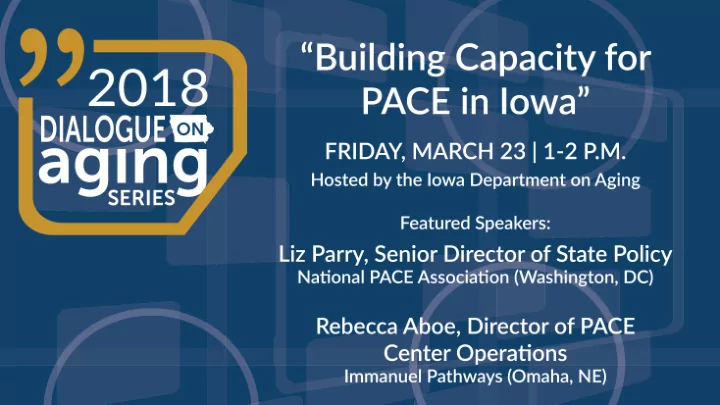
PACE i CE in Iowa Liz P Parr rry Nati tional P PACE Associati - - PowerPoint PPT Presentation
PACE i CE in Iowa Liz P Parr rry Nati tional P PACE Associati tion PACE 101 101 What i t is PACE? E? Seeing PACE Firsthand What i t is PACE? E? Comprehensive Community Based Coordinated Capitated Who ho Do Does s
PACE i CE in Iowa
Liz P Parr rry Nati tional P PACE Associati tion
PACE 101 101
What i t is PACE? E?
Seeing PACE Firsthand
What i t is PACE? E?
- Comprehensive
- Community Based
- Coordinated
- Capitated
Who ho Do Does s PACE S E Serve?
- 55 and older
- At a Nursing Home Level of Care
- Able to live in Community, with PACE services
Miles eston
- nes i
in the P e PACE Model el Histor
- ry
How D Does es P PACE Op Oper erate? e?
- PACE Center
- Primary Care
- Rehabilitative Care
- Activities
- Meals
- In the Home
- Transportation
- Contracted Network:
- Specialists
- Hospitals
- Assisted Living
- Other
Integ egrated ed Ser ervice De Delivery and T nd Team M Managed C d Care
Ou Outcom
- mes
es
- Better care
- Fewer unmet needs
- Improved chronic care management
- Better functional support
- Longer life
- Higher Quality of Life
PACE C E Costs ts
- Reduces high cost of uncoordinated care
- Fewer hospitalizations
- Less ER use
- Capitated = Predictable
- PACE rate less than current Medicaid cost
- No copays
Who
- Pays f
for PACE CE C Care
- PACE is a financially capitated program
- Organizations receive a per member, per month payment
to deliver all the necessary care
- Breakdown of Participants
- 90% dually eligible for Medicaid and Medicare
- 9% Medicaid-only
- 1% private pay, Medicare-only, other
PACE b E by the Number ers - Who
42,000+ Participants
95% In Home &
Communities
76 Average Participant Age
13
PACE b E by the Number ers - What
123 PACE
Organizations
242 PACE Centers
11 Average # Years
Programs in Operation
14
PACE b E by the Number ers - Where re
31 PACE States
19 Operate in Rural Areas
49% of all PACE
- rganizations operate in 5 States
15
PACE b E by the Number ers
Number er o
- f States
es w with P PACE
16 5 10 15 20 25 30 35 JANUARY-12 JANUARY-13 JANUARY-14 JANUARY-15 JANUARY-16 JANUARY-17 JANUARY-18
29 31 31 32 32 31 31
PACE b E by the Number ers
Number o r of PACE O Organ anizations b by State
17
PACE b E by the Number ers
Wher ere i e is PACE
18
PACE b E by the Number ers
Tren ends i in Number er o
- f PACE Center
ers
19
126 173 196 210 228 242 [VALUE]
PACE b E by the Number ers
Tren ends i in Number er o
- f PACE Partici
cipants ts
20 25,443 28,255 31,654 34,413 38,284 42,043 [VALUE] 5,000 10,000 15,000 20,000 25,000 30,000 35,000 40,000 45,000 50,000 January-12 January-13 January-14 January-15 January-16 January-17 January-18
PACE b E by the Number ers
Top
- p E
Eight La Largest P t PACE P Prog
- grams i
in 2017
21
PACE Organization Name State Census CenterLight Health Care NY 3282 InnovAge of Greater Colorado CO 2667 AltaMed Buena SeniorCare CA 2147 On Lok Lifeways CA 1439 Providence ElderPlace - Portland OR 1268 Summit ElderCare MA 1155 Element Care MA 954 Bienvivir All-Inclusive TX 927
- Delivery system reform – fully realized
- Integrated (Medicare/Medicaid; Acute/Primary/LTSS)
- Community based
- Person centered, provider-sponsored
- Value
- Below states’ cost of serving a comparable population – 16%
- Predictable, capitated cost to states
- Quality
- Increased life expectancy 1
- Improved physical and mental functioning 1
- Higher quality of life 1
- Longer ability to live at home 2
1
Wieland, D., Boland, R., Baskins, J., Kinosian, B. (2010). Five-year survival in a Program of All-Inclusive Care for the Elderly compared with alternative institutional and home- and community-based care. J Gerontol A Biol Sci Med Sci. July: 65 (7), pp. 721-726.
2
Segelman, M., Cai, X, van Reenen, Temkin-Greener, H. Transitioning From Community-Based to Institutional Long-term Care: Comparing 1915(c) Waiver and PACE Enrollees. The Gerontologist 2015.
Wh Why Grow P w PAC ACE
Between Jan. 1, 2013 – Jan. 1, 2017 the following states opened five or more new programs:
New P PACE CE P Progr gram am Gr Growth
Between Jan. 1, 2013 – Jan. 1, 2017 the following states opened five or more new centers:
Cu Curr rrent P t PACE P Prog
- gram G
Growth
Between Jan. 1, 2013, and Jan. 1, 2017, the following states had their
- verall census numbers grow more than 50 percent
PACE C CE Census Gr Growth
Qu Ques estion
- ns?
Liz Parry, Senior Director, State Policy, NPA lizp@npaonline.org
27
Immanuel Pathways Council Bluffs, Iowa Immanuel Pathways Omaha, Nebraska Immanuel Pathways Des Moines, Iowa
28
PACE i E in Iowa
Total N Number er o
- f Participants S
Served ed i in I Iowa: 460 P 0 Participants
29
What Does the Immanuel Pathways PACE Population Look Like?
Central Iowa Southwest Iowa Average Age 67 72 Min 55 56 Max 94 97 Percent Female 64% 54% Independent Living 87% 82%
30
What Does the Immanuel Pathways PACE Population Look Like?
Central Iowa Southwest Iowa Dual 110 96% 150 94% Medicare Only 1 1% 3 2% Medicaid Only 4 3% 6 4%
31
Imman anuel P Pathways S Southwest I Iowa a
Location: Council Bluffs, IA Opening D g Date te: January 2012 Servi vice A e Area: Mills, Pottawattamie, and Harrison Counties Enrollment: t: 159 participants (20% saturation) 55-64: 25% 65+: 75% Center er C Capa pacity: 230-240 participants
32
Imman anuel P Pathways C Central al Iowa
Location: Windsor Heights, IA Opening D g Date te: October 2015 Servi vice A e Area: Boone, Dallas, Jasper, Madison, Marion, Marshall, Polk, Story and Warren counties Enrollment: t: 115 participants (3% saturation) 55-64: 54% 65+: 46% Center er C Capa pacity: 250 participants
33
Barri rriers t to
- growin
ing PACE
- Cut-off dates for Enrollment into program
- Awareness in the state
- MCOs reluctant to refer individuals with high needs to
PACE
- Expansion of PACE program
- Capital needed to start program
- Iowa good partner and always willing to have
conversation