PAC Presentation Aspen, Colorado June 19,2012 Outline This - - PowerPoint PPT Presentation

pac presentation aspen colorado june 19 2012 outline
SMART_READER_LITE
LIVE PREVIEW

PAC Presentation Aspen, Colorado June 19,2012 Outline This - - PowerPoint PPT Presentation

PAC Presentation Aspen, Colorado June 19,2012 Outline This presentation follows closely our presentation to DOE on June 6 th regarding Fermilab plans: General comments on the program goals and the strategy to achieve them The


slide-1
SLIDE 1

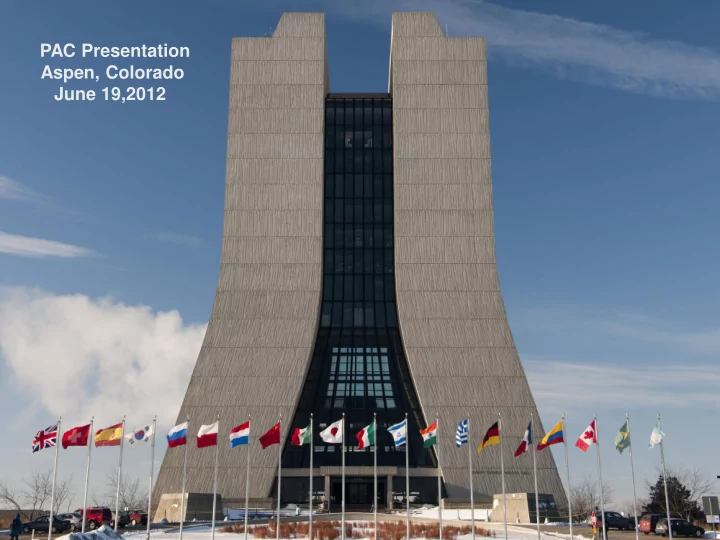
PAC Presentation Aspen, Colorado June 19,2012
slide-2
SLIDE 2

Outline

  • This presentation follows closely our

presentation to DOE on June 6th regarding Fermilab plans:

  • General comments on the program goals and the

strategy to achieve them

  • The restructuring of LBNE
  • How recent results affect strategy
  • The planned program through 2020
  • The planned program beyond 2020
  • Management and operations that sustain the future
  • f Fermilab

2

slide-3
SLIDE 3

The strategy for Fermilab

  • We have a compelling program

that maintains Fermilab and the US as a leader in in the world

  • f particle physics --- and now

fits a leaner budget profile

  • Leadership includes working

with the community and DOE to achieve that program, providing the facilities to pursue fundamental discoveries and attracting international partners

  • Leadership must take place in

the context of a global field

3

Intensity Frontier Workshop, Washington DC

slide-4
SLIDE 4

Other planning for Fermilab

  • We pay major attention to
  • ther important planning

issues: human resources, site development, project management, operational improvements throughout -- but all of these will be for naught if we do not get the strategy right. This presentation is heavily weighted towards the strategic issues that determine the future of Fermilab and HEP in the US

4

Site planning Employee Advisory Group Community Advisory Board Infrastructure

slide-5
SLIDE 5

Criteria for a sustainable strategy

  • Drives world-leading physics
  • Is supported by the HEP community
  • Continually produces scientific results
  • Attracts international participation
  • Is resilient relative to instability in the US system
  • Is resilient relative to new discoveries
  • Has the full support of the Office of Science
  • Is affordable (the definition of affordability varies with

time, up and down)

5

slide-6
SLIDE 6

Strategy: practical matters

  • We have worked hard to design a strategy that:
  • Fits the likely budgetary constraints
  • Builds on getting the greatest returns from existing

investments in our current accelerators and detectors

  • Sets the platform for future initiatives
  • Sets the trajectory for Fermilab and the US program to be

leaders at the Intensity Frontier

  • We enjoy DOE support to achieve these broad goals.

DOE support includes: running the existing facilities, completing ongoing projects like DES and NOvA, building new projects like Mu2e and Muon g-2 and setting the path towards long term achievements with LBNE and Project X

  • We lead this presentation with the reconfiguration of LBNE

6

slide-7
SLIDE 7

The restructuring of LBNE

  • Dr. Brinkman’s letter: LBNE as

currently designed is not affordable; requested phased approach and/or alternatives with physics at every stage

  • We have carried out a major re-

planning effort with the involvement of the community (many leaders); all major stakeholders; open process with all documentation on the web

  • Held community workshop

7

slide-8
SLIDE 8

Organization of the effort

8

Steering Committee: Developed viable

  • ptions, prepared the

report Engineering/cost Working Group: Developed cost with common methodology Physics Working Group: Analyzed physics reach with common assumptions

slide-9
SLIDE 9

Issues for LBNE Phase 1

  • Main issues:
  • What compromises to make in the physics for Phase 1

in order to make it affordable

  • What long-term physics limitations are imposed by the

different options for Phase 1

  • The fundamental practical choice:
  • Do we use the existing beamline to NuMI or do we

develop a new beamline to Homestake?

9

slide-10
SLIDE 10

A beamline is a significant investment

  • Extraction and transport from the Main Injector to target
  • Target hall allows repairs in high-radiation environment
  • Focusing horns for secondary particles
  • Large underground decay pipe (675m for NuMI and

200m for Homestake), with aquifer protection to higher levels than NuMI beamline

10

slide-11
SLIDE 11

Issues for LBNE Phase 1

  • Using the existing NuMI beamline saves the cost of a

new beamline and allows funding a more ambitious detector in Phase 1 (allows either a very large detector

  • n the surface or a smaller detector at depth) -- but

permanently limits the future physics reach for neutrino

  • physics. How significant is this?
  • Developing a new beamline to Homestake requires the

investment of substantial resources that, within limited budgets, reduces the scale of the Phase 1 detector -- but preserves the ability to develop the full physics potential in the long term. Is the Phase 1 physics reach “good enough” to justify the first phase and attract partners?

11

slide-12
SLIDE 12

Reconfiguration Process

  • A large number of options were considered, with full

study of the physics reach and corresponding engineering/cost studies

  • We worked within a guideline of trying not to exceed

about $700M to $800M for LBNE Phase 1 (including escalation and contingency), fully aware that it will be easier to get going with lower costs

  • At the end, three options were considered viable, each

with at least one strength greater than the others. One

  • f the three options was strongly favored by the

Steering Committee, but is also the most costly

  • To understand how we arrived to a favored option we

need to discuss some physics

12

slide-13
SLIDE 13

What does a large q13 mean?

  • For values of sin22q13, >0.02

the measurement of dCP is largely independent of sin22q13

  • A large sin22q13 helps the

measurement of the mass hierarchy at baselines shorter than Homestake – but not over the full range of dCP

  • A large sin22q13 allows mass

hierarchy measurement across the full range of dCP with a smaller detector at Homestake

13

slide-14
SLIDE 14

Three options with different strengths

  • 1. The existing NuMI beamline in the

“low-energy configuration” with a 30 kton LAr-TPC surface detector 14 mrad off-axis at Ash River (810 km)

  • 2. The existing NuMI beamline in the

“low-energy configuration” with a 15 kton LAr-TPC underground (2300 ft) detector on-axis at the Soudan mine (735 km)

  • 3. The new LBNE beamline in the low-

energy configuration on-axis with a 10 kton LAr-TPC surface detector at Homestake in South Dakota (1,300 km)

14

slide-15
SLIDE 15

Three options with different strengths

15

Ash River Soudan Homestake Baseline 810 km 735 km 1300 km Detector Mass 30 kt 15 kt 10 kt Detector position Surface Underground 2300 ft Surface Beamline Existing NuMI Existing NuMI New

slide-16
SLIDE 16

Mass hierarchy reach

16

slide-17
SLIDE 17

Mass hierarchy reach

  • The oscillation effects due to dCP and the matter effect

(mass hierarchy) can both go in the same direction in which case the mass hierarchy is easier to determine or in opposite directions in which case it is harder to determine

  • Adding other baselines (e.g., T2K) to either Homestake
  • r NuMI directions helps the weak part of the dCP range
  • Distance makes a big difference. At a sufficiently long

distance the effects of dCP and the matter effect do not

  • verlap within the measurement precision
  • A smaller detector towards Homestake does

substantially better than larger detectors in the NuMI direction

17

slide-18
SLIDE 18

Reach in CP violation

18

slide-19
SLIDE 19

Reach in CP violation

  • The larger tonnage at Ash River relative to Homestake

and Soudan makes the Ash River option the best for CP violation in one half the delta space. If the mass hierarchy is resolved with the help of other experiments, then it is the Phase 1 option with the highest reach in dCP

  • The Homestake option with the lowest mass of the three
  • ptions does reasonably well for the full range of dCP for

the Phase 1 experiment

  • Soudan has a a more limited reach in dCP due to the

shortest baseline and more limited tonnage than Ash

  • River. It has the advantage of starting deep underground

physics ( proton decay, SN collapse) early.

19

slide-20
SLIDE 20

Beyond measuring parameters…

  • Beyond the measurement of the missing parameters of

the 3x3 mixing matrix, LBNE in the Homestake direction gives us the best sensitivity to new physics

  • The beam energy spectrum and baseline are optimal for

the exploration of the full oscillation phenomena, so it is a first stage of a long program

  • LBNE in the Homestake direction is the one option

capable of ultimately exploiting the full power of Project X due to fundamental limitations of the NuMI beam (total power and tritium mitigation)

  • Reconfiguration studies confirm the validity of the initial

choice of Homestake by previous studies (P5, NRC, Intensity Frontier Workshop)

20

slide-21
SLIDE 21

21

LBNE compared to the state of present measurements. Stringent measurement

  • f whether sin22q23 is maximal possibly indicating new symmetry?

Example of long-term capabilities

slide-22
SLIDE 22

Summary: 30 kton at Ash River

22

Pros  Best Phase 1 CP-violation sensitivity in combination with NOvA and T2K results for the current value of q13. The sensitivity would be enhanced if the mass ordering were known from other experiments.  Excellent (3) mass ordering reach in nearly half of the dCP range. Cons  Narrow-band beam does not allow measurement of oscillatory signature.  Shorter baseline risks fundamental ambiguities in interpreting results.  Sensitivity decreases if q13 is smaller than the current experimental value.  Cosmic ray backgrounds: impact and mitigation need to be determined.  Only accelerator-based physics.  Limited Phase 2 path:

  • Beam limited to 1.1 MW (Project X Stage 1).
  • Phase 2 could be a 15-20 kton underground (2,340 ft) detector at Soudan.
slide-23
SLIDE 23

Summary: 15 kton at Soudan (2300ft)

23

Pros  Broadest Phase 1 physics program:

  • Accelerator-based physics including good (2) mass ordering and good CP-

violation reach in half of the dCP range. CP-violation reach would be enhanced if the mass ordering were known from other experiments.

  • Non-accelerator physics including proton decay, atmospheric neutrinos, and

supernovae neutrinos.  Cosmic ray background risks mitigated by underground location. Cons  Mismatch between beam spectrum and shorter baseline does not allow full measurement of oscillatory signature.  Shorter baseline risks fundamental ambiguities in interpreting results. This risk is greater than for the Ash River option.  Sensitivity decreases if q13 is smaller than the current experimental value.  Limited Phase 2 path:

  • Beam limited to 1.1 MW (Project X Stage 1).
  • Phase 2 could be a 30 kton surface detector at Ash River or an additional 25-30

kton underground (2,340 ft) detector at Soudan.

slide-24
SLIDE 24

Summary: 10 kton at Homestake

24

 Excellent (3) mass ordering reach in the full dCP range.  Good CP violation reach: not dependent on a priori knowledge of the mass ordering.  Longer baseline and broad-band beam allow explicit reconstruction of oscillations in the energy spectrum: self-consistent standard neutrino measurements; best sensitivity to Standard Model tests and non-standard neutrino physics.  Clear Phase 2 path: a 20 – 25 kton underground (4850 ft) detector at the Homestake

  • mine. This covers the full capability of the original LBNE physics program.

 Takes full advantage of Project X beam power increases.  Cosmic ray backgrounds: impact and mitigation need to be determined.  Only accelerator-based physics. Proton decay, supernova neutrino and atmospheric neutrino research are delayed to Phase 2.  ~10% more expensive than the other two options: cost evaluations and value engineering exercises in progress.

slide-25
SLIDE 25

Engineering/cost studies

  • Scrubbed previous costs, did value engineering and

reduced scope wherever possible consistent with the particular option. In the case of the Homestake direction, near detector would be built later or by collaborators

  • Cost for previously estimated items maintained – overall

cost reduced by eliminating requirements and/or items

  • Significant cost savings achieved both for the beamline

and for the conventional facilities at the detector site

  • Comparative work at Homestake and Soudan was very
  • helpful. There is experience with excavation and
  • perations both at Homestake and at Soudan

25

slide-26
SLIDE 26

Cost curves for different choices

26

slide-27
SLIDE 27

Phased approach and alternatives

  • Ideally we would like a detector that exploits both the

long baseline of Homestake and operates underground. It requires a new beamline and development of the underground; it does not fit the cost guidelines (at Homestake +$135M to go underground for 10 kton detector)

  • The option of Homestake on the surface offers strengths

in the neutrino arena and has the best long-term prospects for a phased approach. Because the Phase 1 detector is small, international partners may be interested in adding additional mass.

  • The Soudan option offers underground physics from the

start; the mass is reduced relative to Ash River in order to fund the development of the underground

27

slide-28
SLIDE 28

Phased approach and alternatives

  • Ash River would bring the largest detector early with the

highest CP reach of any of the options in Phase 1, but in the long term it has neither the ideal baseline nor is it

  • underground. Because we would be building only a

detector, cost control can be achieved by scaling the mass back gracefully

  • Of these viable options, the Steering Committee and the

laboratory favor building 10 ktons on the surface at Homestake, provided the somewhat higher costs of this

  • ption could be handled (10%). The long-range physics

potential may bring more partners than other options

  • We are ready to discuss these issues and options in

more detail with the Office of Science, select a path and integrate it into the ongoing project critical decisions

28

slide-29
SLIDE 29

Further phases of LBNE

  • Further phases of LBNE can add mass to the detector,
  • r go underground to extend the breadth of the

program, depending on: a) the particular Phase 1 chosen, b) financial resources and physics results at the time when the choice needs to be made

  • Importantly, we have broken up Project X in several

phases as well so that phases in Project X can be intercalated with further phases of LBNE

  • In particular, the first phase of Project X at

approximately 1/3 the total cost would boost particles at 1 GeV by a factor of 100, and neutrino beams at high energies by 60-70%

29

slide-30
SLIDE 30

30

Recent results: LHC

places many limits implying mass scale for new physics is high; LHC and Tevatron see hints for the Higgs (is it there?)

slide-31
SLIDE 31

Recently: sin22q13 measured (March 2012)

31

Ryan Patterson (Pre Kyoto mtg.)

slide-32
SLIDE 32

Recent results and US strategy

32

Recent results on q13 and the LHC further validate the strategy we are pursuing:

  • The gate for great neutrino

physics is now wide open

  • The absence of low-energy

structures at LHC (other than possibly the Higgs)  must use indirect intensity frontier methods

  • If there are new structures

they are likely to be at higher energies  a boost to muon collider R&D

slide-33
SLIDE 33

E = Mc2

Limit: a few TeV

E

Energy Frontier

33

slide-34
SLIDE 34

High-intensity particle beam

Quantum Fluctuation

Discover the nature of massive known & NEW particles indirectly by intense beams of charged leptons and quarks Top W, Z …. NEW

Intensity Frontier

Uncertainty Principle

E = Mc2

Limit ~104 TeV

34

Rate for rare transition

slide-35
SLIDE 35

high intensity neutrino beam

Seesaw

M

n

Probe even more massive NEW particles and dark sector particles by intense neutrino beams

Intensity Frontier

mn x mN ~ (mquark)2

E = Mc2

Probing~1012 TeV

35

slide-36
SLIDE 36

1 3 5 Log (Energy [GeV]) 13 15 17

Tevatron LHC Quarks Charged Leptons Neutrinos Proton Decays

The strategy and experimental reach

Intensity Frontier Energy Frontier

Indirectly Directly Connection

more complete more elegant theory Time since the Big Bang 10-11 s = 0.01 ns

36

slide-37
SLIDE 37

37

The program through 2020

slide-38
SLIDE 38

38

Illinois Accelerator Research Center (IARC) CDF

slide-39
SLIDE 39

Neutrino beams

39

Diverse and intense beams: Unmatched in the world

slide-40
SLIDE 40

Neutrino oscillations

40

slide-41
SLIDE 41

g-2 Mu2e 8 GeV n 120 GeV n NOvA Shutdown

NOvA LBNE MINOS+ MINERvA

8 GeV m

MicroBooNE

120 GeV n 8 GeV n

MiniBooNE MINOS MINERvA

NOvA accelerator upgrade and Proton Improvement Plan

41

slide-42
SLIDE 42

Matter – Antimatter Asymmetry

_

n = n ?

Mass ordering: Normal Inverted n1 n2 n3 (Mass)2 n3 n1 n2

  • r

q13 q13

Neutrinos: known unknowns

unknown unknowns

42

slide-43
SLIDE 43

MINERvA MiniBooNE

MINOS (far) MINOS (near)

Operating since 2005 (350 kW)

Neutrino program

NOvA (far)

Under construction Online 2013 (700 kW)

MicroBooNE Under construction (LAr TPC) NOvA (near)

43

slide-44
SLIDE 44

Why multiple neutrino experiments?

  • Different aspects of neutrino physics drive different

experiments; each limited by having to operate at one distance and one energy. Beams not used up!!

  • Long baseline:

 MINOS (disapearance; broad energy spectrum, on-

axis; high rate)

 NOVA (electron appearance, off-axis, narrow energy

spectrum; low rate)

 LBNE (appearance and disappearance; on-axis high

rate, best positioned to add second oscillation maximum)

  • Short baseline

 MINERvA: cross sections different nuclei  MiniBOONE and MicroBOONE: anomalies

44

slide-45
SLIDE 45

How do we study neutrinos? Beams

  • Near Detector: 980 tons

Far Detector: 5400 tons

45

slide-46
SLIDE 46

Machado, Nunokawa, Funchal (neutrinos that travel ~750 km) En (GeV)

Exploring unknown unknowns in neutrino oscillation

Extra Dimension

46

slide-47
SLIDE 47

NOvA pictures

47

slide-48
SLIDE 48

NOvA prototype pivoter

48

slide-49
SLIDE 49

MicroBooNE

  • Follow excess in MicroBooNE data. Critical to determine

is it electrons or photons?

  • Use Liquid Argon TPC: physics + further development
  • f the technology

49

slide-50
SLIDE 50

Neutrino experiments and their physics goals in the next ten years

50

Physics goal 2011 2013 2015 2017 2019 2021 Search for CP violation Determine mass hierarchy NOvA Sterile neutrino sector Appearance MicroBooNE Disappearance MINOS+ Establish framework Precision mass difference MINOS Neutrino interaction rates with nuclei MINERvA Confirm q13 through appearance NOvA MiniBooNE

slide-51
SLIDE 51

testbeam proton beam Tevatron SCRF Test Facility Muon Test Facility Main Injector Recycler Neutron cancer center muon beams neutrino beams

Intensity Frontier at Fermilab: Muon program (this decade)

51

slide-52
SLIDE 52

Proton delivery

Intensity Frontier at Fermilab: Muon Campus

52

slide-53
SLIDE 53

Anomalous magnetic moment

Momentum Spin

e

LHC

am = (g-2)/2 ~ 0.001 uncertainty ~ 10-10

Intensity Frontier at Fermilab: Muon g-2

LHC alone 53

slide-54
SLIDE 54

m

n

e

n

neutrino oscillation

W

Intensity Frontier at Fermilab: m  e conversion

Loops Contact Terms Supersymmetry Heavy Neutrinos Two Higgs Doublets Leptoquarks Compositeness New Heavy Bosons / Anomalous Couplings

  • Negligible rate in the SM: < 10-54
  • Measurable rate with new physics contributions: ~ 10-15

54

slide-55
SLIDE 55

Production Solenoid Detector Solenoid Transport Solenoid Proton Beam to Target Tracker Calorimeter

Mu2e experimental rate sensitivity: 10-16 – 10-17 Mu2e has discovery sensitivity to many new physics models

Conversion of a muon into an electron in the field of a nucleus:

Intensity Frontier at Fermilab: m  e conversion

Mu2e

Stopping Target m  e

55

slide-56
SLIDE 56

Seaquest

  • Drell-Yan experiment and possible polarized

extensions

56

slide-57
SLIDE 57

testbeam proton beam SCRF Test Facility Main Injector Recycler muon beams

Intensity Frontier at Fermilab

Kaon beam (if an opportunity arises)

neutrino beams

K+  p+ nn rate in SM ~ 10-10

57

slide-58
SLIDE 58

Fermilab CERN

LHC pp: 7 TeV  14 TeV

Energy Frontier at Fermilab

LHC Energy Upgrade Lepton Collider, …

LHC results

Tevatron pp: 2 TeV

_

Remote Control Room at Fermilab

58

slide-59
SLIDE 59

mHiggs prediction from mW, mtop meas.s mHiggs < 145 GeV/c2 at 95%CL Results still coming out from Tevatron

At the Energy Frontier: the Higgs boson?

W W

top bottom Higgs

Excluded by direct searches at 95%CL Higgs Mass [GeV/c2]

LEP

LHC Tevatron

59

Consistent with expectation from precision measurements

slide-60
SLIDE 60

Energy Frontier

  • The principal activity for the

foreseeable future is exploitation of the LHC

  • Operations, physics analysis
  • Support U.S. LHC community
  • High luminosity upgrades for both

accelerator and detector

  • The biggest unknown is what

follows the LHC?: ILC ? CLIC ? Muon Collider ? Energy doubler ?

60

Muon Accelerator Program New Director Mark Palmer

slide-61
SLIDE 61

Cosmic Frontier at Fermilab

  • Pioneering role in establishing the connection

between cosmology and particle physics: David Schramm, Rocky Kolb, Michael Turner…

  • Leader of the Sloan Digital Sky Survey:

established large surveys as cosmological tools (progenitor of DES, LSST, BigBOSS….)

  • Pioneering work in dark-matter searches and

the study of ultra-high-energy cosmic rays

61

slide-62
SLIDE 62

Dark Matter Detector

nuclear recoil

Cosmic Frontier at Fermilab

Detectors in underground facilities Detector CDMS DarkSide COUPP

Dark Energy Camera

Dark Matter Particle

570-Megapixel digital camera Fermilab

Chile

DES

62

slide-63
SLIDE 63

Cosmic Frontier at Fermilab

Exploring Highest-Energy Cosmic-Ray Particles (Auger) Exploring Quantum Space-time (Fermilab Holometer)

63

slide-64
SLIDE 64

Accelerator stewardship: IARC

64

Funding from the State of Illinois for new building; reconditioning of CDF assembly hall and provision of utilities thanks to DOE. IARC to act as a) portal to Fermilab accelerator facilities b) collaborative space for universities and industries c) training ground for accelerator technologists

slide-65
SLIDE 65

R&D this decade: SCRF and Project X

65

slide-66
SLIDE 66

Accelerator HEP experiments (non-CMS)

Experiment Collaborating Countries

Energy Frontier CDF Canada, Finland, France, Germany, Greece, Italy, Japan, Korea, Russia, Slovakia, Spain, Switzerland, Taiwan, UK, US DZero Argentina, Brazil, Canada, China Columbia, Czech Republic, Ecuador, France, Germany, India, Ireland, Korea, Mexico, Netherlands, Russia, Sweden, UK, Ukraine, US Intensity Frontier MiniBooNE Mexico, US MicroBooNE Italy, Switzerland, US MINOS Brazil, Greece, UK, US MINERvA Brazil, Chile, Greece, Mexico, Peru, Russia, US NOvA Greece, India, Russia, US LBNE India, Italy, Japan, UK, US Muon g-2 India, Italy, Japan, Netherlands, Russia, US Mu2e Italy, Russia, US SeaQuest China, Japan, Taiwan, US Others Test beam Belgium, Canada, China, Cyprus, Czech Republic, England, France, Germany, Italy, Japan, Norway, Russia, South Africa, Spain, US

66

slide-67
SLIDE 67

Summary overall program this decade

  • A very strong start to establish the Intensity Frontier with

premier neutrino and muon experiments. It is a great short term program without LBNE

  • We hope by mid decade to start the construction of LBNE

having developed a strong international collaboration

  • Carry out a vigorous R&D program on SCRF and Project X

to start construction by the end of the decade

  • Exploit the physics opportunities at the LHC and at the

Cosmic Frontier

67

slide-68
SLIDE 68

68

The program after 2020

slide-69
SLIDE 69

Program next decade

  • LBNE: will have completed Phase 1 of the project and we

would be running a 700kW beam to Homestake (or alternative). Assuming a detector on the surface, the second phase of LBNE would be to add mass underground to enlarge the program to proton decay and SN collapse in addition to better neutrino measurements

  • Project X: a broad program with megawatts of continuous

beam, ideal to lead at the Intensity Frontier

  • Neutrino, long/short base-lines, more than 2 MW to LBNE
  • Kaons where the Standard Model backgrounds are minimal and we

are sensitive to many models

  • Rare muon decay with sensitivity to masses 10000 TeV
  • Symmetry violations through electric dipole moments in nuclei
  • Applications to transmutation, spallation targets, ADS

69

slide-70
SLIDE 70

70

as;lkjfda;lskdjf;salkjfd

Argonne National Laboratory • Brookhaven National Laboratory • Fermi National Accelerator Laboratory • Lawrence Berkeley National Laboratory Pacific Northwest National Laboratory • Oak Ridge National Laboratory / SNS • SLAC National Accelerator Laboratory • Thomas Jefferson National Accelerator Facility Bhaba Atomic Research Center • Raja Ramanna Center of Advanced Technology • Variable Energy Cyclotron Center • Inter University Accelerator Center

slide-71
SLIDE 71

Project X Siting

71

slide-72
SLIDE 72

Project X

  • Unique facility with a 3 MW at 3 GeV

continuous-wave (CW) linac. Multiplies low- energy flux of protons at Fermilab by 100 with flexible timing patterns, ideal for rare decays

  • Solves “proton economics”. Experiments run

simultaneously at 3 GeV, 8 Gev and 60-120 GeV at high power

  • Delivers 2+ MW to LBNE
  • To be developed consistently to serve as front

end of neutrino factory or muon collider

72

slide-73
SLIDE 73

Phased approach to Project X

  • Project X can be broken into three phases,

each for about a third of the cost

  • Phase 1: Up to 1 GeV. Retires old linac, increases

flux of neutrinos x1.7, enhances existing Mu2e by x10, starts EDM, nuclear-physics and nuclear- material studies

  • Phase 2: Up to 3 GeV. Starts powerful Intensity

Frontier experiments with kaons and short baseline neutrino programs

  • Phase 3: Up to 8 GeV; Multiplies power to LBNE by

factor of 3; power at 8 GeV by several fold for short- baseline neutrino experiments

  • Decision on when these phases should start

can wait to much later in the decade

73

slide-74
SLIDE 74

Project X: new experiments

74

Neutrinos

  • Matter-

antimatter asymmetry

  • Neutrino mass

spectrum

  • Neutrino-

antineutrino differences

  • Anomalous

interactions

  • Proton decay
  • SuperNova

bursts

Kaons

  • Physics beyond

the Standard Model

  • Elucidation of

LHC discoveries

  • Two to three
  • rders of

magnitude increase in sensitivity

Muons

  • Oscillation in

charged leptons

  • Physics beyond

the Standard Model

  • Elucidation of

LHC physics

  • Sensitive to

energy/mass scales three

  • rders of

magnitude beyond LHC

Nuclei

  • New generation
  • f symmetry-test

experiments

  • Electric Dipole

Moments

  • Three or more
  • rders of

magnitude increase in Francium, Radium, Actinium isotopes

Energy Applications

  • Transmutation

experiments with nuclear waste

  • Spallation target

configurations

  • Materials test

under high irradiation

  • Neutron fluxes

under various configurations relevant to ADS

slide-75
SLIDE 75

Project X and the big questions

75

Where does mass come from? Why is matter dominant? What are the neutrino masses and what do they say? Where are the heavy neutrino partners? Why are there three families of quarks and leptons? Do the forces unify? Does nature use supersymmetry or other new symmetries? Are there extra dimensions of space? What is dark matter? What is dark energy? neutrinos muons kaons Nuclei (EDMs..)

slide-76
SLIDE 76

Did we meet strategic criteria?

  • Drives world-leading physics
  • Is supported by the HEP community
  • Continually produces scientific results
  • Attracts international participation
  • Is resilient relative to instability in the US system
  • Is resilient relative to new discoveries
  • Has the full support of the Office of Science if plan accepted
  • Is affordable (the definition of affordability varies with time, up

and down) now consistent with stable, flat budgets

76

slide-77
SLIDE 77

77

Management and operations that sustain the future of Fermilab

Some highlights. For fuller descriptions refer to the Annual Laboratory Planning Document for Fermilab

slide-78
SLIDE 78

78

Fermilab Organization

Interim Head Carl Strawbridge

Jack Anderson

slide-79
SLIDE 79

Numerous improvement initiatives

  • Safety: persistent awareness
  • Recruitment and retention
  • Site planning and utilization
  • Sustainability
  • Transparency: FermiDash and Contract

Assurance

  • Office of Program and Project Support
  • Employee Advisory Group
  • Community Advisory Group
  • Project management

79

slide-80
SLIDE 80

Safety: persistent awareness

  • This year’s performance is poorer than

previous year. Hard to measure real performance because of low statistics – but we take the increase in injuries seriously

  • Weekly report by division/section managers
  • n all events starting from first aid up
  • Monthly safety walk by senior leaders
  • Increasing number of employees trained on

Human Performance Improvement (HPI)

  • Signage at the front gates constantly updated;

Director’s Corners calling attention to safety; we use other tools like the “porcelain press”

  • Special campaigns: e.g. distributed “Failure to

Learn” to division, section and safety managers and discussed it. It has every conceivable organizational failure mode.

80

slide-81
SLIDE 81

Human resources planning (OHAP)

  • We track individuals in 125 skill categories
  • Define the program
  • Gap analysis
  • Steer staff to the predicted needs over time

81

  • Main issue: instability of planning assumptions

Example: scientist by program, excluding postdocs

slide-82
SLIDE 82

Recruiting and retention

  • Extraordinary record in recruiting top-level junior
  • investigators. For example: Wilson fellows recruitment

top candidate acceptance greater than 90%

  • Excellent record in recruiting leadership positions. For

example, Stuart Henderson (ALD accelerators), Mark Palmer (Head of Muon Collider Program); Jack Anderson (COO)

  • We have lost some top-flight scientists and engineers,

more than usual: primarily the necessary delay in starting Project X

  • Some drastic cuts contemplated for SCRF will damage

competency established over the last several years: we are in negotiation with OHEP

82

slide-83
SLIDE 83

Some awards and recognition….

  • DOE Early Career Awards (2 in 2011, four in 2012)
  • 2012 IOP Career Prize (Schwanenberger)
  • 2012 Vannevar Bush Award (Lederman)
  • 2010 Wilson Prize (Peoples)
  • 2011 Sakurai Prize (Quigg, Eichten)
  • AAAS Fellows (Kim, Mackenzie)
  • NAS (Oddone)
  • 2011 IEEE Council on Superconductivity Award

(Tollestrup)

  • 2011 Alexander von Humboldt Research Award

(Carena)

83

slide-84
SLIDE 84

Site planning and utilization

  • Powerful Geographic

Information System (GIS) documents the site in great detail and gives us an excellent planning tool. In the next five years:

  • 1. CMT (ARRA)
  • 2. IARC (IL)
  • 3. WH Intensity Ops Center
  • 4. Liquid Argon Test facility
  • 5. Muon campus (GPP)
  • Distributed: SLI #1
  • Working on master plan to

sustain the program, including moving out of

  • bsolete shops and trailers

84

slide-85
SLIDE 85

Site planning and utilization

  • The program is well defined for the rest of the decade

and site planning is ongoing. Principal uncertainties: when LBNE? When Project X? We do have developed plans for them as part of the R&D studies, but for plans to be taken seriously we need a more solid foundation

  • SLI projects essential: electrical and water upgrades

start in FY13 budget. Thank you!

  • Next SLI project is the consolidation of antiquated shops

into new building in the industrial area: really important

85

slide-86
SLIDE 86

Sustainability (SSP Dec 2011)

86

  • Scope 1 GHG: fugitive emissions have been greatly

reduced (>76% from refrigerants and other gases)

  • Scope 2 GHG: 90% dominated by accelerators.

Increase efficiency of non-accelerator loads, but RECs will be required for the rest

  • We have ESPC initiative in FY12
  • Assessing 15% of buildings to be improved in

compliance with guiding principles. Requires $3M in FY14 and $5M in FY14 to meet compliance

  • Water goals achieved
  • For detailed status see Laboratory Planning Document
slide-87
SLIDE 87

Transparency: FermiDash

  • Strive for maximum

transparency to our sponsors and stakeholders

  • 11 CAS management

systems, mapped to the FRA Board of Director’s Oversight with specific

  • wners
  • New Tool: FermiDash

keyed to the 11 CAS management systems; available to staff and DOE

87

slide-88
SLIDE 88

Office of Program and Project Support

88

We have created OPPS to enhance coordination between CFO and Programs and Projects, oversight for Office of Quality and Best Practices, Office of Project Management Oversight and new Office

  • f Integrated Planning
slide-89
SLIDE 89

Employee Advisory Group

89

  • Employee Advisory

Group meets monthly with senior managers.

  • Brings together diverse

group of employees from all job classifications.

  • The aim is to improve

policies and working environment

slide-90
SLIDE 90

Community Advisory Group

90

Close advisors on laboratory development

slide-91
SLIDE 91

Project management

  • Essential to the future of the laboratory as Fermilab’s life

for the next decade is dominated by projects as the program is re-stocked

  • We have taken steps to bring more oversight

experience to the laboratory: Office of Program and Project Support

  • Performance on MINERvA and DES completed on

budget and on schedule

  • On-going projects NOvA and MicroBOONE on track, but

ample room for improvement. Primarily: better early warning system as technical or other difficulties develop

91

slide-92
SLIDE 92

Critical and immediate needs

  • On LBNE, DOE needs to decide if we have answered

the charge satisfactorily. We need the following actions:

  • Define the path forward
  • Accept that the path is consistent with CD-0
  • Integrate into project management key decision

process with CD-1 by early next year

  • We need your support to complete the muon program

Mu2e and Muon g-2. CD-1 for Mu2e is ongoing today; Muon g-2 needs funding profile and we need GPP support for the “Muon Campus”

  • For both LBNE and Project X - we need your help in

establishing a stable path in order to encourage international participation. Your support for our collaboration with India is critical

92