P10225: MINI BAJA WATER PROPULSION TEST STAND 02/19/2010 Henriette - - PowerPoint PPT Presentation

p10225 mini baja water
SMART_READER_LITE
LIVE PREVIEW

P10225: MINI BAJA WATER PROPULSION TEST STAND 02/19/2010 Henriette - - PowerPoint PPT Presentation

P10225: MINI BAJA WATER PROPULSION TEST STAND 02/19/2010 Henriette Bullmer Electrical Engineer Blaine Byers Mechanical Engineer Eric Hodgkinson Mechanical Engineer Stephanie Malinowski Mechanical Engineer Ticiano Torres Peralta


slide-1
SLIDE 1

P10225: MINI BAJA WATER PROPULSION TEST STAND

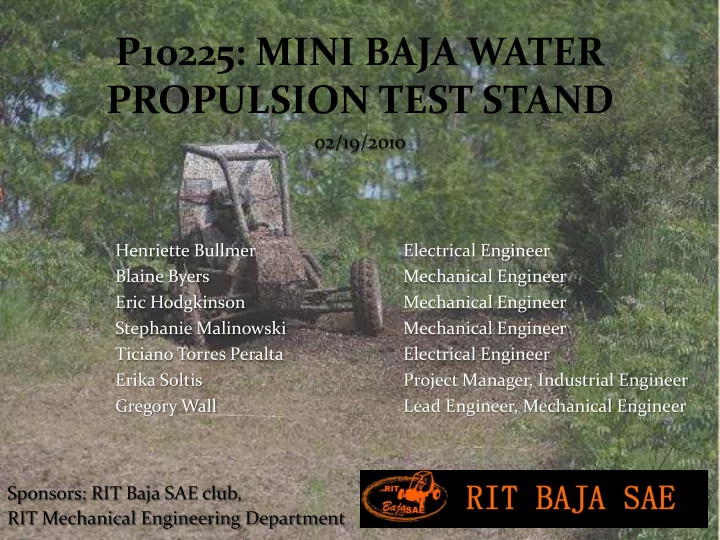
Henriette Bullmer Electrical Engineer Blaine Byers Mechanical Engineer Eric Hodgkinson Mechanical Engineer Stephanie Malinowski Mechanical Engineer Ticiano Torres Peralta Electrical Engineer Erika Soltis Project Manager, Industrial Engineer Gregory Wall Lead Engineer, Mechanical Engineer

02/19/2010

Sponsors: RIT Baja SAE club, RIT Mechanical Engineering Department

slide-2
SLIDE 2

PROJECT DESCRIPTION

 Customer: Mini Baja club at RIT  Endurance race and water event  Project Scope:

 Usable test stand  Software for determining

best water propulsion

  • ption

 Documentation supporting

this decision

slide-3
SLIDE 3

CUSTOMER NEEDS

 Test stand can produce repeatable tire/fender

performance data

 Software can document results of tests  SOP is provided for test stand use  Test stand is safe to use  Test stand is capable of withstanding brief

exposure to rain

slide-4
SLIDE 4

ENGINEERING SPECIFICATIONS

Specif ifica icati tion

  • n Descrip

ipti tion Marginal inal Value Maximum forward propulsion test stand can withstand 13.5 lb Maximum buoyancy force test stand can withstand 55 lb Standard Operating Procedure provided to Baja 1 copy Minimum frame material strength Factor of safety of 2 Maximum water force tank can withstand 6.81 psi Maximum test stand width 4 ft All electronics are resistant to rain water yes

slide-5
SLIDE 5

CONCEPT DESCRIPTION

 Build test stand:

 Stand available for use at any time  Stand designed to meet exact Baja needs  Requires little preparation before each test is performed  Controls outside variables that could affect results

 Alternatives:

 Scale model, Baja vehicle, outside testing, RIT facilities,

simulation, rent testing equipment

slide-6
SLIDE 6

SYSTEM ARCHITECTURE

Computer Control Electronics Load Cell Wheel/Fender Assembly Drive System Motor

Legend: Signal Mechanical

slide-7
SLIDE 7

DESIGN SUMMARY

Plywood walls distribute weight

  • f water

Painted steel frame Sliding assembly pulls against load cell when wheel turns to measure forward propulsion Top assembly supports hanging wheel, slides along top rails as wheel turns Vinyl liner inside plywood contains water

slide-8
SLIDE 8

SYSTEM TESTING RESULTS

 Mechanical:

Liner Material Test

Liner Seal Test

Lid Seal Test

Weld Inspection Test

Frame Loading Test

Lid Placement Test

Tank Water-holding Test

Rail and Runner Movement Test

Shaft Alignment Test

Wheel in Water Test

Bearing Load Test

Bearing Twist Test

Structure Natural Frequency Test  Electrical:

 LabVIEW Data Acquisition Test  Hall Sensor Test  Motor Control Unit Test  Signal Isolation Test  Electronics Wiring Test  Stand Grounding Test  Data Acquisition Operating System

Support Test  Integration:

 Test Stand Assembly Test  Complete Mechanical System

Movement Test

slide-9
SLIDE 9

TEST STAND PICTURES

slide-10
SLIDE 10

PROJECT EVALUATION

 Enthusiastic and supportive customer  Customer needs were not firm at start and changed

throughout process

 Assembly went smoothly because of detailed planning

and CAD drawings

 Most of project completed on time with flexible,

coordinated team efforts

 Significant support from experts  Liner ended up being more complicated than expected  Electronic control of motor wasn’t possible but manual

solution was acceptable

slide-11
SLIDE 11

RECOMMENDATIONS

 Run test stand without lid when possible  Add a window in the tank and liner to allow for

viewing test if lid is used

 Determine fender designs that don’t create so

much friction against the wheel/tire

 Add more sensors to allow for gathering of

more information (torque)

slide-12
SLIDE 12

QUESTIONS?