
Overview Landscape From models to programming languages Summary
Realization of Models in Programming Languages: Achieving Non-Functional Properties Derived from the Models
Silvia Lizeth Tapia Tarifa
Precise Modeling and Analysis Group Department of Informatics Faculty of Mathematics and Natural Sciences University of Oslo sltarifa@ifi.uio.no
07.05.2014
- S. Lizeth Tapia Tarifa
Realization of Models in Programming Languages 1/41 Overview Landscape From models to programming languages Summary
Overview
Software life cycle Requirements: Functional and non-functional (NFR) From design to operation: Models, systems, modeling languages & programming languages From models to programming languages: Example using a representative concrete approach Summary
Title of this lecture Realization of models in programming languages: Achieving non-functional properties derived from the models
- S. Lizeth Tapia Tarifa
Realization of Models in Programming Languages 2/41 Overview Landscape From models to programming languages Summary Software life cycle Requirements From design to operation
Overview
Software life cycle
Requirements: Functional and non-functional (NFR) From design to operation: Models, systems, modeling languages & programming languages From models to programming languages: Example using a representative concrete approach Summary
- S. Lizeth Tapia Tarifa
Realization of Models in Programming Languages 3/41 Overview Landscape From models to programming languages Summary Software life cycle Requirements From design to operation
Software Life Cycle
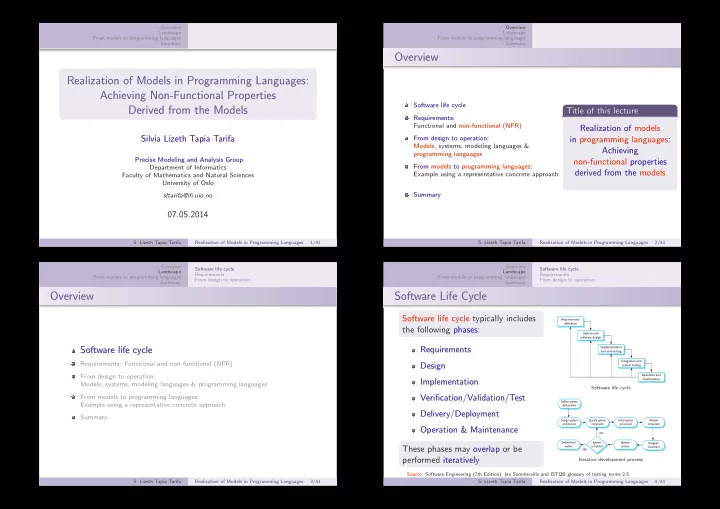
Software life cycle typically includes the following phases: Requirements Design Implementation Verification/Validation/Test Delivery/Deployment Operation & Maintenance These phases may overlap or be performed iteratively
Software life cycle Iterative development process Source: Software Engineering (7th Edition), Ian Sommerville and ISTQB glossary of testing terms 2.3
- S. Lizeth Tapia Tarifa
Realization of Models in Programming Languages 4/41