Outline Static Analysis: Symbolic Execution and Inductive - - PowerPoint PPT Presentation
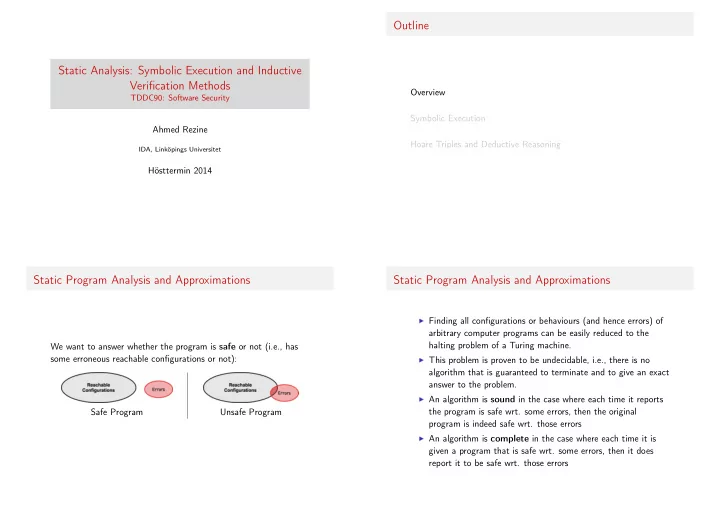
Outline Static Analysis: Symbolic Execution and Inductive Verification Methods Overview TDDC90: Software Security Symbolic Execution Ahmed Rezine Hoare Triples and Deductive Reasoning IDA, Linkpings Universitet Hsttermin 2014 Static
Static Program Analysis and Approximations
■ The idea is then to come up with efficient approximations and
algorithms to give correct answers in as many cases as possible. Over-approximation Under-approximation
Static Program Analysis and Approximations
■ A sound analysis cannot give false negatives ■ A complete analysis cannot give false positives
False Positive False Negative
Two Lectures on Static Analysis
These two lectures on static program analysis briefly introduce different types of analysis:
■ Previous lecture:
■ syntactic analysis: scalable but neither sound nor complete ■ abstract interpretation sound but not complete
■ This lecture:
■ symbolic executions: complete but not sound ■ inductive methods: may require heavy human interaction in
proving the program correct
First, What Are SMT Solvers?
■ Stands for Satisfiability Modulo Theory ■ Intuitively, these are constraint solvers that extend SAT solvers
to richer theories
■ Many solvers exist (Face’s, CVC, STP, OpenSMT), you will
use Z3 http://z3.codeplex.com in the lab.
■ SAT solvers find a satisfying assignment to a formula where all
variables are booleans or establishes its unsatisfiability
■ SMT solvers find satisfying assignments to first order formulas
where some variables may range over other values than just booleans
■ For instance, formulas can involve Linear real arithmetic, Linear
integer arithmetic, uninterpreted functions, bit-vectors, etc.
■ E.g., f (x)! = z ❫ f (2y) = z ❫ x y = y is unsat while
f (x)! = z ❫ f (2y) = z ❫ x + y = y is sat.
■ Many applications in verification, testing, planning, theorem
proving, etc.
Outline
Overview Symbolic Execution Hoare Triples and Deductive Reasoning
Testing
■ Most common form of software validation ■ Explores only one possible execution at a time ■ For each new value, run a new test. ■ On a 32 bit machine, if(i==2014) bug() would require 232
different values to make sure there is no bug.
■ The idea in symbolic testing is to associate symbolic values
to the variables
Symbolic Testing
■ Main idea by JC. King in “Symbolic Execution and Program
Testing” in the 70s
■ Use symbolic values instead of concrete ones ■ Along the path, maintain a Patch Constraint (PC) and a
symbolic state (✛)
■ PC collects constraints on variables’ values along a path, ■ ✛ associates variables to symbolic expressions, ■ We get concrete values if PC is satisfiable ■ The program can be run on these values ■ Negate a condition in the path constraint to get another path
Symbolic Execution: a simple example
■ Can we get to the ERROR? explore using SSA forms. ■ Useful to check array out of bounds, assertion violations, etc.
1
foo(int x,y,z){
2
x = y - z;
3
if(x==z){
4
z = z - 3;
5
if (4*z < x + y){
6
if (25 > x + y) {
7
...
8
}
9
else{
10
ERROR;
11
}
12
}
13
}
14
... PC1 = true PC2 = PC1 x ✼✦ x0❀ y ✼✦ y0❀ z ✼✦ z0 PC3 = PC2 ❫ x1 = y0 z0 x ✼✦ x1❀ y ✼✦ y0❀ z ✼✦ z0 PC4 = PC3 ❫ x1 = z0 x ✼✦ x1❀ y ✼✦ y0❀ z ✼✦ z0 PC5 = PC4 ❫ z1 = z0 3 x ✼✦ x1❀ y ✼✦ y0❀ z ✼✦ z1 PC6 = PC5 ❫ 4 ✄ z1 ❁ x1 + y0 x ✼✦ x1❀ y ✼✦ y0❀ z ✼✦ z1 PC10 = PC6 ❫ 25 ✔ x1 + y0 x ✼✦ x1❀ y ✼✦ y0❀ z ✼✦ z1 PC = (x1 = y0 z0 ❫ x1 = z0 ❫ z1 = z0 3 ❫ 4 ✄ z1 ❁ x1 + y0 ❫ 25 ✔ x1 + y0)
Check satisfiability with an SMT solver (e.g., http://rise4fun.com/Z3)
Symbolic execution today
■ Leverages on the impressive advancements for SMT solvers ■ Modern symbolic execution frameworks are not purely
symbolic, and not necessarily static:
■ They can follow a concrete execution while collecting
constraints along the way, or
■ They can treat some of the variables concretely, and some
- ther symbolically
■ This allows them to scale, to handle closed code or complex
queries
Outline
Overview Symbolic Execution Hoare Triples and Deductive Reasoning
Function Specifications and Correctness
■ Contract between the caller and the implementation. Total
Correctness requires that:
■ if the pre-condition (-100 <= x && x <= 100) holds ■ then the implementation terminates, ■ after termination, the following post-condition holds
(x>=0 && \result == x || x<0 && \result == -x)
■ Partial Correctness does not require termination
1
/*@ requires
- 100
<= x && x <= 100;
2
@ ensures x>=0 && \result == x || x<0 && \result == -x;
3
*/
4
int abs(int x){
5
if(x < 0)
6
return
- x;
7
return x;
8
}
Hoare Triples and Partial Correctness
■ a Hoare triple ❢P❣ stmt ❢R❣ consists in:
■ a predicate pre-condition P ■ an instruction stmt, ■ a predicate post-condition R
■ intuitively, ❢P❣ stmt ❢R❣ holds if whenever P holds and stmt
is executed and terminates (partial correctness), then R holds after stmt terminates.
■ For example:
■ ❢true❣ x = y ❢(x == y)❣ ■ ❢(x == 1)&&(y == 2)❣ x = y ❢(x == 2)❣ ■ ❢(x ❃= 1)❣ y = 2 ❢(x == 0)❥❥(y ❁= 10)❣ ■ ❢(x ❃= 1)❣ (if(y == 2) then x = 0) ❢(x ❃= 0)❣ ■ ❢false❣ x = 1 ❢(x == 2)❣
Weakest Precondition
■ if ❢P❣ stmt ❢R❣ and P✵ ✮ P for any P✵ s.t. ❢P✵❣ stmt ❢R❣,
then P is the weakest precondition of R wrt. stmt, written wp(stmt❀ R)
■ wp(x = x + 1❀ x ❃= 1) = (x ❃= 0).
(x ❃= 5)❀ (x = 6)❀ (x ❃= 0&&y = 8) are all valid preconditions, but they are not weaker than x ❃= 0.
■ Intuitively wp(stmt❀ R) is the weakest predicate P for which
❢P❣ stmt ❢R❣ holds
Weakest Precondition of assignments
■ wp(x = E❀ R) = R[x❂E], i.e., replace each occurrence of x in
R by E.
■ For instance:
■ wp(x = 3❀ x == 5) = (x == 5)[x❂3] = (3 == 5) = false ■ wp(x = 3❀ x ❃= 0) = (x ❃= 0)[x❂3] = (3 ❃= 0) = true ■ wp(x = y + 5❀ x ❃= 0) = (x ❃= 0)[x❂y + 5] = (y + 5 ❃= 0) ■ wp(x = 5 ✄ y + 2 ✄ z❀ x + y ❃= 0) = (x + y ❃=
0)[x❂5 ✄ y + 2 ✄ z] = (6 ✄ y + 2 ✄ z ❃= 0)
Weakest Precondition of sequences
■ Assume a sequence of two instructions stmt; stmt✵;, for
example x = 2 ✄ y; y = x + 3 ✄ y;
■ the the weakest precondition is given by:
wp(stmt; stmt✵❀ R) = wp(stmt❀ wp(stmt✵❀ R)),
■
wp(x = 2 ✄ y; y = x + 3 ✄ y❀ y ❃ 10) = wp(x = 2 ✄ y❀ wp(y = x + 3 ✄ y❀ y ❃ 10)) = wp(x = 2 ✄ y❀ (y ❃ 10)[y❂x + 3 ✄ y]) = wp(x = 2 ✄ y❀ x + 3 ✄ y ❃ 10) = (x + 3 ✄ y ❃ 10)[x❂2 ✄ y] = (2 ✄ y + 3 ✄ y ❃ 10) = y ❃ 2
Weakest Precondition of conditionals
■ Assume a conditional (if(B) then stmt else stmt✵), for
example (if(x ❃ y) then z = x else z = y)
■ The weakest precondition is given by:
✥
wp((if(B) then stmt else stmt✵)❀ R) = (B ✮ wp(stmt❀ R))&&(!B ✮ wp(stmt✵❀ R))
✦
■ For example,
wp((if(x ❃ y) then z = x else z = y)❀ z ❁= 10) = (x ❃ y ✮ wp(z = x❀ z ❁= 10)) &&(x ❁= y ✮ wp(z = y❀ z ❁= 10)) = (x ❃ y ✮ x ❁= 10)&&(x ❁= y ✮ y ❁= 10) ,
Hoare Triples for Loops, Partial Correctness
■ In order to establish ❢P❣ (while(B)do❢stmt❣) ❢R❣, you will
need to find an invariant Inv such that:
■ P ✮ Inv ■ ❢Inv&&B❣ stmt ❢Inv❣ ■ (Inv&&!B)✮R
■ For example ❢i == j == 0❣ (while(i ❁ 10)do❢i = i + 1; j =
j + 1❣) ❢j == 10❣, we need to find Inv such that:
■ (i == j == 0) ✮ Inv ■ ❢Inv&&(i ❁ 10)❣ i = i + 1; j = j + 1 ❢Inv❣ ■ (Inv&&i ❃= 10)✮j == 10
Hoare Triples for Loops, Total Correctness
■ ❢P❣ (while(B)do❢stmt❣) ❢R❣ ■ Partial correctness: if we start from P and
(while(B)do❢stmt❣) terminates, then R terminates.
■ P ✮ Inv ■ ❢Inv&&B❣ stmt ❢Inv❣ ■ (Inv&&!B)✮R
■ Total correctness: the loop does terminate: find a variant
function v such that:
■ (Inv&&B) ✮ (v ❃ 0) ■ ❢Inv&&B&&v = v0❣ stmt ❢v ❁ v0❣