Outline DMP204 SCHEDULING, TIMETABLING AND ROUTING 1. Math - - PowerPoint PPT Presentation

outline
SMART_READER_LITE
LIVE PREVIEW

Outline DMP204 SCHEDULING, TIMETABLING AND ROUTING 1. Math - - PowerPoint PPT Presentation

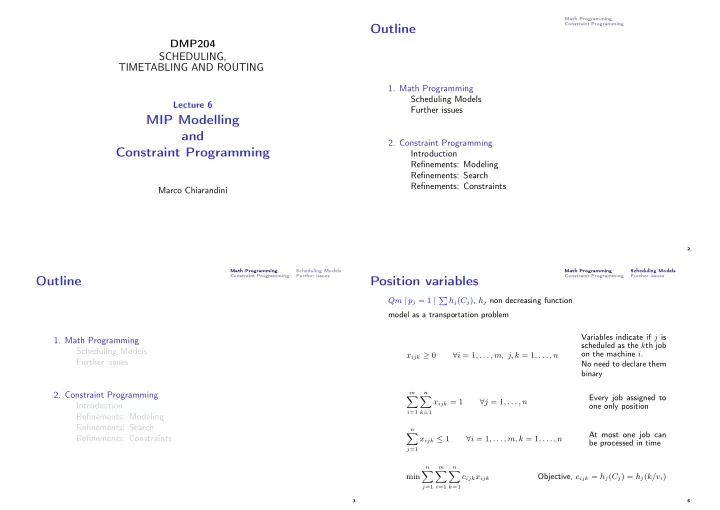
Math Programming Constraint Programming Outline DMP204 SCHEDULING, TIMETABLING AND ROUTING 1. Math Programming Scheduling Models Lecture 6 Further issues MIP Modelling and 2. Constraint Programming Constraint Programming Introduction


slide-1
SLIDE 1

DMP204 SCHEDULING, TIMETABLING AND ROUTING

Lecture 6

MIP Modelling and Constraint Programming

Marco Chiarandini

Math Programming Constraint Programming

Outline

  • 1. Math Programming

Scheduling Models Further issues

  • 2. Constraint Programming

Introduction Refinements: Modeling Refinements: Search Refinements: Constraints

2 Math Programming Constraint Programming Scheduling Models Further issues

Outline

  • 1. Math Programming

Scheduling Models Further issues

  • 2. Constraint Programming

Introduction Refinements: Modeling Refinements: Search Refinements: Constraints

3 Math Programming Constraint Programming Scheduling Models Further issues

Position variables

Qm | pj = 1 | P hj(Cj), hj non decreasing function model as a transportation problem xijk ≥ 0 ∀i = 1, . . . , m, j, k = 1, . . . , n Variables indicate if j is scheduled as the kth job

  • n the machine i.

No need to declare them binary

m

X

i=1 n

X

k=1

xijk = 1 ∀j = 1, . . . , n Every job assigned to

  • ne only position

n

X

j=1

xijk ≤ 1 ∀i = 1, . . . , m, k = 1, . . . , n At most one job can be processed in time min

n

X

j=1 m

X

i=1 n

X

k=1

cijkxijk Objective, cijk = hj(Cj) = hj(k/vi)

5

slide-2
SLIDE 2

Math Programming Constraint Programming Scheduling Models Further issues

Time indexed variables

1|rj| P wjCj Discretize time in t = 0, . . . , l, where l is upper bound xjt ∈ {0, 1} j = 1, . . . , n; t = 0, . . . , l Variables indicate if j starts at t

l

X

t=1

xjt = 1 ∀j = 1, . . . , n Every job starts at one point in time

n

X

j=1 t−1

X

s=max{t−pj,0}

xjs ≤ 1 ∀t = 0, . . . , l At most one job can be processed in time xjt = 0 ∀j = 1, . . . , n, t = 0, . . . , max{rj − 1, 0} Jobs cannot start be- fore their release dates min

n

X

j=1 l

X

t=0

wj(t + pj)xjs Objective

6 Math Programming Constraint Programming Scheduling Models Further issues

Sequencing variables

1|prec| P wjCj xjk ∈ {0, 1} j, k = 1, . . . , n Variables indicate if j precedes k xjj = 0 ∀j = 1, . . . , n xkj + xjk = 1 ∀j, k = 1, . . . , n, j = k Precedence constraints xkj + xlk + xjl ≥ 1 j, k, l = 1, . . . , n, j = k, k = l, j = l Precedence constraints min

n

X

j=1 n

X

k=1

wjpkxkj +

n

X

j=1

wjpj Objective

7 Math Programming Constraint Programming Scheduling Models Further issues

Real Variables

Disjunctive Programming

1|prec| P wjCj Disjunctive graph model made of conjunctive arcs A and disjunctive arcs I. Select disjunctive arcs such that the graph does not contain a cycle. xj ∈ R j = 1, . . . , n Variables denote com- pletion of job j xk − xj ≥ pk ∀j → k ∈ A precedence constraints conjunctive arcs xj ≥ pj ∀j = 1, . . . , n min processing time xk − xj ≥ pk

  • r

xj − xk ≥ pj ∀(i, j) ∈ I disjunctive constraints min

n

X

j=1

wjxj Objective

8 Math Programming Constraint Programming Scheduling Models Further issues

Linearizations

How to linearize these non linear functions? Disjunctive constraints min |a − b| min{max(a, b)} min maxi=1,...,m(cT

i x + di) piecewise-linear functions

10

slide-3
SLIDE 3

Math Programming Constraint Programming Scheduling Models Further issues

Constraint types

x binary, y general integer, z a continuous variable. a and b integer numbers; p, q, r, s real numbers

Specific domain propagation, preprocessing and cut generation exist for some of these constraints.

[Achterberg, T. Constraint Integer Programming Department of Mathematics, Phd Thesis, Technical University of Berlin, Germany, 2007]

11 Math Programming Constraint Programming Introduction Refinements: Modeling Refinements: Search Refinements: Constraints

Outline

  • 1. Math Programming

Scheduling Models Further issues

  • 2. Constraint Programming

Introduction Refinements: Modeling Refinements: Search Refinements: Constraints

12 Math Programming Constraint Programming Introduction Refinements: Modeling Refinements: Search Refinements: Constraints

Constraint Programming

Constraint Programming is about a formulation of the problem as a constraint satisfaction problem and about solving it by means of general or domain specific methods.

14 Math Programming Constraint Programming Introduction Refinements: Modeling Refinements: Search Refinements: Constraints

Constraint Satisfaction Problem

Input:

a set of variables X1, X2, . . . , Xn each variable has a non-empty domain Di of possible values a set of constraints. Each constraint Ci involves some subset of the variables and specifies the allowed combination of values for that subset. [A constraint C on variables Xi and Xj, C(Xi, Xj), defines the subset of the Cartesian product of variable domains Di × Dj of the consistent assignments of values to variables. A constraint C on variables Xi, Xj is satisfied by a pair of values vi, vj if (vi, vj) ∈ C(Xi, Xj).]

Task:

find an assignment of values to all the variables {Xi = vi, Xj = vj, . . .} such that it is consistent, that is, it does not violate any constraint

If assignments are not all equally good, but some are preferable this is reflected in an objective function.

15

slide-4
SLIDE 4

Math Programming Constraint Programming Introduction Refinements: Modeling Refinements: Search Refinements: Constraints

Solution Process

Standard search problem: initial state: the empty assignment {} in which all variables are unassigned successor function: a value can be assigned to any unassigned variable, provided that it does not conflict with previous assignments goal test: the current assignment is complete path cost: a constant cost for every step. Two fundamental issues: exploration of search tree constraint propagation (filtering)

at every node of the search tree, remove domain values that do not belong to a solution Repeat until nothing can be removed anymore

The search may be both complete and incomplete.

16 Math Programming Constraint Programming Introduction Refinements: Modeling Refinements: Search Refinements: Constraints

Types of Variables and Values

Discrete variables with finite domain: complete enumeration is O(dn) Discrete variables with infinite domains: Impossible by complete enumeration. Instead a constraint language (constraint logic programming and constraint reasoning) Eg, project planning. Sj + pj ≤ Sk NB: if only linear constraints, then integer linear programming Variables with continuous domains NB: if only linear constraints or convex functions then mathematical programming

17 Math Programming Constraint Programming Introduction Refinements: Modeling Refinements: Search Refinements: Constraints

Constraint Propagation

Definition A constraint C on the variables x1, . . . , xk is called domain consistent if for each variable xi and each value di ∈ D(xi) (i = 1, . . . , k), there exist a value dj ∈ D(xj) for all j = i such that (d1, . . . , dk) ∈ C. domain consistency = hyper-arc consistency or generalized-arc consistency Establishing domain consistency for binary constraints is inexpensive. For higher arity constraints the naive approach requires time that is exponential in the number of variables. Exploiting underlying structure of a constraint can sometimes lead to establish domain consistency much more efficiently.

18 Math Programming Constraint Programming Introduction Refinements: Modeling Refinements: Search Refinements: Constraints

Types of constraints

Unary constraints Binary constraints (constraint graph) Higher order (constraint hypergraph) Eg, alldiff(), among(), etc. Every higher order constraint can be reconduced to binary (you may need auxiliary constraints) Preference constraints cost on individual variable assignments

20

slide-5
SLIDE 5

Math Programming Constraint Programming Introduction Refinements: Modeling Refinements: Search Refinements: Constraints

General Purpose Algorithms

Search algorithms

  • rganize and explore the search tree

Search tree with branching factor at the top level nd and at the next level (n − 1)d. The tree has n! · dn leaves even if only dn possible complete assignments. Insight: CSP is commutative in the order of application of any given set of action (the order of the assignment does not influence) Hence we can consider search algs that generate successors by considering possible assignments for only a single variable at each node in the search tree. The tree has dn leaves. Backtracking search depth first search that chooses one variable at a time and backtracks when a variable has no legal values left to assign.

21 Math Programming Constraint Programming Introduction Refinements: Modeling Refinements: Search Refinements: Constraints

Backtrack Search

22 Math Programming Constraint Programming Introduction Refinements: Modeling Refinements: Search Refinements: Constraints

Backtrack Search

No need to copy solutions all the times but rather extensions and undo extensions Since CSP is standard then the alg is also standard and can use general purpose algorithms for initial state, successor function and goal test. Backtracking is uninformed and complete. Other search algorithms may use information in form of heuristics

23 Math Programming Constraint Programming Introduction Refinements: Modeling Refinements: Search Refinements: Constraints

General Purpose Backtracking

Implementation Refinements 1) Which variable should we assign next, and in what order should its values be tried? 2) What are the implications of the current variable assignments for the

  • ther unassigned variables?

3) When a path fails – that is, a state is reached in which a variable has no legal values can the search avoid repeating this failure in subsequent paths?

24

slide-6
SLIDE 6

Math Programming Constraint Programming Introduction Refinements: Modeling Refinements: Search Refinements: Constraints

1) Which variable should we assign next, and in what order should its values be tried? Select-Initial-Unassigned-Variable degree heuristic (reduces the branching factor) also used as tied breaker Select-Unassigned-Variable Most constrained variable (DSATUR) = fail-first heuristic = Minimum remaining values (MRV) heuristic (speeds up pruning) Order-Domain-Values least-constraining-value heuristic (leaves maximum flexibility for subsequent variable assignments) NB: If we search for all the solutions or a solution does not exists, then the ordering does not matter.

25 Math Programming Constraint Programming Introduction Refinements: Modeling Refinements: Search Refinements: Constraints

2) What are the implications of the current variable assignments for the

  • ther unassigned variables?

Propagating information through constraints Implicit in Select-Unassigned-Variable Forward checking (coupled with MRV) Constraint propagation (filtering)

arc consistency: force all (directed) arcs uv to be consistent: ∃ a value in D(v) : ∀ values in D(u), otherwise detects inconsistency can be applied as preprocessing or as propagation step after each assignment (MAC, Maintaining Arc Consistency) Applied repeatedly k-consistency: if for any set of k − 1 variables, and for any consistent assignment to those variables, a consistent value can always be assigned to any k-th variable. determining the appropriate level of consistency checking is mostly an empirical science.

26 Math Programming Constraint Programming Introduction Refinements: Modeling Refinements: Search Refinements: Constraints

Example: Arc Consistency Algorithm AC-3

27 Math Programming Constraint Programming Introduction Refinements: Modeling Refinements: Search Refinements: Constraints

3) When a path fails – that is, a state is reached in which a variable has no legal values can the search avoid repeating this failure in subsequent paths? Backtracking-Search chronological backtracking, the most recent decision point is revisited backjumping, backtracks to the most recent variable in the conflict set (set of previously assigned variables connected to X by constraints). every branch pruned by backjumping is also pruned by forward checking idea remains: backtrack to reasons of failure.

28

slide-7
SLIDE 7

Math Programming Constraint Programming Introduction Refinements: Modeling Refinements: Search Refinements: Constraints

An Empirical Comparison

Median number of consistency checks

29 Math Programming Constraint Programming Introduction Refinements: Modeling Refinements: Search Refinements: Constraints

The structure of problems

Decomposition in subproblems:

connected components in the constraint graph O(dcn/c) vs O(dn)

Constraint graphs that are tree are solvable in poly time by reverse arc-consistency checks. Reduce constraint graph to tree:

removing nodes (cutset conditioning: find the smallest cycle cutset. It is NP-hard but good approximations exist) collapsing nodes (tree decomposition) divide-and-conquer works well with small subproblems

30 Math Programming Constraint Programming Introduction Refinements: Modeling Refinements: Search Refinements: Constraints

Optimization Problems

Objective function F(X1, X2, . . . , Xn) Solve a modified Constraint Satisfaction Problem by setting a (lower) bound z∗ in the objective function Dichotomic search: U upper bound, L lower bound M = U + L 2 Reified constraints (more later)

31 Math Programming Constraint Programming Introduction Refinements: Modeling Refinements: Search Refinements: Constraints

CP Systems

Programming language + Systems The system typically includes built-in constraint propagation for various constraints (eg, linear, boolean, global constraints) general purpose algorithms for constraint propagation (arc consistency on finite domains) built-ins for constructing various forms of search Constraints are added to a constrain store to which various constraint solvers are attached. Constraint variables are unknowns in mathematical sense.

32

slide-8
SLIDE 8

Math Programming Constraint Programming Introduction Refinements: Modeling Refinements: Search Refinements: Constraints

Logic Programming

Logic programming is the use of mathematical logic for computer programming. First-order logic is used as a purely declarative representation language, and a theorem-prover or model-generator is used as the problem-solver. Syntax – Language

Alphabet Well-formed Expressions E.g., 4X + 3Y = 10; 2X - Y = 0

Semantics – Meaning

Interpretation Logical Consequence

Calculi – Derivation

Inference Rule Transition System

Logic programming supports the notion of logical variables

33 Math Programming Constraint Programming Introduction Refinements: Modeling Refinements: Search Refinements: Constraints

Logic Programming

Example: Prolog A logic program is a set of axioms, or rules, defining relationships between objects. A computation of a logic program is a deduction of consequences of the program. A program defines a set of consequences, which is its meaning.

[Sterling and Shapiro: The Art of Prolog, Page 1]

To deal with the other constraints one has to add other constraint solvers to the language. This led to Constraint Logic Programming

34 Math Programming Constraint Programming Introduction Refinements: Modeling Refinements: Search Refinements: Constraints

A Puzzle Example

SEND + MORE = MONEY Two representations The first yields initially a weaker constraint propagation. The tree has 23 nodes and the unique solution is found after visiting 19 nodes The second representation has a tree with 29 nodes and the unique solution is found after visiting 23 nodes However for the puzzle GERALD + DONALD = ROBERT the situation is

  • reverse. The first has 16651 nodes and 13795 visits while the second has

869 nodes and 791 visits Finding the best model is an empirical science

36 Math Programming Constraint Programming Introduction Refinements: Modeling Refinements: Search Refinements: Constraints

Guidelines

Rules of thumbs for modelling (to take with a grain of salt): use representations that involve less variables and simpler constraints for which constraint propagators are readily available use constraint propagation techniques that require less preprocessing (ie, the introduction of auxiliary variables) since they reduce the search space better. Disjunctive constraints may lead to an inefficient representation since they can generate a large search space. use global constraints (see below)

37

slide-9
SLIDE 9

Math Programming Constraint Programming Introduction Refinements: Modeling Refinements: Search Refinements: Constraints

Randomization in Search Tree

Dynamical selection of solution components in construction or choice points in backtracking. Randomization of construction method or selection of choice points in backtracking while still maintaining the method complete randomized systematic search. Randomization can also be used in incomplete search

39 Math Programming Constraint Programming Introduction Refinements: Modeling Refinements: Search Refinements: Constraints

Incomplete Search

http: //4c.ucc.ie/~hsimonis/visualization/techniques/partial_search/main.htm

40 Math Programming Constraint Programming Introduction Refinements: Modeling Refinements: Search Refinements: Constraints

Incomplete Search

Credit-based search Key idea: important decisions are at the top of the tree Credit = backtracking steps Credit distribution: one half at the best child the other divided among the other children. When credits run out follow deterministic best-search In addition: allow limited backtracking steps (eg, 5) at the bottom Control parameters: initial credit, the distribution of credit among the children, and the amount of local backtracking at the bottom.

41 Math Programming Constraint Programming Introduction Refinements: Modeling Refinements: Search Refinements: Constraints

Incomplete Search

Limited Discrepancy Search (LDS) Key observation that often the heuristic used in the search is nearly always correct with just a few exceptions. Explore the tree in increasing number of discrepancies, modifications from the heuristic choice. Eg: count one discrepancy if second best is chosen count two discrepancies either if third best is chosen or twice the second best is chosen Control parameter: the number

  • f discrepancies

42

slide-10
SLIDE 10

Math Programming Constraint Programming Introduction Refinements: Modeling Refinements: Search Refinements: Constraints

Incomplete Search

Barrier Search Extension of LDS Key idea: we may encounter several, independent problems in our heuristic choice. Each of these problems can be

  • vercome locally with a limited

amount of backtracking. At each barrier start LDS-based backtracking

43 Math Programming Constraint Programming Introduction Refinements: Modeling Refinements: Search Refinements: Constraints

Local Search for CSP

Uses a complete-state formulation: a value assigned to each variable (randomly) Changes the value of one variable at a time Min-conflicts heuristic is effective particularly when given a good initial state. Run-time independent from problem size Possible use in online settings in personal assignment: repair the schedule with a minimum number of changes

44 Math Programming Constraint Programming Introduction Refinements: Modeling Refinements: Search Refinements: Constraints

Handling special constraints

Higher order constraints

Definition Global constraints are complex constraints that are taken care of by means of a special purpose algorithm. Modelling by means of global constraints is more efficient than relying on the general purpose constraint propagator. Examples: alldiff

for m variables and n values cannot be satisfied if m > n, consider first singleton variables propagation based on bipartite matching considerations

46