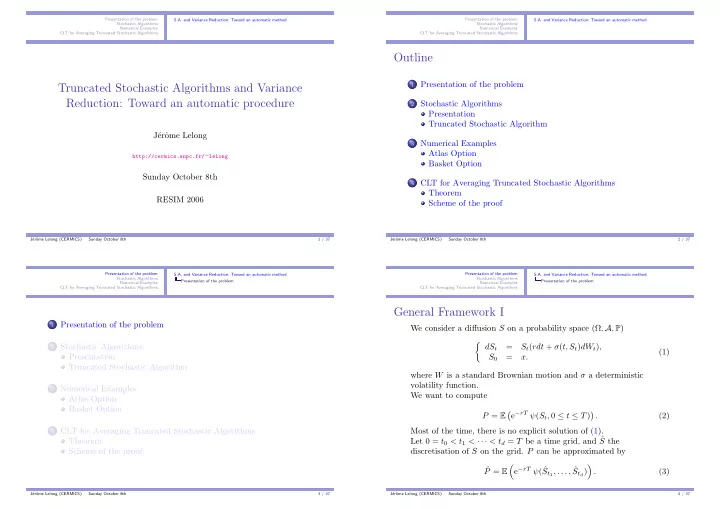
Outline 1 Presentation of the problem Truncated Stochastic - - PowerPoint PPT Presentation

outline
SMART_READER_LITE
LIVE PREVIEW

Outline 1 Presentation of the problem Truncated Stochastic - - PowerPoint PPT Presentation

Presentation of the problem Presentation of the problem S.A. and Variance Reduction: Toward an automatic method S.A. and Variance Reduction: Toward an automatic method Stochastic Algorithms Stochastic Algorithms Numerical Examples Numerical


slide-1
SLIDE 1

Presentation of the problem Stochastic Algorithms Numerical Examples CLT for Averaging Truncated Stochastic Algorithms S.A. and Variance Reduction: Toward an automatic method

Truncated Stochastic Algorithms and Variance Reduction: Toward an automatic procedure

J´ erˆ

  • me Lelong

http://cermics.enpc.fr/∼lelong

Sunday October 8th RESIM 2006

J´ erˆ

  • me Lelong (CERMICS)

Sunday October 8th 1 / 37 Presentation of the problem Stochastic Algorithms Numerical Examples CLT for Averaging Truncated Stochastic Algorithms S.A. and Variance Reduction: Toward an automatic method

Outline

1 Presentation of the problem 2 Stochastic Algorithms

Presentation Truncated Stochastic Algorithm

3 Numerical Examples

Atlas Option Basket Option

4 CLT for Averaging Truncated Stochastic Algorithms

Theorem Scheme of the proof

J´ erˆ

  • me Lelong (CERMICS)

Sunday October 8th 2 / 37 Presentation of the problem Stochastic Algorithms Numerical Examples CLT for Averaging Truncated Stochastic Algorithms S.A. and Variance Reduction: Toward an automatic method Presentation of the problem

1 Presentation of the problem 2 Stochastic Algorithms

Presentation Truncated Stochastic Algorithm

3 Numerical Examples

Atlas Option Basket Option

4 CLT for Averaging Truncated Stochastic Algorithms

Theorem Scheme of the proof

J´ erˆ

  • me Lelong (CERMICS)

Sunday October 8th 3 / 37 Presentation of the problem Stochastic Algorithms Numerical Examples CLT for Averaging Truncated Stochastic Algorithms S.A. and Variance Reduction: Toward an automatic method Presentation of the problem

General Framework I

We consider a diffusion S on a probability space (Ω, A, P) dSt = St(rdt + σ(t, St)dWt), S0 = x. (1) where W is a standard Brownian motion and σ a deterministic volatility function. We want to compute P = E

  • e−rT ψ(St, 0 ≤ t ≤ T )
  • .

(2) Most of the time, there is no explicit solution of (1). Let 0 = t0 < t1 < · · · < td = T be a time grid, and ˆ S the discretisation of S on the grid. P can be approximated by ˆ P = E

  • e−rT ψ( ˆ

St1, . . . , ˆ Std)

  • .

(3)

J´ erˆ

  • me Lelong (CERMICS)

Sunday October 8th 4 / 37

slide-2
SLIDE 2

Presentation of the problem Stochastic Algorithms Numerical Examples CLT for Averaging Truncated Stochastic Algorithms S.A. and Variance Reduction: Toward an automatic method Presentation of the problem

General Framework II

Using standard discretisation schemes, it is quite easy to see that ψ( ˆ St1, . . . , ˆ Std) can be expressed in terms of the Brownian increments. Equation (3) has an equivalent form ˆ P = E(φ(G)) (4) where G is a d−dimensional Gaussian vector with identity covariance matrix. Expectation in (4) will be computed using Monte Carlo simulations. The prize is to improve the convergence of the Monte Carlo procedure. We focus on Importance Sampling.

J´ erˆ

  • me Lelong (CERMICS)

Sunday October 8th 5 / 37 Presentation of the problem Stochastic Algorithms Numerical Examples CLT for Averaging Truncated Stochastic Algorithms S.A. and Variance Reduction: Toward an automatic method Presentation of the problem

Importance Sampling I

An elementary change of variables in the expectation enables to change the mean of G to obtain ˆ P = E

  • φ(G + θ) e−θ·G− θ2

2

  • (5)

for any θ ∈ Rd. {Xθ = φ(G + θ) e−θ·G− θ2

2 ; θ ∈ Rd} is of constant expectation.

Find the parameter θ⋆ that minimises Var(Xθ) rare event simulation : consider φ(G) = (x eσG −K)+ with x ≪ K, P({φ(G) > 0}) may be really small. Centering G + θ around 1

σ ln(K/x) makes P({φ(G) > 0}) ≈ P({φ(G) = 0}).

J´ erˆ

  • me Lelong (CERMICS)

Sunday October 8th 6 / 37 Presentation of the problem Stochastic Algorithms Numerical Examples CLT for Averaging Truncated Stochastic Algorithms S.A. and Variance Reduction: Toward an automatic method Presentation of the problem

Importance Sampling II

The variance V is given by V (θ) = E

  • φ(G + θ)2 e−2θ·G−θ2

= E

  • φ(G)2 e−θ·G+ θ2

2

  • .

V is strictly convex and differentiable without any particular assumptions on ψ, θ⋆ is also defined as the unique root of ∇V ∇V (θ) = E

  • (θ − G)φ(G)2 e−θ·G+ θ2

2

  • = E(U(θ, G)).

= ⇒ Try to construct a procedure to approximate θ⋆. (First introduced by Arouna [Arouna, 2004]).

J´ erˆ

  • me Lelong (CERMICS)

Sunday October 8th 7 / 37 Presentation of the problem Stochastic Algorithms Numerical Examples CLT for Averaging Truncated Stochastic Algorithms S.A. and Variance Reduction: Toward an automatic method Stochastic Algorithms

1 Presentation of the problem 2 Stochastic Algorithms

Presentation Truncated Stochastic Algorithm

3 Numerical Examples

Atlas Option Basket Option

4 CLT for Averaging Truncated Stochastic Algorithms

Theorem Scheme of the proof

J´ erˆ

  • me Lelong (CERMICS)

Sunday October 8th 8 / 37

slide-3
SLIDE 3

Presentation of the problem Stochastic Algorithms Numerical Examples CLT for Averaging Truncated Stochastic Algorithms S.A. and Variance Reduction: Toward an automatic method Stochastic Algorithms Presentation

Stochastic Algorithms I

Gn i.i.d. ∼ G. γn>0, γn = ∞, γ2

n < ∞.

For θ0 ∈ Rd, θn+1 = θn − γn+1U(θn, Gn+1). This algorithm quickly fails because θ − → E(U(θ, G)2) increases much faster than θ2. Need of a more elaborate algorithm.

J´ erˆ

  • me Lelong (CERMICS)

Sunday October 8th 9 / 37 Presentation of the problem Stochastic Algorithms Numerical Examples CLT for Averaging Truncated Stochastic Algorithms S.A. and Variance Reduction: Toward an automatic method Stochastic Algorithms Truncated Stochastic Algorithm

Truncated Stochastic Algorithm

Consider an increasing sequence of compact sets (Kj)j such that ∞

j=0 Kj = Rd.

Consider (Gn)n and (γn)n as defined previously. Prevent the algorithm from blowing up: At each step, θn should remain in a given compact set. If such is not the case, reset the algorithm and consider a larger compact set. This is due to Chen (see [Chen and Zhu, 1986]).

J´ erˆ

  • me Lelong (CERMICS)

Sunday October 8th 10 / 37 Presentation of the problem Stochastic Algorithms Numerical Examples CLT for Averaging Truncated Stochastic Algorithms S.A. and Variance Reduction: Toward an automatic method Stochastic Algorithms Truncated Stochastic Algorithm

+

θ⋆ Kσn Kσn+1

+

θn

+

θ0

+

θn+1 =θn+ 1

2

= Kσn+1

+

θn+ 1

2

θn+1 = = Kσn+1

J´ erˆ

  • me Lelong (CERMICS)

Sunday October 8th 11 / 37 Presentation of the problem Stochastic Algorithms Numerical Examples CLT for Averaging Truncated Stochastic Algorithms S.A. and Variance Reduction: Toward an automatic method Stochastic Algorithms Truncated Stochastic Algorithm

For θ0 ∈ K0 and σ0 = 0, we define (θn)n and (σn)n      θn+ 1

2 = θn − γn+1U(θn, Zn+1),

if θn+ 1

2 ∈ Kσn

θn+1 = θn+ 1

2

and σn+1 = σn, if θn+ 1

2 /

∈ Kσn θn+1 = θ0 and σn+1 = σn + 1. (6) σn counts the number of truncations up to time n. Fn = σ(Gk; k ≤ n). θn is Fn−measurable and Gn+1 is independent of Fn.

J´ erˆ

  • me Lelong (CERMICS)

Sunday October 8th 12 / 37

slide-4
SLIDE 4

Presentation of the problem Stochastic Algorithms Numerical Examples CLT for Averaging Truncated Stochastic Algorithms S.A. and Variance Reduction: Toward an automatic method Stochastic Algorithms Truncated Stochastic Algorithm

Averaging version I

For some t > 0, we introduce ˆ θn(t) = γn t

n+⌊t/γn⌋

  • i=n

θi. (7) where the step sequence is of the form γn =

γ (n+1)α where

1/2 < α < 1.

Theorem 1

If there exists δ > 0 such that E |φ(G)|4+4δ < ∞, the sequence ˆ θn(t) defined by (7) converges a.s. to θ⋆ for any t > 0. Conversely to Arouna, Theorem (1) is true for any increasing sequence of compact sets (Kj)j. Great improvement for practical issues.

J´ erˆ

  • me Lelong (CERMICS)

Sunday October 8th 13 / 37 Presentation of the problem Stochastic Algorithms Numerical Examples CLT for Averaging Truncated Stochastic Algorithms S.A. and Variance Reduction: Toward an automatic method Numerical Examples

1 Presentation of the problem 2 Stochastic Algorithms

Presentation Truncated Stochastic Algorithm

3 Numerical Examples

Atlas Option Basket Option

4 CLT for Averaging Truncated Stochastic Algorithms

Theorem Scheme of the proof

J´ erˆ

  • me Lelong (CERMICS)

Sunday October 8th 14 / 37 Presentation of the problem Stochastic Algorithms Numerical Examples CLT for Averaging Truncated Stochastic Algorithms S.A. and Variance Reduction: Toward an automatic method Numerical Examples Atlas Option

Atlas Option

Consider a basket of 16 stocks. At maturity time, remove the stocks with the three best and the three worst performances. It pays off 105% of the average of the remaining stocks.

basket size : 16 maturity time : 10 interest rate : 0.02 volatility : 0.2 step size : 1 Sample Number : 10000 (standard MC) 5000 (importance sampling)

J´ erˆ

  • me Lelong (CERMICS)

Sunday October 8th 15 / 37 Presentation of the problem Stochastic Algorithms Numerical Examples CLT for Averaging Truncated Stochastic Algorithms S.A. and Variance Reduction: Toward an automatic method Numerical Examples Atlas Option

400 800 1200 1600 2000 2400 −0.11 −0.07 −0.03 0.01 0.05 0.09 0.13 0.17 0.21

Figure: Approximation of the drift vector with averaging

1e3 2e3 3e3 4e3 5e3 −0.11 −0.07 −0.03 0.01 0.05 0.09 0.13 0.17 0.21

Figure: Approximation of the drift vector without averaging

J´ erˆ

  • me Lelong (CERMICS)

Sunday October 8th 16 / 37

slide-5
SLIDE 5

Presentation of the problem Stochastic Algorithms Numerical Examples CLT for Averaging Truncated Stochastic Algorithms S.A. and Variance Reduction: Toward an automatic method Numerical Examples Atlas Option

1e3 2e3 3e3 4e3 5e3 6e3 7e3 8e3 9e3 10e3 0.85 0.87 0.89 0.91 0.93 0.95 0.97 0.99 1.01 1.03 1.05

Figure: Evolution of the standard Monte Carlo simulation

variance 0.240096

1e3 2e3 3e3 4e3 5e3 0.85 0.87 0.89 0.91 0.93 0.95 0.97 0.99 1.01 1.03 1.05

Figure: Evolution of the Monte Carlo simulation with importance sampling

variance 0.004460

J´ erˆ

  • me Lelong (CERMICS)

Sunday October 8th 17 / 37 Presentation of the problem Stochastic Algorithms Numerical Examples CLT for Averaging Truncated Stochastic Algorithms S.A. and Variance Reduction: Toward an automatic method Numerical Examples Basket Option

Basket Option

Payoff N

  • i=1

λiSi

T − K

  • +

.

  • ption size 5

strike 200 initial value 50 40 60 30 55 maturity 1 volatility 0.2 interest rate 0.05 correlation 0.8 payoff coefficients 1 1 1 1 1 step size 0.01 Sample Number 5000

J´ erˆ

  • me Lelong (CERMICS)

Sunday October 8th 18 / 37 Presentation of the problem Stochastic Algorithms Numerical Examples CLT for Averaging Truncated Stochastic Algorithms S.A. and Variance Reduction: Toward an automatic method Numerical Examples Basket Option

400 800 1200 1600 2000 2400 −0.1 0.1 0.3 0.5 0.7

Figure: Approximation of the drift vector with averaging

1e3 2e3 3e3 4e3 5e3 −0.5 −0.1 0.3 0.7 1.1

Figure: Approximation of the drift vector without averaging

The variance is divided by 10 compared with standard Monte Carlo.

J´ erˆ

  • me Lelong (CERMICS)

Sunday October 8th 19 / 37 Presentation of the problem Stochastic Algorithms Numerical Examples CLT for Averaging Truncated Stochastic Algorithms S.A. and Variance Reduction: Toward an automatic method Numerical Examples Basket Option

Robustness of averaging algorithms

We consider the previous example and compare the convergence of the averaging and non-averaging version of the truncated algorithm for a fixed number of iterations. We extract the first component of the drift.

4e3 8e3 12e3 16e3 20e3 24e3 0.2 0.4 0.6 0.8 γ = 1 γ = 0.1 γ = 0.01 γ = 0.5

Figure: Robustness of the averaging algorithm

J´ erˆ

  • me Lelong (CERMICS)

Sunday October 8th 20 / 37

slide-6
SLIDE 6

Presentation of the problem Stochastic Algorithms Numerical Examples CLT for Averaging Truncated Stochastic Algorithms S.A. and Variance Reduction: Toward an automatic method Numerical Examples Basket Option

Non averaging

1e4 2e4 3e4 4e4 5e4 −1 1 2 gamma=0.01 gamma=0.1 gamma=0.5

Figure: Non robustness of the non averaging algorithm

J´ erˆ

  • me Lelong (CERMICS)

Sunday October 8th 21 / 37 Presentation of the problem Stochastic Algorithms Numerical Examples CLT for Averaging Truncated Stochastic Algorithms S.A. and Variance Reduction: Toward an automatic method CLT for Averaging Truncated Stochastic Algorithms

1 Presentation of the problem 2 Stochastic Algorithms

Presentation Truncated Stochastic Algorithm

3 Numerical Examples

Atlas Option Basket Option

4 CLT for Averaging Truncated Stochastic Algorithms

Theorem Scheme of the proof

J´ erˆ

  • me Lelong (CERMICS)

Sunday October 8th 22 / 37 Presentation of the problem Stochastic Algorithms Numerical Examples CLT for Averaging Truncated Stochastic Algorithms S.A. and Variance Reduction: Toward an automatic method CLT for Averaging Truncated Stochastic Algorithms Theorem

It is often more convenient to rewrite (6) as follows θn+1 = θn − γn+1∇V (θn)

  • Newton algorithm

− γn+1δMn+1

  • noise term
  • standard Robbins Monro algorithm

+ γn+1pn+1

  • truncation term

(8) where δMn+1 = U(θn, Zn+1) − ∇V (θn), and pn+1 =

  • u(θn) + δMn+1 +

1 γn+1 (θ0 − θn)

if θn+ 1

2 /

∈ Kσn,

  • therwise.

δMn is a martingale increment, pn is the truncation term.

J´ erˆ

  • me Lelong (CERMICS)

Sunday October 8th 23 / 37 Presentation of the problem Stochastic Algorithms Numerical Examples CLT for Averaging Truncated Stochastic Algorithms S.A. and Variance Reduction: Toward an automatic method CLT for Averaging Truncated Stochastic Algorithms Theorem

Convergence Rate I

We are interested in the convergence of the renormalised iterates centred about its limit ˆ ∆n(t) = ˆ θn(t) − θ⋆ √γn .

Hypothesis 1

Hypotheses on function ∇V There exists a function y : Rd → Rd×d satisfying limx→0 y(x) = 0 and a symmetric definite positive matrix A such that ∇V (θ) = A(θ − θ⋆) + y(θ − θ⋆)(θ − θ⋆).

J´ erˆ

  • me Lelong (CERMICS)

Sunday October 8th 24 / 37

slide-7
SLIDE 7

Presentation of the problem Stochastic Algorithms Numerical Examples CLT for Averaging Truncated Stochastic Algorithms S.A. and Variance Reduction: Toward an automatic method CLT for Averaging Truncated Stochastic Algorithms Theorem

Convergence Rate II

Hypothesis 2

There exist two real numbers ρ > 0 and η > 0 such that κ = sup

n E

  • δMn2+ρ 1θn−1−θ⋆≤η
  • < ∞.

There exists a symmetric definite positive matrix Σ such that E (δMnδM ′

n|Fn−1) 1θn−1−θ⋆≤η P

− − − − →

n→∞ Σ.

Hypothesis 3

There exists µ > 0 such that ∀n ≥ 0 d(θ⋆, ∂Kn) > µ.

J´ erˆ

  • me Lelong (CERMICS)

Sunday October 8th 25 / 37 Presentation of the problem Stochastic Algorithms Numerical Examples CLT for Averaging Truncated Stochastic Algorithms S.A. and Variance Reduction: Toward an automatic method CLT for Averaging Truncated Stochastic Algorithms Theorem

Convergence Rate III

Theorem 2

For γn =

γ (n+1)α with 1/2 < α < 1 and under Hypotheses 1, 2 and 3,

the sequence ˆ ∆n(t) converges in distribution to a normally distributed random variable with mean 0 and variance ˆ V = 1 t A−1ΣA−1 + A−2(e−At − I)V + V A−2(e−At − I) t2 where V = ∞ e−AuΣe−Audu.

J´ erˆ

  • me Lelong (CERMICS)

Sunday October 8th 26 / 37 Presentation of the problem Stochastic Algorithms Numerical Examples CLT for Averaging Truncated Stochastic Algorithms S.A. and Variance Reduction: Toward an automatic method CLT for Averaging Truncated Stochastic Algorithms Scheme of the proof

Scheme of the proof

We introduce ∆n = θn − θ⋆ √γn . ˆ ∆n(t) can be rewritten ˆ ∆n(t) = √γn t

n+⌊t/γn⌋

  • i=n

∆i √γi. Since γn =

γ (n+1)α with α < 1, √γiγn ∼ γi.

Hence, ˆ ∆n(t) = 1 t

n+⌊t/γn⌋

  • i=n

∆iγi. To prove Theorem 2, one needs to caracterise the limit law of (∆n, · · · , ∆n+⌊t/γn⌋). = ⇒ Need of a functional result.

J´ erˆ

  • me Lelong (CERMICS)

Sunday October 8th 27 / 37 Presentation of the problem Stochastic Algorithms Numerical Examples CLT for Averaging Truncated Stochastic Algorithms S.A. and Variance Reduction: Toward an automatic method CLT for Averaging Truncated Stochastic Algorithms Scheme of the proof

A functional CLT for Chen’s algorithm I

For any integers k and n, we define sn,k =

n+k−1

  • i=n

γi with sn,0 = 0. For each fixed n > 0, Sn = (sn,k)k≥0 defines a discretisation grid of [0, ∞) with decreasing stepsize γn+k.

+ + + + + + +

sn,1 sn,2 sn,p

We define ∆n(·) as the piecewise constant interpolation of (∆n+k)k on the grid Sn. More precisely, ∆n(0) = ∆n and ∆n(t) = ∆n+k if t ∈ [sn,k, sn,k+1). (9)

J´ erˆ

  • me Lelong (CERMICS)

Sunday October 8th 28 / 37

slide-8
SLIDE 8

Presentation of the problem Stochastic Algorithms Numerical Examples CLT for Averaging Truncated Stochastic Algorithms S.A. and Variance Reduction: Toward an automatic method CLT for Averaging Truncated Stochastic Algorithms Scheme of the proof

A functional CLT for Chen’s algorithm II

θn(·) is defined similarly. We also introduce Wn(.) Wn(0) = 0 and Wn(t) =

n+k

  • i=n+1

√γiδMi if t ∈ [sn,k, sn,k+1). (10)

Theorem 3

Assume the Hypotheses of Theorem 2. (∆n(·), Wn(·))

D×D

= = = ⇒ (∆, W)

  • n any finite time interval

where ∆ is a stationary Ornstein Uhlenbeck process of initial law N(0, V ) and W a Wiener process F∆,W −measurable with covariance matrix Σ.

scheme of the proof J´ erˆ

  • me Lelong (CERMICS)

Sunday October 8th 29 / 37 Presentation of the problem Stochastic Algorithms Numerical Examples CLT for Averaging Truncated Stochastic Algorithms S.A. and Variance Reduction: Toward an automatic method CLT for Averaging Truncated Stochastic Algorithms Scheme of the proof

Numerical Illustration

−0.7 −0.3 0.1 0.5 0.9 0.2 0.4 0.6 0.8 1.0 1.2 1.4 −0.7 −0.3 0.1 0.5 0.9 0.2 0.4 0.6 0.8 1.0 1.2 1.4

Figure: density of the renormalised error for the Atlas option

J´ erˆ

  • me Lelong (CERMICS)

Sunday October 8th 30 / 37 Presentation of the problem Stochastic Algorithms Numerical Examples CLT for Averaging Truncated Stochastic Algorithms S.A. and Variance Reduction: Toward an automatic method CLT for Averaging Truncated Stochastic Algorithms Scheme of the proof

1 Presentation of the problem 2 Stochastic Algorithms

Presentation Truncated Stochastic Algorithm

3 Numerical Examples

Atlas Option Basket Option

4 CLT for Averaging Truncated Stochastic Algorithms

Theorem Scheme of the proof

J´ erˆ

  • me Lelong (CERMICS)

Sunday October 8th 31 / 37 Proof of Theorems Tightness S.A. and Variance Reduction: Toward an automatic method Proof of Theorems

a.s convergence of Chen’s procedure

Theorem 4

If For all p > 0, the series

n γn+1δMn+11θn≤p converges a.s, then

the sequence (θn)n defined by (6) converges a.s. to θ⋆ and the sequence (σn)n is a.s. finite. The integrability condition is satisfied as soon as u and θ − → E[U(θ, Z)2] are bounded on any compact sets (or continuous).

Hint

A proof of this theorem can be found in [Delyon, 1996].

J´ erˆ

  • me Lelong (CERMICS)

Sunday October 8th 32 / 37

slide-9
SLIDE 9

Proof of Theorems Tightness S.A. and Variance Reduction: Toward an automatic method Proof of Theorems

Comments on Integrability

Mn is a martingale Mn =

n

  • i=1

γiδMi1θi−1≤p, E (Mn|Fn−1) = Mn−1 + γn1θn−1≤pE (δMn|Fn−1) . if supnMn < ∞ then Mn converges a.s. Mn =

n

  • i=1

γ2

i E(δM 2 i |Fi−1)1θi−1≤p.

E(δM 2

i |Fi−1)

= E

  • U(θ, Z)2

|θ=θi−1 − ∇(θi−1)2

≤ E

  • U(θ, Z)2

|θ=θi−1 .

J´ erˆ

  • me Lelong (CERMICS)

Sunday October 8th 33 / 37 Proof of Theorems Tightness S.A. and Variance Reduction: Toward an automatic method Proof of Theorems

Major steps

∆n is tight in R.

Tightness

Use a localisation technique to prove that (supt∈[0,T ] ∆n(t))n is tight. Prove a Donsker Theorem for martingales increment.

Theorem

∆n(·) satisfies Aldous’ criteria.

Tightness in D

(Wn(·), ∆n(·))n is tight in D × D and converges in law to (W, ∆) where W is a Wiener process with respect to the smallest σ−algebra that measures (W(·), ∆(·)) with covariance matrix Σ and ∆ is the stationary solution of d∆(t) = −Q∆(t)dt − dW(t).

J´ erˆ

  • me Lelong (CERMICS)

Sunday October 8th 34 / 37 Proof of Theorems Tightness S.A. and Variance Reduction: Toward an automatic method Proof of Theorems

Donsker’s Theorem for martingales increments

Theorem 5

Let (Mn(t))n be a sequence of martingales. Assume that (Mn(·))n is tight in D and satisfies a C−tightness criteria. (Mn(t))n is a uniformly square integrable family for each t. Mnt

P

− →

n t

Then, Mn(·)

D[0,T ]

= = = = ⇒

n

B.M. Wn(t) satisfies Theorem 5.

J´ erˆ

  • me Lelong (CERMICS)

Sunday October 8th 35 / 37 Proof of Theorems Tightness S.A. and Variance Reduction: Toward an automatic method Tightness Tightness in R

Tightness in R

A sequence of real valued r.v. Yn is said to be tight if ∀ε > 0, ∃K, P(|Yn| < K) > 1 − ε ∀n > 0. If such a condition holds, then from any subsequence one can extract a further subsequence which converges in distribution. Conversely, any weak converging sequence is tight. See [Billingsley, 1968] for details on convergence of probability measures.

J´ erˆ

  • me Lelong (CERMICS)

Sunday October 8th 36 / 37

slide-10
SLIDE 10

Proof of Theorems Tightness S.A. and Variance Reduction: Toward an automatic method Tightness Tightness in Skorokhod’s space

Tightness in Skorokhod’s space

Aldous’ criteria: ∀ η > 0, ∀ε > 0, ∃0 < δ < 1 such that lim sup

n

sup

  • P (Xn(τ) − Xn(S) ≥ η) ; S and τ s.t. in [0, 1],

S ≤ τ ≤ (S + δ) ∧ 1

  • ≤ ε.

if (Xn(·)) satisfies Aldous’ criteria and (Xn(t)∞)n is tight in R, then Xn(·) is tight in D[0, 1]. Kolmogorov’s criteria (C− tightness) ∃α > 0, β > 0, ∀(t, s) ∈ [0, 1]2 E(Xn(t) − Xn(s)α) ≤ κ |t − s|1+β . if (Xn(·)) satisfies Kolmogorov’s criteria and (Xn(t)∞)n is tight in R, then (Xn(·)) is tight D[0, 1] and any converging subsequence converges in distribution to a continuous process.

J´ erˆ

  • me Lelong (CERMICS)

Sunday October 8th 37 / 37 Proof of Theorems Tightness S.A. and Variance Reduction: Toward an automatic method Tightness Tightness in Skorokhod’s space

Arouna, B. (Winter 2003/2004). Robbins-monro algorithms and variance reduction in finance. The Journal of Computational Finance, 7(2). Billingsley, P. (1968). Convergence of Probability Measures. Wiley, New York. Chen, H. and Zhu, Y. (1986). Stochastic Approximation Procedure with randomly varying truncations. Scientia Sinica Series. Delyon, B. (1996). General results on the convergence of stochastic algorithms. IEEE Transactions on Automatic Control, 41(9):1245–1255.

J´ erˆ

  • me Lelong (CERMICS)

Sunday October 8th 37 / 37