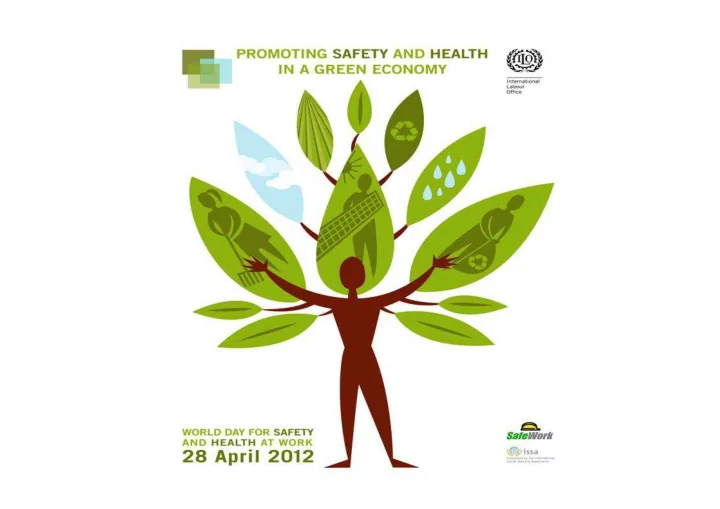
OUTLINE B- Waste management and recycling I- A safe and just - - PowerPoint PPT Presentation
OUTLINE B- Waste management and recycling I- A safe and just transition? Global challenges for sustainable 1. Shipbreaking development C- OSH risks in the greening of traditional sectors II- The green debate and its social dimension Mining
2
OUTLINE
I- A safe and just transition? Global challenges for sustainable development II- The green debate and its social dimension III- The shades of green in green jobs
- IV. Green jobs and occupational risks
A- Occupational risks in renewable energies
1.
Solar energy
2.
Wind energy
3.
Hydropower
4.
Bioenergy
B- Waste management and recycling
- 1. Shipbreaking
C- OSH risks in the greening of traditional sectors
1.
Mining and extractive technologies
2.
Agriculture
3.
Forestry work
4.
Construction and refurbishment
V- The way ahead
3
I- A Safe and just transition?
Global challenges for sustainable development
climate change + deterioration of natural resources
- built on economic growth, social equity & environmental
protection
Green Economy Green Jobs Decent & Safe
Work
4
II- The green debate and its social dimension
- ILO Focus for RIO +20 (UNCSD 2012):
- economically efficient, socially just,
environmentally sound transition to a green economy
- green jobs creation
- a framework for a “Just Transition”
- social protection in green economy
policies
- inclusion of workers and employers in
governance & implementation
5
- III. The shades of green in green jobs
Protection of biodiversity
and the environment
Resource efficiency and
low-carbon development in “green sectors”
“Greening” industries
renewable energy construction transport recycling forestry, & agriculture
6
IV- Green jobs and occupational risks
A.
Occupational risks in renewable energy
1.
Solar energy
2.
Wind energy
3.
Hydropower
4.
Bioenergy
7
- 1. Solar Energy
Converted to electricity using PVP¹ or CSP² PVP occupational hazards manufacturing (> 15 hazardous materials+ toxic cleaning
agents)
installation (Physical hazards: Falls from height, manual
handling, high temp, confined spaces, electrocution)
end of life electronic waste disposal of PVPs CSP hazards in construction and maintenance of installations
8
- 2. Wind Energy
Types of jobs project development, turbine component manufacturing,
construction, installation, operation and maintenance of wind turbines
Worker exposure chemical hazards and solvents harmful gases, vapours, physical hazards dusts and fumes
health related consequences
dermatitis, liver & kidney damage, blisters, chemical burns,
and reproductive effects & MSDs
9
- 3. Hydropower
Important renewable energy for electrical power
production
Small-scale hydropower vs. large hydropower
stations
Hazards during construction, operation +
maintenance
Electrical, water and moving machinery hazards Chemical exposure
10
- 4. Bioenergy
Fast development of bioenergy Impact of using land to grow energy crops Same OSH & environmental concerns as in fossil
fuels
during thermal processing: Exposure to carcinogens, heavy
metals & gases, particulate matter, CO, SO, lead, VOC, mercury & dioxins.
11
- B. Waste management and recycling
Fastest growing source of
green employment
Hazards and risks from
- recycling technologies
- waste to energy process
- landfill mining
- electronic waste
Involves workers in the
informal economy
12
The waste hierarchy
The waste hierarchy. Being wise to waste. EC, 2010
13
- B. Waste management and recycling
(Cont’d)
Shipbreaking
found 90% in Bangladesh, China, India, Pakistan & Turkey green job? recycles metal, reduces need for mining Hazards
exposure to hazardous substances & wastes (asbestos, oil &
- il sludge, toxic paints, PCBs, isocyanides, sulphuric acid, lead
& mercury)
physical, mechanical, biological, ergonomic, psychosocial
14
C- OSH risks in the greening of traditional sectors
- 1. Mining and extractive technologies
- 2. Agriculture
- 3. Forestry work
- 4. Construction and refurbishment
15
- 2. Mining and extractive technologies
Environmental impact:
green-house gases, soil and water contaminants
Occupational risks:
fires & explosions, electrocutions, exposure to silica dust,
mercury, other chemicals & heat
Mine project design:
- ptimize mine planning, processes, operations, technology &
equipment
- incorporation of OSH into performance criteria
16
- 2. Agriculture
- Sustainable agriculture
promotes the elimination of agrochemicals through organic agriculture
- Common hazards for both
traditional and organic agriculture
- Need for research on the OSH
implications of production, handling, processing & storage
- f GMOs
17
- 3. Forestry work
Deforestation & forest degradation contribute to greenhouse
gas emissions
OSH hazards are similar between conventional and sustainable
forestry
Green jobs in this sector is dependent on inclusion of decent
work in sustainable forest management
OSH guidelines and local community concerns to be integrated
in certification standards
18
- 4. Construction and refurbishment
- Energy-efficient construction & sustainable refurbishment
- The ILO 7 principles for sustainable construction &renovation
- OSH competences should be incorporated in the greening of the
building sector reduce resource consumption re-use resources use recyclable resources protect nature, eliminate toxics eliminate hazardous chemicals apply life-cycle costing focus on quality
19
- V. The way ahead
The transition to a green economy
- Decent employment + environmental protection
- Social-equity and well-being
- OSH as an integral part of the strategy:
green job creation policies risk assessment and management from design phase to life-cycle
analysis implementation & monitoring
Enforcement of OSH quality standards in green jobs
- Social dialogue and participation of employers organizations, trade
unions and other stakeholders in policy making & governance
For an environmentally sustainable and socially inclusive green economy, the Safety and Health
- f workers