Outline CP for VRP DMP204 SCHEDULING, TIMETABLING AND ROUTING 1. - - PowerPoint PPT Presentation

outline
SMART_READER_LITE
LIVE PREVIEW

Outline CP for VRP DMP204 SCHEDULING, TIMETABLING AND ROUTING 1. - - PowerPoint PPT Presentation

Construction Heuristics Improvement Heuristics Metaheuristics Outline CP for VRP DMP204 SCHEDULING, TIMETABLING AND ROUTING 1. Construction Heuristics Construction Heuristics for CVRP Construction Heuristics for VRPTW Lecture 27 Vehicle


slide-1
SLIDE 1

DMP204 SCHEDULING, TIMETABLING AND ROUTING

Lecture 27

Vehicle Routing Heuristics

Marco Chiarandini

Construction Heuristics Improvement Heuristics Metaheuristics CP for VRP

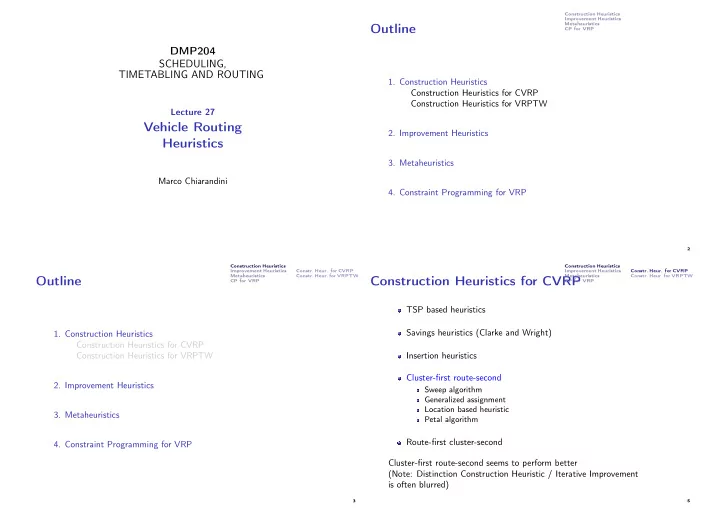
Outline

  • 1. Construction Heuristics

Construction Heuristics for CVRP Construction Heuristics for VRPTW

  • 2. Improvement Heuristics
  • 3. Metaheuristics
  • 4. Constraint Programming for VRP

2 Construction Heuristics Improvement Heuristics Metaheuristics CP for VRP

  • Constr. Heur. for CVRP
  • Constr. Heur. for VRPTW

Outline

  • 1. Construction Heuristics

Construction Heuristics for CVRP Construction Heuristics for VRPTW

  • 2. Improvement Heuristics
  • 3. Metaheuristics
  • 4. Constraint Programming for VRP

3 Construction Heuristics Improvement Heuristics Metaheuristics CP for VRP

  • Constr. Heur. for CVRP
  • Constr. Heur. for VRPTW

Construction Heuristics for CVRP

TSP based heuristics Savings heuristics (Clarke and Wright) Insertion heuristics Cluster-first route-second

Sweep algorithm Generalized assignment Location based heuristic Petal algorithm

Route-first cluster-second Cluster-first route-second seems to perform better (Note: Distinction Construction Heuristic / Iterative Improvement is often blurred)

5

slide-2
SLIDE 2

Construction Heuristics Improvement Heuristics Metaheuristics CP for VRP

  • Constr. Heur. for CVRP
  • Constr. Heur. for VRPTW

Construction heuristics for TSP They can be used for route-first cluster-second or for growing multiple tours subject to capacity constraint. Heuristics that Grow Fragments

Nearest neighborhood heuristics Double-Ended Nearest Neighbor heuristic Multiple Fragment heuristic (aka, greedy heuristic)

Heuristics that Grow Tours

Nearest Addition Farthest Addition Random Addition Clarke-Wright savings heuristic Nearest Insertion Farthest Insertion Random Insertion

Heuristics based on Trees

Minimum spanning tree heuristic Christofides’ heuristics

(But recall! Concorde: http://www.tsp.gatech.edu/)

6 Construction Heuristics Improvement Heuristics Metaheuristics CP for VRP

  • Constr. Heur. for CVRP
  • Constr. Heur. for VRPTW

[Bentley, 1992]

NN (Flood, 1956)

  • 1. Randomly select a starting node
  • 2. Add to the last node the closest node until no more node is available
  • 3. Connect the last node with the first node

Running time O(N2)

7 Construction Heuristics Improvement Heuristics Metaheuristics CP for VRP

  • Constr. Heur. for CVRP
  • Constr. Heur. for VRPTW

[Bentley, 1992]

Add the cheapest edge provided it does not create a cycle.

8 Construction Heuristics Improvement Heuristics Metaheuristics CP for VRP

  • Constr. Heur. for CVRP
  • Constr. Heur. for VRPTW

[Bentley, 1992]

NA

  • 1. Select a node and its closest node and build a tour of two nodes
  • 2. Insert in the tour the closest node v until no more node is available

Running time O(N3)

9

slide-3
SLIDE 3

Construction Heuristics Improvement Heuristics Metaheuristics CP for VRP

  • Constr. Heur. for CVRP
  • Constr. Heur. for VRPTW

[Bentley, 1992]

FA

  • 1. Select a node and its farthest and build a tour of two nodes
  • 2. Insert in the tour the farthest node v until no more node is available

FA is more effective than NA because the first few farthest points sketch a broad outline of the tour that is refined after. Running time O(N3)

10 Construction Heuristics Improvement Heuristics Metaheuristics CP for VRP

  • Constr. Heur. for CVRP
  • Constr. Heur. for VRPTW

[Bentley, 1992]

11 Construction Heuristics Improvement Heuristics Metaheuristics CP for VRP

  • Constr. Heur. for CVRP
  • Constr. Heur. for VRPTW

[Bentley, 1992]

  • 1. Find a minimum spanning tree O(N2)
  • 2. Append the nodes in the tour in a depth-first, inorder traversal

Running time O(N2) A = MST(I)/OPT(I) ≤ 2

12 Construction Heuristics Improvement Heuristics Metaheuristics CP for VRP

  • Constr. Heur. for CVRP
  • Constr. Heur. for VRPTW

[Bentley, 1992]

  • 1. Find the minimum spanning tree T. O(N2)
  • 2. Find nodes in T with odd degree and find the cheapest perfect

matching M in the complete graph consisting of these nodes only. Let G be the multigraph all nodes and edges in T and M. O(N3)

  • 3. Find an Eulerian walk (each node appears at least once and each

edge exactly once) on G and an embedded tour. O(N) Running time O(N3) A = CH(I)/OPT(I) ≤ 3/2

13

slide-4
SLIDE 4

Construction Heuristics Improvement Heuristics Metaheuristics CP for VRP

  • Constr. Heur. for CVRP
  • Constr. Heur. for VRPTW

Construction Heuristics Specific for VRP Clarke-Wright Saving Heuristic (1964)

  • 1. Start with an initial allocation of one vehicle to each customer (0 is

the depot for VRP or any chosen city for TSP) Sequential:

  • 2. consider in turn route (0, i, . . . , j, 0) determine ski and sjl
  • 3. merge with (k, 0) or (0, l)

14 Construction Heuristics Improvement Heuristics Metaheuristics CP for VRP

  • Constr. Heur. for CVRP
  • Constr. Heur. for VRPTW

Construction Heuristics Specific for VRP Clarke-Wright Saving Heuristic (1964)

  • 1. Start with an initial allocation of one vehicle to each customer (0 is

the depot for VRP or any chosen city for TSP) Parallel:

  • 2. Calculate saving sij = c0i + c0j − cij and order the saving in non-

increasing order

  • 3. scan sij

merge routes if i) i and j are not in the same tour ii) neither i and j are interior to an existing route iii) vehicle and time capacity are not exceeded

14 Construction Heuristics Improvement Heuristics Metaheuristics CP for VRP

  • Constr. Heur. for CVRP
  • Constr. Heur. for VRPTW

15 Construction Heuristics Improvement Heuristics Metaheuristics CP for VRP

  • Constr. Heur. for CVRP
  • Constr. Heur. for VRPTW

Matching Based Saving Heuristic

  • 1. Start with an initial allocation of one vehicle to each customer (0 is

the depot for VRP or any chosen city for TSP)

  • 2. Compute spq = t(Sp) + t(Sq) − t(Sp ∪ Sq) where t(·) is the TSP

solution

  • 3. Solve a max weighted matching on the Sk with weights spq on
  • edges. A connection between a route p and q exists only if the

merging is feasible.

16

slide-5
SLIDE 5

Construction Heuristics Improvement Heuristics Metaheuristics CP for VRP

  • Constr. Heur. for CVRP
  • Constr. Heur. for VRPTW

Insertion Heuristic α(i, k, j) = cik + cki − λcij β(i, k, j) = µc0k − α(i, k, j)

  • 1. construct emerging route (0, k, 0)
  • 2. compute for all k unrouted the feasible insertion cost:

α∗(ik, k, jk) = min

p {α(ip, k, ip+1)}

if no feasible insertion go to 1 otherwise choose k∗ such that β∗(i∗

k, k∗, j∗ k) = max k {β(ik, k, jk}

17 Construction Heuristics Improvement Heuristics Metaheuristics CP for VRP

  • Constr. Heur. for CVRP
  • Constr. Heur. for VRPTW

Cluster-first route-second: Sweep algorithm [Wren & Holliday (1971)]

  • 1. Choose i∗ and set θ(i∗) = 0 for the rotating ray
  • 2. Compute and rank the polar coordinates (θ, ρ) of each point
  • 3. Assign customers to vehicles until capacity not exceeded. If needed

start a new route. Repeat until all customers scheduled.

18 Construction Heuristics Improvement Heuristics Metaheuristics CP for VRP

  • Constr. Heur. for CVRP
  • Constr. Heur. for VRPTW

19 Construction Heuristics Improvement Heuristics Metaheuristics CP for VRP

  • Constr. Heur. for CVRP
  • Constr. Heur. for VRPTW

Cluster-first route-second: Generalized-assignment-based algorithm

[Fisher & Jaikumur (1981)]

  • 1. Choose a jk at random for each route k
  • 2. For each point compute

dik = min{c0,i + ci,jk + cjk,0, c0jk + cjk,i + ci,0} − (c0,jk + cjk,0)

  • 3. Solve GAP with dik, Q and qi

20

slide-6
SLIDE 6

Construction Heuristics Improvement Heuristics Metaheuristics CP for VRP

  • Constr. Heur. for CVRP
  • Constr. Heur. for VRPTW

Cluster-first route-second: Location based heuristic [Bramel & Simchi-Levi

(1995)]

  • 1. Determine seeds by solving a capacited location problem (k-median)
  • 2. Assign customers to closest seed

(better performance than insertion and saving heuristics)

21 Construction Heuristics Improvement Heuristics Metaheuristics CP for VRP

  • Constr. Heur. for CVRP
  • Constr. Heur. for VRPTW

Cluster-first route-second: Petal Algorithm

  • 1. Construct a subset of feasible routes
  • 2. Solve a set partitioning problem

22 Construction Heuristics Improvement Heuristics Metaheuristics CP for VRP

  • Constr. Heur. for CVRP
  • Constr. Heur. for VRPTW

Route-first cluster-second [Beasley, 1983]

  • 1. Construct a TSP tour over all customers
  • 2. Choose an arbitrary orientation of the TSP;

partition the tour according to capacity constraint; repeat for several orientations and select the best Alternatively, solve a shortest path in an acyclic digraph with cots on arcs: dij = c0i + c0j + lij where lij is the cost of traveling from i to j in the TSP tour. (not very competitive)

23 Construction Heuristics Improvement Heuristics Metaheuristics CP for VRP

  • Constr. Heur. for CVRP
  • Constr. Heur. for VRPTW

Exercise

Which heuristics can be used to minimize K and which ones need to have K fixed a priori?

24

slide-7
SLIDE 7

Construction Heuristics Improvement Heuristics Metaheuristics CP for VRP

  • Constr. Heur. for CVRP
  • Constr. Heur. for VRPTW

Construction Heuristics for VRPTW

Extensions of those for CVRP [Solomon (1987)] Savings heuristics (Clarke and Wright) Time-oriented nearest neighbors Insertion heuristics Time-oriented sweep heuristic

26 Construction Heuristics Improvement Heuristics Metaheuristics CP for VRP

  • Constr. Heur. for CVRP
  • Constr. Heur. for VRPTW

Time-Oriented Nearest-Neighbor Add the unrouted node “closest” to the depot or the last node added without violating feasibility Metric for “closest”: cij = δ1dij + δ2Tij + δ3vij

dij geographical distance Tij time distance vij urgency to serve j

27 Construction Heuristics Improvement Heuristics Metaheuristics CP for VRP

  • Constr. Heur. for CVRP
  • Constr. Heur. for VRPTW

Insertion Heuristics Step 1: Compute for each unrouted costumer u the best feasible position in the route: c1(i(u), u, j(u)) = min

p=1,...,m{c1(ip−1, u, ip)}

(c1 is a composition of increased time and increase route length due to the insertion of u) (use push forward rule to check feasibility efficiently) Step 2: Compute for each unrouted customer u which can be feasibly inserted: c2(i(u∗), u∗, j(u∗)) = max

u {λd0u − c1(i(u), u, j(u))}

(max the benefit of servicing a node on a partial route rather than on a direct route) Step 3: Insert the customer u∗ from Step 2

28 Construction Heuristics Improvement Heuristics Metaheuristics CP for VRP

  • Constr. Heur. for CVRP
  • Constr. Heur. for VRPTW

Let’s assume waiting is allowed and si indicates service times bi = max{ei, bj + sj + tji} begin of service insertion of u: (i0, i1, . . . , ip, u, ip+1, . . . , im) PFip+1 = bnew

ip+1 − bip+1 ≥ 0

push forward PFir+1 = max{0, PFir − wir+1}, p ≤ r ≤ m − 1 Theorem The insertion is feasible if and only if: bu ≤ lu and PFir + bir ≤ lir ∀p < r ≤ m Check vertices k, u ≤ k ≤ m sequentially. if bk + PFk > lk then stop: the insertion is infeasible if PFk = 0 then stop: the insertion is feasible

29

slide-8
SLIDE 8

Construction Heuristics Improvement Heuristics Metaheuristics CP for VRP

Outline

  • 1. Construction Heuristics

Construction Heuristics for CVRP Construction Heuristics for VRPTW

  • 2. Improvement Heuristics
  • 3. Metaheuristics
  • 4. Constraint Programming for VRP

30 Construction Heuristics Improvement Heuristics Metaheuristics CP for VRP

Local Search for CVRP and VRPTW

Neighborhoods structures:

Intra-route: 2-opt, 3-opt, Lin-Kernighan (not very well suited) 2H-opt, Or-opt Inter-routes: λ-interchange, relocate, exchange, cross, 2-opt∗, ejection chains, GENI

Solution representation and data structures

They depend on the neighborhood. It can be advantageous to change them from one stage to another of the heuristic

31 Construction Heuristics Improvement Heuristics Metaheuristics CP for VRP

Intra-route Neighborhoods

2-opt {i, i + 1}{j, j + 1} − → {i, j}{i + 1, j + 1}

i i+1 j j+1 i i+1 j j+1

O(n2) possible exchanges One path is reversed

32 Construction Heuristics Improvement Heuristics Metaheuristics CP for VRP

Intra-route Neighborhoods

3-opt {i, i + 1}{j, j + 1}{k, k + 1} − → . . .

i i+1 k k+1 j j+1 i i+1 k k+1 j j+1 i i+1 k k+1 j j+1

O(n3) possible exchanges Paths can be reversed

33

slide-9
SLIDE 9

Construction Heuristics Improvement Heuristics Metaheuristics CP for VRP

Intra-route Neighborhoods

Or-opt [Or (1976)] {i1 − 1, i1}{i2, i2 + 1}{j, j + 1} − → {i1 − 1, i2 + 1}{j, i1}{i2, j + 1}

j j+1 i −1

1

i +1 i

2 1 2

i j j+1 i −1

1

i +1 i

2 1 2

i

sequences of one, two, three consecutive vertices relocated O(n2) possible exchanges — No paths reversed

34 Construction Heuristics Improvement Heuristics Metaheuristics CP for VRP

Inter-route Neighborhoods

[Savelsbergh, ORSA (1992)]

35 Construction Heuristics Improvement Heuristics Metaheuristics CP for VRP

Inter-route Neighborhoods

[Savelsbergh, ORSA (1992)]

36 Construction Heuristics Improvement Heuristics Metaheuristics CP for VRP

Inter-route Neighborhoods

[Savelsbergh, ORSA (1992)]

37

slide-10
SLIDE 10

GENI: generalized insertion

[Gendreau, Hertz, Laporte, Oper. Res. (1992)]

select the insertion restricted to the neighborhood of the vertex to be added (not necessarily between consecutive vertices) perform the best 3- or 4-opt restricted to reconnecting arc links that are close to one another.

Construction Heuristics Improvement Heuristics Metaheuristics CP for VRP

Efficient Implementation

Intra-route

Time windows: Feasibility check In TSP verifying k-optimality requires O(nk) time In TSPTW feasibility has to be tested then O(nk+1) time (Savelsbergh 1985) shows how to verify constraints in constant time Search strategy + Global variables ⇓ O(nk) for k-optimality in TSPTW

39 Construction Heuristics Improvement Heuristics Metaheuristics CP for VRP

Search Strategy Lexicographic search, for 2-exchange:

i = 1, 2, . . . , n − 2 (outer loop) j = i + 2, i + 3, . . . , n (inner loop)

1 2 3 4 5

{1,2}{3,4}−>{1,3}{2,4}

1 2 3 4 5

{1,2}{4,5}−>{1,4}{2,5}

1 2 3 4 5

Previous path is expanded by the edge {j − 1, j}

40 Construction Heuristics Improvement Heuristics Metaheuristics CP for VRP

Global variables (auxiliary data structure) Maintain auxiliary data such that it is possible to:

handle single move in constant time update their values in constant time

Ex.: in case of time windows: total travel time of a path earliest departure time of a path latest arrival time of a path

41

slide-11
SLIDE 11

Construction Heuristics Improvement Heuristics Metaheuristics CP for VRP

Outline

  • 1. Construction Heuristics

Construction Heuristics for CVRP Construction Heuristics for VRPTW

  • 2. Improvement Heuristics
  • 3. Metaheuristics
  • 4. Constraint Programming for VRP

42 Construction Heuristics Improvement Heuristics Metaheuristics CP for VRP

Metaheuristics

Many and fancy examples, but first thing to try: Variable Neighborhood Search + Iterated greedy

43 Construction Heuristics Improvement Heuristics Metaheuristics CP for VRP

Basic Variable Neighborhood Descent (BVND) Procedure VND input : Nk, k = 1, 2, . . . , kmax, and an initial solution s

  • utput: a local optimum s for Nk, k = 1, 2, . . . , kmax

k ← 1 repeat s′ ← FindBestNeighbor(s,Nk) if g(s′) < g(s) then s ← s′ (k ← 1) else k ← k + 1 until k = kmax ;

44 Construction Heuristics Improvement Heuristics Metaheuristics CP for VRP

Variable Neighborhood Descent (VND) Procedure VND input : Nk, k = 1, 2, . . . , kmax, and an initial solution s

  • utput: a local optimum s for Nk, k = 1, 2, . . . , kmax

k ← 1 repeat s′ ← IterativeImprovement(s,Nk) if g(s′) < g(s) then s ← s′ (k ← 1) else k ← k + 1 until k = kmax ;

45

slide-12
SLIDE 12

Construction Heuristics Improvement Heuristics Metaheuristics CP for VRP

Final solution is locally optimal w.r.t. all neighborhoods First improvement may be applied instead of best improvement Typically, order neighborhoods from smallest to largest If iterative improvement algorithms IIk, k = 1, . . . , kmax are available as black-box procedures:

  • rder black-boxes

apply them in the given order possibly iterate starting from the first one

  • rder chosen by: solution quality and speed

46

General recommendation: use a combination of 2-opt∗ + or-opt [Potvin, Rousseau, (1995)] However, Designing a local search algorithm is an engineering process in which learnings from other courses in CS might become important. It is important to make such algorithms as much efficient as possible. Many choices are to be taken (search strategy, order, auxiliary data structures, etc.) and they may interact with instance features. Often a trade-off between examination cost and solution quality must be decided. The assessment is conducted through:

analytical analysis (computational complexity) experimental analysis

Construction Heuristics Improvement Heuristics Metaheuristics CP for VRP

Iterated Greedy

Key idea: use the VRP cosntruction heuristics alternation of Construction and Deconstruction phases an acceptance criterion decides whether the search continues from the new or from the old solution. Iterated Greedy (IG): determine initial candidate solution s while termination criterion is not satisfied do r := s greedily destruct part of s greedily reconstruct the missing part of s apply subsidiary iterative improvement procedure (eg, VNS) based on acceptance criterion, keep s or revert to s := r

49

slide-13
SLIDE 13

Construction Heuristics Improvement Heuristics Metaheuristics CP for VRP

In the literature, the overall heuristic idea received different names: Removal and reinsertion Ruin and repair Iterated greedy Fix and re-optimize

50 Construction Heuristics Improvement Heuristics Metaheuristics CP for VRP

Remove Remove some related customers (their re-insertion is likely to change something) Relatedness measure rij geographical rij = 1 D (d′(i, j) + d′(i, j + n) + d′(i + n, j) + d′(i + n, j + n)) temporal and load based d′(u, v) = |Tpi − Tpj| + |Tdi − Tdj| + |li − lj| cluster removal history based: neighborhood graph removal

51 Construction Heuristics Improvement Heuristics Metaheuristics CP for VRP

Dispersion sub-problem: choose q customers to remove with minimal rij Heuristic stochastic procedure: choose a pair randomly; select an already removed i and find j that minimizes rij

52 Construction Heuristics Improvement Heuristics Metaheuristics CP for VRP

Insertion procedures: Greedy (cheapest insertion) Max regret: ∆fq

i due to insert i into its best position in its qth best route

i = arg max(∆f2

i − ∆f1 i )

Constraint Programming (max 20 costumers)

53

slide-14
SLIDE 14

Construction Heuristics Improvement Heuristics Metaheuristics CP for VRP

Advantages of removal-reinsert procedure with many side constraints: the search space in local search may become disconnected it is easier to implement feasibility checks no need of computing delta functions in the objective function

54 Construction Heuristics Improvement Heuristics Metaheuristics CP for VRP

Further ideas Adaptive removal: start by removing 1 pair and increase after a certain number of iterations use of roulette wheel to decide which removal and reinsertion heuristic to use pi = πi πi for each heuristic i SA as accepting criterion after each reconstruction

55 Construction Heuristics Improvement Heuristics Metaheuristics CP for VRP

Outline

  • 1. Construction Heuristics

Construction Heuristics for CVRP Construction Heuristics for VRPTW

  • 2. Improvement Heuristics
  • 3. Metaheuristics
  • 4. Constraint Programming for VRP

56 Construction Heuristics Improvement Heuristics Metaheuristics CP for VRP

Performance of exact methods

Current limits of exact methods [Ropke, Pisinger (2007)]: CVRP: up to 135 customers by branch and cut and price VRPTW: 50 customers (but 1000 customers can be solved if the instance has some structure) CP can handle easily side constraints but hardly solve VRPs with more than 30 customers.

57

slide-15
SLIDE 15

Construction Heuristics Improvement Heuristics Metaheuristics CP for VRP

Large Neighborhood Search

Other approach with CP:

[Shaw, 1998]

Use an over all local search scheme Moves change a large portion of the solution CP system is used in the exploration of such moves. CP used to check the validity of moves and determine the values of constrained variables As a part of checking, constraint propagation takes place. Later, iterative improvement can take advantage of the reduced domains to speed up search by performing fast legality checks.

58 Construction Heuristics Improvement Heuristics Metaheuristics CP for VRP

Solution representation: Handled by local search: Next pointers: A variable ni for every customer i representing the next visit performed by the same vehicle ni ∈ N ∪ S ∪ E where S = Sk and E = Ek are additional visits for each vehicle k marking the start and the end of the route for vehicle k Handled by the CP system: time and capacity variables.

59 Construction Heuristics Improvement Heuristics Metaheuristics CP for VRP

Insertion by CP: constraint propagation rules: time windows, load and bound considerations search heuristic most constrained variable + least constrained valued (for each v find cheapest insertion and choose v with largest such cost) Complete search: ok for 15 visits (25 for VRPTW) but with heavy tails Limited discrepancy search

60 Construction Heuristics Improvement Heuristics Metaheuristics CP for VRP

[Shaw, 1998]

61