OUTLINE Maternal age statistics and trends Multiple Assisted - - PowerPoint PPT Presentation

outline
SMART_READER_LITE
LIVE PREVIEW

OUTLINE Maternal age statistics and trends Multiple Assisted - - PowerPoint PPT Presentation

10/15/2015 Advanced Maternal Age Management of Pregnancy in I have nothing to disclose. Women over 40 Kirsten E. Salmeen, MD Assistant Professor Obstetrics, Gynecology & Reproductive Sciences Maternal-Fetal Medicine OUTLINE Maternal


slide-1
SLIDE 1

10/15/2015 1

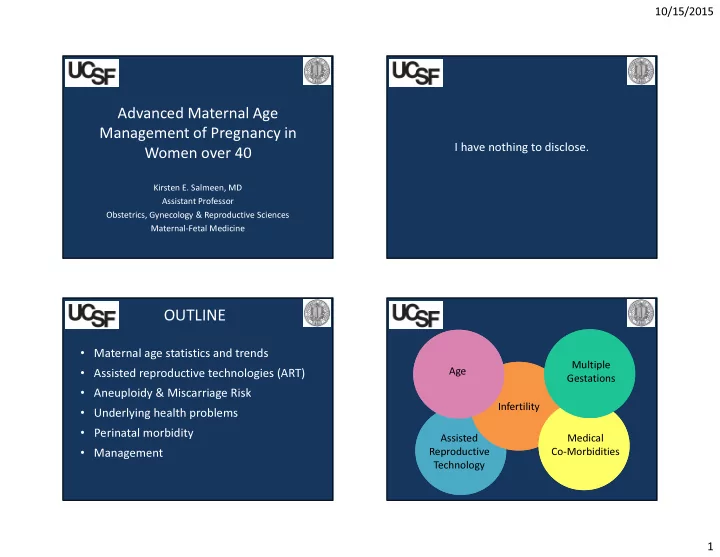
Advanced Maternal Age Management of Pregnancy in Women over 40

Kirsten E. Salmeen, MD Assistant Professor Obstetrics, Gynecology & Reproductive Sciences Maternal-Fetal Medicine

I have nothing to disclose.

  • Maternal age statistics and trends
  • Assisted reproductive technologies (ART)
  • Aneuploidy & Miscarriage Risk
  • Underlying health problems
  • Perinatal morbidity
  • Management

OUTLINE

Infertility Infertility Assisted Reproductive Technology Age Multiple Gestations Medical Co-Morbidities

slide-2
SLIDE 2

10/15/2015 2

MATERNAL AGE – STATISTICS AND TRENDS Age

What percent of births in the United States would you estimate are in women over age 40?

  • A. < 5%
  • B. 5 – 10%
  • C. 10 – 15%
  • D. > 15%

< 5 % 5 – 1 % 1 – 1 5 % > 1 5 %

22% 11% 28% 39%

US Birth Rates Among Women ≥ 35

0% 2% 4% 6% 8% 10% 12% 1997 2002 2008 2013

Deliveries to Women 35-39 Years Deliveries to Women ≥ 40 Years

CDC, National Center for Health Statistics, National Vital Statistics System. http://www.cdc.gov/nchs/nvss.htm

3% 12%

slide-3
SLIDE 3

10/15/2015 3 1997 2013

Total # of Births in US 3,880,894 3,932,181 Age 40-44 Years # of Births (%) 76,084 (2) 109,484 (2.8) Age 45-49 Years # of Births (%) 3,333 (0.09) 7,495 (0.19) Age ≥ 50 Years # of Births (%) 144 (0.004) 677 (0.017)

CDC, National Center for Health Statistics, National Vital Statistics System. http://www.cdc.gov/nchs/nvss.htm

93%

Infertility Infertility Age

Age and Fertility

Practice Committee Committee Opinion No 589 Fertil Steril 2014

Data from multiple non-contracepting communities over many decades

By age 40 it is ~ 5% per cycle At age 30, a woman’s chance of conception is ~ 20% per cycle

Age and Fertility

Births Resulting from ART Procedures National Vital Statistics Data 2011 Maternal Age Number of Births Number of Known ART-Births Percent < 35 2,273,953 19,285 0.85 35-37 228,392 7,949 3.48 38-40 117,937 5,905 5.01 41-42 33,299 2,354 7.07 43-44 11,717 1,379 11.77 ≥ 45 5,247 1,624 30.95

National Vital Statistics Reports, Vol. 63, No. 8, December 2014

slide-4
SLIDE 4

10/15/2015 4

RISKS ASSOCIATED WITH ASSISTED REPRODUCTIVE TECHNOLOGIES Infertility Infertility Assisted Reproductive Technology Age ART & Multiple Gestation

  • 25 – 30% of ART pregnancies are twins
  • 1.5 – 3% of ART pregnancies are triplets or more
  • Monozygotic twinning: 1.7 – 2.5% (vs 0.5%)

Kanter et al Trends and correlates of monozygotic twinning after single embryo transfer Ob Gyn 2015; cdc.gov Assisted Reproductive Technology (ART) National Summary Report 2010

Infertility Infertility Assisted Reproductive Technology Age Multiple Gestations

slide-5
SLIDE 5

10/15/2015 5 ART is an independent risk factor for which of the following?

  • A. Birth defects
  • B. Cesarean section
  • C. Placenta previa
  • D. Pre-eclampsia
  • E. All of the above

Birth defects Cesarean section Placenta previa Pre-eclampsia All of the above

4% 2% 89% 3% 1%

Hansen et al. NEJM 346:725-30, 2002

ART & Birth Defects

Figure 1. Cumulative prevalence of diagnosed major birth defects in singleton infants, according to age at diagnosis 301 Infants 837 Infants 4,000 Infants

ART & Birth Defects

Singleton Births

Assisted Conception (N = 4333) Spontaneous Conception (N = 295,220) Adjusted Odds Ratio Any Defect 361 (8.3) 16,989 (5.8) 1.30 (1.16 – 1.45) Multiple Defects 95 (2.2) 4,690 (1.6) 1.24 (1.00 – 1.54) Cardiovascular 78 (1.8) 3,472 (1.2) 1.36 (1.08 – 1.72) Musculoskeletal 130 (3.0) 4,776 (1.6) 1.50 (1.24 – 1.80) Urogenital 95 (2.2) 4,872 (1.7) 1.25 (1.01 – 1.55) Gastrointestinal 34 (0.8) 1832 (0.6) 1.18 (0.83 – 1.68) Central nervous system 22 (0.5) 1,104 (0.4) 1.34 (0.86 – 2.07) Cerebral Palsy 17 (0.4) 496 (0.2) 2.22 (1.35 – 3.63)

Adjusted for age, parity, fetal sex, year, race/ethnicity, country of birth, maternal conditions in pregnancy, maternal smoking during pregnancy, socioeconomic status and maternal and paternal occupation

Davies et al. NEJM 366:1803-13, 2012
Multiple Births

Assisted Conception (N = 1,830) Spontaneous Conception (N = 7,591) Adjusted Odds Ratio Any Defect 152 (8.3) 557 (7.3) 1.16 (0.91 – 1.49) Multiple Defects 55 (3.0) 188 (2.5) 1.10 (0.73 – 1.64) Cardiovascular 30 (1.6) 142 (1.9) 0.99 (0.60 – 1.64) Musculoskeletal 25 (1.4) 102 (1.3) 0.92 (0.54 – 1.57) Urogenital 50 (2.7) 173 (2.3) 1.10 (0.74 – 1.65) Gastrointestinal 23 (1.3) 88 (1.2) 1.13 (0.59 – 2.26) Central nervous system 10 (0.5) 42 (0.6) 1.08 (0.39 – 2.96) Cerebral Palsy 16 (0.9) 50 (0.7) 1.39 (0.69 – 2.77)

ART & Birth Defects

Adjusted for age, parity, fetal sex, year, race/ethnicity, country of birth, maternal conditions in pregnancy, maternal smoking during pregnancy, socioeconomic status and maternal and paternal occupation

Davies et al. NEJM 366:1803-13, 2012

slide-6
SLIDE 6

10/15/2015 6

ART & Perinatal Risk

Reddy et al. Infertility, assisted reproductive technology, and adverse pregnancy outcomes. Ob Gyn 2007.

ANEUPLOIDY & MISCARRIAGE RISK Risk of Chromosomal Abnormalities

Maternal Age at Delivery (years) Risk of Down Syndrome Risk of Any Chromosomal Abnormality 20 1/1667 1/526 35 1/378 1/192 40 1/106 1/66 45 1/30 1/21

Risk at Live Birth, According to Maternal Age

Hook EB, Cross PK, Schreinemachers DM. Chromosomal abnormality rates at amniocentesis and in live-born infants. JAMA 1983;249:2034-8

Miscarriage Risk

Nybo Anderson AM, Wohlfahrt J, Christens P, Olsen J, Melbye M. Maternal age and fetal loss: population based register linkage study. BMJ 2000;320:1708–12.

Risk of Spontaneous Abortion According to Maternal Age at Conception Risk of Spontaneous Abortion (%) Maternal Age at Conception (Years) 40% 80%

slide-7
SLIDE 7

10/15/2015 7

ART Modifies Miscarriage Risk

cdc.gov Assisted Reproductive Technology (ART) National Summary Report 2010

~ 30% ~ 65%

cdc.gov Assisted Reproductive Technology (ART) National Summary Report 2010

Donor Oocytes Further Modify SAB Risk

~ 50%

UNDERLYING HEALTH PROBLEMS

Infertility Infertility Assisted Reproductive Technology Age Multiple Gestations Medical Co-Morbidities

slide-8
SLIDE 8

10/15/2015 8 Risk of Death Increases with Age

50 100 150 200 250 300 350 400 25-29 30-34 35-39 40-44 45-49 50-54

Number of Deaths/100,000 US Females 2010

Age - Years

CDC, National Center for Health Statistics, National Vital Statistics System. http://www.cdc.gov/nchs/nvss.htm

Percent of US Women With Obesity (BMI > 30) 2007

0% 5% 10% 15% 20% 25% 30% 35% 18-29 yrs 30-39 yrs 40-49 yrs 50-59 yrs

cdc.gov NHANES 2006-2007

Percent of US Females With Hypertension NHANES 1999-2008

0% 2% 4% 6% 8% 10% 12% 14% 16% 18% 20% 20-34 35-39 40-44

aOR = 3.3 (2.1 – 5.2) aOR = 8.2 (5.0 – 13.3)

Bateman et al. Hypertension in Women of Reproductive Age in the United States: NHANES 1999-2008. PLoS ONE 2012

Adjusted for: race/ethnicity, diabetes, chronic kidney disease, alcohol use, OCP use, BMI 11.1% 3.1% 10.6% 51.1% 39.7% 39.7% 0% 10% 20% 30% 40% 50% 60% 45-54 Yrs 18-44 Yrs Total Diabetes Prediabetes

Diabetes & Prediabetes Women ≥ 18, 2007-2010

cdc.gov NHANES 2007-2010

slide-9
SLIDE 9

10/15/2015 9

0.00% 0.50% 1.00% 1.50% 2.00% 2.50% 30-39 yrs 40-49 yrs 50-59 yrs

Colon Cancer Breast Cancer

Chance of Being Diagnosed with Breast

  • r Colon Cancer in the Next 10 Years

http://www.cancer.org; http://www.cdc.gov/cancer/colorectal/statistics/age.htm

PERINATAL MORBIDITY

Infertility Infertility Assisted Reproductive Technology Age Multiple Gestations Medical Co-Morbidities

50 100 150 20 25 30 35 40 45 50

Age (Years) Perinatal Risk

slide-10
SLIDE 10

10/15/2015 10

% Odds Ratio/Relativ e Risk Maternal Age Reference Age Non-Chromosomal Congenital Anomalies Reefhuis 1.1 – 1.9 35-40 25-29 Loane 2.3 – 2.5 1 – 1.8 ≥ 40 25-29 Cleary-Goldman 2.8 – 2.9 1.4 – 1.7 ≥ 35 < 35 Preterm Birth Cleary-Goldman (< 37 wks) 8.6 – 11.8 1.0 – 1.4 ≥ 35 < 35 Yogev (< 34 wks) 5.6 1.8 40-44 20-29 Yogev (< 34 wks) 8.5 3.5 ≥ 45 20-29 Luke (< 32 wks) 2.5 – 3.0 1.6 – 2.1 ≥ 40 30 – 34

Obstetrical Risks Associated with Increased Maternal Age

Reefhuis et al. Birth Defects Research (Part A) 70:572–579, 2004; Loane et al. BJOG 116:1111–1119, 2009; Yogev et al. Am J Obstet Gynecol 203:558.e1-7, 2010; Cleary-Goldman et al. Obstet Gynecol105:983–90, 2005; Luke B et al. Hum Reprod 22(5):1264-1272, 2007

% Odds Ratio/Relativ e Risk Maternal Age Reference Age Low Birth Weight Cleary-Goldman 5.1 – 7.5 1.1 – 1.6 ≥ 35 < 35 Yogev 12.7 0.8 40-44 20-29 Luke 7.7 – 9.2 NR ≥ 40 30-34 Yogev 16.9 0.7 ≥ 45 20-29 Salihu ~ 14 3.0 ≥ 50 20-29

Obstetrical Risks Associated with Increased Maternal Age

Cleary-Goldman et al. Obstet Gynecol 105:983–90, 2005; Yogev et al. Am J Obstet Gynecol 203:558.e1-7, 2010; Luke B et al. Hum Reprod 22(5):1264-1272, 2007; Salihu et al. Obstet Gynecol 102:1006 –14, 2003

Obstetrical Risks Associated with Increased Maternal Age

% Odds Ratio/Relativ e Risk Maternal Age Reference Age Pre-Eclampsia Cleary-Goldman 2.3 – 3.0 0.9 – 1.1 ≥ 35 < 35 Yogev 2.4 NR 40-44 N/A Yogev 10.7 NR ≥ 45 N/A Pare 13.4 aOR NS > 40 < 35 Luke 6.2-7.4 1.3 – 1.6 > 40 30 – 34 Paulson 35 NR ≥ 50 N/A

Cleary-Goldman et al. Obstet Gynecol105:983–90, 2005; Yogev et al. Am J Obstet Gynecol 203:558.e1-7, 2010; Luke et al. Hum Reprod 22(5):1264-1272, 2007; Paulson et al. JAMA;228:2320-2323, 2002

Obstetrical Risks Associated with Increased Maternal Age

% Odds Ratio/Relativ e Risk Maternal Age Reference Age Gestational Diabetes Cleary-Goldman 5.3 – 7.3 1.8 – 2.4 ≥ 35 < 35 Yogev 10.2 NR 40-44 N/A Yogev 17.0 NR ≥ 45 N/A Paulson 17.5 NR ≥ 50 N/A Placenta Previa Cleary-Goldman 0.9 – 1.9 1.8 – 2.8 ≥ 35 < 35 Yogev 1.4 5.7 40-44 20-29 Yogev 5.6 13.4 ≥ 45 20-29 Jacobsson 0.2 – 0.7 1.04 – 4.6 ≥ 40 20-29 Salihu 16.7 NR ≥ 50 N/A

Cleary-Goldman et al. Obstet Gynecol 105:983–90, 2005; Yogev et al. Am J Obstet Gynecol 203:558.e1-7, 2010; Paulson et al. JAMA;228:2320-2323, 2002; Jacobsson et al. Obstet Gynecol 104:727–33, 2004; Salihu et al. Obstet Gynecol 102:1006 –14, 2003

slide-11
SLIDE 11

10/15/2015 11

Mode of Delivery

Cesarean Section

35 – 40 Yrs 40 – 45 Yrs 45 – 50 Yrs > 50 Yrs Cleary- Goldman 31.4% 40.5% (aOR 2.0) Yogev 42.9% (RR 3.7) 78.5% (RR 31.8) Luke (primiparous) 43% (RR 1.96 54.1% (RR 3.14) Jacobsson 23.5% (OR 2.8) 30.3% (OR 3.8) Dulitzki 39.4% (OR 7.3) Paulson (singletons) 68%

Dulitzki et al. Effect of very advanced maternal age on pregnancy outcome and rate of cesarean delivery. Ob Gyn 1998

Risk Factors for Cesarean Section

  • Krieg: Stanford University, 40 pregnancies in oocyte

recipients compared to women ≥ 38 yrs who underwent autologous IVF cycles – OR for C/S in oocyte recipients: 2.78 (1.44-5.36) – Each 1 year increase in maternal age was associated with a 13% increase in the odds of C/S. Cesarean Section & Oocyte Recipients

Krieg SA, Henne MB, Westphal LM. Obstetric outcomes in donor oocyte pregnancies compared with advanced maternal age in in vitro fertilization pregnancies. Fertil Steril 2008;90:65–70.

slide-12
SLIDE 12

10/15/2015 12

Risk of Intrauterine Fetal Demise

At what gestational age do you offer induction

  • f labor for women who are over 40 without
  • ther risk factors?
  • A. 39 – 40 weeks
  • B. 40 – 41 weeks
  • C. > 41 weeks
  • D. 41 – 42 weeks

39 – 40 weeks 40 – 41 weeks > 41 weeks 41 – 42 weeks

40% 8% 24% 28%

Hoffman et al. Pregnancy at or beyond age 40 years is associated with an increased risk of fetal death and other adverse

  • utcomes. AJOG 2006.

Risk of IUFD

35-39 Years aOR* (95% CI) N = 13,902 ≥ 40 years aOR* (95% CI) N = 3,953 32 – 36 weeks 2.03 (1.54 – 2.69) 1.73 (1.05 – 2.83) 37 – 39 weeks 1.20 (0.85 – 1.70) 1.63 (0.97 – 2.75) 40 – 41 weeks 0.80 (0.44 – 1.45) 2.28 (1.82 – 4.40)

Odds of IUFD by GA compared to women < 35 years (N = 108,547)

* Adjusted for race/ethnicity, parity, chronic hypertension, pre-elcampsia, diabetes

Bateman et al. Higher rate of stillbirth at the extremes of reproductive age: A large nationwide sample of deliveries in the United States. AJOG 2006.

IUFD Risk

slide-13
SLIDE 13

10/15/2015 13

Reddy et al. Maternal age and the risk of stillbirth throughout pregnancy in the United States. AJOG 2006.

IUFD Risk

Other Reported Risks

  • Intensive care stay
  • Myocardial infarction
  • Pulmonary edema
  • Venous thromboembolism
  • Postpartum depression

Other Anecdotal Risks

  • Anxiety
  • Difficulty with breastfeeding

A BRIEF DIVERSION TO ADVANCED PATERNAL AGE

slide-14
SLIDE 14

10/15/2015 14 Advanced Paternal Age

Salmeen, Zlatnik. The oldest gravidas: a review of pregnancy risks in women over 45. Obstetrical and Gynecological Survey 2011

Possibly increased risk for other birth defects, autism-spectrum disorders

MANAGEMENT What I do… Without a lot of evidence

  • Hemoglobin A1c, fasting glucose
  • TSH
  • Mammogram
  • EKG
  • Lipids
  • Serial BPs
  • Cardiac Stress Test/Cardiology evaluation

Preconception Work-Up for Women ≥ 40 (or ≥ 35 with risk factors)

slide-15
SLIDE 15

10/15/2015 15

First Trimester Care for Women ≥ 40

  • Determine mode of conception
  • Assess fetal number, chorionicity of multiples
  • TSH (if not recently obtained)
  • Early glucose testing
  • If hypertensive: baseline pre-eclampsia labs
  • Genetic counseling (adjust for oocyte-donor age)
  • Consideration of aspirin prophylaxis

** Aspirin Prophylaxis **

  • In “high-risk” women, aspirin prophylaxis may

reduce the risk of pre-eclampsia by up to 17%

  • I consider women over 40 to be “high risk” and
  • ffer aspirin
  • Detailed fetal anatomic survey
  • Low-threshold for fetal echocardiogram
  • Repeat glucose tolerance testing
  • Evaluation of fetal growth in the third trimester
  • Antenatal testing
  • Labor planning, counseling regarding mode of delivery
  • Labor induction 39-40 weeks

Prenatal Care for Women ≥ 40 (or ≥ 35 with risk factors)

TAKE HOME POINTS

  • Age-related risks are actually multifactorial
  • IUFD increases with increasing maternal age.

Induction for “post dates” may be appropriate after 39-40 weeks for women > 35 – 40 years.

  • Age nor donor-oocyte recipient status are

indications for cesarean delivery.

  • Aspirin prophylaxis is indicated for women at high-

risk for pre-eclampsia, including women over 40.

slide-16
SLIDE 16

10/15/2015 16

Questions?