SLIDE 1 6/1/2013 1
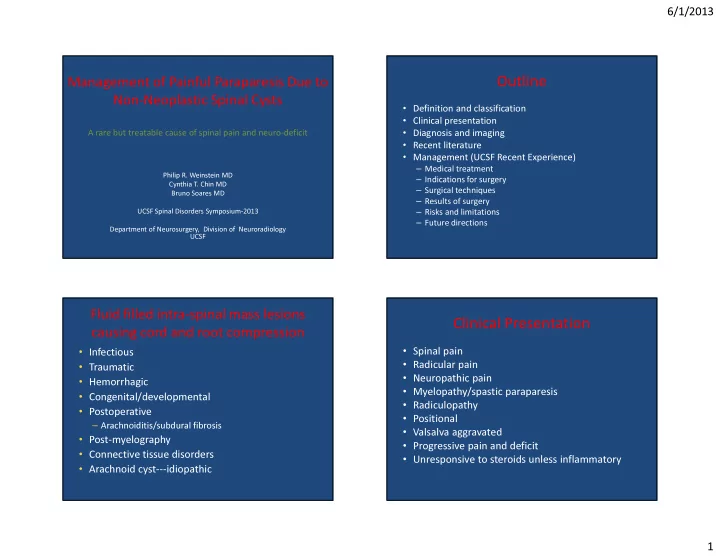
Management of Painful Paraparesis Due to Non-Neoplastic Spinal Cysts
A rare but treatable cause of spinal pain and neuro-deficit
Philip R. Weinstein MD Cynthia T. Chin MD Bruno Soares MD UCSF Spinal Disorders Symposium-2013 Department of Neurosurgery, Division of Neuroradiology UCSF
Outline
- Definition and classification
- Clinical presentation
- Diagnosis and imaging
- Recent literature
- Management (UCSF Recent Experience)
– Medical treatment – Indications for surgery – Surgical techniques – Results of surgery – Risks and limitations – Future directions
Fluid filled intra-spinal mass lesions causing cord and root compression
- Infectious
- Traumatic
- Hemorrhagic
- Congenital/developmental
- Postoperative
– Arachnoiditis/subdural fibrosis
- Post-myelography
- Connective tissue disorders
- Arachnoid cyst---idiopathic
Clinical Presentation
- Spinal pain
- Radicular pain
- Neuropathic pain
- Myelopathy/spastic paraparesis
- Radiculopathy
- Positional
- Valsalva aggravated
- Progressive pain and deficit
- Unresponsive to steroids unless inflammatory
SLIDE 2 6/1/2013 2
Diagnosis
– Contrast – CSF flow study – Diffusion – Neurogam (STIR) – FIESTA
- CT myelogram
- Dynamic “cine” CT myelogram
- CT guided aspiration or injection therapy
- CT or MRI brain
Medical Pain Management
- NSAID’s
- Oral steroids
- Analgesics
- Anti-spasmodics
- Membrane stabilizers
- Surgical spinal pain implants
– DCS – ITDD
Intradural Spinal Arachnoid cysts N=24 USC
- Age 56 Av. M =13; F=8
- Thoracic 81% Dorsal=15 Ventral=6
- Laminectomy for cyst fenestration/partial resection/ ultrasound
guidance
- Cysto-SAS shunt 4; Duraplasty 7
- Syringo-SAS shunt 4/7;
- Postop MRI all cysts resolved and syrinx decreased (7) or resolved
(4)
- Improved: weakness 100%; hyper-reflexia 91%; incontinence 80%;
neuropathic pain 44%; numbness 33%; numbness increased 1 pt. Wang MY, Levi AC, Green BA Surg Neurol 2003 60(1);49-55
SLIDE 3
6/1/2013 3
Additional recent references
Idiopathic cystic spinal arachnoiditis Vaughan D, et al Br J. Neurosurg, 2012 26 (4): 555-7 Giant ant. arachnoid cyst with syrinx Peruzotti-Jametti L, et al Spine 2010; 35 (8) 322-4 Partial median corpectomy for C2-3 ant. arach. cyst Srinivasan US, et al Neurol India 2009 57 (6): 803-5 Spinal intradural juxtamedullary cysts Bassiouni H, et al Neurosurg 2004; 55 (6) 1352-9 Surgical treatment of spinal extradural arachnoid cysts Funao H, et al Neurosurg 2012; 71(2): 278-84
SLIDE 4 6/1/2013 4
Recent UCSF Cases
- Arachnoid cyst
- Meningeal cyst
- Inflammatory/post-
infectious cyst
- Postoperative cyst
- Post traumatic syrinx
- Discogenic cyst
- Synovial cyst
- Tarlov’s cyst
- Ventral cord hernia-
dorsal “cyst”
- Cystic Schwanoma
- Dermal sinus/tether
- Pseudo-meningocoel
- Epidermoid tumor
- Cystic Arachnoiditis
Arachnoid Cyst MRI Arachnoid Cyst myelogram Meningeal Cyst T2
SLIDE 5
6/1/2013 5
T2 NEUROCYSTICERCOSIS ARACHNOIDITIS NEUROCYSTICERCOSIS ARACHNOIDITIS Gad
Post-operative Nerve root herniation
SLIDE 6 6/1/2013 6
Post traumatic syrinx T1 T2 Post traumatic syrinx T2
Discal Cyst
Dean Chou J Neurosurg Spine 2007 Jan 6(1):81
Post-gad T1
SLIDE 7 6/1/2013 7
Five months later Discal cyst
T2 Gad GRE
SYNOVIAL CYST
T2 Gad
Sag STIR Axial T2 Tarlov Cyst
SLIDE 8 6/1/2013 8
Myelogram Tarlov cyst Ventral Dural Defect cord herniation
Ventral Dural Defect cord herniation
myelogram Dermal cyst
SLIDE 9
6/1/2013 9
Cystic conus schwannoma T2 Cystic conus schwannoma Gad
Steady State Free Precession MRI (SSFP) FIESTA
Low flip angle gradient echo; short repetition High spatial resolution Increased water-tissue resolution Enhances imaging detail of spinal meninges, nerve roots, cord and relationships to cystic structures May obviate need for CTM (CSF flow study for communication)
SLIDE 10
6/1/2013 10
SLIDE 11 6/1/2013 11
History
- 55 yo male engineer
- Back and bilat. posterolateral leg pain to knees
- Numbness soles of both feet ascending
- Progressively incapacitating for any activity
- Sitting aggravates back pain
- Walking or Valsalva increases leg pain
- DVT after bedrest in Jan.
- NSAID’s, Analgesics, PT: no relief
History
- L L5-S1 discectomy for L sciatica 1988
- Preop/postop myelogram: spinal headache 2wks
- Pain free until 2 yrs. ago
- Severe progressive LBP: spontaneous onset
- ESI 2 yrs. ago triggered onset progressive leg
pain/numb feet ever since
- Medrol dose pak completely relieved leg
symptoms for one week 2 mos. ago
LS MRI –S1: T2/STIR MRI T1 + C: Cystic arachnoiditis
SLIDE 12 6/1/2013 12
Summary
- Non-neoplastic intradural cysts can cause spinal
pain, myelopathy, and/or radiculopathy
- Diagnosis is verified with Contrast MRI, CSF flow
MRI, Diffusion MRI and CT MYELOGRAM
- Microsurgical fenestration with ultrasound
guidance and duraplasty or shunting obliterates cysts, relieves deficits and reduces pain
- Future studies needed to evaluate FIESTA imaging
and percutaneous CT or MRI guided aspiration for non-communicating cysts