Outline the instability of texts in the postmodern moment the - - PDF document

outline
SMART_READER_LITE
LIVE PREVIEW

Outline the instability of texts in the postmodern moment the - - PDF document

10/2/19 Class 2c Technologies, Religion & Meaning-Making Outline the instability of texts in the postmodern moment the role of interpretive communities the role of media definition types relation to


slide-1
SLIDE 1

10/2/19 1

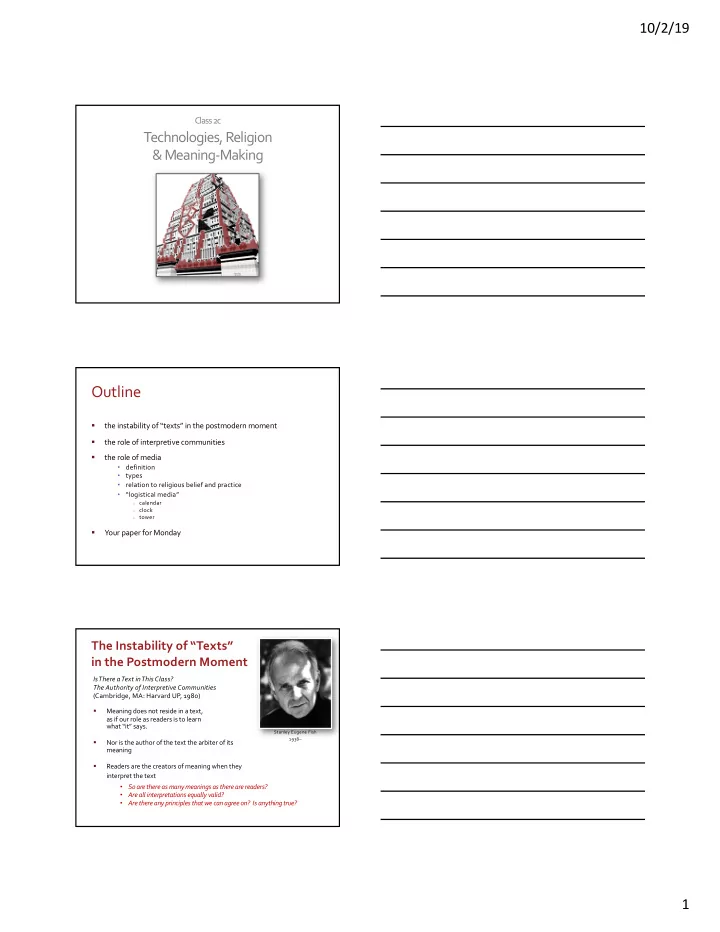
Class 2c

Technologies, Religion & Meaning-Making

Outline

§ the instability of “texts” in the postmodern moment § the role of interpretive communities § the role of media

  • definition
  • types
  • relation to religious belief and practice
  • “logistical media”
  • calendar
  • clock
  • tower

§ Your paper for Monday

The Instability of “Texts” in the Postmodern Moment

Is There a Text in This Class? The Authority of Interpretive Communities (Cambridge, MA: Harvard UP, 1980) § Meaning does not reside in a text, as if our role as readers is to learn what “it” says. § Nor is the author of the text the arbiter of its meaning § Readers are the creators of meaning when they interpret the text

Stanley Eugene Fish 1938–

  • So are there as many meanings as there are readers?
  • Are all interpretations equally valid?
  • Are there any principles that we can agree on? Is anything true?
slide-2
SLIDE 2

10/2/19 2

The Instability of “Texts” in the Postmodern Moment

Mine is not an argument for an infinitely plural or open text, but for a text that is always set; and yet because it is set not for all places

  • r all times but for wherever and

however long a particular way of reading [interpretation] is in force, it is a text that can change.

Is There a Text in This Class, 274

Stanley Eugene Fish 1938–

The Role of Interpretive Communities

§ “Ways of reading” or styles of interpretation impact how we read § We learn these sometimes consciously, sometimes unconsciously, from the culture around us § Interpretive communities shape the interpretations and we choose (or find

  • urselves part of) those

§ Everything is already in context; the context shapes meaning

Stanley Eugene Fish 1938–

The Role of Media

§ Defining media:

  • From Latin medium – in between
  • The means of conveyance of

communications

slide-3
SLIDE 3

10/2/19 3

Types of Media

§ speech § . § . § . § . § . § .

The Oral vs the Written Medium

Plato

§ The advantages of oral

  • .
  • .
  • .

§ Disadvantages of written

  • .
  • .
  • .

§ Pace Plato, are there advantages to the written?

Plato 428–348 BCE

Relation

to Religious Belief and Practice

§ Religious practices are multi- modal, making use of multiple technologies § Religious texts are ONE such technology, emerging from historical contexts that are culture-specific and reflect many modes, even if they appear to be in one mode (written) § Religious texts are interpreted in specific historical contexts and in media that differ from the original modes and meanings

slide-4
SLIDE 4

10/2/19 4

Logistical Media

§ Technologies so basic we tend not to think of them as media at all § They arrange people and property into time and space § They lack content, but form the grid for other communication § Examples: Calendar, Clock and Tower

Priene Calendar Inscription 9 BCE Priene Calendar Inscription 9 BCE

since [the birthday] of the god was the beginning of the good good new[s] for the world that came by reason of him The Greeks of Asia resolve to reset their calendar from a lunar calendar to a solar one, beginning on the birthday of Augustus Caesar

slide-5
SLIDE 5

10/2/19 5

Priene Calendar Inscription 9 BCE

since [the birthday] of the god was the beginning of the good good new[s] for the world that came by reason of him The Greeks of Asia resolve to reset their calendar from a lunar calendar to a solar one, beginning on the birthday of Augustus Caesar

2:1 In those days a decree went out from Emperor Augustus that all

the world should be registered…. [So Joseph travels from Nazareth down to Bethlehem with his pregnant fiancé Mary.]

6 While they were there, the time came for her to deliver

her child. 7 And she gave birth to her firstborn son and wrapped him in bands of cloth, and laid him in a manger, because there was no place for them in the inn.

8 In that region there were shepherds living in the fields,

keeping watch over their flock by night. 9 Then an angel of the Lord stood before them, and the glory of the Lord shone around them, and they were terrified. 10 But the angel said to them, “Do not be afraid; for see—I am bringing you good news of great joy for all the people: 11 to you is born this day in the city of David a Savior, who is the Messiah, the Lord. 12 This will be a sign for you: you will find a child wrapped in bands of cloth and lying in a manger.” 13 And suddenly there was with the angel a multitude of the heavenly host, praising God and saying,

14 “Glory to God in the highest heaven,

and on earth peace among those whom he favors!”

Gospel of Luke 75–110 CE

Calendar, Clock, Tower

§ With a partner and with your assigned technology (calendar, clock or tower, discuss and write answers on one sheet of paper to the following questions:

  • How does your technology extend human “power over,”

and over what?

  • How was or is your technology related to formal religion?
  • Consider your technology for calendar, clock or tower in our own

secular society; how does the use of them still convey or shape “spiritual” concerns (over ultimate meaning, our place in the cosmos, our hopes in time)?

  • What “logistical media” do you personally use?

Your paper for Monday

§ Create an image and write an accompanying paper that present the “sacred” moments in your life.

  • For your image, follow the pattern of the Tavola of St. Clare,

with your image in the center and scenes or symbols of the sacred moments from your life around the periphery.

  • In your accompanying 3-page, double-spaced paper,
  • explain the perimeter scenes—what each is and why each is

so significant for you

  • close with a statement about what all the scenes have in

common—that is, what makes a moment in your life sacred

  • r significant, and
  • define what the term “sacred” means to you.

§ Format it properly § Upload it to Camino before class.
slide-6
SLIDE 6

10/2/19 6

§ What makes events in your life stand out as the most significant? § Which of these experiences might be further defined as sacred?

Defining Your “Sacred”