SLIDE 1 CSci 4271W Development of Secure Software Systems Day 5: Memory safety attacks
Stephen McCamant
University of Minnesota, Computer Science & Engineering
Outline
Threat modeling, cont’d Shellcode techniques Binary-level GDB commands and demo In-person lab logistics reminders Project 1 bcimgview intro and demo Exploiting other vulnerabilities
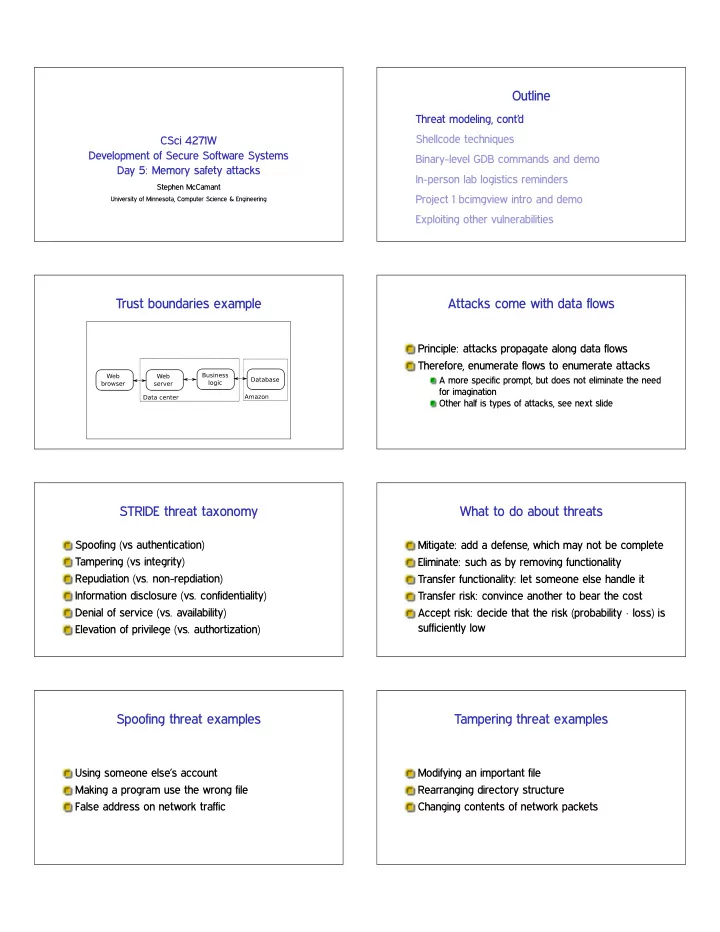
Trust boundaries example Attacks come with data flows
Principle: attacks propagate along data flows Therefore, enumerate flows to enumerate attacks
A more specific prompt, but does not eliminate the need for imagination Other half is types of attacks, see next slide
STRIDE threat taxonomy
Spoofing (vs authentication) Tampering (vs integrity) Repudiation (vs. non-repdiation) Information disclosure (vs. confidentiality) Denial of service (vs. availability) Elevation of privilege (vs. authortization)
What to do about threats
Mitigate: add a defense, which may not be complete Eliminate: such as by removing functionality Transfer functionality: let someone else handle it Transfer risk: convince another to bear the cost Accept risk: decide that the risk (probability ✁ loss) is sufficiently low
Spoofing threat examples
Using someone else’s account Making a program use the wrong file False address on network traffic
Tampering threat examples
Modifying an important file Rearranging directory structure Changing contents of network packets
SLIDE 2 Repudiation threat examples
Performing an important action without logging Destroying existing logs Add fake events to make real events hard to find or not credible
- Info. disclosure threat examples
Eavesdropping on network traffic Reading sensitive files Learning sensitive information from meta-data
DoS threat examples
Flood network link with bogus traffic Make a server use up available memory Make many well-formed but non-productive interactions
Elevation of privilege threat examples
Cause data to be interpreted as code Change process to run as root/administrator Convince privileged process to run attacker’s code
Outline
Threat modeling, cont’d Shellcode techniques Binary-level GDB commands and demo In-person lab logistics reminders Project 1 bcimgview intro and demo Exploiting other vulnerabilities
Basic definition
Shellcode: attacker supplied instructions implementing malicious functionality Name comes from example of starting a shell Often requires attention to machine-language encoding
Classic execve ✴❜✐♥✴s❤
❡①❡❝✈❡✭❢♥❛♠❡✱ ❛r❣✈✱ ❡♥✈♣✮ system call Specialized syscall calling conventions Omit unneeded arguments Doable in under 25 bytes for Linux/x86
Avoiding zero bytes
Common requirement for shellcode in C string Analogy: broken 0 key on keyboard May occur in other parts of encoding as well
SLIDE 3
More restrictions
No newlines Only printable characters Only alphanumeric characters “English Shellcode” (CCS’09)
Transformations
Fold case, escapes, Latin1 to Unicode, etc. Invariant: unchanged by transformation Pre-image: becomes shellcode only after transformation
Multi-stage approach
Initially executable portion unpacks rest from another format Improves efficiency in restricted environments But self-modifying code has pitfalls
NOP sleds
Goal: make the shellcode an easier target to hit Long sequence of no-op instructions, real shellcode at the end
x86: 0x90 0x90 0x90 0x90 0x90 . . . shellcode
Where to put shellcode?
In overflowed buffer, if big enough Anywhere else you can get it
Nice to have: predictable location
Convenient choice of Unix local exploits:
Where to put shellcode?
Environment variables
Code reuse
If can’t get your own shellcode, use existing code Classic example: s②st❡♠ implementation in C library
“Return to libc” attack
More variations on this later
Outline
Threat modeling, cont’d Shellcode techniques Binary-level GDB commands and demo In-person lab logistics reminders Project 1 bcimgview intro and demo Exploiting other vulnerabilities
SLIDE 4
GDB commands
(See separate slides)
Outline
Threat modeling, cont’d Shellcode techniques Binary-level GDB commands and demo In-person lab logistics reminders Project 1 bcimgview intro and demo Exploiting other vulnerabilities
In-person and online labs this week
Starting tomorrow, in-person labs will be available In 1-250 Keller, same time as online labs Online labs also still available, no name split
Electronic collaboration in-person
Because of social distancing, in-person labs still need screen sharing
Zoom room posted for staff interaction
Any groups you want, in one area of the lab
But still not too close together Collaboration may use t♠❛t❡, Zoom, anything else
Labs safety reminders
Mask or other face covering is required Stay 6 feet apart, don’t come if you’re sick Self-service disinfecting wipes
You might also consider gloves
Safety rules are a compromise, no pressure to attend if it’s not worth it
Outline
Threat modeling, cont’d Shellcode techniques Binary-level GDB commands and demo In-person lab logistics reminders Project 1 bcimgview intro and demo Exploiting other vulnerabilities
Project 1 aspects
Threat modeling (from now) Code auditing Attack creation Security report Revision and fixes (second submission)
Project 1 scenario
Benign but buggy image viewer Key threat class: opening untrusted images
Imagine web or email downloads Similar to many historical problems
SLIDE 5 Project 1 logistics
Individual project Submission deadlines finalized with code release
Planned for Thursday
❜❝✐♠❣✈✐❡✇ demo
Simple image viewer functionality
Outline
Threat modeling, cont’d Shellcode techniques Binary-level GDB commands and demo In-person lab logistics reminders Project 1 bcimgview intro and demo Exploiting other vulnerabilities
Non-control data overwrite
Overwrite other security-sensitive data No change to program control flow Set user ID to 0, set permissions to all, etc.
Heap meta-data
Boundary tags similar to doubly-linked list Overwritten on heap overflow Arbitrary write triggered on ❢r❡❡ Simple version stopped by sanity checks
Heap meta-data Use after free
Write to new object overwrites old, or vice-versa Key issue is what heap object is reused for Influence by controlling other heap operations
Integer overflows
Easiest to use: overflow in small (8-, 16-bit) value, or
- nly overflowed value used
2GB write in 100 byte buffer
Find some other way to make it stop
Arbitrary single overwrite
Use math to figure out overflowing value
SLIDE 6
Null pointer dereference
Add offset to make a predictable pointer
On Windows, interesting address start low
Allocate data on the zero page
Most common in user-space to kernel attacks Read more dangerous than a write
Format string attack
Attacker-controlled format: little interpreter Step one: add extra integer specifiers, dump stack
Already useful for information disclosure
Format string attack layout Format string attack layout Format string attack: overwrite
✪♥ specifier: store number of chars written so far to pointer arg Advance format arg pointer to other attacker-controlled data Control number of chars written with padding On x86, can use unaligned stores to create pointer