SLIDE 1 CSci 5271 Introduction to Computer Security Day 15: Cryptography part 2: public-key
Stephen McCamant
University of Minnesota, Computer Science & Engineering
Outline
Public-key crypto basics Announcements Public key encryption and signatures
Pre-history of public-key crypto
First invented in secret at GCHQ Proposed by Ralph Merkle for UC Berkeley grad. security class project
First attempt only barely practical Professor didn’t like it
Merkle then found more sympathetic Stanford collaborators named Diffie and Hellman
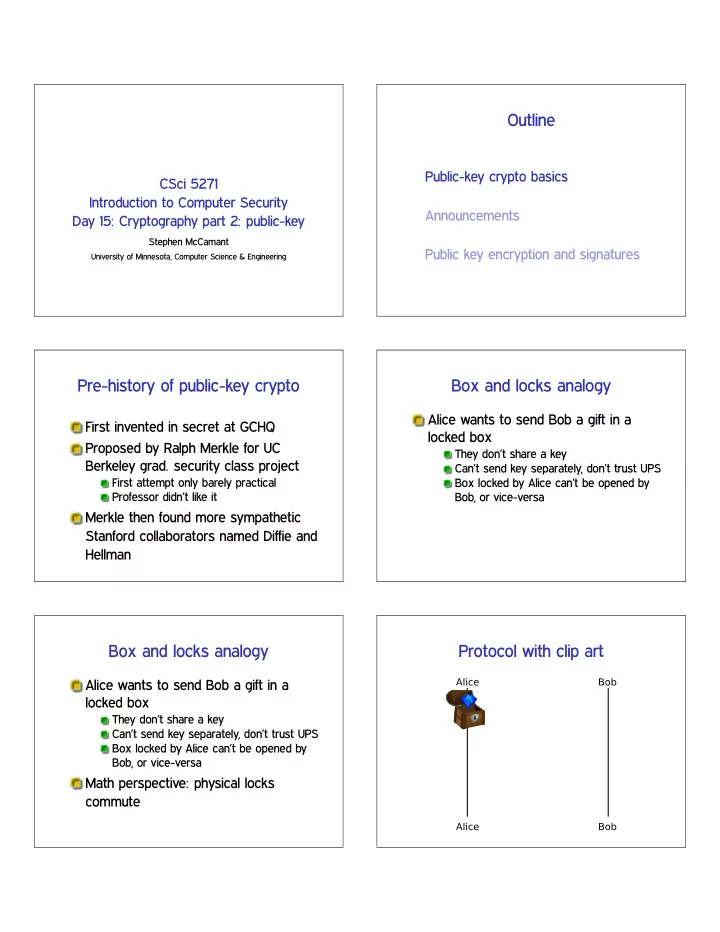
Box and locks analogy
Alice wants to send Bob a gift in a locked box
They don’t share a key Can’t send key separately, don’t trust UPS Box locked by Alice can’t be opened by Bob, or vice-versa
Box and locks analogy
Alice wants to send Bob a gift in a locked box
They don’t share a key Can’t send key separately, don’t trust UPS Box locked by Alice can’t be opened by Bob, or vice-versa
Math perspective: physical locks commute
Protocol with clip art
SLIDE 2
Protocol with clip art Protocol with clip art Protocol with clip art Public key primitives
Public-key encryption (generalizes block cipher)
Separate encryption key EK (public) and decryption key DK (secret)
Signature scheme (generalizes MAC)
Separate signing key SK (secret) and verification key VK (public)
Modular arithmetic
Fix modulus ♥, keep only remainders mod ♥
mod 12: clock face; mod ✷✸✷: ✉♥s✐❣♥❡❞ ✐♥t
✰, ✲, and ✂ work mostly the same Division: see Exercise Set 1 Exponentiation: efficient by square and multiply
Generators and discrete log
Modulo a prime ♣, non-zero values and ✂ have a nice (“group”) structure ❣ is a generator if ❣✵❀ ❣❀ ❣✷❀ ❣✸❀ ✿ ✿ ✿ cover all elements Easy to compute ① ✼✦ ❣① Inverse, discrete logarithm, hard for large ♣
SLIDE 3
Diffie-Hellman key exchange
Goal: anonymous key exchange Public parameters ♣, ❣; Alice and Bob have resp. secrets ❛, ❜ Alice✦Bob: ❆ ❂ ❣❛ ✭mod ♣✮ Bob✦Alice: ❇ ❂ ❣❜ ✭mod ♣✮ Alice computes ❇❛ ❂ ❣❜❛ ❂ ❦ Bob computes ❆❜ ❂ ❣❛❜ ❂ ❦
Relationship to a hard problem
We’re not sure discrete log is hard (likely not even NP-complete), but it’s been unsolved for a long time If discrete log is easy (e.g., in P), DH is insecure Converse might not be true: DH might have other problems
Categorizing assumptions
Math assumptions unavoidable, but can categorize E.g., build more complex scheme, shows it’s “as secure” as DH because it has the same underlying assumption Commonly “decisional” (DDH) and “computational” (CDH) variants
Key size, elliptic curves
Need key sizes ✘10 times larger then security level
Attacks shown up to about 768 bits
Elliptic curves: objects from higher math with analogous group structure
(Only tenuously connected to ellipses)
Elliptic curve algorithms have smaller keys, about 2✂ security level
Outline
Public-key crypto basics Announcements Public key encryption and signatures
Note to early readers
This is the section of the slides most likely to change in the final version If class has already happened, make sure you have the latest slides for announcements
SLIDE 4
Outline
Public-key crypto basics Announcements Public key encryption and signatures
General description
Public-key encryption (generalizes block cipher)
Separate encryption key EK (public) and decryption key DK (secret)
Signature scheme (generalizes MAC)
Separate signing key SK (secret) and verification key VK (public)
RSA setup
Choose ♥ ❂ ♣q, product of two large primes, as modulus ♥ is public, but ♣ and q are secret Compute encryption and decryption exponents ❡ and ❞ such that ▼❡❞ ❂ ▼ ✭mod ♥✮
RSA encryption
Public key is ✭♥❀ ❡✮ Encryption of ▼ is ❈ ❂ ▼❡ ✭mod ♥✮ Private key is ✭♥❀ ❞✮ Decryption of ❈ is ❈❞ ❂ ▼❡❞ ❂ ▼ ✭mod ♥✮
RSA signature
Signing key is ✭♥❀ ❞✮ Signature of ▼ is ❙ ❂ ▼❞ ✭mod ♥✮ Verification key is ✭♥❀ ❡✮ Check signature by ❙❡ ❂ ▼❞❡ ❂ ▼ ✭mod ♥✮ Note: symmetry is a nice feature of RSA, not shared by other systems
RSA and factoring
We’re not sure factoring is hard (likely not even NP-complete), but it’s been unsolved for a long time If factoring is easy (e.g., in P), RSA is insecure Converse might not be true: RSA might have other problems
SLIDE 5 Homomorphism
Multiply RSA ciphertexts ✮ multiply plaintexts This homomorphism is useful for some interesting applications Even more powerful: fully homomorphic encryption (e.g., both ✰ and ✂)
First demonstrated in 2009; still very inefficient
Problems with vanilla RSA
Homomorphism leads to chosen-ciphertext attacks If message and ❡ are both small compared to ♥, can compute ▼✶❂❡
Many more complex attacks too
Hybrid encryption
Public-key operations are slow In practice, use them just to set up symmetric session keys ✰ Only pay RSA costs at setup time ✲ Breaks at either level are fatal
Padding, try #1
Need to expand message (e.g., AES key) size to match modulus PKCS#1 v. 1.5 scheme: prepend 00 01 FF FF .. FF Surprising discovery (Bleichenbacher’98): allows adaptive chosen ciphertext attacks on SSL
Modern “padding”
Much more complicated encoding schemes using hashing, random salts, Feistel-like structures, etc. Common examples: OAEP for encryption, PSS for signing Progress driven largely by improvement in random oracle proofs
Simpler padding alternative
“Key encapsulation mechanism” (KEM) For common case of public-key crypto used for symmetric-key setup
Also applies to DH
Choose RSA message r at random mod ♥, symmetric key is ❍✭r✮ ✲ Hard to retrofit, RSA-KEM insecure if ❡ and r reused with different ♥
SLIDE 6
Box and locks revisited
Alice and Bob’s box scheme fails if an intermediary can set up two sets of boxes
Man-in-the-middle (or middleperson) attack
Real world analogue: challenges of protocol design and public key distribution
Next time
Building crypto into more complex protocols