SLIDE 1 1
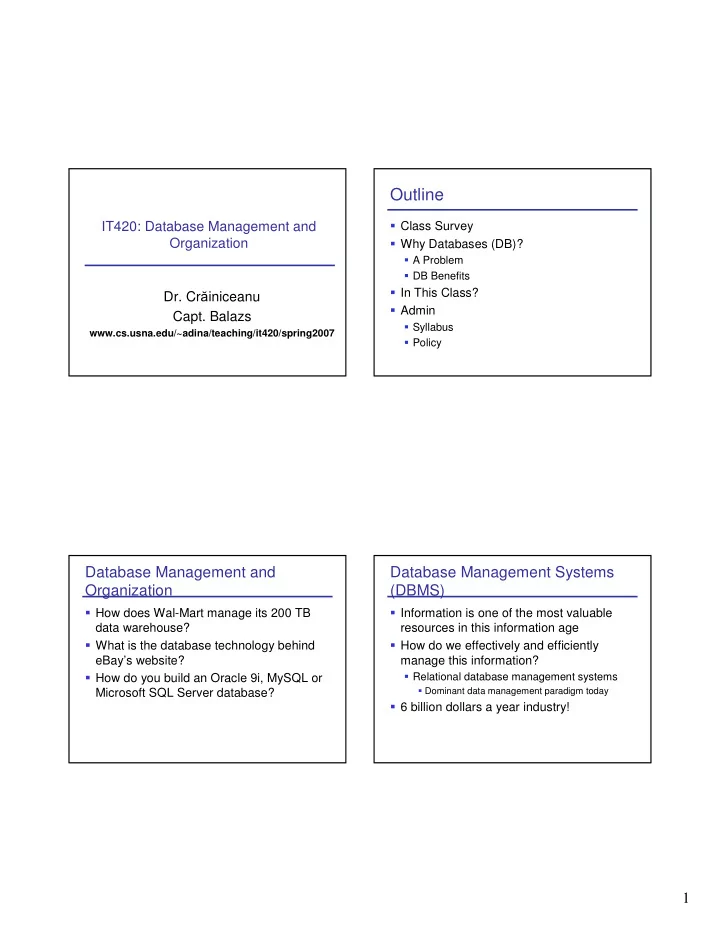
IT420: Database Management and Organization
- Dr. Criniceanu
- Capt. Balazs
www.cs.usna.edu/~adina/teaching/it420/spring2007
Outline
Class Survey Why Databases (DB)?
A Problem DB Benefits
In This Class? Admin
Syllabus Policy
Database Management and Organization
How does Wal-Mart manage its 200 TB data warehouse? What is the database technology behind eBay’s website? How do you build an Oracle 9i, MySQL or Microsoft SQL Server database?
Database Management Systems (DBMS)
Information is one of the most valuable resources in this information age How do we effectively and efficiently manage this information?
Relational database management systems
Dominant data management paradigm today
6 billion dollars a year industry!
SLIDE 2
2
ICE: The Mid Store
Create a system to keep track of inventory
Problems
Changes to data - Data model “on the fly” queries Data inconsistencies Security of information (views) Performance Partial processing Concurrency
Why Database Management Systems?
Benefits
High-level abstractions for data modeling, access, manipulation, and administration Data integrity and security Performance and scalability Transactions (concurrent data access, recovery from system crashes)
Data Model
Entity-Relationship model Relational model Object-oriented model Object-relational model XML
SLIDE 3 3
The Relational Data Model
Turing Award for Codd in 1980 Tables Database
The Object-Oriented Data Model
Richer data model. Goal: Bridge mismatch between programming languages and the database system. Example components of the data model:
Relationships between objects directly as pointers.
Result: Can store abstract data types directly in the DBMS
Pictures Geographic coordinates Movies CAD objects
Object-Oriented DBMS
Advantages:
Engineering applications (CAD and CAM and CASE computer aided software engineering), multimedia applications.
Disadvantages:
Querying is much harder
Object-Relational DBMS
Mixture between the object-oriented and the object-relational data model
Combines ease of querying with ability to store abstract data types Conceptually, the relational model, but every column type is a class
All major relational vendors are currently extending their relational DBMS to the
SLIDE 4
4
XML Query Languages
We need a high-level language to describe and manipulate the data Requirements:
Precise semantics Easy integration into applications written in C++/Java/Visual Basic/etc. Easy to learn DBMS needs to be able to efficiently evaluate queries written in the language
SQL: Structured Query Language
IBM (System R) in the 1970s ANSI standard since 1986 Example: SELECT * FROM Customers WHERE Customers.cid = 3
Why Database Management Systems?
Benefits
High-level abstractions for data modeling, access, manipulation, and administration Data integrity and security Performance and scalability Transactions (concurrent data access, recovery from system crashes)
SLIDE 5 5
Integrity Constraints
Integrity Constraints (ICs): Condition that must be true for any instance of the database. ICs are specified when schema is defined. ICs are checked when tables are modified. A legal instance of a table is one that satisfies all specified ICs. DBMS should only allow legal instances. Example: Domain constraints.
Security
Secrecy: Users should not be able to see things they are not supposed to.
E.g., A student can’t see other students’ grades.
Integrity: Users should not be able to modify things they are not supposed to.
E.g., Only instructors can assign grades.
Availability: Users should be able to see and modify things they are allowed to.
Why Database Management Systems?
Benefits
High-level abstractions for data modeling, access, manipulation, and administration Data integrity and security Performance and scalability Transactions (concurrent data access, recovery from system crashes)
DBMS and Performance
Efficient implementation of all database
Indexes Query optimization Automatic high-performance concurrent query execution, query parallelization
SLIDE 6
6 Why Database Management Systems?
Benefits
High-level abstractions for data modeling, access, manipulation, and administration Data integrity and security Performance and scalability Transactions (concurrent data access, recovery from system crashes)
What is a Transaction?
The execution of a program that performs a function by accessing a database. Examples:
Buy an airline ticket. Withdraw money from an ATM. Verify a credit card sale. Order an item from an Internet retailer.
Transactions
A transaction is an atomic sequence of actions Each transaction must leave the system in a consistent state The ACID Properties
Example Transaction: Online Store
Your purchase transaction: Atomicity: Either the complete purchase happens, or nothing Consistency: The inventory and internal accounts are updated correctly Isolation: It does not matter whether other customers are also currently making a purchase Durability: Once you have received the order confirmation number, your order information is permanent, even if the site crashes
SLIDE 7
7 What Makes Transaction Processing Hard?
Reliability Availability Response time Throughput Scalability Security Configurability Atomicity Durability Distribution
What Makes TP Important?
It is at the core of electronic commerce Most medium-to-large businesses use TP for their production systems. It is a huge slice of the computer system market – over $50 B/year
Summary Of DBMS Benefits
High-level abstractions for data access
Data models
Data integrity and security
Key constraints, integrity constraints, access control
Performance and scalability
Parallel DBMS, distributed DBMS, performance tuning
Transactions
ACID properties, concurrency control, recovery
Best Jobs!
SLIDE 8 8
IT Analyst Course Topics
Database design Relational model SQL Normalization Database administration PHP MySQL
Course Goals
- Explain the main advantages of modern database
management systems over file systems.
- Design, create, and query relational databases to satisfy
user requirements.
- Design, build and deploy database-backed applications
with dynamic website front-end.
- Implement data access control mechanisms for database
and application security.
- Analyze the ethical issues and responsibilities related to
records management Create applications that USE a Database Management System
Things We Will NOT Cover
Relational algebra and calculus Implementation of index structures Query evaluation and optimization
How to BUILD a Database Management System
SLIDE 9
9
Success in IT420
Lecture – stay engaged
Take notes – provided slides are not enough! Exams closed-book – but open-note! Ask & answer questions
Make the most of in-class lab time
Read lab in advance Think before you start typing Don’t stay stuck!
Don’t fall behind
Finish lab early and leave time for reading See me for help and/or talk to friends Course material builds on itself and gets more complex
Academic Integrity - Honor
Collaboration on labs/ hws is allowed, but submitted work should be your own
Cite any assistance, from any sources
Collaboration on projects, quizzes and exams is prohibited http://www.cs.usna.edu/academics/honor. htm
Resources
Lecture slides / your notes Textbook: Database Processing by David Kroenke Database Management Systems by R. Ramakrishnan and J. Gehrke PHP and MySQL Web Development by L. Welling and L. Thomson