Outline Cloud Computing for CE devices Elastic Application - - PDF document

outline
SMART_READER_LITE
LIVE PREVIEW

Outline Cloud Computing for CE devices Elastic Application - - PDF document

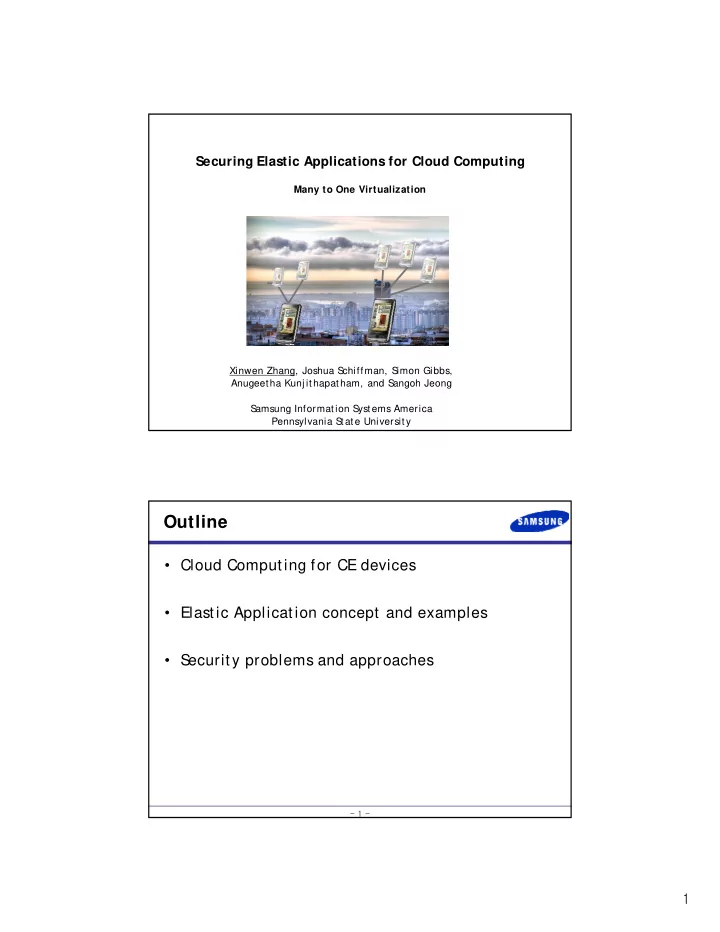
Securing Elastic Applications for Cloud Computing Many to One Virtualization Xinwen Zhang, Joshua S chiffman, S imon Gibbs, Anugeetha Kunj ithapatham, and S angoh Jeong S amsung Information S ystems America Pennsylvania S tate University


slide-1
SLIDE 1

1

Securing Elastic Applications for Cloud Computing

Many to One Virtualization Xinwen Zhang, Joshua S chiffman, S imon Gibbs, Anugeetha Kunj ithapatham, and S angoh Jeong S amsung Information S ystems America Pennsylvania S tate University

  • 1 -

Outline

  • Cloud Computing for CE devices
  • Elastic Application concept and examples
  • S

ecurity problems and approaches

slide-2
SLIDE 2

2

  • 2 -

CE + Cloud Computing (1 of 2)

Cloud is a platform for service delivery Push from services into devices

IT View of Cloud Computing cloud = web service platform

  • 3 -

CE + Cloud Computing (2 of 2)

Cloud is a platform

for new applications that run across the cloud and device (“ elastic applications” )

Expand the device into the cloud

Proposed CE View of Cloud Computing cloud = data/ core center + API

API

slide-3
SLIDE 3

3

  • 4 -

Ongoing Approaches for Mobile + Cloud

  • CloneCloud (Hot Cloud’ 09)

– Clone of phone image at cloud

  • Dynamic Composable Comput ing (Hot Mobile’ 08)

– Dynamic composition of functions with mobile devices and surrogates.

  • Cloudlet (PVC’ 09)

– Offloading VM to proximate infrastructure – 60-90s on VM synthesis

  • HW-supported VM migrat ion (At om) (MobiCase’ 09)

– Focus on mobility of app

  • Elastic Device/ Application

– On application level – Dynamic execution configuration – More flexible and easy for parallel…

  • 5 -

Motivation

CE Devices

Compute – Fixed S torage – Fixed* Power – Limited Bandwidth – Limited Applications – CONS TRAINED

The Cloud

Compute – ELASTIC S torage – ELAS TIC Applications – UNCONS TRAINED

The goal of the Elastic Device proj ect is to enable development of cross device/cloud

  • applications. The advantages are:
  • Remove device constraints, create new classes of powerful applications
  • Help realize a new business model for device applications
  • Provide developers a transition path to multi/many core
slide-4
SLIDE 4

4

  • 6 -

Core Operating System UI Container Elastic Layer

Elastic Device Concept

Hardware Battery

Application Store

When device resources are sufficient

App Core App

Cloud Platform

When device resources are not sufficient

Core

App

New!

RAM Flash

  • 7 -
  • 7 -

Elastic Applications (EA)

  • EA are cloud aware applications
  • Weblets

– Define discrete application components – Communicate using RES T interface – Run on Device or Cloud – Can be replicated to handle loads

  • Application GUI

– Launches the program – Directs the creation of new weblets

  • Manifest

– Meta-data of EA – Dynamic configuration info – Integrity of weblets – Policies for each weblet

  • E.g. JVM, network, access control, location

Elastic App

Weblet Weblet

App GUI

Weblet

Manifest

Manifest

Integrity Access Control Location Info Security Settings

slide-5
SLIDE 5

5

  • 8 -
  • 8 -

Elastic Devices (ED)

  • ED support EAs

– Enable seamless migration of weblets – Manage resources to optimize costs – Interface with cloud providers

  • Elastic Manager

– S pawns weblets on demand – Migrates weblets to / from cloud – S enses resource availability

  • Cloud Fabric Interface

– Exposes cloud services to devices – Controls weblets on behalf of EM

  • S

tart / S top / Create / Destroy

– Can provide PaaS or IaaS model

Elastic Device

Elastic Manager Weblet App GUI Cloud Fabric Interface Weblet Weblet Weblet

  • 9 -

Benefits

  • Many-to-one virt ualizat ion

– S eamlessly expands and shrinks of platform capability

  • Dynamic user experience

– User control of expending/ shrinking based on factors such as battery consuming, monetary cost, latency/ throughput, etc.

  • Device flexibility

– CE device computation and storage capabilities need not be designed to satisfy the most demanding applications.

  • Dependability

– Migrating applications to cloud when device is low in battery/ weak signal

  • Future proof:

– Move app from cloud to device, extend app lifetime, reduce development cost

slide-6
SLIDE 6

6

  • 10 -

Challenges

  • Application model (data model, concurrency, lang features, …

)

  • Performance (QoS

, caching, scheduling, … )

  • Dynamic configuration (costs, migration, replication, …

)

  • S

ecurity (new threats, data privacy, access control, … )

  • 11 -

Reference Architecture

Sensing Device Elasticity Manager Elastic Layer Http(s) http Router UI Container Application Store

Application Installation Elastic Device

Cloud Fabric Interface manifest weblet1 weblet 2 UI Elastic Application Cloud Manager Node Manager Cloud Sensing Application Manager UI Weblet2 Weblet1 Weblet Container Weblet Container

IaaS/PaaS Cloud Elasticity Service

Http(s)

Elastic application package

including UI and weblets

Cloud nodes running on Amazon

EC2 instances

Web service –

based CFI

Application installation on both

cloud and device sides

slide-7
SLIDE 7

7

  • 12 -

Elasticity Patterns and Applications

  • Elastic image processing
  • Elastic augmented reality
  • Elastic augmented video
  • 13 -

Elastic Image Processing

S amsung Q1 S amsung Omnia

  • n device: image processing
  • n cloud: image processing

ElasticIP App ImageWeblet 1 ImageWeblet n ImageWeblet 2

ImageWeblet App on Device (Analysis & Filtering of images)

slide-8
SLIDE 8

8

  • 14 -

Elastic Augmented Video

S amsung Q1

planar object recognition and replacement

  • n device: feature point extraction from video, tracking, compositing
  • n cloud: matching live features against library of target images

ElasticAV App Splitter Matcher 1 Matcher n Matcher 2

Tracker Camera ElasticAV Application (ident ify, t rack & replace “ t arget ” images) Composito r

  • 15 -

Elastic Augmented Reality

S amsung Galaxy

  • n device: using compass and GPS to align POI markers with live video from camera
  • n cloud: POI service and crowd simulator (gives # people in proximity to POI’s)

ElasticAV App POI Servic e Crowd Sim Tracker GPS ElasticAR Application (register POI icons & real-time info

  • n live camera)

Composit

  • r

Compass Camera

slide-9
SLIDE 9

9

  • 16 -

Security Threats

  • Threats from Applications

– Untrusted applications can damage the weblets, weblet containers, the elastic manager, and their behaviors

  • Compromise the code and data integrity of installed elastic applications
  • Change or disable t he elast ic manager’ s funct ionalit y
  • Launch weblets on cloud platforms without user authorization/ awareness
  • Threats in the Cloud

– Malicious change to cloud VM, including VM itself and any configurations. – Malicious change to weblet code and data on cloud side – Malicious change to network and cost settings: e.g., use expensive network connections – Hidden malicious activities that consume cloud resources

  • Threats on the Network

– Man-in-the-Middle (MITM) attack:

  • Passive eavesdropping all the t raffic in the middle
  • Act ive replay attack
  • S

ession hij ack.

– Dynamic Denial-of-S ervice (DDoS ) attack to both ED and cloud – Generate random traffic to weblets such consume user bill

  • 17 -

Elastic Application Security Requirements

  • Trust

– Applications must trust both the cloud and device.

  • Weblets

– Communication with weblets must be secure. Only application should be able to issue request s t o its weblets. – Privacy of weblet data. Maintaining isolation.

  • Migration

– What happens t o access rights when an weblet is migrated. – How are sessions maintained when a weblet is migrated.

  • Monitoring / Aggregation

– Want t o monit or and collect device and cloud dat a. Privacy considerations. – Using cloud t o detect malicious behavior.

slide-10
SLIDE 10

10

  • 18 -

5 Security Aspects

Main() Elastic Manager CFI

Weblet Weblet Weblet Weblet Elastic Device

III: Building trusted elastic device:

  • Secure downloading and installation
  • Secure Elastic app runtime environment

Application Store IV: Building trusted cloud VM:

  • Authenticated installation and launching weblets
  • Secure weblet runtime in cloud
  • Trusted behavior or cloud VM, e.g., no hidden resource consuming

II: Resource Usage Monitoring, Logging, and Auditing

  • Monitoring resource usage on both ED and cloud
  • Detect and confine any malicious behavior

I: Building secure communication between weblets:

  • Secure session management
  • Comm. upon authentication
  • Secure weblet migration

Other web services or clouds (e.g., Facebook, Twitter) V: Authorization to access external services:

  • Fine-grained permission control
  • Secure revocation
  • Privacy control
  • 19 -

Secure Session and Authentication

  • Issues and Challenges:

– S ecure session and authentication with heterogeneous clouds

  • Cloud weblets may need access other cloud/ ws on behalf of user, so need permission

– Weblet migration: seamless accessing resource after migration

  • weblet migrates between ED and clouds
  • S

ession migration is need to provide seamless runtime performance

– Least of privilege:

– not sharing user account credential in cloud weblets – otherwise malicious weblets can get all user info – Give less trust to cloud weblets – S

  • far, user does not trust cloud environment too much

– Permission delegation:

  • a cloud weblet only can access authorized resources specified by the user or application

developer

– Must be efficient – Must have minimum application developer awareness:

  • we are building an infrastructure for application developers

– Must have minimum user interference:

  • E.g., user only needs to login to external web services
slide-11
SLIDE 11

11

  • 20 -

Device Elasticity Manager Local Weblet Cloud Node Main CFI LaunchWeblet (wid1) LaunchWeblet (cfi,wid2,wsk,wss) GenerateS ession(wsk,wss) LaunchWeblet (localhost ,wid1,wsk,wss) app_method(p1,..,pn, wsk, N1, wid1,wid2, sig) Decide locat ion t o launch wid1 S elect cloud node t o launch WebletOK(wid2_url,wid2,wsk,sig) WebletOK(wid2_url,wid2,wsk,sig) Get Weblet s(wsk) WebletList (wsk) LaunchWeblet (nodeid,wid2,wsk,wss) LaunchWeblet (wid2,wsk,wss) Cloud Weblet WebletOK(wid1_url,wid1,wsk,sig) LaunchWeblet (wid2) WebletOK(wid2_url,wid2,wsk,sig) Htt ps Htt p

Authentication & Session Management

Security Objectives

  • Session Identity

– To identify a session between weblets in different locations – Identify instances of the same elast ic app (EA)

  • Prevent network attacks

– Replay attack – S ession hij ack

  • Accountability

– Monit or usage and cost of elastic applications

WebletOK(wid1_url,wid1,wsk,sig) WebletOK(wid2_url,wid2,wsk,sig)

  • 21 -

Secure Migration

Security Objectives

  • Integrity

– Maintain session secrets and tokens during migration – Resume secure communication between weblets

  • Transparency

– Transparent to cloud-level migration (When a cloud node weblet container is migrated from one physical machine t o another.)
slide-12
SLIDE 12

12

  • 22 -

Ongoing and Future Work

  • Fine-grained authorization for cloud-based weblets

– Delegate subset of permissions to cloud weblets: less trust for cloud components – For least-privilege, information flow control, etc.

  • S

ecure elast icity layer

– Resistant to compromise

  • Verifying distributed application integrity with less trust on service provider

– Results depend on all weblets’ integrity – Data and control flow integrity verification

  • Establishing trust in public cloud systems

– Trusted Computing – Integrity Measurement / Verification

  • 23 -

Q & A