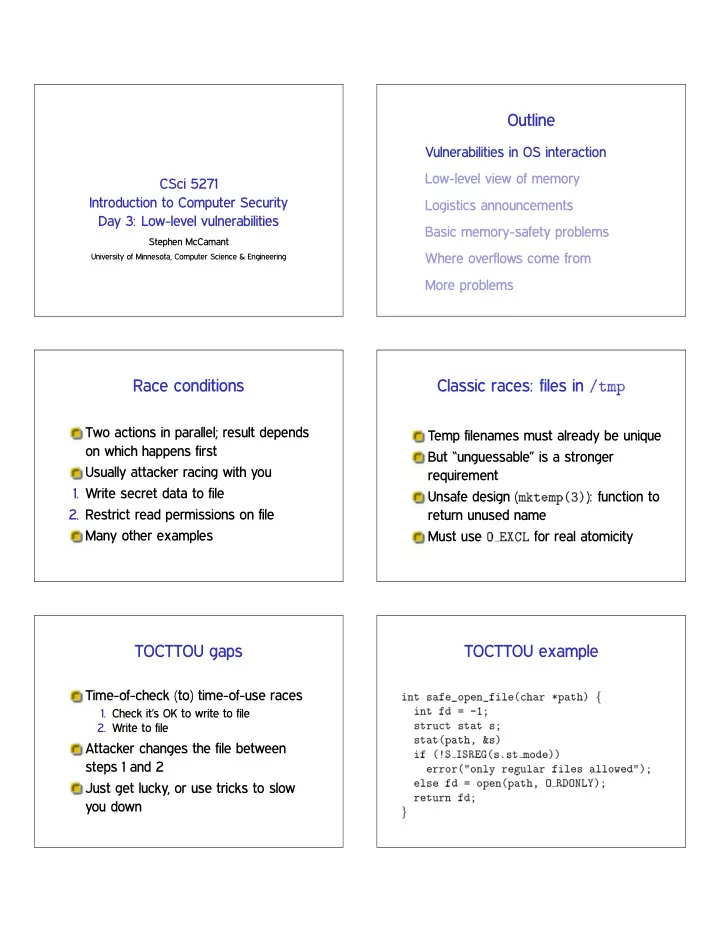
SLIDE 1 CSci 5271 Introduction to Computer Security Day 3: Low-level vulnerabilities
Stephen McCamant
University of Minnesota, Computer Science & Engineering
Outline
Vulnerabilities in OS interaction Low-level view of memory Logistics announcements Basic memory-safety problems Where overflows come from More problems
Race conditions
Two actions in parallel; result depends
Usually attacker racing with you
- 1. Write secret data to file
- 2. Restrict read permissions on file
Many other examples
Classic races: files in ✴t♠♣
Temp filenames must already be unique But “unguessable” is a stronger requirement Unsafe design (♠❦t❡♠♣✭✸✮): function to return unused name Must use ❖ ❊❳❈▲ for real atomicity
TOCTTOU gaps
Time-of-check (to) time-of-use races
- 1. Check it’s OK to write to file
- 2. Write to file
Attacker changes the file between steps 1 and 2 Just get lucky, or use tricks to slow you down
TOCTTOU example
✐♥t s❛❢❡❴♦♣❡♥❴❢✐❧❡✭❝❤❛r ✯♣❛t❤✮ ❢ ✐♥t ❢❞ ❂ ✲✶❀ str✉❝t st❛t s❀ st❛t✭♣❛t❤✱ ✫s✮ ✐❢ ✭✦❙ ■❙❘❊●✭s✳st ♠♦❞❡✮✮ ❡rr♦r✭✧♦♥❧② r❡❣✉❧❛r ❢✐❧❡s ❛❧❧♦✇❡❞✧✮❀ ❡❧s❡ ❢❞ ❂ ♦♣❡♥✭♣❛t❤✱ ❖ ❘❉❖◆▲❨✮❀ r❡t✉r♥ ❢❞❀ ❣
SLIDE 2
TOCTTOU example
✐♥t s❛❢❡❴♦♣❡♥❴❢✐❧❡✭❝❤❛r ✯♣❛t❤✮ ❢ ✐♥t ❢❞ ❂ ✲✶✱ r❡s❀ str✉❝t st❛t s❀ r❡s ❂ st❛t✭♣❛t❤✱ ✫s✮ ✐❢ ✭r❡s ⑤⑤ ✦❙ ■❙❘❊●✭s✳st ♠♦❞❡✮✮ ❡rr♦r✭✧♦♥❧② r❡❣✉❧❛r ❢✐❧❡s ❛❧❧♦✇❡❞✧✮❀ ❡❧s❡ ❢❞ ❂ ♦♣❡♥✭♣❛t❤✱ ❖ ❘❉❖◆▲❨✮❀ r❡t✉r♥ ❢❞❀ ❣
TOCTTOU example
✐♥t s❛❢❡❴♦♣❡♥❴❢✐❧❡✭❝❤❛r ✯♣❛t❤✮ ❢ ✐♥t ❢❞ ❂ ✲✶✱ r❡s❀ str✉❝t st❛t s❀ r❡s ❂ st❛t✭♣❛t❤✱ ✫s✮ ✐❢ ✭r❡s ⑤⑤ ✦❙ ■❙❘❊●✭s✳st ♠♦❞❡✮✮ ❡rr♦r✭✧♦♥❧② r❡❣✉❧❛r ❢✐❧❡s ❛❧❧♦✇❡❞✧✮❀ ❡❧s❡ ❢❞ ❂ ♦♣❡♥✭♣❛t❤✱ ❖ ❘❉❖◆▲❨✮❀ r❡t✉r♥ ❢❞❀ ❣
Changing file references
With symbolic links With hard links With changing parent directories Avoid by instead using:
❢✯ functions that operate on fds ✯❛t functions that use an fd in place of the CWD
Directory traversal with ✳✳
Program argument specifies file with directory ❢✐❧❡s What about ❢✐❧❡s✴✳✳✴✳✳✴✳✳✴✳✳✴❡t❝✴♣❛ss✇❞?
Environment variables
Can influence behavior in unexpected ways
P❆❚❍ ▲❉ ▲■❇❘❆❘❨ P❆❚❍ ■❋❙ . . .
Also umask, resource limits, current directory
IFS and why it’s a problem
In Unix, splitting a command line into words is the shell’s job
String ✦ argv array ❣r❡♣ ❛ ❜ ❝ vs. ❣r❡♣ ✬❛ ❜✬ ❝
Choice of separator characters (default space, tab, newline) is configurable Exploit s②st❡♠✭✧✴❜✐♥✴✉♥❛♠❡✧✮
SLIDE 3
Outline
Vulnerabilities in OS interaction Low-level view of memory Logistics announcements Basic memory-safety problems Where overflows come from More problems
Overall layout (Linux 32-bit) Detail: static code and data Detail: heap Detail: initial stack Example stack frame
SLIDE 4
Outline
Vulnerabilities in OS interaction Low-level view of memory Logistics announcements Basic memory-safety problems Where overflows come from More problems
HA1 virtual machines
Ubuntu 16.04 server, hosted on CSE Labs
64-bit kernel but 32-bit BCMTA, ❣❝❝ ✲♠✸✷
One VM per group (up to 2 students) For allocation, send group list to Aditya ♣❛❦❦✐✵✵✶❅✉♠♥✳❡❞✉ Don’t put off until the last minute
Other parts of HA1
Instructions will be on the Assignments area of course web page But BCMTA is not ready yet, so first due date will be delayed Nothing due before next Wednesday, no hidden vulnerability before next Friday
Exercise set 1
Available on website Due Wednesday, February 13th, on Canvas Groups of 1-2, turn in one copy
Canvas, discussions
Canvas page started, will use for assignment turn-in Online discussions, including for group formation For spoiler questions, email both me and the TA, keep CC’d
Finding project topics
Pre-proposal due 2/6 (one week from Wednesday) Don’t skimp on topic selection: important to success Conference papers linked from class site
SLIDE 5 More on choosing topics
Can’t: wait to see what part of class you like best
But feel free to look ahead
Think about your group’s skills
Also: available hardware/software
Think about where to find novelty Topic changes allowed, but will set you back
Outline
Vulnerabilities in OS interaction Low-level view of memory Logistics announcements Basic memory-safety problems Where overflows come from More problems
Stack frame overflow Overwriting adjacent objects
Forward or backward on stack
Other local variables, arguments
Fields within a structure Global variables Other heap objects
Overwriting metadata
On stack:
Return address Saved registers, incl. frame pointer
On heap:
Size and location of adjacent blocks
Double free
Passing the same pointer value to ❢r❡❡ more than once More dangerous the more other heap
- perations occur in between
SLIDE 6
Use after free
AKA use of a dangling pointer Could overwrite heap metadata Or, access data with confused type
Outline
Vulnerabilities in OS interaction Low-level view of memory Logistics announcements Basic memory-safety problems Where overflows come from More problems
Library funcs: unusable
❣❡ts writes unlimited data into supplied buffer No way to use safely (unless stdin trusted) Finally removed in C11 standard
Library funcs: dangerous
Big three unchecked string functions
str❝♣②✭❞❡st✱ sr❝✮ str❝❛t✭❞❡st✱ sr❝✮ s♣r✐♥t❢✭❜✉❢✱ ❢♠t✱ ✳✳✳✮
Must know lengths in advance to use safely (complicated for s♣r✐♥t❢) Similar pattern in other funcs returning a string
Library funcs: bounded
Just add “n”:
str♥❝♣②✭❞❡st✱ sr❝✱ ♥✮ str♥❝❛t✭❞❡st✱ sr❝✱ ♥✮ s♥♣r✐♥t❢✭❜✉❢✱ s✐③❡✱ ❢♠t✱ ✳✳✳✮
Tricky points:
Buffer size vs. max characters to write Failing to terminate str♥❝♣② zero-fill
More library attempts
OpenBSD str❧❝♣②, str❧❝❛t
Easier to use safely than “n” versions Non-standard, but widely copied
Microsoft-pushed str❝♣② s, etc.
Now standardized in C11, but not in glibc Runtime checks that ❛❜♦rt
Compute size and use ♠❡♠❝♣② C++ st❞✿✿str✐♥❣, glib, etc.
SLIDE 7
Still a problem: truncation
Unexpectedly dropping characters from the end of strings may still be a vulnerability E.g., if attacker pads paths with ✴✴✴✴✴✴✴ or ✴✳✴✳✴✳✴✳ Avoiding length limits is best, if implemented correctly
Off-by-one bugs
str❧❡♥ does not include the terminator Comparison with ❁ vs. ❁❂ Length vs. last index ①✰✰ vs. ✰✰①
Even more buffer/size mistakes
Inconsistent code changes (use s✐③❡♦❢) Misuse of s✐③❡♦❢ (e.g., on pointer) Bytes vs. wide chars (UCS-2) vs. multibyte chars (UTF-8) OS length limits (or lack thereof)
Other array problems
Missing/wrong bounds check
One unsigned comparison suffices Two signed comparisons needed
Beware of clever loops
Premature optimization
Outline
Vulnerabilities in OS interaction Low-level view of memory Logistics announcements Basic memory-safety problems Where overflows come from More problems
Integer overflow
Fixed size result ✻❂ math result Sum of two positive ✐♥ts negative or less than addend Also multiplication, left shift, etc. Negation of most-negative value ✭❧♦✇ ✰ ❤✐❣❤✮✴✷
SLIDE 8 Integer overflow example
✐♥t ♥ ❂ r❡❛❞❴✐♥t✭✮❀ ♦❜❥ ✯♣ ❂ ♠❛❧❧♦❝✭♥ ✯ s✐③❡♦❢✭♦❜❥✮✮❀ ❢♦r ✭✐ ❂ ✵❀ ✐ ❁ ♥❀ ✐✰✰✮ ♣❬✐❪ ❂ r❡❛❞❴♦❜❥✭✮❀
Signed and unsigned
Unsigned gives more range for, e.g., s✐③❡ t At machine level, many but not all
Most important difference: ordering In C, signed overflow is undefined behavior
Mixing integer sizes
Complicated rules for implicit conversions
Also includes signed vs. unsigned
Generally, convert before operation:
E.g., ✶❯▲▲ ❁❁ ✻✸
Sign-extend vs. zero-extend
❝❤❛r ❝ ❂ ✵①❢❢❀ ✭✐♥t✮❝
Null pointers
Vanilla null dereference is usually non-exploitable (just a DoS) But not if there could be an offset (e.g., field of struct) And not in the kernel if an untrusted user has allocated the zero page
Undefined behavior
C standard “undefined behavior”: anything could happen Can be unexpectedly bad for security Most common problem: compiler
- ptimizes assuming undefined behavior
cannot happen
Linux kernel example
str✉❝t s♦❝❦ ✯s❦ ❂ t✉♥✲❃s❦❀ ✴✴ ✳✳✳ ✐❢ ✭✦t✉♥✮ r❡t✉r♥ P❖▲▲❊❘❘❀ ✴✴ ♠♦r❡ ✉s❡s ♦❢ t✉♥ ❛♥❞ s❦
SLIDE 9
Format strings
♣r✐♥t❢ format strings are a little interpreter ♣r✐♥t❢✭❢♠t✮ with untrusted ❢♠t lets the attacker program it Allows:
Dumping stack contents Denial of service Arbitrary memory modifications!
Next time
Exploitation techniques for these vulnerabilities