Outline Why utilize APPs in the ICU Advanced Practice Providers - - PDF document

outline
SMART_READER_LITE
LIVE PREVIEW

Outline Why utilize APPs in the ICU Advanced Practice Providers - - PDF document

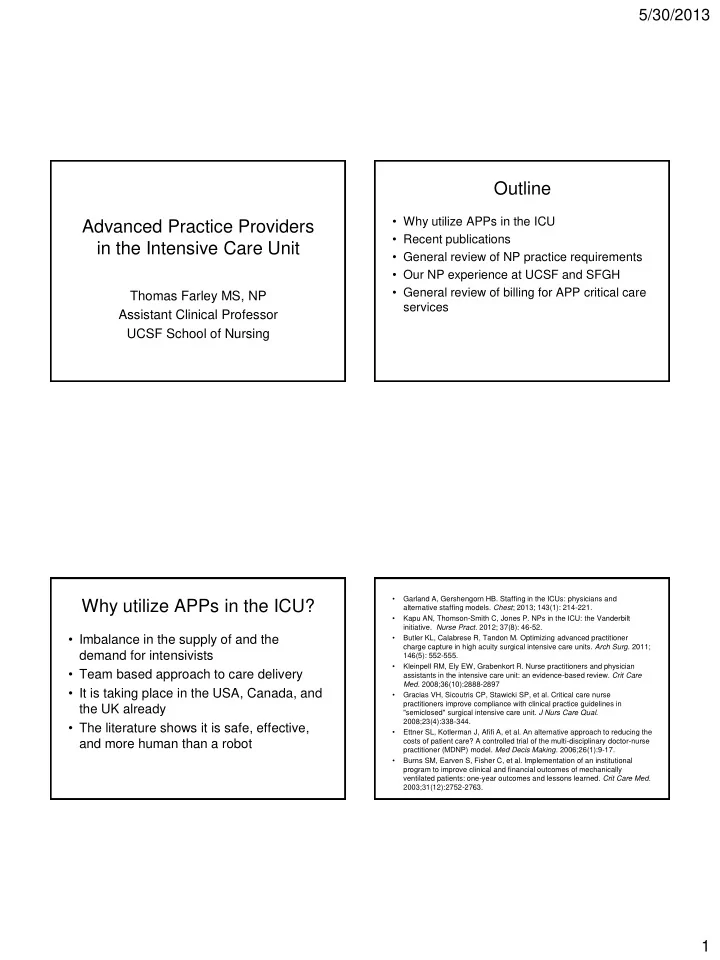
5/30/2013 Outline Why utilize APPs in the ICU Advanced Practice Providers Recent publications in the Intensive Care Unit General review of NP practice requirements Our NP experience at UCSF and SFGH General review of billing


slide-1
SLIDE 1

5/30/2013 1

Advanced Practice Providers in the Intensive Care Unit

Thomas Farley MS, NP Assistant Clinical Professor UCSF School of Nursing

Outline

  • Why utilize APPs in the ICU
  • Recent publications
  • General review of NP practice requirements
  • Our NP experience at UCSF and SFGH
  • General review of billing for APP critical care

services

Why utilize APPs in the ICU?

  • Imbalance in the supply of and the

demand for intensivists

  • Team based approach to care delivery
  • It is taking place in the USA, Canada, and

the UK already

  • The literature shows it is safe, effective,

and more human than a robot

  • Garland A, Gershengorn HB. Staffing in the ICUs: physicians and

alternative staffing models. Chest; 2013; 143(1): 214-221.

  • Kapu AN, Thomson-Smith C, Jones P. NPs in the ICU: the Vanderbilt
  • initiative. Nurse Pract. 2012; 37(8): 46-52.
  • Butler KL, Calabrese R, Tandon M. Optimizing advanced practitioner

charge capture in high acuity surgical intensive care units. Arch Surg. 2011; 146(5): 552-555.

  • Kleinpell RM, Ely EW, Grabenkort R. Nurse practitioners and physician

assistants in the intensive care unit: an evidence-based review. Crit Care

  • Med. 2008;36(10):2888-2897
  • Gracias VH, Sicoutris CP, Stawicki SP, et al. Critical care nurse

practitioners improve compliance with clinical practice guidelines in "semiclosed" surgical intensive care unit. J Nurs Care Qual. 2008;23(4):338-344.

  • Ettner SL, Kotlerman J, Afifi A, et al. An alternative approach to reducing the

costs of patient care? A controlled trial of the multi-disciplinary doctor-nurse practitioner (MDNP) model. Med Decis Making. 2006;26(1):9-17.

  • Burns SM, Earven S, Fisher C, et al. Implementation of an institutional

program to improve clinical and financial outcomes of mechanically ventilated patients: one-year outcomes and lessons learned. Crit Care Med. 2003;31(12):2752-2763.

slide-2
SLIDE 2

5/30/2013 2

Recently published

  • Gershengorn HB, Wunsch H, Wahab R, et
  • al. Impact of non-physician staffing on
  • utcomes in a medical intensive care unit.
  • Chest. 2011; 139(6): 1347-1353.
  • Columbia Presbyterian Medical Center
  • Retrospective review of two ICUs
  • Patients managed by NP/PA team had no

worse outcomes

NPs in Critical Care or Trauma

  • Memorial Sloan Kettering Cancer Center
  • Columbia University
  • Henry Ford Hospital Detroit
  • Cleveland Clinic
  • UC Davis
  • California Pacific Medical Center
  • UCSF/SFGH Medical Centers
  • Oregon Health Sciences University

Nurse Practitioners

  • RN with Masters or Doctoral degree
  • National certification exam required
  • CA mandates use of standardized

procedures

  • Independent licensure
  • Eligible for DEA schedule 2-5 prescribing
  • NPI for medicare/private billing

NP Species

  • Focus of education and national

certification

  • Acute Care: generally inpatient care
  • Adult and Family: primary care
  • Current recommendation by National

Council of State Boards of Nursing is to restrict intensive care roles to acute care nurse practitioners

slide-3
SLIDE 3

5/30/2013 3

Our experience at UCSF

Farley, TL, Latham, G. Evolution of a critical care nurse practitioner role within a US academic medical center. ICU Director. 2011; 2(1-2): 16-19.

Evolution of a NP practice

  • At UCSF 76 adult critical care beds
  • Limited amount of housestaff
  • Goal of providing immediate critical care

consultation 24 hours a day

  • 4 NPs added in 2005
  • Currently15 NPs covering 4 ICUs
  • At times no residents on team

Evolution of a NP practice

  • At SFGH level 1 trauma center
  • Recognized need for quality control and

improvement

  • Added 4 NPs to service in 2001
  • Current environment of limited housestaff

and work hour reductions

  • Now 12 NPs in trauma/general surgery
  • At times no interns on teams

Experience at UCSF and SFGH

  • Employed by hospital not by MD group
  • Medicare part A not part B
  • No independent billing performed
  • Close contact with the UCSF SON
slide-4
SLIDE 4

5/30/2013 4

UCSF Critical Care

ICU Attending MD ICU Fellow MD Resident MD Nurse Practitioner

SFGH Surgery

Surgical Attending Surgical PGY4/5 Surgical Intern Nurse Practitioner

NP responsibilities

  • Follow and teach standard ICU practices

and protocols

  • Quality standards and improvement
  • Intervene and direct or provide

appropriate initial therapy

  • First call at UCSF and SFGH
  • Overnight shifts at UCSF and SFGH
slide-5
SLIDE 5

5/30/2013 5

Critical Care NP Duties

  • History taking and physical exams
  • Entering admission histories and physical in to the EMR
  • Entering daily progress notes into the EMR
  • Writing admission orders and routine orders
  • Independently performing procedures
  • Rounding with the critical care team and presenting

patients

  • Implementing proven care bundles (sepsis, early

mobilization, DVT prophylaxis)

Critical Care NP Duties

  • Consultative role to admitting services
  • Consultative role to bedside RNs
  • Guidance of house staff
  • Responding to code blue activations
  • Assisting with rapid response consultations
  • Serving on hospital wide multidisciplinary committees
  • Precepting acute care nurse practitioner students
  • Attending morning teaching and monthly morbidity and

mortality conferences

NP Procedures

  • Central venous catheter insertion
  • PICC insertion
  • Arterial catheter insertion
  • Chest tube insertion
  • Lumbar puncture
  • Suture and drain removal
  • Airway intubation
  • RN First Assist for OR role

Why it works

  • It is essential to have appropriate conduits

for collaboration and supervision

  • Supportive attending MDs
  • Buy-in from the ICU RNs
  • NPs have experience as ICU RNs
  • SON provides excellent job candidates
  • Dedicated and professional group of NPs
slide-6
SLIDE 6

5/30/2013 6

NPP Billing in Critical Care

  • Reference CMS transmittal #1548
  • http://www.cms.hhs.gov/Transmittals/Dow

nloads/R1548CP.pdf

  • Services may be provided by qualified

NPPs and reported for payment

  • Unlike outpatients no ‘incident to’ or

‘shared’ visits allowed

Billing in surgical critical care

  • Painter, JR. Critical care in the surgical

global period. Chest 2013;143(3):851-855.

  • Trauma and burn patients are unique
  • Medicare allows separate payment to

surgeon for post op critical care during global period

Billing in Critical Care

  • Only one provider per day can bill for CPT

99291critical care eval and mgt 30-74min

  • Follow-up after first 74min of services

billable by MD or NPP using CPT 99292 each additional 30min of critical care

  • That time must be spent at the bedside or

elsewhere on the floor as long as the provider is immediately available

Billing in Critical Care

  • May be continuous clock time or

intermittent time increments and aggregated

  • Only one provider can bill for critical care

services within an actual time period even if more than one provider involved

  • More than one provider can provide critical

care at another time and be paid

slide-7
SLIDE 7

5/30/2013 7

NP Billing in Critical Care

  • For Medicare NP billing as hospital

employees (part A) not allowed

  • To bill Medicare NPs must be employed

by clinical departments or groups

  • For Medicare, reimbursement is 85% of

published MD fee schedule

  • NPs may be credentialed by private payor
  • Private payors may reimburse up to 100%