SLIDE 1 CSci 5271 Introduction to Computer Security Day 6: Low-level defenses and counterattacks, part 2
Stephen McCamant
University of Minnesota, Computer Science & Engineering
Outline
Return-oriented programming (ROP) Announcements BCECHO Control-flow integrity (CFI) More modern exploit techniques
Basic new idea
Treat the stack like a new instruction set “Opcodes” are pointers to existing code Generalizes return-to-libc with more programmability
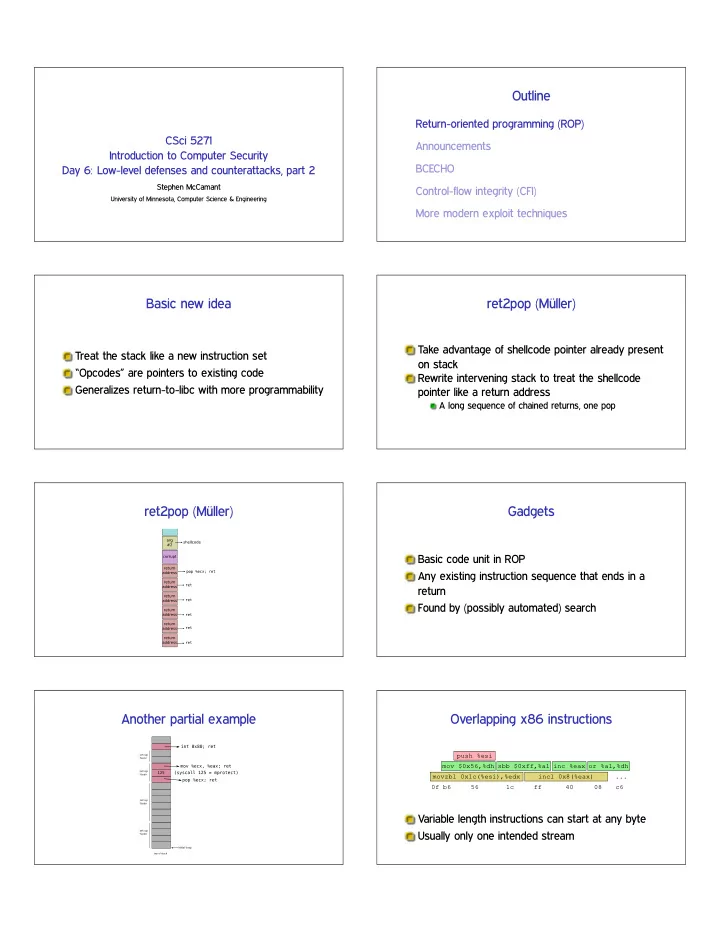
ret2pop (M¨ uller)
Take advantage of shellcode pointer already present
Rewrite intervening stack to treat the shellcode pointer like a return address
A long sequence of chained returns, one pop
ret2pop (M¨ uller) Gadgets
Basic code unit in ROP Any existing instruction sequence that ends in a return Found by (possibly automated) search
Another partial example Overlapping x86 instructions
push %esi mov $0x56,%dh sbb $0xff,%al inc %eax or %al,%dh movzbl 0x1c(%esi),%edx incl 0x8(%eax) ... 0f b6 56 1c ff 40 08 c6
Variable length instructions can start at any byte Usually only one intended stream
SLIDE 2 Where gadgets come from
Possibilities:
Entirely intended instructions Entirely unaligned bytes Fall through from unaligned to intended
Standard x86 return is only one byte, 0xc3
Building instructions
String together gadgets into manageable units of functionality Examples:
Loads and stores Arithmetic Unconditional jumps
Must work around limitations of available gadgets
Hardest case: conditional branch
Existing jCC instructions not useful But carry flag CF is Three steps:
- 1. Do operation that sets CF
- 2. Transfer CF to general-purpose register
- 3. Add variable amount to ✪❡s♣
Further advances in ROP
Can also use other indirect jumps, overlapping not required Automation in gadget finding and compilers In practice: minimal ROP code to allow transfer to
Anti-ROP: lightweight
Check stack sanity in critical functions Check hardware-maintained log of recent indirect jumps (kBouncer) Unfortunately, exploitable gaps
Gaps in lightweight anti-ROP
Three papers presented at 2014’s USENIX Security Hide / flush jump history Very long loop ✦ context switch Long “non-gadget” fragment (Later: call-preceded gadgets)
Anti-ROP: still research
Modify binary to break gadgets Fine-grained code randomization Beware of adaptive attackers (“JIT-ROP”) Next up: control-flow integrity
Outline
Return-oriented programming (ROP) Announcements BCECHO Control-flow integrity (CFI) More modern exploit techniques
SLIDE 3
Note to early readers
This is the section of the slides most likely to change in the final version If class has already happened, make sure you have the latest slides for announcements In particular, the BCMTA vulnerability announcement is embargoed
Outline
Return-oriented programming (ROP) Announcements BCECHO Control-flow integrity (CFI) More modern exploit techniques
BCECHO code
✈♦✐❞ ♣r✐♥t❴❛r❣✭❝❤❛r ✯str✮ ④ ❝❤❛r ❜✉❢❬✷✵❪❀ ✐♥t ❧❡♥❀ ✐♥t ❜✉❢❴s③ ❂ ✭s✐③❡♦❢✭❜✉❢✮✲s✐③❡♦❢✭◆❯▲▲✮✮ ✯ s✐③❡♦❢✭❝❤❛r ✯✮❀ ❧❡♥ ❂ str❧❝♣②✭❜✉❢✱ str✱ ❜✉❢❴s③✮❀ ✐❢ ✭❧❡♥ ❃ ❜✉❢❴s③✮ ④ ❢♣r✐♥t❢✭st❞❡rr✱✧❚r✉❝❛t✐♦♥ ♦❝❝✉r❡❞ ✧ ✧✇❤❡♥ ♣r✐♥t✐♥❣ ✪s❭♥✧✱ str✮❀ ⑥ ❢✇r✐t❡✭❜✉❢✱ s✐③❡♦❢✭❝❤❛r✮✱ ❧❡♥✱ st❞♦✉t✮❀ ⑥
Attack planning
Looks like candidate for classic stack-smash Where to put the attack value?
Via disassembly inspection Via GDB Via experimentation
Overwriting the return address Shellcode concept
❢❞ ❂ ♦♣❡♥✭✧✴❡t❝✴♣❛ss✇❞✧✱ ❖❴❲❘❖◆▲❨⑤❖❴❆PP❊◆❉✮❀ ✇r✐t❡✭❢❞✱ ✧♣✇♥❡❞❭♥✧✱ ✻✮❀
Outline
Return-oriented programming (ROP) Announcements BCECHO Control-flow integrity (CFI) More modern exploit techniques
Some philosophy
Remember whitelist vs. blacklist? Rather than specific attacks, tighten behavior
Compare: type system; garbage collector vs. use-after-free
CFI: apply to control-flow attacks
SLIDE 4
Basic CFI principle
Each indirect jump should only go to a programmer-intended (or compiler-intended) target I.e., enforce call graph Often: identify disjoint target sets
Approximating the call graph
One set: all legal indirect targets Two sets: indirect calls and return points ♥ sets: needs possibly-difficult points-to analysis
Target checking: classic
Identifier is a unique 32-bit value Can embed in effectively-nop instruction Check value at target before jump Optionally add shadow stack
Target checking: classic
❝♠♣ ❬❡❝①❪✱ ✶✷✸✹✺✻✼✽❤ ❥♥❡ ❡rr♦r❴❧❛❜❡❧ ❧❡❛ ❡❝①✱ ❬❡❝①✰✹❪ ❥♠♣ ❡❝①
Challenge 1: performance
In CCS’05 paper: 16% avg., 45% max.
Widely varying by program Probably too much for on-by-default
Improved in later research
Common alternative: use tables of legal targets
Challenge 2: compatibility
Compilation information required Must transform entire program together Can’t inter-operate with untransformed code
Recent advances: COTS
Commercial off-the-shelf binaries CCFIR (Berkeley+PKU, Oakland’13): Windows CFI for COTS Binaries (Stony Brook, USENIX’13): Linux
COTS techniques
CCFIR: use Windows ASLR information to find targets Linux paper: keep copy of original binary, build translation table
SLIDE 5
Control-Flow Guard
CFI-style defense now in latest Windows systems Compiler generates tables of legal targets At runtime, table managed by kernel, read-only to user-space
Coarse-grained counter-attack
“Out of Control” paper, Oakland’14 Limit to gadgets allowed by coarse policy
Indirect call to function entry Return to point after call site (“call-preceded”)
Use existing direct calls to ❱✐rt✉❛❧Pr♦t❡❝t Also used against kBouncer
Control-flow bending counter-attack
Control-flow attacks that still respect the CFG Especially easy without a shadow stack Printf-oriented programming generalizes format-string attacks
Outline
Return-oriented programming (ROP) Announcements BCECHO Control-flow integrity (CFI) More modern exploit techniques
Target #1: web browsers
Widely used on desktop and mobile platforms Easily exposed to malicious code JavaScript is useful for constructing fancy attacks
Heap spraying
How to take advantage of uncontrolled jump? Maximize proportion of memory that is a target Generalize NOP sled idea, using benign allocator Under W✟X, can’t be code directly
JIT spraying
Can we use a JIT compiler to make our sleds? Exploit unaligned execution:
Benign but weird high-level code (bitwise ops. with constants) Benign but predictable JITted code Becomes sled + exploit when entered unaligned
JIT spray example
✷✺ ✾✵ ✾✵ ✾✵ ✸❝ ❛♥❞ ✩✵①✸❝✾✵✾✵✾✵✱✪❡❛① ✷✺ ✾✵ ✾✵ ✾✵ ✸❝ ❛♥❞ ✩✵①✸❝✾✵✾✵✾✵✱✪❡❛① ✷✺ ✾✵ ✾✵ ✾✵ ✸❝ ❛♥❞ ✩✵①✸❝✾✵✾✵✾✵✱✪❡❛① ✷✺ ✾✵ ✾✵ ✾✵ ✸❝ ❛♥❞ ✩✵①✸❝✾✵✾✵✾✵✱✪❡❛①
SLIDE 6 JIT spray example
✾✵ ♥♦♣ ✾✵ ♥♦♣ ✾✵ ♥♦♣ ✸❝ ✷✺ ❝♠♣ ✩✵①✷✺✱✪❛❧ ✾✵ ♥♦♣ ✾✵ ♥♦♣ ✾✵ ♥♦♣ ✸❝ ✷✺ ❝♠♣ ✩✵①✷✺✱✪❛❧
Use-after-free
Low-level memory error of choice in web browsers Not as easily audited as buffer overflows Can lurk in attacker-controlled corner cases JavaScript and Document Object Model (DOM)
Sandboxes and escape
Chrome NaCl: run untrusted native code with SFI
Extra instruction-level checks somewhat like CFI
Each web page rendered in own, less-trusted process But not easy to make sandboxes secure
While allowing functionality
Chained bugs in Pwnium 1
Google-run contest for complete Chrome exploits
First edition in spring 2012
Winner 1: 6 vulnerabilities Winner 2: 14 bugs and “missed hardening
Each got $60k, bugs promptly fixed
Next time
Defensive design and programming Make your code less vulnerable the first time