OUTLINE The Boston origins and evolution of surgery of the DTA/TAAA - - PDF document

outline
SMART_READER_LITE
LIVE PREVIEW

OUTLINE The Boston origins and evolution of surgery of the DTA/TAAA - - PDF document

Evolving Treatment of Paravisceral & Thoracoabdominal Aortic Disease Richard P. Cambria, M.D. Systems Chief Vascular Services, and Chief of Vascular and Endovascular Surgery, Steward Health Care System and St. Elizabeths Medical Center,


slide-1
SLIDE 1

1

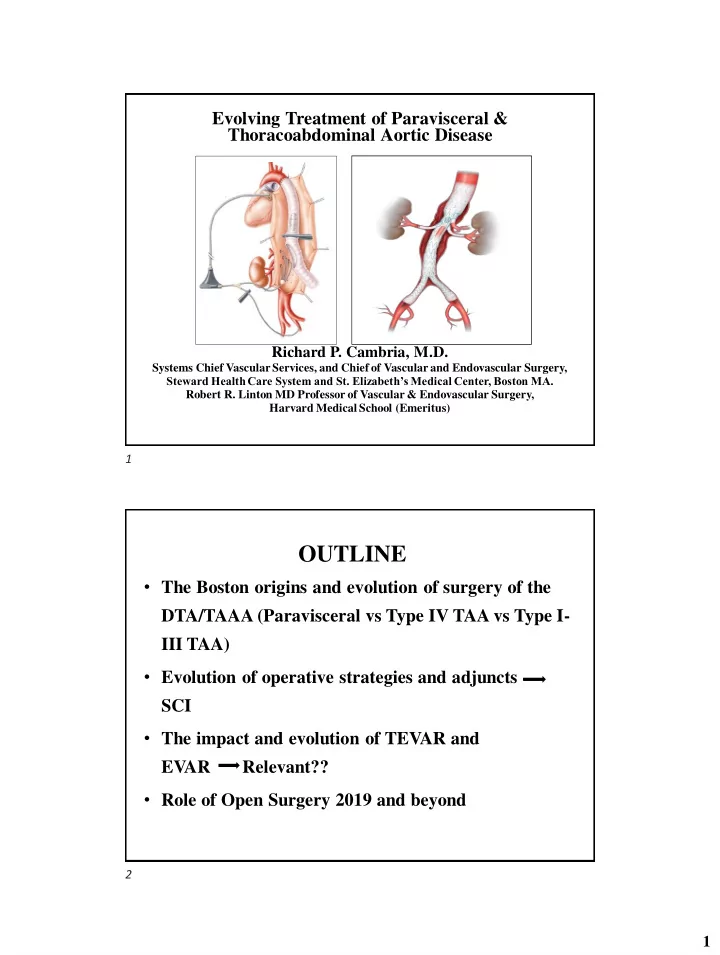
Evolving Treatment of Paravisceral & Thoracoabdominal Aortic Disease

Richard P. Cambria, M.D.

Systems Chief Vascular Services, and Chief of Vascular and Endovascular Surgery, Steward Health Care System and St. Elizabeth’s Medical Center, Boston MA. Robert R. Linton MD Professor of Vascular & Endovascular Surgery, Harvard Medical School (Emeritus)

  • The Boston origins and evolution of surgery of the

DTA/TAAA (Paravisceral vs Type IV TAA vs Type I- III TAA)

  • Evolution of operative strategies and adjuncts

SCI

  • The impact and evolution of TEVAR and

EVAR Relevant??

  • Role of Open Surgery 2019 and beyond

OUTLINE

1 2

slide-2
SLIDE 2

2

Historical Perspective

LINTON – INTRASACCULAR WIRING - 1952

50 YEAR FOLLOW-UP !

3 4

slide-3
SLIDE 3

3

BOSTON ORIGINS OF DTA SURGERY

  • Robert Gross, M.D. @ The Children’s Hospital 1945 → first

direct repair coarc.

  • At MGH Dr. Linton’s coarc. repairs and the short lived

homograft era

LINTON BEGINS THORACOABDOMINAL AORTIC SURGERY - 1956

5 6

slide-4
SLIDE 4

4

Arch Surg 1989; 124:620

  • Prior to 1985 TAA repair @ MGH →

50% mortality!

  • Initial experience after 1986 in 30

patients → 8% mortality

  • Impact of elective operation,  op time,

blood loss, x-clamp times

Pararenal Aneurysms

DEFINITIONS

  • Juxtarenal/pararenal → infrarenal neck ≤ 1cm

 implies clamp placement needs to be suprarenal/supraceliac (EVAR IFU Relevant)

7 8

slide-5
SLIDE 5

5

  • Suprarenal aneurysm → one or both renals
  • riginate from AAA → separate

reconstruction

DEFINITIONS

9 10

slide-6
SLIDE 6

6

  • Type IV TAA → graft carried proximal to celiac

Complex Aneurysms

DEFINITIONS

11 12

slide-7
SLIDE 7

7

THORACOABDOMINAL ANEURYSMS

42% WITH STRICT CRAWFORD DESIGNATION

(27%) (15%) (36%) (22%) Type I Type II Type III Type IV

Circulation 2015;132:1620-29

DESCENDING THORACIC AND TAAA SIZE CRITERIA FOR SURGERY

13 14

slide-8
SLIDE 8

8

Prior Aortic Resection (32.7%) n=149 (%) AAA 88 (59) Descending or TAAA 30 (20) Ascending/Arch 31 (21) Clinical Presentation Elective 347 (76.3) Urgent non-ruptured 51 (11.2) Ruptured 52 (11.4) 20 % of case chronic dissection

Distinguishing TAA Characteristics

X

Suprarenal AAA

15 16

slide-9
SLIDE 9

9

AAA SURGERY SELECTIVE USE OF SURGICAL APPROACHES FOR AAA

Transperitoneal

  • Right renal graft
  • Right iliac or complex

pelvic repair

  • Prior left colectomy
  • AAA neck turns to right

Retroperitoneal

  • Multiple prior

laparotomies

  • Obesity
  • Selected ABD stoma
  • Graft above renals
  • Horseshoe kidney,

inflammatory AAA Routine Infrarenal Aortic Surgery

EVAR

Retroperitoneal Approach

For Aneurysms → LT Kidney Up

17 18

slide-10
SLIDE 10

10 Celiac SMA R Renal Renal Vein IMA Left Kidney

Total Exposure of Visceral Segment

Retroperitoneal Approach

19 20

slide-11
SLIDE 11

11

Thoracoabdominal Incision Transpleural / Transabdominal

21 22

slide-12
SLIDE 12

12

Partial lateral division of diaphragm TA APPROACH FOR PARA/SUPRARENAL AAA AND TYPE IV TAA

23 24

slide-13
SLIDE 13

13

Suprarenal Type IV TAA Repair

Current Results Open Juxta/Para Renal Aneurysm Repair

Author Year Patients Op Mortality Chong et.al. 2009 171 1.8% Landry et.al 2009 82 6.1% Knott et.al 2008 126 0.8% Chiesa et.al 2006 85 3.5% Nathan et.al 2011 97 3.4% Tsai et.al 2012 199 2.5% TOTALS 760 mean 3 %

Rutherford 9th ed. 2019

25 26

slide-14
SLIDE 14

14 JVASC Surg 2012; 56: 2-7

Stent Graft Repair Juxtarenal AAA

  • SLOW

Regulatory Evolution

  • Oct 2001 first Z-

FEN (RG)

  • 2018 1,600

implanted in USA

27 28

slide-15
SLIDE 15

15

JVASC Surg 2014; 60: 1420

Current Results EVAR for Complex AAA (only)

  • 16 Publications (2004-12) detailing 1,187

patients with mean F/U 19 months

  • Technical Success nearly uniform
  • Branch patency 95 % range
  • 30 day Mortality (range 0-3.5 %) mean 1.8 %
  • GLOBALSTAR Registry (n=318) 3.5 %

Source: Endovascular Aortic Repair ed. Oderich: Springer 2017

29 30

slide-16
SLIDE 16

16 J VASC Surg 2015; 61: 242-55

  • NEARLY 10K PATIENTS!
  • POOLED OP MORTALITY  11%
  • COMMENTARY: MORE THAN HALF

SERIES ≥ 15 YEARS OLD!

JJ Vasc Surg 2018: 68:634-451

31 32

slide-17
SLIDE 17

17

CURRENT RESULTS WITH OPEN AND ENDOVASCULAR REPAIR Type I Type II Type III Type IV

Outcomes and operative strategies vary with TAA extent for Open and Endovascular Repair

Type IV TAAA Conduct and mode of Operation

  • Risk of SCI << in Type IV ?? Higher with

TEVAR

  • Adjuncts not utilized in Type IV repair:

Atrial-femoral bypass CSF drain Motor evoked potential monitoring Permissive hypothermia

  • Type IV ? Open ? Endo ? hybrid

33 34

slide-18
SLIDE 18

18

Current Results Open Type IV TAA Repair

Author Year #Patients Op Mortality Coselli et.al 2002, 07 329 3.6 % Chiesa et.al 2006 34 2.9 % Kieffer et.al 2008 171 13.4 % Richards et.al 2010 53 6.0 % Nathan et.al 2011 83 5.6 % Patel et.al 2011 179 2.8 % TOTALS 849 5.7 %

Source: Rutherford 9th ed. 2019

TYPE IV RESULTS

J Vasc Surg 2011;53:1492-8

35 36

slide-19
SLIDE 19

19

STANDARDIZED CLAMP/SEW OPERATION

Cold renal perfusion Beveled prox. suture line Routine lt. renal sidearm Preserve diaphram

Clinical features in 178 Type IV pts

  • Age:

73 ± 8

  • HTN:

153 (86%)

  • Smoker:

147 (83%)

  • CRI (>1.8mg/dl):

32 (18%)

  • Symptomatic:

32 (18%)

37 38

slide-20
SLIDE 20

20

Clinical Outcomes

N=178

  • Mortality:

5 (2.8%)

  • SCI:

4 (2.2%)

  • HD / renal failure:

5 (2.8%)

  • Any complication: 45 (25%)

Predictors of Mortality/Complications

Composite outcome: death + any complication

Variable OR 95% CI p value CRInsuff 3.4 [1.4 – 8] 0.016

39 40

slide-21
SLIDE 21

21

Ann of Surgery 2014;00:1-10

Op mortality → 14.3% SCI → 4.8% Multi-center French Experience OPEN TAA REPAIR BACKGROUND

  • Mortality ≈ 10%
  • Total Spinal Cord Ischemia → 16%

half (8%) devastating paraplegia

J Vasc Surg 1993; 17:357-70

41 42

slide-22
SLIDE 22

22

Adjuncts to prevent paraplegia → operative conduct

IMPACT OF SPINAL CORD ISCHEMIA

  • Emphasis on expediency and simplicity
  • clamp/sew without external bypass/perfusion
  • In-line mesenteric shunt to decrease visceral

ischemia

  • Cold renal perfusion
  • Epidural cooling for spinal cord protection
  • Aggressive reimplantation of T9-L1

intercostals

SUMMARY OF OPERATIVE TECHNIQUE 1986- 2005

43 44

slide-23
SLIDE 23

23

Ann Thorac Surg 2007;83;S865-9

routine sacrifice of segmental aortic branches can be carried out in a way that will allow surgical and endovascular therapy of extensive distal aortic aneurysms without neurologic injury.

J Vasc Surg 2008;48:261-71

MRA DEMONSTRATES CORD COLLATERALS

  • 85 TAA pts studied with MRA and intraoperative

MEVOK potentials

  • p < .0015 correlation between collateral demonstration
  • f preservation MEVOK with x-clamp
  • Most collaterals originated caudal to the distal clamp →

pelvic arteries

45 46

slide-24
SLIDE 24

24

J Vasc Surg 2011;53:1195-201

Impact of Collateral Network Concept

  • Refined techniques for spinal cord protection
  • Operative mortality for Extent I-III TAA under 5%

Shift in Spinal Cord Protection

  • Support of the cord

collateral network with distal aortic perfusion

  • Monitoring of MEVOP

during sequential clamping

47 48

slide-25
SLIDE 25

25

Literature Review Open TAAA Repair (?? Includes acute)

Author Year #pts 30-day mortality Coselli et.al 2007 2,286 6.6 % Schepens et.al 2007 500 12.4 % Etz et.al 2007 858 9.7 % Achweck et.al 2007 130 12 % Jacobs et.al 2004 279 8.6 % Safi et.al 2005 1,106 14.6 % Lancaster et.al 2013 485 8 %

TOTALS 5, 644 10 % Source: Endovascular Aortic Repair ed. Oderich. Springer 2017 J Vasc Surgery 2013; 58:283-290

Current Results

30% last 100 cases were TAAA of chronic dissection etiology

49 50

slide-26
SLIDE 26

26

Results - Outcomes

Variable Cl Clamp mp/Se /Sew w (n=3 =385) DAP/ME AP/MEVOP P (n=1 =100) p

Intra-op Death 0.5% 1.0% 0.501 Early Post-op Death 9.9% 4.0% 0.072 Hospital LOS (d) 21.6 + 23.5 19.9 + 12.6 0.492 Permanent SCI 11.9% 3.0% 0.008 Perm SCI/Death 19.1% 7.0% 0.003 ARF with HD 11.4% 5.1% 0.063

Early Post-op Death 9.9% 4.0% 0.072 Permanent SCI 11.9% 3.0% 0.008

  • MEDICARE DATABASE (2004-07)
  • SIGNIFICANT IMPROVEMENT IN

EARLY MORTALITY (P = .02), COMPLICATIONS (P < .01) AND 1 YEAR SURVIVAL (P < .01)

J Vasc Surg 2018; 68; 941-7

51 52

slide-27
SLIDE 27

27

Ann of Surgery 2014;00:1-10

Op mortality → 14.3% SCI → 4.8% Op mortality →21% SCI →16.6% Multi-center French Experience

“F/B-EVAR carries a significant rate of mortality and complications…the complexity

  • f the procedure”

J Thorac Cardiovasc Surg. 2017 Feb;153(2):S32-S41.

  • 112 TYPE IV and 73 TYPES I-III
  • MORTALITY FOR I-III 8.2%
  • REINTERVENTION AT 5 YEARS 50%

53 54

slide-28
SLIDE 28

28

Durability of Open Surgical Repair of Type I-III Thoracoabdominal aortic aneurysm

JVASC Surg April 2019; 1-11

Summary Results Endovascular TAAA Repair

  • 15 clinical series (of pioneers e.g. Chutter,

Greenberg, etc) detailing 1,517 patients

  • Many include JRA, SRA, and few non-elective

cases

  • Technical success uniform
  • 30-day mortality (edited) range (2-9 %) and

SCI (2-16.7 %)

Source: Endovascular Aortic Repair

55 56

slide-29
SLIDE 29

29

JVASC Surg 2018; 68: 1936-1945

Role of Hybrid Operation (?)

57 58

slide-30
SLIDE 30

30

  • Combination of

debranching bypasses creates distal seal zone for TEVAR

  • Aortic Arch
  • Visceral Segment

Hybrid Operation:

Question Less Invasive Alternative

Gustavo S. Oderich, Peter Gloviczki, Mark Farber, William Quinones-Baldrich, Roy Greenberg, Gilbert R. Upchurch Jr., Dan Clair, Sean Lyden, Guillermo A. Escobar, Carlos Timaran, James Black, Sharif Ellozy, Edward Woo, Michael Singh, Mark Fillinger, Jason Lee, Juan C Jimenez, Jonathan L. Eliason, Himanchu J. Patel, Purandath

  • Lall. Stephen Cha and Patrick Clagett

For the NACAAD investigators

Preliminary Results of the North American Complex Abdominal Aortic Debranching (NACAAD) Registry

59 60

slide-31
SLIDE 31

31

NACAAD registry

Mortality

30 early deaths (14%)

– Multisystem organ failure, 11 – Cardiac event, 10 – Ruptured aneurysm, 4 – Ischemic stroke, 2 – Intracranial hemorrhage, 2 – Intraoperative hemorrhage, 1

Mortality in centers with > 10 cases: 11% (0 – 21%)

TAAA, thoracoabdominal aortic aneurysm PRAA, pararenal aortic aneurysm Early death, 30-day and/or in-hospital

  • CIRC. 2011; 124: 2670

61 62

slide-32
SLIDE 32

32

Ann Cardiothoracic Surg.2012 Sep; 1(3): 311-319 JVASC Surg 2011 Jul; 54(1): 30-40

63 64

slide-33
SLIDE 33

33

  • J. Vis Surg 2018; 4

Summary

  • The Evolution of total Endovascular repair of

TAA HAS BEEN SLOW!

USA Regulatory Environment INTERNATIONAL MARKET

  • Surgeon Experience and Expertise recalls the

Evolution of Open Repair

  • Current Results

Pararenal Type IV TAAA Type I-III TAA

65 66