Outline International market for green products 1 Trade - - PDF document

outline
SMART_READER_LITE
LIVE PREVIEW

Outline International market for green products 1 Trade - - PDF document

5/11/2012 Indonesia as the Largest CSPO Producer: Continuous Commitment Edi Suhardi Vice President II, RSPO Director of Sustainability, PT Agro Harapan Lestari (A Goodhope Company) 1 Outline International market for green products 1 Trade


slide-1
SLIDE 1

5/11/2012 1

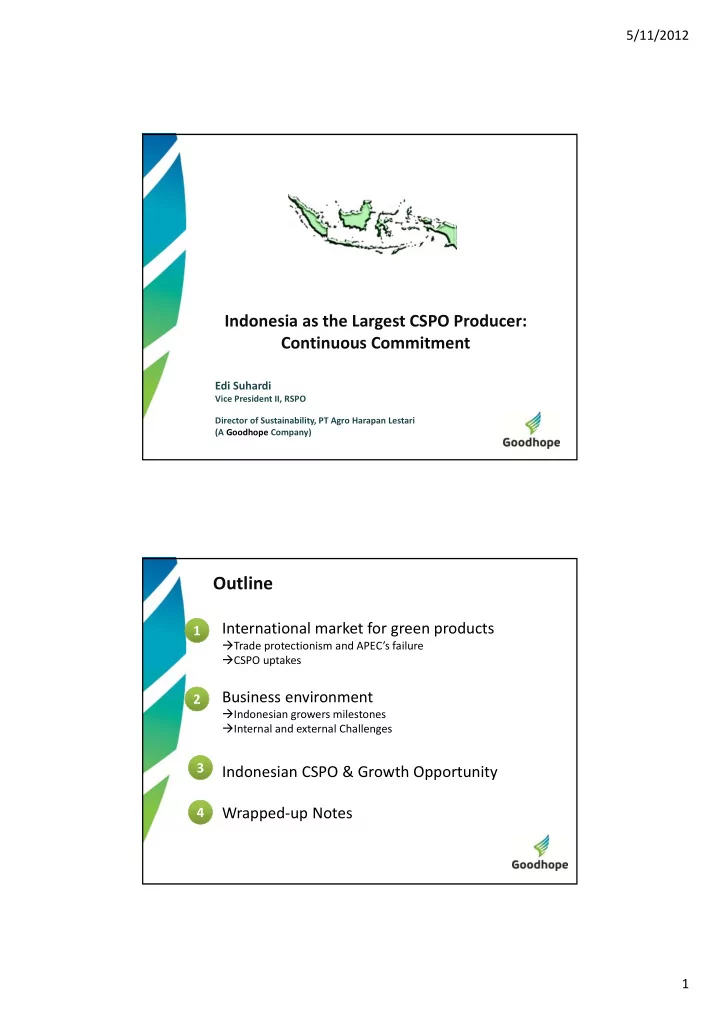
Indonesia as the Largest CSPO Producer: Continuous Commitment

1

Edi Suhardi

Vice President II, RSPO Director of Sustainability, PT Agro Harapan Lestari (A Goodhope Company)

Outline

Indonesian CSPO & Growth Opportunity

2

International market for green products

Trade protectionism and APEC’s failure CSPO uptakes

Business environment

Indonesian growers milestones Internal and external Challenges

1 2 3

Wrapped‐up Notes

4

slide-2
SLIDE 2

5/11/2012 2

INTERNATIONAL MARKET FOR GREEN PRODUCTS

3

1

Trade Protectionism and APEC’s Failure

4

APEC in September 2012 failed to include CPO as one of the 54 eco‐friendly products in APEC Is the (developed & developing countries) market really prepared for eco‐friendly CPO/CSPO? What to do with low premium rate and uptakes level?

 54 categories: cover more than 300 items, i.e. chopsticks, bicycles, turbines, generators, and bamboo products  APEC’s failure is narrowing Indonesia’s CPO (whether CSPO or not) to penetrate global market through tariff reduction facility  Trade barriers and protectionism: NODA EPA, REDD+, Food labeling in Australia and NZ

slide-3
SLIDE 3

5/11/2012 3

5

CSPO market is growing despite low incentive (low premium price)  Gaps persist

slide-4
SLIDE 4

5/11/2012 4

CSPO BUYERS 2011

BUSINESS ENVIRONMENT:

INTERNAL AND EXTERNAL CHALLENGES

8

2

slide-5
SLIDE 5

5/11/2012 5

Milestone Indonesian Growers in RSPO

9

2000‐2003 2004 2005 2006 2007 2008 2009

RT1, Kuala Lumpur, Malaysia. RSPO was established, voluntary membership RT2 & GA1, Jakarta. Agreed on P & Cs for certification. RT3 & GA2, Malaysia. Agreed on the use of generic 8 Ps & 39 Cs RSPO. RT4 & GA3, Singapore. RILO was established. RT5 & GA4, Indonesia. NI were elaborated RT6 & GA5, Malaysia. Indonesian NI on P&C RSPO was approved by EB RT7 & GA6: PT Musim Mas, PT Hindoli, PT Lonsum, Minamas wer certified

2010

RT8 & GA7, Bali, Indonesia. 27% CSPO certified by RSPO

2011

Gapki quit RSPO

November 2011, RT9 &GA8 2012 July 2012, 48% of Global CSPO and is growing.

RSPO Membership

116 (15.9%) 260 (35.8%) 270 (37%)

Indonesian Growers: 54 members plus 14 palm oil companies operated in Indonesia but listed abroad and growing...

slide-6
SLIDE 6

5/11/2012 6

Internal and External Challenges

Internal External

  • Skepticism and suspicion from

business association and the Government

  • ISPO
  • Low premium price?
  • Low market uptakes
  • Governance
  • Social issues
  • Legal certainty
  • Anti‐palm oil movement
  • Trade barriers
  • Other sustainability

certifications

  • Individual companies‐introduced

sustainability certification

  • No coherent efforts on CSPO

campaign

  • Visibility of RSPO
  • RSPO’s Relevance
  • Making the new vision work!
  • Quo Vadis RSPO?

3

INDONESIA CSPO & GROWTH OPPORTUNITY

slide-7
SLIDE 7

5/11/2012 7

13

Indonesian Palm Oil and CPO: An Overview

Ownership 2001 2003 2005 2007 2009 2011 2012 2013 2014 2015 2017 2019 2021 2023 2025 Smallholders 1.561 1.854 2.357 2.752 3.061 3.620 3.801 3.991 4.191 4.400 4.851 5.348 5.897 6.501 7.167 Private Company 2.542 2.766 2.567 3.408 4.181 4.652 4.792 4.935 5.083 5.236 5.555 5.893 6.252 6.633 7.037 State‐owned Company 609 663 530 606 631 637 643 650 656 663 676 690 704 718 732 Total 4.712 5.283 5.454 6.766 7.873 8.909 9.236 9.576 9.930 10.299 11.082 11.931 12.852 13.851 14.936 Ownership 2001 2003 2005 2007 2009 2011 2012 2013 2014 2015 2017 2019 2021 2023 2025 Smallholders 2.798 3.517 4.501 6.383 7.518 9.045 10.084 11.243 12.535 13.975 17.371 21.593 25.277 27.868 30.725 Private Company 4.079 5.173 7.883 8.700 9.850 11.728 12.938 14.274 15.747 17.372 21.142 25.731 29.238 31.019 32.908 State‐owned Company 1.519 1.751 2.002 2.117 2.332 2.124 2.194 2.266 2.340 2.417 2.579 2.751 2.870 2.928 2.987 Total 8.396 10.441 14.386 17.200 19.700 22.897 25.216 27.783 30.622 33.764 41.093 50.075 57.386 61.815 66.620 Palm Oil Plantation (in thousand hectares) CPO Production (in thousand MT) 4.712 9.236 14.936 8.396 25.216 66.620

‐ 10.000 20.000 30.000 40.000 50.000 60.000 70.000

Palm Oil Plantation ('000 Ha) CPO Production ('000 MT) ‐ 1.000 2.000 3.000 4.000 5.000 6.000 7.000 8.000

Smallholders Private Company State‐owned Company

Indonesian Palm Oil and CPO: An Overview

Ownership 2000 2001 2003 2005 2008 2010 2011 2012 2013 2015 2017 2019 2020 2023 2025 Smallholders 1.167 1.561 1.854 2.357 2.881 3.387 3.620 3.801 3.991 4.400 4.851 5.348 5.616 6.501 7.167 Private Company 2.403 2.542 2.766 2.567 3.879 4.367 4.652 4.792 4.935 5.236 5.555 5.893 6.070 6.633 7.037 State‐owned Company 588 609 663 530 603 632 637 643 650 663 676 690 697 718 732 Total 4.158 4.712 5.283 5.454 7.363 8.386 8.909 9.236 9.576 10.299 11.082 11.931 12.382 13.851 14.936 Palm Oil Plantation (in thousand hectares)

slide-8
SLIDE 8

5/11/2012 8

Favorable Indonesian Policy

1. Further development in a sustainable way 2. Prioritizing smallholders

– Improve farmers’ access to capital, agriculture inputs – Enact 20% mandatory partnership ‘smallholders’ program – Enhance smallholders development and productivity:

  • Support for certification program: ISPO
  • Building infrastructure
  • Vision 35:26 (productivity 35 ton TBS/year, OER 26%)
  • Plantation expansion
  • 3. Value Added & Efficiency

– Fostering value added palm oil‐based –downstream industry – Tapping any potential developments and building infrastructure – Biofuels, alternative energy

Indonesian Growers: A Key RSPO’s Stakeholder

 RSPO has revolutionized the Indonesian Palm Oil Industry

 Rising the bar of the industry standard: improved productivity  Environmental and social responsibility  Set a high value/good corporate citizen platform

slide-9
SLIDE 9

5/11/2012 9

CPO PRODUCTION 2008‐2011:

INDONESIA Vs WORLD

5,000 10,000 15,000 20,000 25,000 30,000 35,000 40,000 45,000 50,000

('000 METRIC TONS)

2008 2009 2010 2011 Indonesian CPO World CPO

CPO Production (in thousand MT) 2008 2009 2010 2011

Indonesian CPO 17.539 19.324 21.958 22.508 World CPO 42.763 43.968 45.031 46.528 Indonesia CPO (%) 41,01 43,95 48,76 48,38

RSPO‐CERTIFIED 2008‐2012: CERTIFIED PALM OIL PLANTATIONS

Certified Palm Oil Plantations 2008 2009 2010 2011 2012 (Oct)

RSPO Area CSPO 106.384 264.952 644.816 1.130.969 1.302.206 Indonesian Area CSPO 66.792 208.448 463.969 628.962 % Indonesian Area CSPO 25,21 32,33 41,02 48,30

200,000 400,000 600,000 800,000 1,000,000 1,200,000 1,400,000 2008 2009 2010 2011 2012 (Oct) HECTARES

RSPO Area CSPO Indonesian Area CSPO

slide-10
SLIDE 10

5/11/2012 10

INDONESIAN CSPO: 2008 ‐ 2012

CSPO Producers: (1) Indonesia : 3,059,537 MT (47%); (2) Malaysia : 2,754,853 MT (42.8%); (3) Papua New Guinea: 435,331 MT (6.8%); (4) Brazil: 125,793 MT (2.0%); (5) Solomon Island: 28.830 MT (0.4%); (6) Colombia: 22.000 MT (0.3%); (7) Ivory Coast: 5.760 MT (0.1%)

CSPO Production 2008 2009 2010 2011 2012 (Oct) World CSPO (MT) 619.012 1.473.912 3.522.207 5.573.202 6.432.103 Indonesian CSPO (MT) 403.474 984.046 2.245.375 3.059.537 Indonesian CSPO (%) 27,37 27,94 40,29 47,57

1,000,000 2,000,000 3,000,000 4,000,000 5,000,000 6,000,000 7,000,000 2008 2009 2010 2011 2012 (Oct) METRIC TONS World CSPO (MT) Indonesian CSPO (MT)

INDONESIAN CSPKO: 2008 ‐ 2012

CSPO Production 2008 2009 2010 2011 2012 (Oct) World CSPKO (MT) 154.335 338.740 803.999 1.296.488 1.468.694 Indonesian CSPKO (MT) 93.746 218.143 517.733 690.253 Indonesian CSPKO (%) 27,67 27,13 39,93 47,00

200,000 400,000 600,000 800,000 1,000,000 1,200,000 1,400,000 1,600,000 2008 2009 2010 2011 2012 (Oct) METRIC TONS World CSPKO (MT) Indonesian CSPKO (MT)

slide-11
SLIDE 11

5/11/2012 11

I N D O N E S I A

GROWTH FORECAST

CPO, CSPO and Production Area

CPO PRODUCTION: INDONESIA VS. WORLD ‐ FORECAST 2025

  • 20,000

40,000 60,000 80,000 100,000 120,000 140,000 ('000 METR IC TON S) 2010 2011 2012 2013 2014 2015 2016 2017 2018 2019 2020 2021 2022 2023 2024 2025 Indonesia Malaysia Thailand Nigeria Colombia Other CPO Production Based on 2000-2011 Data (in thousand MT)

Country 2010 2011 2012 2013 2014 2015 2016 2017 2018 2019 2020 2021 2022 2023 2024 2025

Indonesia 20.800 22.897 25.216 27.783 30.622 33.764 37.242 41.093 45.355 50.075 55.302 57.386 59.556 61.815 64.168 66.620 Malaysia 16.994 17.793 18.629 19.505 20.421 21.381 22.386 23.438 24.540 25.693 26.901 28.165 29.489 30.875 32.326 33.845 Thailand 1.500 1.683 1.888 2.119 2.377 2.667 2.993 3.358 3.767 4.227 4.743 5.321 5.970 6.699 7.516 8.433 Nigeria 850 862 874 886 899 911 924 937 950 963 977 990 1.004 1.018 1.033 1.047 Colombia 810 848 888 930 973 1.019 1.067 1.117 1.170 1.225 1.282 1.342 1.406 1.472 1.541 1.613 Other 3.077 3.197 3.322 3.451 3.586 3.726 3.871 4.022 4.179 4.342 4.511 4.687 4.870 5.060 5.257 5.462 Total 44.031 47.280 50.817 54.673 58.878 63.469 68.483 73.964 79.961 86.525 93.716 97.892 102.295 106.938 111.841 117.020 Growth (%) 3,0 7,4 7,5 7,6 7,7 7,8 7,9 8,0 8,1 8,2 8,3 4,5 4,5 4,5 4,6 4,6 Sources : MoA, IPOB, MPOB, FAS USDA, Oilworld, InfoSAWIT Data Centre 2012.

slide-12
SLIDE 12

5/11/2012 12

SCENARIO 1: FORECAST 2025 CSPO AREA IN INDONESIA

2,000 4,000 6,000 8,000 10,000 12,000 14,000 16,000 '000 METRIC TONS 2009 2010 2011 2012 2013 2014 2015 2016 2017 2018 2019 2020 2021 2022 2023 2024 2025 INDONESIA AREA CSPO AREA

Projection of CSPO Production Area

Palm Oil Plantation

2009 2010 2011 2012 2013 2014 2015 2016 2017 2018 2019 2020 2021 2022 2023 2024 2025

Area (in Million Hectares) 7.873 8.385 8.909 9.236 9.576 9.930 10.299 10.683 11.082 11.498 11.931 12.382 12.852 13.342 13.851 14.383 14.936 CSPO Area 67 208 464 682 916 1.167 1.434 1.721 2.027 2.353 2.702 3.074 3.471 3.894 4.345 4.825 5.336 % CSPO Area to Total Area 0,85 2,49 5,21 7,39 9,57 11,75 13,93 16,11 18,29 20,47 22,65 24,83 27,01 29,19 31,37 33,55 35,73 Growth Assumption (%) 1,64 2,72 2,18 2,18 2,18 2,18 2,18 2,18 2,18 2,18 2,18 2,18 2,18 2,18 2,18 2,18

(in thousand hectares) :.

SCENARIO 2: FORECAST 2025 CSPO INDONESIA

10,000 20,000 30,000 40,000 50,000 60,000 70,000 '000 METRIC TONS

2009 2010 2011 2012 2013 2014 2015 2016 2017 2018 2019 2020 2021 2022 2023 2024 2025

INDONESIAN CPO RSPO CSPO

Projection of CSPO Production

Palm Oil Production 2009 2010 2011 2012 2013 2014 2015 2016 2017 2018 2019 2020 2021 2022 2023 2024 2025 Indonesian CPO 19.700 20.800 22.897 25.216 27.783 30.622 33.764 37.242 41.093 45.355 50.075 55.302 57.386 59.556 61.815 64.168 66.620 CSPO 403 984 2.245 3.451 4.880 6.567 8.551 10.877 13.595 16.765 20.453 24.734 27.892 31.258 34.842 38.658 42.720 % Indonesian CSPO to CPO 2,05 4,73 9,80 13,68 17,56 21,44 25,32 29,20 33,08 36,96 40,84 44,72 48,60 52,48 56,36 60,24 64,12

(in thousand MT)
slide-13
SLIDE 13

5/11/2012 13

Wrapped‐up Notes:

1. Indonesian growers are committed champions of sustainability

– Survive and thrive against all odds in domestic and global environment – Steady growths: membership, certifield estates/mills, and CSPO production – Indonesian CSPO will grow from 48% of Global CSPO now to 57% in 2025

2. Continuous commitment: trailblazers to set a new bar for sustainability standards

– ISPO as a showcase of institutionalization of sustainability principles – Partnership of GAR – TFT – Greenpeace – Musim Mas Commitment on 100% CSPO Production – Indonesian Growers Caucus and FORMISBI (Indonesian Forum on SPO) as CSPO Advocates

3. Demand for a balanced and fair shared‐responsibility of all RSPO members: Quid pro quo!

– Recognition of RSPO Certificate’s values against competing sustainability certifications – Incentives for CSPO: boosting premium price and uptakes – Growers representations in RSPO: producing country reps and smallholders – Revamped RSPO Secretariat: Improved member services, advocacy roles – Unequivocal Members’ Commitment

  • Tangible efforts to advocate CSPO uses and mitigate anti‐palm oil movement.
  • Real responsibilities of other stakeholders: P&C for supply chains

“Revised P&Cs must be fair, reasonable, realistic, workable and acceptable by all, particularly Growers as the most affected party!”

Wrapped‐up Notes:

slide-14
SLIDE 14

5/11/2012 14

Thank You