Outline Isolated Congenital Diaphragmatic Hernia Prenatal diagnosis - - PDF document

outline
SMART_READER_LITE
LIVE PREVIEW

Outline Isolated Congenital Diaphragmatic Hernia Prenatal diagnosis - - PDF document

20-3-2012 Prenatal management of the fetus with isolated Congenital Diaphragmatic Hernia Jan Deprest Center for Fetal Medicine Department Woman and Child, Division Woman University Hospitals Leuven Leuven, Belgium On behalf of the FETO consortium A


slide-1
SLIDE 1

20-3-2012 1

Prenatal management of the fetus with isolated Congenital Diaphragmatic Hernia

Jan Deprest

Center for Fetal Medicine Department Woman and Child, Division Woman University Hospitals Leuven Leuven, Belgium On behalf of the FETO consortium

A number of instruments and devices are used of label The presenter has no financial interests to disclose

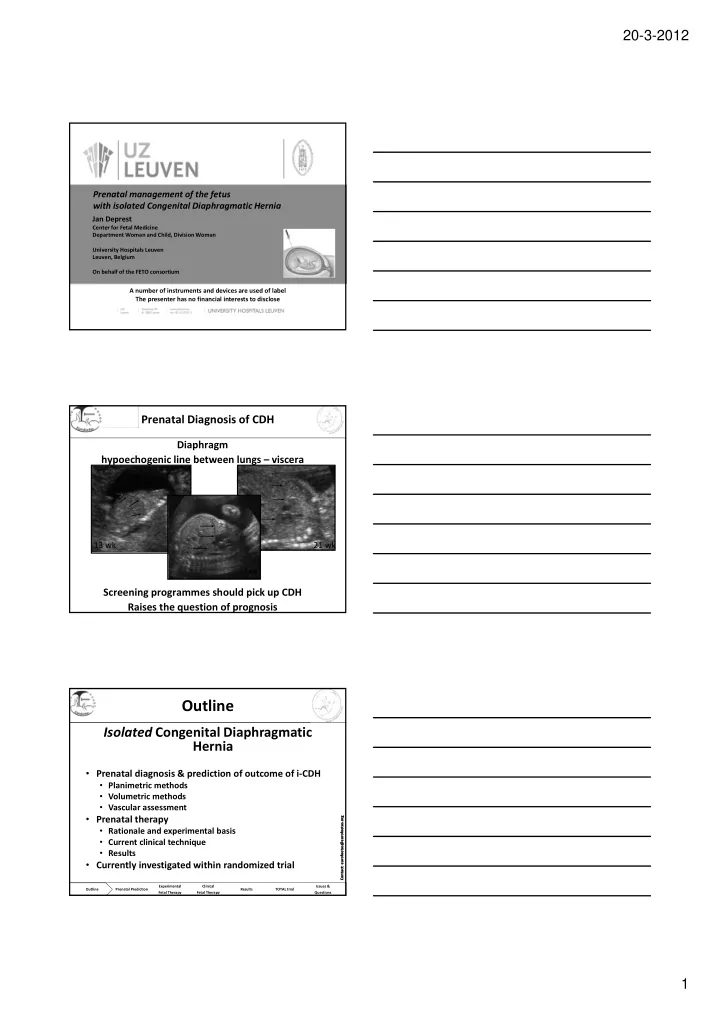
Prenatal Diagnosis of CDH

Diaphragm hypoechogenic line between lungs – viscera Screening programmes should pick up CDH Raises the question of prognosis

13 wk 21 wk

27 wk

Contact: eurofoetus@eurofoetus.org Outline Outline Prenatal Prediction Prenatal Prediction Experimental Fetal Therapy Experimental Fetal Therapy Clinical Fetal Therapy Clinical Fetal Therapy Results Results TOTAL trial TOTAL trial Issues & Questions Issues & Questions Contact: eurofoetus@eurofoetus.org

Outline

Isolated Congenital Diaphragmatic Hernia

  • Prenatal diagnosis & prediction of outcome of i‐CDH
  • Planimetric methods
  • Volumetric methods
  • Vascular assessment
  • Prenatal therapy
  • Rationale and experimental basis
  • Current clinical technique
  • Results
  • Currently investigated within randomized trial
slide-2
SLIDE 2

20-3-2012 2 Congenital Diaphragmatic Hernia

Increasingly being picked up in screening programmes Few in utero problems Postnatal: correctable defect ventilatory insufficiency pulmonary hypertension long term morbidity Overall outcome associated: 85% mortality isolated: 30% mortality

Deprest et al, Sem Fet Neonat Med 2009

Reduced number of airways Abnormal compliance CDH normal Reduced and abnormal vessels

Contact: eurofoetus@eurofoetus.org

Survival and hidden mortality

Isolated CDH n TOP rate survival till discharge Gallot 2007 314 7% 63% Steege 2003 185 n.a. 70 % Schaible 2006 244*

70% Hedrick 2007 89 n.a. 66% Datin‐Dorrière 08 99 20% 63% Mettauer 09 147

postnatal series

77% Grushka 2009 121

postnatal series

81%

* In utero referral in third trimester, ECMO policy of 50%; case load 35 cases/year ** isolated only, courtesy G Ryan & D Bohn , University of Toronto, Canada (May 2010)

Mt Sinai (2000‐2009)** 86 15% 65% Sick Kids (2002‐2009) ** 45

Postnatal series

85%

Contact: eurofoetus@eurofoetus.org Outline Outline Prenatal Prediction Prenatal Prediction Experimental Fetal Therapy Experimental Fetal Therapy Clinical Fetal Therapy Clinical Fetal Therapy Results Results TOTAL trial TOTAL trial Issues & Questions Issues & Questions Contact: eurofoetus@eurofoetus.org

Liver position Liver herniation

Antenatal CDH registry 2006 Mullasery UOG 2010 Mayer Prenat Diagn 2011 Survival: 74% → 45%

Prediction prognosis

Lung to Head Ratio (LHR)

Metkus 1996 Antenatal CDH registry 2006‐8 Knox 2010 Alfarai 2011

slide-3
SLIDE 3

20-3-2012 3

Contact: eurofoetus@eurofoetus.org Contact: eurofoetus@eurofoetus.org

Metkus et al, 1996 Jani et al, 2006 Peralta 2005

Lung to head ratio

  • LHR increases with gestation

(Peralta, 2005)

  • Different methods of which the

tracing method is most accurate (Jani, 2006)

  • Using correct nomogram,

expressed as a percentage what is expected in normal fetus, provides gestational age independent size estimation

Observed/expected LHR

OBSERVED Fetal Lung Area

(fetus at risk for lung hypoplasia)

EXPECTED Fetal Lung Area

(matched normal fetus)

matched fetus based on gestational age

area measured 0.5 area predicted 2.0

O/E = 25%

Methodology and discussion in Claus et al, Fet Diagn Ther 2010

Right lung

18 22 26 30 34 38 Gestation (wks) 0.5 1.0 1.5 2.0 2.5 3.0 3.5 4.0 Lung area to head circumference ratio 18 22 26 30 34 38 Gestation (wks) 10 20 30 40 50 60 70 80 90 Observed / Expected LHR (%)

O/E LHR discounts effect of gestational age

Fetuses with left CDH (n=329)

100

Peralta et al 2005 Jani et al 2007

slide-4
SLIDE 4

20-3-2012 4

Contact: eurofoetus@eurofoetus.org Outline Outline Prenatal Prediction Prenatal Prediction Experimental Fetal Therapy Experimental Fetal Therapy Clinical Fetal Therapy Clinical Fetal Therapy Results Results TOTAL trial TOTAL trial Issues & Questions Issues & Questions Contact: eurofoetus@eurofoetus.org

< 15 15‐25 26‐35 36‐45

O/E LHR (%) 10 20 30 40 50 60 70 80 90 100

Survival rate (%) 46 and higher

extreme liver in abdomen (“down”) liver in thorax (“up”) severe moderate mild

Current algorithm

Antenatal Registry – Jani et al, UOG 2008 (n=329 LCDH) ‐Deprest J et al, Sem Neonat Fetl Med, 2008.

1% 14% 45% 40%

Contact: eurofoetus@eurofoetus.org Outline Outline Prenatal Prediction Prenatal Prediction Experimental Fetal Therapy Experimental Fetal Therapy Clinical Fetal Therapy Clinical Fetal Therapy Results Results TOTAL trial TOTAL trial Issues & Questions Issues & Questions Contact: eurofoetus@eurofoetus.org

Isolated CDH eiter expectantly managed (n=100)

Jani et al UOG 2009 ≤25 26‐45 >45

Patch rate (%)

10 20 30 40 50 60 70 80 90 100

O/E LHR (%)

10 20 30 40 50 60

Conventional ventilation days

≤25 26‐45 >45

O/E LHR (%)

10 20 30 40 50 60

Enteral feeding days

<25 26‐45 >45

O/E LHR (%)

10 20 30 40 50 60

NICU** days

<25 26‐45 >45

O/E LHR (%)

10 20 30 40 50 60 70 80 90 ≤25 26‐45 >45

O/E LHR (%) Oxygen O2 at 28d (%)

100

Early neonatal morbidity indicators

slide-5
SLIDE 5

20-3-2012 5

O/E LHR and CDH

  • Normative data for calculation expected LHR ‐Peralta et al, UOG 2005

– Calculation formula based on the raw data – Deprest et al, Fet Diagn Ther 2010

– available as calculator on www.totaltrial.eu

  • Antenatal registry CDH:

– Prediction of mortality : Jani et al, UOG 2006 (LHR), 2007 (O/E LHR) – Accuracy versus GA: Jani et al, UOG 2008 – Prediction of morbidity: Jani et al, UOG 2009 – Validation with pathology: Jani et al, UOG 2011 (on line)

  • Learning curve: Cruz‐Martinez et al, UOG 2010
  • Recent meta‐analysis: Knox et al, J Mat Fet Med 2010
  • Assessment methods reviewed in Claus et al, Fet Diagn Ther 2011

2 versus 3 dimensional

Cross section at the 4 chamber view Of ONE lung volumetric measurement

  • f two lungs and of liver herniation

Contact: eurofoetus@eurofoetus.org Outline Outline Prenatal Prediction Prenatal Prediction Experimental Fetal Therapy Experimental Fetal Therapy Clinical Fetal Therapy Clinical Fetal Therapy Results Results TOTAL trial TOTAL trial Issues & Questions Issues & Questions Contact: eurofoetus@eurofoetus.org ≤ 25 26‐35 36‐45 > 45

Observed to expected total FLV (%)

10 20 30 40 50 60 70 80 90

Survival rate (%)

Liver up

Cannie et al UOG 2008

20% survival rate ~ 33%

Multicenter studies prediction on volumetry

Cannie et al UOG 2008 – n = 40 – 35 LCDH

10 20 30 40 50

LiTR (%)

10 20 30 40 50 60 70 80

  • /e TFLV (%)

Liver to thorax ratio (LiTR) OR survival: 0.87 (0.79‐0.95) (p=0.003)

  • /e Total Fetal Lung Volume (TFLV)

OR: 1.16 (1.04‐1.30) (p=0.09)

slide-6
SLIDE 6

20-3-2012 6

Contact: eurofoetus@eurofoetus.org Outline Outline Prenatal Prediction Prenatal Prediction Experimental Fetal Therapy Experimental Fetal Therapy Clinical Fetal Therapy Clinical Fetal Therapy Results Results TOTAL trial TOTAL trial Issues & Questions Issues & Questions Contact: eurofoetus@eurofoetus.org

False positive rate (%) Sensitivity (%) 100 75 50 25 100 75 50 25

2D‐US MRI

MRI may be better than 2D LHR in predicting outcome Isolated CDH born alive >30 wks, paired observations (n=76

Cannie et al UOG 2008

O/E LHR rather than volumetry ?

Contact: eurofoetus@eurofoetus.org Outline Outline Prenatal Prediction Prenatal Prediction Experimental Fetal Therapy Experimental Fetal Therapy Clinical Fetal Therapy Clinical Fetal Therapy Results Results TOTAL trial TOTAL trial Issues & Questions Issues & Questions Contact: eurofoetus@eurofoetus.org

Prenatal prediction: lung vasculature

Measurements of

– Pulmonary artery diameters

(Sokol et al.AJOG;2006)

– Flow velocity waveforms

(Laudy 1997; Sivan 2000; Fuke 2003, Moreno UOG 2008)

– Resistance within

(Rizzo, UOG 1996; Mitchell, UOG 1998; Chaoui, UOG 1999)

– Power Doppler imaging

(Mahieu‐Caputo, 2004, Ruano 2004‐6)

– Fractional moving blood volume

(Hernandez‐Andrade, UOG 04; Moreno, UOG 2010; Cruz –Martinez , UOG 2010)

– Hyperoxygenation test

(Broth 2002, Doné UOG 2010)

Proximal branch intrapulmonary artery Fractional Moving Blood Volume (FMBV)

Contact: eurofoetus@eurofoetus.org Outline Outline Prenatal Prediction Prenatal Prediction Experimental Fetal Therapy Experimental Fetal Therapy Clinical Fetal Therapy Clinical Fetal Therapy Results Results TOTAL trial TOTAL trial Issues & Questions Issues & Questions Contact: eurofoetus@eurofoetus.org

Lung growth is triggered by tracheal occlusion

Flake et al, 20000 Congenital High Airway Obstruction

Anatomical repair → Tracheal Occlusion

Jost 1948 , Carmel 1960, Di Fiore & Wilson 1994 Luks & Deprest, Leuven 1995‐1996

slide-7
SLIDE 7

20-3-2012 7

Fetal Tracheal Occlusion

normal surfactant 85 % ↓ peripheric muscularization

Tracheal Occlusion In utero reversal TO prevention of egress of produced lung fluid mechanotransduction induces lung growth

Temporary Fetal Tracheal Occlusion

improves postnatal pulmonary function

Abnormal differentiation ( Lipsett 1998); ↓AE2 ( De Paepe 1998); ↓ surfactant ( O’Toole 1996) Flageole H, et al: J Ped Surg 1997 Evrard V, et al, Ann Surg 1997 Roubliova X, et al. J Ped Surg, 2004 Roubliova X, et al, Am J Obstet Gynecol, 2004 Davey et al, Ped Research 2003

Contact: eurofoetus@eurofoetus.org Outline Outline Prenatal Prediction Prenatal Prediction Experimental Fetal Therapy Experimental Fetal Therapy Clinical Fetal Therapy Clinical Fetal Therapy Results Results TOTAL trial TOTAL trial Issues & Questions Issues & Questions Contact: eurofoetus@eurofoetus.org

Clinical Experience

Prenatal Diagnosis 2010

University Hospitals Leuven Jan Deprest Karel Allegaert Toni Lerut King’s College Hospital London Kypros Nicolaides Anne Greenough Mark Davenport Hospital Clinic Barcelona Eduardo Gratacos Ana Martin Ancel Monsterrat Castanon

Contact: eurofoetus@eurofoetus.org Contact: eurofoetus@eurofoetus.org Outline Outline Prenatal Prediction Prenatal Prediction Experimental Fetal Therapy Experimental Fetal Therapy Clinical Fetal Therapy Clinical Fetal Therapy Results Results TOTAL trial TOTAL trial Issues & Questions Issues & Questions

Clinical instruments

  • Fetoscope 1.3 mm
  • Off label use
  • deported eye piece
  • pixels: 17,000
  • 11540AA (K Storz, Germany)
  • Sheath (3.0 mm)

+ forceps + needle

  • catheter and balloon
  • Baltacci catheter & Goldbal2

Balt (20*7 mm, France)

  • Off label use

Deprest et al, J Ped Surg 2011

Testing prior to use

Gynecol Surg 2010

slide-8
SLIDE 8

20-3-2012 8

Contact: eurofoetus@eurofoetus.org

Lessons learned from FETO experience

lung <25% & liver in thorax Isolated lesion Ideal protocol Balloon in at 26‐28 weeks Reversal at 34 weeks

Clinical Procedure (n=210 by 2008)

  • 3.3 mm; loco(‐regional)
  • 10 min
  • pancuronium 0.2 mg/kg
  • fentanyl 10 µg/kg

Deprest et al, 2005; FETO Consortium, UOG 2009

Contact: eurofoetus@eurofoetus.org Outline Outline Prenatal Prediction Prenatal Prediction Experimental Fetal Therapy Experimental Fetal Therapy Clinical Fetal Therapy Clinical Fetal Therapy Results Results TOTAL trial TOTAL trial Issues & Questions Issues & Questions Contact: eurofoetus@eurofoetus.org

10 20 30 40 50 60 70 26‐27 28‐29 30‐31 32‐33 > 34

Gestation at delivery (wks)

%

Median 35 wks

Median GA @ birth: 35.3 wks (26‐41 wks) Related to

GA @ FETO GA @ PPROM

PPROM ≤3 wks: 16.7%

Dependent on operation time Conservative management

~25%

Gestational age at delivery

Need for urgent balloon retrieval

Contact: eurofoetus@eurofoetus.org Contact: eurofoetus@eurofoetus.org Outline Outline Prenatal Prediction Prenatal Prediction Experimental Fetal Therapy Experimental Fetal Therapy Clinical Fetal Therapy Clinical Fetal Therapy Results Results TOTAL trial TOTAL trial Issues & Questions Issues & Questions

Retrieval of balloon

Ideally in utero at 34 weeks

Enhances lung maturation Allows vaginal delivery Allows transfer to referring unit

Earlier than planned:

As late as possible just prior to delivery

  • r at the time of earlier delivery

Tracheoscopy

  • r puncture

7% Exit 21% Fetoscopy 50% Ultrasound Guided 19% % in a consecutive series of 210 cases – FETO consortium UOG 2009 Removal balloon >24 h prior to delivery increases survival (p<0.001; Done SMFM 2011)

slide-9
SLIDE 9

20-3-2012 9

Contact: eurofoetus@eurofoetus.org Outline Outline Prenatal Prediction Prenatal Prediction Experimental Fetal Therapy Experimental Fetal Therapy Clinical Fetal Therapy Clinical Fetal Therapy Results Results TOTAL trial TOTAL trial Issues & Questions Issues & Questions Contact: eurofoetus@eurofoetus.org

Emergency postnatal extraction

(ideally on placental support)

Cause of neonatal death in ~5% in unprepared/inexperienced hands (1/5 of unscheduled postnatal extractions) (nearly always) AVOIDABLE

  • 1. Patient must be near experienced hands
  • 2. Make emergency removal easier

Prototype bronchoscope with fiber endoscope & extraction forceps

FP7 programme – www.eurostec.eu

Contact: eurofoetus@eurofoetus.org Outline Outline Prenatal Prediction Prenatal Prediction Experimental Fetal Therapy Experimental Fetal Therapy Clinical Fetal Therapy Clinical Fetal Therapy Results Results TOTAL trial TOTAL trial Issues & Questions Issues & Questions Contact: eurofoetus@eurofoetus.org

FETO experience

FETO consortium, UOG 2009 Left sided 175 49.1% Isolated 158 49.4% + cardicac 6 50% + CCAM 7 57.1% + pleural effusion 2 50% + del chromosome 8 missed on karyotype 2 0% Right sided 34 35.3% Isolated 29 35.3% + CCAM 1 0% + pleural effusion 4 25% Bilateral 1 0% Type n (%) survival

Contact: eurofoetus@eurofoetus.org

Results FETO

< 15 15‐25 26‐45 >45

O/E LHR (%)

10 20 30 40 50 60 70 80 90 100

Survival rate (%)

Right (contralateral) lung O/E LHR vs survival

FETO Consortium, UOG 2009 n=210 – 175 LCDH – 158 iLCDH PPROM ~ 20% < 34 wks

  • most common complication
  • operation time dependent

Delivery < 34 wks: 25%

  • urgent need for balloon removal

Gestational age: 35.3 wks median Survival rate: <20% → 50% for L‐CDH 0% → 35% for R‐CDH Survival is related to

  • lung size (LHR)
  • gestation at delivery (p<0.001)
  • balloon removal >24 hrs (p<001)

Peralta, AJOG 2007 – Jani, UOG 2009 – Done 2012

slide-10
SLIDE 10

20-3-2012 10

Contact: eurofoetus@eurofoetus.org

Isolated left CDH – FETO experience

10 20 30 40 50 60 70 80 <29 wks 30‐31 wks 32‐33 wks 34 wks + % of population % survival

Survival below 32 wks ~ controls Survival beyond 32 wks is ~ 60% Same at 32‐33 as 34 wks +

Contact: eurofoetus@eurofoetus.org Outline Outline Prenatal Prediction Prenatal Prediction Experimental Fetal Therapy Experimental Fetal Therapy Clinical Fetal Therapy Clinical Fetal Therapy Results Results TOTAL trial TOTAL trial Issues & Questions Issues & Questions Contact: eurofoetus@eurofoetus.org

Isolated CDH eiter expectantly managed (n=100) or FETO (n=90)

Done et al 2012 (UOG, in press) ≤25 26‐45 >45

Patch rate (%)

10 20 30 40 50 60 70 80 90 100

O/E LHR (%)

10 20 30 40 50 60

Conventional ventilation days

≤25 26‐45 >45

O/E LHR (%)

10 20 30 40 50 60

Enteral feeding days

<25 26‐45 >45

O/E LHR (%)

10 20 30 40 50 60

NICU** days

<25 26‐45 >45

O/E LHR (%)

10 20 30 40 50 60 70 80 90 ≤25 26‐45 >45

O/E LHR (%) Oxygen O2 at 28d (%)

100

FETO decreases morbidity

Contact: eurofoetus@eurofoetus.org Outline Outline Prenatal Prediction Prenatal Prediction Experimental Fetal Therapy Experimental Fetal Therapy Clinical Fetal Therapy Clinical Fetal Therapy Results Results TOTAL trial TOTAL trial Issues & Questions Issues & Questions Contact: eurofoetus@eurofoetus.org

www.TOTAL trial.eu

Tracheal Occlusion To Accelerate Lunggrowth

slide-11
SLIDE 11

20-3-2012 11

Contact: eurofoetus@eurofoetus.org Outline Outline Prenatal Prediction Prenatal Prediction Experimental Fetal Therapy Experimental Fetal Therapy Clinical Fetal Therapy Clinical Fetal Therapy Results Results TOTAL trial TOTAL trial Issues & Questions Issues & Questions Contact: eurofoetus@eurofoetus.org

< 15

15‐25 26‐35 36‐45 O/E LHR (%)

10 20 30 40 50 60 70 80 90 100

Survival rate (%) 46 and higher

extreme liver in abdomen (“down”) liver in thorax (“up”) severe moderate mild

2 randomized trials

From : Sem Neonat Fetl Med, 2008.

FETO [27 – 29+6 wks]

  • vs. expectant

Outcome measure: Survival Kicked off Leuven: Q2/2011 Barcelona Paris, London FETO [30‐31+6 wks]

  • vs. expectant

Outcome measure: Survival w/o BPD Started: 10/2008 48 inclusions

Contact: eurofoetus@eurofoetus.org

isolated left CDH – normal karyotype SEVERE (<25%, liver up or down) MODERATE (26‐35%, any liver& 36‐45%, up) measurement standardized postnatal therapy counseling and consent web randomization 1:1 FETO 27‐29+6w unplug ≤34+6 w expectant management

REFERING CENTER

FETO 30 ‐ 32+6w

Flow of patient

FETO CENTER

Contact: eurofoetus@eurofoetus.org Outline Outline Prenatal Prediction Prenatal Prediction Experimental Fetal Therapy Experimental Fetal Therapy Clinical Fetal Therapy Clinical Fetal Therapy Results Results TOTAL trial TOTAL trial Issues & Questions Issues & Questions Contact: eurofoetus@eurofoetus.org

www.totaltrial.eu

slide-12
SLIDE 12

20-3-2012 12

Contact: eurofoetus@eurofoetus.org Outline Outline Prenatal Prediction Prenatal Prediction Experimental Fetal Therapy Experimental Fetal Therapy Clinical Fetal Therapy Clinical Fetal Therapy Results Results TOTAL trial TOTAL trial Issues & Questions Issues & Questions Contact: eurofoetus@eurofoetus.org

Trachea

Breysem et al, 2010 (Radiology) Contact: eurofoetus@eurofoetus.org Outline Outline Prenatal Prediction Prenatal Prediction Experimental Fetal Therapy Experimental Fetal Therapy Clinical Fetal Therapy Clinical Fetal Therapy Results Results TOTAL trial TOTAL trial Issues & Questions Issues & Questions Contact: eurofoetus@eurofoetus.org

Trachea

  • In follow up progressive relative decrease

(Breysem et al, Radiol 2010)

  • Iatrogenic damage at the time of problematic

removal (McHugh et al & Deprest et al, Pediatr Radiol 2010)

Contact: eurofoetus@eurofoetus.org Outline Outline Prenatal Prediction Prenatal Prediction Experimental Fetal Therapy Experimental Fetal Therapy Clinical Fetal Therapy Clinical Fetal Therapy Results Results TOTAL trial TOTAL trial Issues & Questions Issues & Questions Contact: eurofoetus@eurofoetus.org

Conclusion

  • Prenatal diagnosis of CDH and assessment of prognosis is

feasible

– Functional prediction must be improved

  • Fetal Endoluminal Tracheal Occlusion

– minimally invasive intervention with limited maternal side effects – might improve prognosis – associated with PPROM & preterm labour – must be evaluated in a properly designed trial – long term follow up is being gathetered at this stage

  • Identification of those not salvageable by FETO

– Smallest lungs: alternatives? – Individual profiling : “personalized medicine” based on –omics profile

slide-13
SLIDE 13

20-3-2012 13

Contact: eurofoetus@eurofoetus.org

Contact: jan.deprest@uzleuven.be