Outline ___________________________________ 2 What is - - PDF document

outline
SMART_READER_LITE
LIVE PREVIEW

Outline ___________________________________ 2 What is - - PDF document

Canine Enrichment: Stress Reduction For Happy and Healthy Shelter Dogs June 23, 2016 ___________________________________ 1 CANINE ENRICHMENT: STRESS ___________________________________


slide-1
SLIDE 1

Canine Enrichment: Stress Reduction For Happy and Healthy Shelter Dogs June 23, 2016

  • pg. 1

CANINE ENRICHMENT: STRESS REDUCTION FOR HAPPY AND HEALTHY SHELTER DOGS

Maddie’s Institute Webinar June 23, 2016

Sara L. Bennett, DVM, MS, DACVB

1

___________________________________ ___________________________________ ___________________________________ ___________________________________ ___________________________________ ___________________________________ ___________________________________

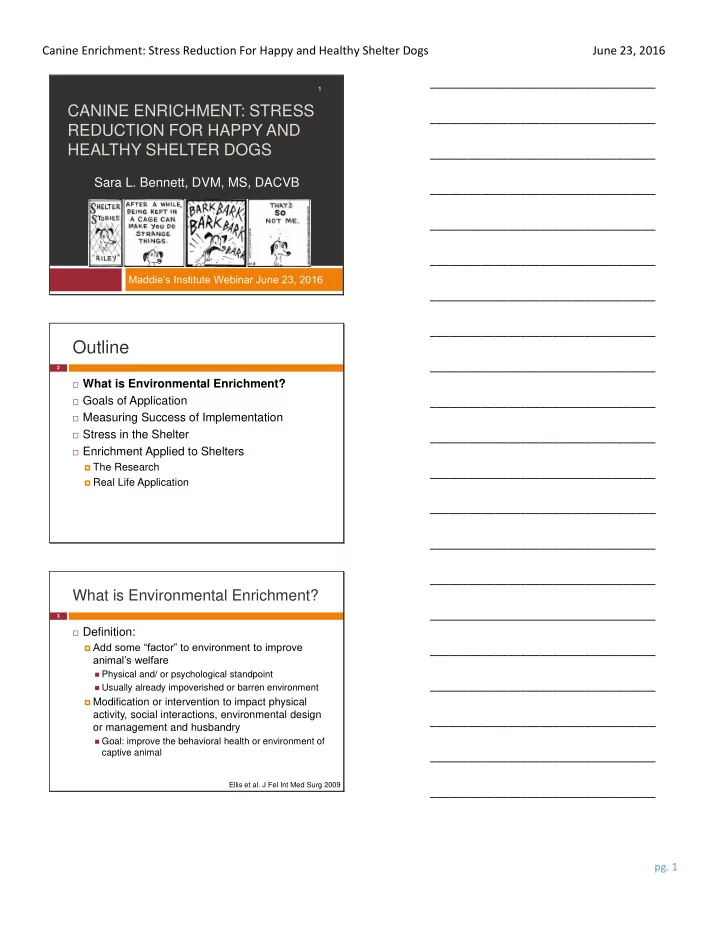
Outline

 What is Environmental Enrichment?  Goals of Application  Measuring Success of Implementation  Stress in the Shelter  Enrichment Applied to Shelters  The Research  Real Life Application

2

___________________________________ ___________________________________ ___________________________________ ___________________________________ ___________________________________ ___________________________________ ___________________________________

What is Environmental Enrichment?

3

 Definition:  Add some “factor” to environment to improve

animal’s welfare

 Physical and/ or psychological standpoint  Usually already impoverished or barren environment  Modification or intervention to impact physical

activity, social interactions, environmental design

  • r management and husbandry

 Goal: improve the behavioral health or environment of

captive animal

Ellis et al. J Fel Int Med Surg 2009

___________________________________ ___________________________________ ___________________________________ ___________________________________ ___________________________________ ___________________________________ ___________________________________

slide-2
SLIDE 2

Canine Enrichment: Stress Reduction For Happy and Healthy Shelter Dogs June 23, 2016

  • pg. 2

What is Environmental Enrichment?

4

 Modification often focus on the environment

itself and the basic resources needed

 Food, water, shelter or elimination  Activating the animal’s five senses  Increasing physical activity  Adding social interactions with conspecifics and/

  • r other species

___________________________________ ___________________________________ ___________________________________ ___________________________________ ___________________________________ ___________________________________ ___________________________________

What is Environmental Enrichment?

5

 Association of Shelter Veterinarians

Guidelines for Standards of Care in Animal Shelters

 Definition: Process for improving environment and

behavioral care of confined animals within context

  • f their behavioral needs

 Purpose: Reduce stress and improve well-being  Physical and mental stimulation  Encourage species-typical behaviors  Allow animals more control over environment http://www.sheltervet.org/wp-content/uploads/2011/08/Shelter- Standards-Oct2011-wForward.pdf

___________________________________ ___________________________________ ___________________________________ ___________________________________ ___________________________________ ___________________________________ ___________________________________

What is Environmental Enrichment?

6

 Trend to label as “environmental needs”  Implies required for behavioral and physical

health and adequate welfare

 Should be offered to every pet  Not only when signs of poor health already

present

 Addressed quickly when deficits noted  Goal: Maintain behavioral health  Prevent unwanted behaviors AAFP IFMS Feline Environmental Needs Guidelines catvet.com

___________________________________ ___________________________________ ___________________________________ ___________________________________ ___________________________________ ___________________________________ ___________________________________

slide-3
SLIDE 3

Canine Enrichment: Stress Reduction For Happy and Healthy Shelter Dogs June 23, 2016

  • pg. 3

Outline

 What is Environmental Enrichment?  Goals of Application  Measuring Success of Implementation  Stress in the Shelter  Enrichment Applied to Shelters  The Research  Real Life Application

7

___________________________________ ___________________________________ ___________________________________ ___________________________________ ___________________________________ ___________________________________ ___________________________________

Goals of Application

8

 Define or classify environmental enrichment by

the goal of the application

 Increasing behavioral diversity  Increasing expression of normal species typical

behavior

 Decreasing abnormal behavior  Increase positive use of available environment  More than just increasing motor activity now Ellis et al. J Fel Int Med Surg 2009

___________________________________ ___________________________________ ___________________________________ ___________________________________ ___________________________________ ___________________________________ ___________________________________

Outline

 What is Environmental Enrichment?  Goals of Application  Measuring Success of Implementation  Stress in the Shelter  Enrichment Applied to Shelters  The Research  Real Life Application

9

___________________________________ ___________________________________ ___________________________________ ___________________________________ ___________________________________ ___________________________________ ___________________________________

slide-4
SLIDE 4

Canine Enrichment: Stress Reduction For Happy and Healthy Shelter Dogs June 23, 2016

  • pg. 4

Measuring Success of Implementation

10

 Confirm that behavior changes result in actual

welfare improvement

 Five Freedoms  Freedom from Hunger and Thirst  Freedom from Discomfort*  Freedom from Pain, Injury or Disease  Freedom to Express Normal Behavior*  Freedom from Fear and Distress* Farm Animal Welfare Council

___________________________________ ___________________________________ ___________________________________ ___________________________________ ___________________________________ ___________________________________ ___________________________________

Measuring Success of Implementation

11

 Confirm that behavior changes result in actual

welfare improvement

 ID animal’s emotional state as result of enrichment  Measure physiologic parameters  Monitor body language  Longer term evaluation  What normal behavior being stimulated  Does that change other associated behaviors,

emotional states or activities?

 Social interaction through fencing- can see but cannot

touch- increase frustration because cannot complete sequence

AAFP IFMS Feline Environmental Needs Guidelines

___________________________________ ___________________________________ ___________________________________ ___________________________________ ___________________________________ ___________________________________ ___________________________________

Measuring Success of Implementation

12

 Don’t automatically assume rotation of all

enrichments are beneficial

 Effect of rotation depends on:  Type of enrichment  Stress to animal when changing it  Effect of novelty and habituation on use  Balance between too much rotation/ lack of

control and barren environment with strict schedule

___________________________________ ___________________________________ ___________________________________ ___________________________________ ___________________________________ ___________________________________ ___________________________________

slide-5
SLIDE 5

Canine Enrichment: Stress Reduction For Happy and Healthy Shelter Dogs June 23, 2016

  • pg. 5

Measuring Success of Implementation

13

 Lack of control in environment or inability to

predict occurrence of stressors can be extremely stressful

 Inconsistent or irregular interactions  Unfamiliar people or dogs  Ability to predict occurrence of stressor can help

animal return to lower stress state between events

 Definition (Assoc. Shelter Vet.)  Includes “allowing animals more control over their

environment.”

___________________________________ ___________________________________ ___________________________________ ___________________________________ ___________________________________ ___________________________________ ___________________________________

Outline

 What is Environmental Enrichment?  Goals of Application  Measuring Success of Implementation  Stress in the Shelter  Enrichment Applied to Shelters  The Research  Real Life Application

14

___________________________________ ___________________________________ ___________________________________ ___________________________________ ___________________________________ ___________________________________ ___________________________________

Stress in the Shelter

 Signs of stress  Fear and anxiety  Withdrawn, curled up in back of kennel  Lack of interest in social interaction  Frustration  Motivated to perform a behavior without an

appropriate outlet

 Aggression  Result of fear and/ or frustration

15

___________________________________ ___________________________________ ___________________________________ ___________________________________ ___________________________________ ___________________________________ ___________________________________

slide-6
SLIDE 6

Canine Enrichment: Stress Reduction For Happy and Healthy Shelter Dogs June 23, 2016

  • pg. 6

Behavior Problems in Shelters

 Stress/ Anxiety  Fears  Fear aggression  Repetitive behaviors  Displacement  Stereotypic  Compulsive disorder  Hyper-excitable  Jumpy/ mouthy  Frustration

16

___________________________________ ___________________________________ ___________________________________ ___________________________________ ___________________________________ ___________________________________ ___________________________________

Kennel Stress

 Kennel stress considered when:  Increased barking, jumping and lunging at

passersby; difficulty focusing during play & training

 Hiding, trembling, cowering, or excessively

drooling in current housing system

 No history of this level of fear previous environments  Repetitive behaviors  Patterned pacing, circling, tail chasing, shadow

chasing, stereotyped pouncing, other repeated behaviors

17

___________________________________ ___________________________________ ___________________________________ ___________________________________ ___________________________________ ___________________________________ ___________________________________

Fear vs. Anxiety

18

 Definitions:  Fear  Behavioral response to perceived actual danger  Goal to protect, get out of harm’s way  Combination of behavioral and physiologic changes  Alarm reaction & resistance phase of stress  Anxiety  Reaction to a potential threat  Anticipation or worry  Can become maladaptive  Include exhaustion phase of stress

Boissey & Erhard, in: Gen & Behav Dom Anim

___________________________________ ___________________________________ ___________________________________ ___________________________________ ___________________________________ ___________________________________ ___________________________________

slide-7
SLIDE 7

Canine Enrichment: Stress Reduction For Happy and Healthy Shelter Dogs June 23, 2016

  • pg. 7

Fear

19

 Flight  Run away, hide  Fight  Often last resort  Cannot hide or cornered  Expensive  Defend oneself  Perceive life in danger

___________________________________ ___________________________________ ___________________________________ ___________________________________ ___________________________________ ___________________________________ ___________________________________

Fear

20

 At Shelter:  In unfamiliar confined space  Unfamiliar dogs, cats and people around  Intense smells and sounds  Person/animal continues to approach despite

trying to hide

 Which option will pet choose?

___________________________________ ___________________________________ ___________________________________ ___________________________________ ___________________________________ ___________________________________ ___________________________________

Frustration

 Results in  High arousal, lack of impulse control  Jumping, mouthing  Acute conflict behaviors  Stereotypic behaviors  Cage biting  Aggression  Fence running, charging the kennel door  Very difficult to ignore some of these unwanted

behaviors

21

___________________________________ ___________________________________ ___________________________________ ___________________________________ ___________________________________ ___________________________________ ___________________________________

slide-8
SLIDE 8

Canine Enrichment: Stress Reduction For Happy and Healthy Shelter Dogs June 23, 2016

  • pg. 8

Frustration

22

 Animals at particular risk  Highly social dogs and cats  To people or conspecifics  Highly trainable breeds  Working breeds

 German Shepherds  Other herding breeds- Aussie, Border collie, Sheltie  Rottweilers, Dobermans  Terriers

 Including Pit bull terriers

___________________________________ ___________________________________ ___________________________________ ___________________________________ ___________________________________ ___________________________________ ___________________________________

Frustration

23

 Highly trainable breeds  Learning by operant conditioning  Trial and error  Occurring all of the time, whether we want it to or

not

 Law of Effect

___________________________________ ___________________________________ ___________________________________ ___________________________________ ___________________________________ ___________________________________ ___________________________________

Law of Effect

 Behavior resulting in pleasant consequence

strengthened/ Increases in frequency

 Behavior resulting in no consequence is

weakened

 Behavior resulting in unpleasant consequence

Weakened/ decreases in frequency

 Interpretation of consequence based on dog’s

perception, not ours!

24

___________________________________ ___________________________________ ___________________________________ ___________________________________ ___________________________________ ___________________________________ ___________________________________

slide-9
SLIDE 9

Canine Enrichment: Stress Reduction For Happy and Healthy Shelter Dogs June 23, 2016

  • pg. 9

Outline

 What is Environmental Enrichment?  Goals of Application  Measuring Success of Implementation  Stress in the Shelter  Enrichment Applied to Shelters  The Research  Real Life Application

25

___________________________________ ___________________________________ ___________________________________ ___________________________________ ___________________________________ ___________________________________ ___________________________________

Enrichment Applied to Shelters

26

 Role & Goal of Shelters  Role: offer food, water and shelter for un-owned

dogs

 Goal: to find dogs new home as quickly as

possible

 Make shelter stay as short and stress-free as

possible

 Maintain physical and behavioral health

___________________________________ ___________________________________ ___________________________________ ___________________________________ ___________________________________ ___________________________________ ___________________________________

Enrichment Applied to Shelters

27

 Real life application strategies  Consider application strategies in the context of

cost of implementation, finances, manpower and time

 Triage those dogs first in line  Longer term residents  Those most stressed, hiding, frustrated  Log activity and reaction  Send list of what dog likes home with new owner

___________________________________ ___________________________________ ___________________________________ ___________________________________ ___________________________________ ___________________________________ ___________________________________

slide-10
SLIDE 10

Canine Enrichment: Stress Reduction For Happy and Healthy Shelter Dogs June 23, 2016

  • pg. 10

Areas to Address

 Environment  Size  Indoor/ outdoor  Bedding  Learning  Safety  Life skills  Politeness/ Impulse

control

 Behavior modification  Job/ cool behaviors  Social  Play  Quiet time  People  Dogs  Senses  Sight  Hearing  Smell  Touch  Taste

28

___________________________________ ___________________________________ ___________________________________ ___________________________________ ___________________________________ ___________________________________ ___________________________________

Areas to Address

 Environment  Housing  Size  Indoor/outdoor  Noise/ Light  Enrichment  Beds  Toys  Social interaction  Conspecific interaction  Human interaction  Exercise

29

___________________________________ ___________________________________ ___________________________________ ___________________________________ ___________________________________ ___________________________________ ___________________________________

Housing size, indoor/ outdoor

 Dogs spent more time moving and less time in

repetitive behaviors in larger pens

 Outdoor access  Associated with a decrease in stereotypy  Sometimes an increase in activity or pace  By very nature, outdoor and/or group housing

increases physical complexity of kennel environment

30

(Hughes & Campbell 1990; Hetts et al 1992; Hubrecht et al 1992; Beerda et al 1999)

___________________________________ ___________________________________ ___________________________________ ___________________________________ ___________________________________ ___________________________________ ___________________________________

slide-11
SLIDE 11

Canine Enrichment: Stress Reduction For Happy and Healthy Shelter Dogs June 23, 2016

  • pg. 11

Beds

 Moving bed to front of cage made dog more likely

to be at the front even though it’s activity was not altered

 May indirectly increase welfare by facilitating adoption  Visitors reported dogs at the front of cages to be more

attractive than ones at the back

 Raised platforms were used by young dogs 55%

  • f the time

 After two months these dogs were rated as more

confident, friendly and playful than previously

31

(Wells & Hepper 1992, 2000; Wells 1996; Hubrecht 1993)

___________________________________ ___________________________________ ___________________________________ ___________________________________ ___________________________________ ___________________________________ ___________________________________

Conspecific Social Interaction

 Keeping dogs in groups  Opportunity to satisfy biological need for physical

exercise and social contact with conspecifics

 Increased risk of behavioral abnormalities when

housed singly

 Particularly evident if isolated from a young age  More likely to circle repetitively, vocalize, and self groom  Almost complete absence of stereotypic behaviors

reported in group-housed dogs .

32

(Sonderegger & TuAn ;Thompson et al 1956; Fuller & Clark 1966; Scott 1980; Hubrecht et al 1992; Hubrecht 1993; Mertens & Unshelm 1996; Beerda et al 1999 )

___________________________________ ___________________________________ ___________________________________ ___________________________________ ___________________________________ ___________________________________ ___________________________________

Conspecific Social Interaction

 Group-housed shelter dogs:  More active, less aggressive,

quicker to re-home

 Showed fewer behavior

problems in the new home

 Visual and auditory

perception of conspecific without opportunity to physically interact can be very frustrating

33

(Mertens and Unshelm 1996 ; McAfee et al 2002; Mills & Davenport 2002)

___________________________________ ___________________________________ ___________________________________ ___________________________________ ___________________________________ ___________________________________ ___________________________________

slide-12
SLIDE 12

Canine Enrichment: Stress Reduction For Happy and Healthy Shelter Dogs June 23, 2016

  • pg. 12

Human Social Interaction

 Presence of people can be both stimulating

and calming

 Periods of human activity were correlated with

increased dog activity and barking

 Dogs more likely to stand near the front of the

cage and bark during busy visiting periods

34

(Neamand et al 1975; Hughes et al 1989; Hetts et al 1992; Wells and Hepper 2000; Sales et al 1997; Ledger et al 1996)

___________________________________ ___________________________________ ___________________________________ ___________________________________ ___________________________________ ___________________________________ ___________________________________

 Human contact may decrease stress-related

behavior and physiology

 Mechanism to help kenneled dogs cope with

stress

 Petting can reduce heart rate,

after an initial rise upon greeting

Human Social Interaction

35

(McMillan 1999; Hennessey et al 1998; Lynch & Gantt 1968; Kostarczyk 1992)

___________________________________ ___________________________________ ___________________________________ ___________________________________ ___________________________________ ___________________________________ ___________________________________

Human Social Interaction

 Visual access to people without physical

access

 Can be over-stimulating, facilitate barking and be

source of frustration

 Visual access to people may be detrimental to

the welfare of the dogs

 particularly for fearful dogs in shelters during

maintenance or visiting times

 Not been fully explored

36

___________________________________ ___________________________________ ___________________________________ ___________________________________ ___________________________________ ___________________________________ ___________________________________

slide-13
SLIDE 13

Canine Enrichment: Stress Reduction For Happy and Healthy Shelter Dogs June 23, 2016

  • pg. 13

Play!

 http://www.maddiesfund.org/the-best-medicine-

playing-with-shelter-dogs.htm

37

___________________________________ ___________________________________ ___________________________________ ___________________________________ ___________________________________ ___________________________________ ___________________________________

Behavior Modification/ Training

 Center for Shelter Dogs  http://www.centerforshelterdogs.com/Home/DogB

ehavior/ProblemsandManagement.aspx

 ASPCAPro  http://aspcapro.org/behavior-enrichment  Maddie’s Institute  http://www.maddiesfund.org/topic-animal-

behavior.htm

38

___________________________________ ___________________________________ ___________________________________ ___________________________________ ___________________________________ ___________________________________ ___________________________________

Behavior Modification/ Training

 Herron, Kirby-Madden, Lord. JAVMA 2014  Dogs receiving food toy and kennel side training

showed more approaching the front, lying down, sitting and quiet behaviors when approached

 Luescher, Medlock. AABS 2009  Dogs that underwent training were 1.4 times more

  • ften adopted

 Walk on a head halter, sit on cue, approach front of

kennel, not jump when greeting

39

___________________________________ ___________________________________ ___________________________________ ___________________________________ ___________________________________ ___________________________________ ___________________________________

slide-14
SLIDE 14

Canine Enrichment: Stress Reduction For Happy and Healthy Shelter Dogs June 23, 2016

  • pg. 14

Enrichment Applied to Shelters

40

 Social interaction with people  Positive reinforcement training sessions  Very social and easily frustrated dogs  Clicker training is ideally suited for this  Easy foundation behaviors:

 Target object with nose, sit, give paw,

go to place

___________________________________ ___________________________________ ___________________________________ ___________________________________ ___________________________________ ___________________________________ ___________________________________

Enrichment Applied to Shelters

41

 Social interaction with

people

 Caregivers calm, quiet,

patient, positive

 Consistent schedule for

caretakers

 Calm handling with minimal

low stress restraint

 Interactions should not be

forced

 Visit, pet, play, train Book Buddies ARL Huffington Post Gourkow & Fraser Anim Welf 2006; Rochlitz, The Welfare of Cats 2007

___________________________________ ___________________________________ ___________________________________ ___________________________________ ___________________________________ ___________________________________ ___________________________________

Areas to Address

 Sight  Hearing  Smell  Taste  Touch

42

___________________________________ ___________________________________ ___________________________________ ___________________________________ ___________________________________ ___________________________________ ___________________________________

slide-15
SLIDE 15

Canine Enrichment: Stress Reduction For Happy and Healthy Shelter Dogs June 23, 2016

  • pg. 15

Light

 Don’t underestimate the power of a normal

daily routine

 Highly stressful for lights to be on overnight or

for lights not to be on during day chronically

 Disrupts normal biorhythm  ICU psychosis/ delirium/ syndrome  Lights should be turned off in evening and

back on in morning

43

___________________________________ ___________________________________ ___________________________________ ___________________________________ ___________________________________ ___________________________________ ___________________________________

Sound

 Don’t underestimate the power of quiet  Other barking dogs, clanging bowls and

cleaning noise can be very stressful

 Sound dampening material in enclosures  Quiet kennel exercises  Music: (Wells, Graham, Hepper Animal Welfare 2002)  Type of music affected activity, position in kennel

and vocalization

 More time resting and less time standing with classical  More time barking with heavy metal

44

___________________________________ ___________________________________ ___________________________________ ___________________________________ ___________________________________ ___________________________________ ___________________________________

Smell

 Pheromones  Essential oil diffusion

 (Graham, Wells, Hepper Applied Animal Behaviour Science 2005)

 Chamomile and Lavender  More time resting, less time moving,

less vocalization

 Rosemary and Peppermint  More standing, moving, vocalizing

45

___________________________________ ___________________________________ ___________________________________ ___________________________________ ___________________________________ ___________________________________ ___________________________________

slide-16
SLIDE 16

Canine Enrichment: Stress Reduction For Happy and Healthy Shelter Dogs June 23, 2016

  • pg. 16

Taste

46

___________________________________ ___________________________________ ___________________________________ ___________________________________ ___________________________________ ___________________________________ ___________________________________

Touch

 Offer variety of toys  Determine what pet likes to play with  Stays with that pet through shelter until ready to

be replaced

 If disinfectable, should be done between animals www.petedge.com

47

___________________________________ ___________________________________ ___________________________________ ___________________________________ ___________________________________ ___________________________________ ___________________________________

Enrichment Applied to Shelters

48

 Rotation schedules  Keep those items that the pets really love to

interact with present at all times

 Rotate through toy variety  Log which toys/ enrichment each dog prefers  Send list home with new owner  Scheduled times  Music, scent, quiet time, social interactions  Make it fun for volunteers and dogs!

___________________________________ ___________________________________ ___________________________________ ___________________________________ ___________________________________ ___________________________________ ___________________________________

slide-17
SLIDE 17

Canine Enrichment: Stress Reduction For Happy and Healthy Shelter Dogs June 23, 2016

  • pg. 17

Enrichment Schedule

49

Time Enrichment

Morning Music time Noon Toy/ Object Time Afternoon Petting/ Training time (alternate with play?) Evening Quiet Time

___________________________________ ___________________________________ ___________________________________ ___________________________________ ___________________________________ ___________________________________ ___________________________________

Enrichment Schedule

50

Day Enrichment

Sunday Training Day Monday Food Toy Day Tuesday Play Group Day Wednesday Food Toy Day Thursday Aromatherapy Day Friday Food Toy Day Saturday Reading/ Massage Day

___________________________________ ___________________________________ ___________________________________ ___________________________________ ___________________________________ ___________________________________ ___________________________________

Conclusions

51

 Enrichment and environmental management should

be offered to all dogs, not just those most visibly stressed.

 Monitoring of physical and behavioral changes as a

result of the enrichment should be part of enrichment plan.

 Don’t assume rotation of enrichment is always good.  Utilize the 5 senses, space management and social

interactions for opportunities for enrichment.

 Get creative! Enlist the help of staff and volunteers to

come up with creative and inexpensive ways to offer enrichment.

___________________________________ ___________________________________ ___________________________________ ___________________________________ ___________________________________ ___________________________________ ___________________________________

slide-18
SLIDE 18

Canine Enrichment: Stress Reduction For Happy and Healthy Shelter Dogs June 23, 2016

  • pg. 18

Overall Conclusions

52

 Enrichment can reduce stress  Reduced stress reduces illness  Happy healthy dogs are more adoptable  Need to be able to interpret body language in

  • rder to determine:

 Emotional State  Motivation for undesired behavior  Those most in need of immediate intervention  Set up plan appropriate for behavior signs displayed  Evaluate response to plan implementation

___________________________________ ___________________________________ ___________________________________ ___________________________________ ___________________________________ ___________________________________ ___________________________________

Thank You for Your Time!

53

 Sara L. Bennett, DVM, MS, DACVB  Veterinary Behavior Specialist  sbennettdvm@gmail.com  Behavior consultation, client or patient

inquiries

 DrB.Behavior@gmail.com

 P: 812-550-1033  F: 888-726-9034

 www.DrBennettBehavior.com

___________________________________ ___________________________________ ___________________________________ ___________________________________ ___________________________________ ___________________________________ ___________________________________