Outline Background recidivism and role of mental - - PDF document

outline
SMART_READER_LITE
LIVE PREVIEW

Outline Background recidivism and role of mental - - PDF document

11/12/2017 Outline Background recidivism and role of mental illness The role of mental illness in New study recidivism ImplicaJons


slide-1
SLIDE 1

11/12/2017 ¡ 1 ¡

The ¡role ¡of ¡mental ¡illness ¡in ¡ recidivism ¡

Seena ¡Fazel, ¡ ¡ Department ¡of ¡Psychiatry, ¡ ¡ University ¡of ¡Oxford ¡ ¡

Outline ¡ ¡

  • Background ¡– ¡recidivism ¡and ¡role ¡of ¡mental ¡

illness ¡

  • New ¡study ¡ ¡
  • ImplicaJons ¡
  • Risk ¡assessment ¡ ¡

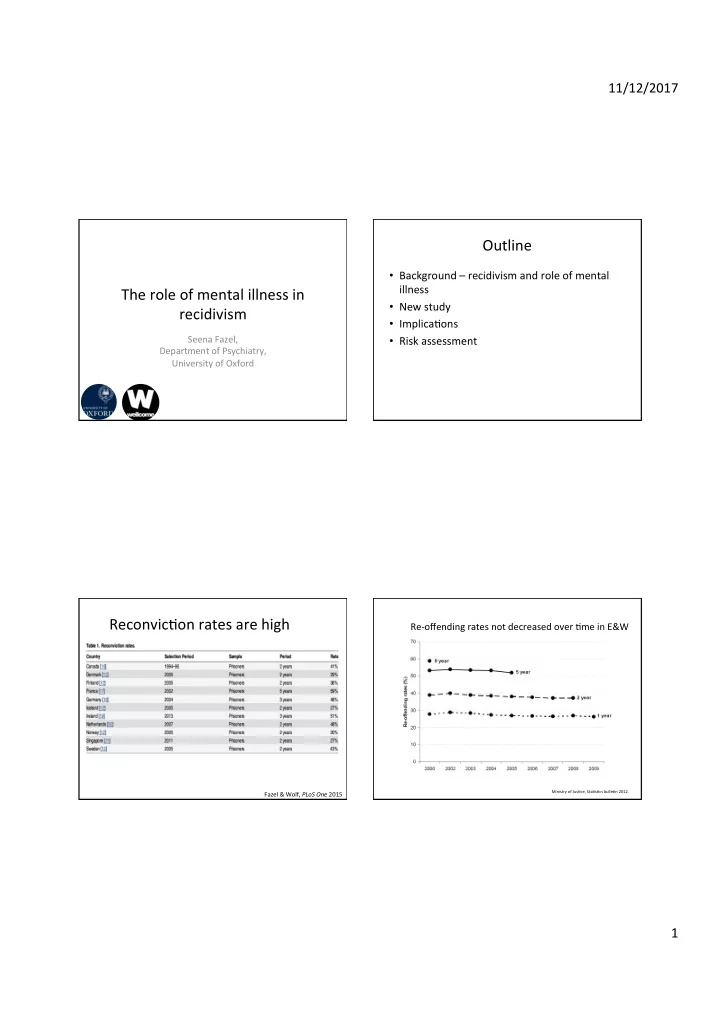
ReconvicJon ¡rates ¡are ¡high ¡

Fazel ¡& ¡Wolf, ¡PLoS ¡One ¡2015 ¡

Re-­‑offending ¡rates ¡not ¡decreased ¡over ¡Jme ¡in ¡E&W ¡ ¡

Ministry ¡of ¡JusJce, ¡StaJsJcs ¡bulleJn ¡2012. ¡

slide-2
SLIDE 2

11/12/2017 ¡ 2 ¡ Previous ¡reviews ¡downplay ¡clinical ¡factors ¡ ¡

Are ¡psychoJc ¡disorders ¡associated ¡with ¡recidivism? ¡ ¡

Fazel, ¡Scz ¡Bull ¡2012 ¡

New ¡study ¡ ¡

  • Swedish ¡populaJon ¡ ¡
  • High ¡quality ¡naJonal ¡registers ¡that ¡can ¡be ¡

linked ¡accurately ¡ ¡

  • Similar ¡rates ¡of ¡violent ¡reoffending, ¡mental ¡

illness ¡and ¡substance ¡abuse ¡in ¡prisoners; ¡ lower ¡rates ¡of ¡incarceraJon ¡ ¡

Methods

Population and data sources INCLUSION CRITERIA

  • All prison

releases between 2000 and 2009

  • Age 15-75

FOLLOW UP

  • Violent crime at

1,2 and 5 years SWEDISH REGISTERS

  • Total Population

Register

  • Patient Register
  • Cause of Death

Register

  • National Crime

Register

  • Longitudinal

Integration Database

slide-3
SLIDE 3

11/12/2017 ¡ 3 ¡

QuesJons ¡

  • Is ¡there ¡an ¡associaJon ¡between ¡mental ¡

disorders ¡and ¡violent ¡reoffending? ¡ ¡

  • To ¡what ¡extent ¡is ¡this ¡associaJon ¡

confounded? ¡And ¡by ¡what? ¡ ¡

  • Are ¡there ¡differences ¡by ¡individual ¡diagnoses? ¡ ¡

¡

Sample ¡descripJve ¡staJsJcs

¡ Male Female Number ¡of ¡individuals 43840 3486 Any ¡psychiatric ¡disorder ¡(%) 42.3 64.1 Alcohol ¡abuse ¡(%) 21.2 27.8 Drug ¡abuse ¡(%) 21.9 41.3 Personality ¡disorder ¡(%) 5.3 10.1 ADHD ¡(%) 1.3 1.5 Other ¡developmental ¡or ¡childhood ¡disorder ¡(%) 2.2 4.0 Schizophrenia ¡spectrum ¡disorder ¡(%) 2.8 3.7 Bipolar ¡disorder ¡(%) 0.5 1.0 Depression ¡(%) 5.8 12.0 Anxiety ¡disorder ¡(%) 7.4 15.3 0.00 0.20 0.40 0.60 0.80 1.00 2 4 6 8 10

Year after release Male prisoner without psychiatric disorder Male prisoner with psychiatric disorder Female prisoner without psychiatric disorder Female prisoner with psychiatric disorder Kaplan-Meier survival estimates

Higher ¡rates ¡of ¡violent ¡recidivism ¡ ¡

Probability ¡of ¡violent ¡reoffending ¡by ¡Jme ¡aaer ¡release

slide-4
SLIDE 4

11/12/2017 ¡ 4 ¡

Non-­‑specific ¡links? ¡ ¡

slide-5
SLIDE 5

11/12/2017 ¡ 5 ¡

Findings ¡are ¡generalizable ¡to ¡other ¡countries ¡ ¡

ImplicaJons ¡ ¡

  • NaJonal ¡violence ¡prevenJon ¡strategies ¡should ¡

include ¡prison ¡health ¡

  • Very ¡lidle ¡familial ¡confounding ¡suggesJng ¡

causality ¡ ¡

  • Non-­‑specificity ¡by ¡diagnosis ¡suggests ¡shared ¡

mechanisms ¡(emoJonal ¡dysregulaJon?) ¡

  • MulJmorbidity ¡important ¡ ¡

Overall ¡implicaJons ¡

  • ExplanaJons ¡of ¡reoffending ¡– ¡criminological, ¡

psychological, ¡medical/public ¡health ¡ ¡

  • What ¡next ¡for ¡risk ¡assessment? ¡ ¡
  • What ¡next ¡for ¡risk ¡management? ¡ ¡

New ¡Scien1st, ¡2013 ¡

slide-6
SLIDE 6

11/12/2017 ¡ 6 ¡

Coid, ¡JFFP ¡2011 ¡

And ¡what ¡does ¡high ¡risk ¡mean? ¡ ¡

Singh, ¡BJP ¡2014 ¡

slide-7
SLIDE 7

11/12/2017 ¡ 7 ¡

Problems ¡

  • Costly ¡(direct ¡and ¡indirect) ¡
  • Time ¡consuming ¡
  • Not ¡transparent ¡
  • PublicaJon ¡bias ¡
  • Evidence ¡base ¡is ¡variable ¡ ¡ ¡
  • Guru-­‑like ¡system ¡of ¡training ¡ ¡
  • Meaningless ¡cut-­‑offs? ¡ ¡
  • Don’t ¡improve ¡outcomes ¡ ¡

So ¡lets ¡do ¡it ¡differently ¡and ¡properly ¡

  • What ¡precedents ¡are ¡there? ¡ ¡
slide-8
SLIDE 8

11/12/2017 ¡ 8 ¡ So ¡lets ¡do ¡it ¡differently ¡and ¡properly ¡

  • What ¡precedents ¡are ¡there? ¡ ¡
  • Develop ¡web ¡based ¡calculator, ¡free ¡to ¡use, ¡

requires ¡no ¡training ¡ ¡

Methods

Population and data sources INCLUSION CRITERIA

  • All prison

releases between 2000 and 2009

  • Age 15-75

FOLLOW UP

  • Violent crime

within 12/24 months

  • Any crime within

12/24 months SWEDISH REGISTERS

  • Total Population

Register

  • Patient Register
  • Cause of Death

Register

  • National Crime

Register

  • Longitudinal

Integration Database

Methods

Samples & Analyses DERIVATION

  • Cox regression
  • Risk factor groups
  • Low / Medium /

High

10% 50%

  • All pre-specified

VALIDATION

  • Sensitivity/

Specificity

  • PPV/NPV
  • AUC
  • Brier score

SAMPLES

  • 47 326 prisoners
  • Derivation sample

(n= 37 100)

  • Validation sample

(n= 10 226) Index violent crime, previous violent crime, length of incarceration

CRIMINOGENIC

Sex, age, immigrant status, marital status, educational level, income, deprivation

SOCIO-DEMOGRAPHIC

Homicide, assault, robbery, arson, sexual offense, illegal threat or intimidation

VIOLENT CRIME

Alcohol or drug disorders, mental illness, developmental or childhood disorders

CLINICAL

Methods

Risk factors and event 18 % within 24 months

slide-9
SLIDE 9

11/12/2017 ¡ 9 ¡

Results

Included risk factors MALE 93 % MEAN AGE 36 yrs IMMIGRANT STATUS 31 % LENGTH OF INCARCERATION VIOLENT INDEX OFFENCE 38 % PREVIOUS VIOLENT CRIME 53 % UNMARRIED 65 % EDUCATION EMPLOYMENT 25 % DISPOSABLE INCOME NEIGHBOURHOOD DEPRIVATION ALCOHOL USE DISORDER 22 % ANY MENTAL DISORDER 22 % DEVELOPMENTAL/CHILDHOOD DIS 3 %

1 2 3

DRUG USE DISORDER 23 % ANY SEVERE MENTAL DISORDER 3 %

Variable Adjusted Odds Ratio Sex (female) 0.51 (0.45-0.57) Age (per 5 years) 0.84 (0.83-0.85) Immigrant status 0.97 (0.92-1.02) Length of incarceration 6-11 months 12-23 months 24+ months ¡ 0.85 (0.81-0.90) 0.69 (0.63-0.75) 0.55 (0.48-0.64) Violent index

  • ffence

1.53 (1.46-1.59) Previous violent crime 2.41 (2.29-2.54) Unmarried 1.08 (1.02-1.15) Education level 9-11 years 12+ years 0.83 (0.79-0.87) 0.65 (0.57-0.75)

Results

Risk factor odds ratios

Variable Adjusted Odds Ratio Employment 0.68 (0.63-0.72) Disposable income Zero Low (<20º) Medium (20º - 80º) High (>80º) 1.69 (1.11-2.57) 1.68 (1.11-2.53) 1.45 (0.96-2.19) 1.57 (0.92-2.67) Neighbourhood deprivation 1.03 (1.01-1.04) Alcohol use disorder 1.41 (1.33-1.49) Drug use disorder 1.51 (1.44-1.59) Any mental disorder 1.09 (1.03-1.15) Any severe mental disorder 1.10 (0.99-1.22)

Results

Validation and web tool NPV PPV Specificity

99

%

Sensitivity

37

%

70

%

67

%

c-index (AUC)

.76

slide-10
SLIDE 10

11/12/2017 ¡ 10 ¡

Results

Comparison with other tools

SENSITIVITY

67%

SPECIFICITY

70%

POSITIVE PREDICTIVE VALUE

37%

NEGATIVE PREDICTIVE VALUE

99%

AREA UNDER THE CURVE

0.76

SENSITIVITY

92%

SPECIFICITY

36%

POSITIVE PREDICTIVE VALUE

41%

NEGATIVE PREDICTIVE VALUE

91%

AREA UNDER THE CURVE

0.72

VIOLENCE TOOLS

Mean values for HCR-20, SARA, SAVRY, and VRAG*

OXREC

OXFORD RISK OF RECIDIVISM TOOL

*Fazel et al., BMJ 2012

Conclusions ¡

  • Scalable ¡tool ¡
  • Overall ¡similar ¡predicJve ¡abiliJes ¡to ¡current ¡

approaches ¡

  • More ¡effecJve ¡targeJng ¡than ¡current ¡tools ¡– ¡

sensiJvity ¡67% ¡ ¡

  • IdenJfies ¡those ¡with ¡drug ¡and ¡alcohol ¡needs, ¡and ¡

mental ¡health ¡problems ¡

  • Simple ¡way ¡of ¡providing ¡BASELINE ¡risk ¡ ¡
  • Needs ¡to ¡be ¡complemented ¡with ¡more ¡

individualised ¡needs ¡assessments ¡ ¡

Published paper

Lancet Psychiatry 2016; 3: 535–43 Published Online April 13, 2016 http://dx.doi.org/10.1016/ S2215-0366(16)00103-6 See Comment page 493 Department of Psychiatry, Warneford Hospital (Prof S Fazel MD, Z Chang PhD) and Department of Primary Care Health Sciences (T Fanshawe PhD), University of Oxford, Oxford, UK; Department of Medical Epidemiology and Biostatistics, Karolinska Institutet, Stockholm, Sweden

Prediction of violent reoff ending on release from prison: derivation and external validation of a scalable tool

Seena Fazel, Zheng Chang, Thomas Fanshawe, Niklas Långström, Paul Lichtenstein, Henrik Larsson, Susan Mallett

Summary

Background More than 30 million people are released from prison worldwide every year, who include a group at high risk of perpetrating interpersonal violence. Because there is considerable inconsistency and ineffi ciency in identifying those who would benefi t from interventions to reduce this risk, we developed and validated a clinical prediction rule to determine the risk of violent off ending in released prisoners. Methods We did a cohort study of a population of released prisoners in Sweden. Through linkage of population-based registers, we developed predictive models for violent reoff ending for the cohort. First, we developed a derivation model to determine the strength of prespecifi ed, routinely obtained criminal history, sociodemographic, and clinical risk factors using multivariable Cox proportional hazard regression, and then tested them in an external validation. We measured discrimination and calibration for prediction of our primary outcome of violent reoff ending at 1 and 2 years using cutoff s of 10% for 1-year risk and 20% for 2-year risk. Findings We identifi ed a cohort of 47 326 prisoners released in Sweden between 2001 and 2009, with 11 263 incidents of violent reoff ending during this period. We developed a 14-item derivation model to predict violent reoff ending and tested it in an external validation (assigning 37 100 individuals to the derivation sample and 10 226 to the validation sample). The model showed good measures of discrimination (Harrell’s c-index 0·74) and calibration. For risk of violent reoff ending

Results

Summary ¡

  • High ¡rates ¡of ¡recidivism ¡
  • Previous ¡reviews ¡of ¡role ¡of ¡mental ¡illness ¡

misleading ¡

  • New ¡research ¡using ¡large ¡sample, ¡novel ¡design, ¡

reliable ¡exposures ¡and ¡hard ¡outcomes ¡ ¡

  • All ¡mental ¡disorders ¡associated ¡with ¡violent ¡

recidivism ¡

  • NaJonal ¡violence ¡strategies, ¡prison ¡health ¡

services, ¡and ¡risk ¡assessment ¡need ¡review ¡in ¡light ¡
  • f ¡this ¡ ¡
slide-11
SLIDE 11

11/12/2017 ¡ 11 ¡

References ¡(open ¡access) ¡

  • Fazel ¡S, ¡Chang ¡Z, ¡Fanshawe ¡T, ¡Långström ¡N, ¡Lichtenstein ¡P, ¡Larsson ¡H, ¡Malled ¡S. ¡

PredicJon ¡of ¡violent ¡reoffending ¡on ¡release ¡from ¡prison: ¡derivaJon ¡and ¡external ¡ validaJon ¡of ¡a ¡scalable ¡tool. ¡Lancet ¡Psychiatry ¡2016; ¡3: ¡535-­‑543. ¡PMID: ¡26946390 ¡

  • Chang ¡Z, ¡Larsson ¡H, ¡Lichtenstein ¡P, ¡Fazel ¡S. ¡Psychiatric ¡disorders ¡and ¡violent ¡

reoffending: ¡a ¡naJonal ¡cohort ¡study ¡of ¡convicted ¡prisoners ¡in ¡Sweden. ¡Lancet ¡ Psychiatry ¡2015; ¡2: ¡891-­‑900. ¡PMID: ¡26342957. ¡

  • OxRec: ¡www.oxrisk.com/oxrec ¡

Acknowledgements

Achim Wolf

Psychiatry, Oxford

Zheng Chang

Karolinska Institutet

Henrik Larsson

Karolinska Institutet

Paul Lichtenstein

Karolinska Institutet

Susan Mallett

University of Birmingham

seena.fazel@psych.ox.ac.uk Twitter: @seenafazel

Johan Zetterqvist

Karolinska Institutet

Niklas Långström

Karolinska Institutet

Thomas Fanshawe

Primary Care, Oxford