Outline Overview of my PhD studies HSE: How did the relationship - - PDF document

outline
SMART_READER_LITE
LIVE PREVIEW

Outline Overview of my PhD studies HSE: How did the relationship - - PDF document

Widening my SPHeRE of influence in childhood obesity prevention: research, policy and practice Marita Hennessy, HBCRG, School of Psychology, NUI Galway @MaritaHennessy @hbcrg INTeRACT for Health: Increasing Integrated Knowledge Translation


slide-1
SLIDE 1

1

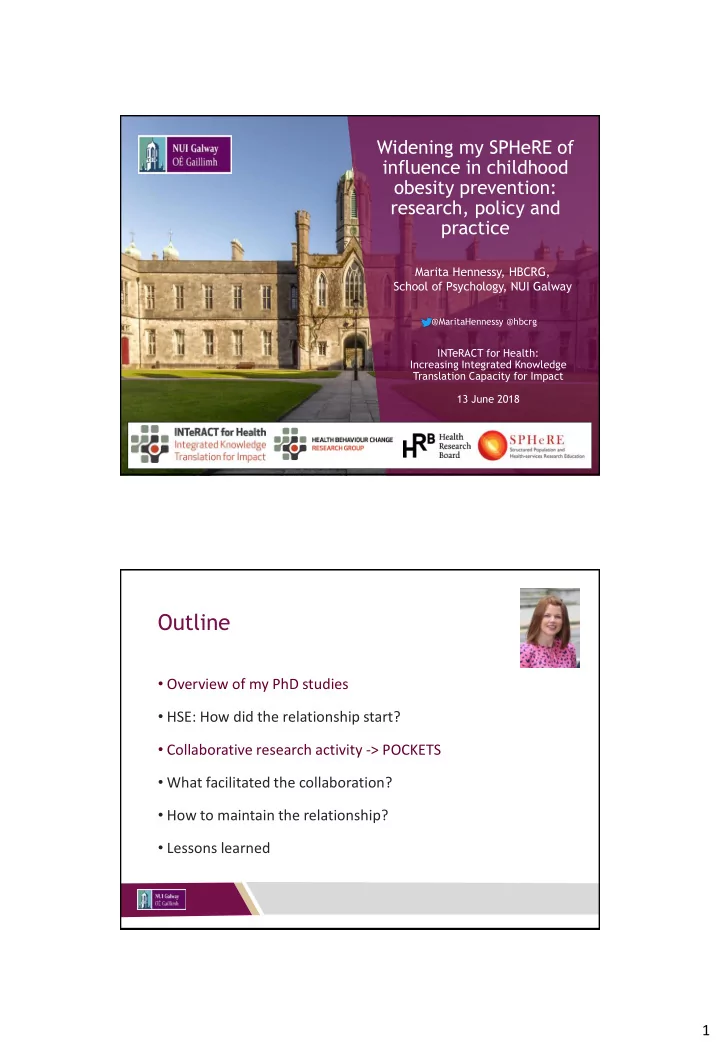
Widening my SPHeRE of influence in childhood

  • besity prevention:

research, policy and practice

INTeRACT for Health: Increasing Integrated Knowledge Translation Capacity for Impact 13 June 2018

Marita Hennessy, HBCRG, School of Psychology, NUI Galway

@MaritaHennessy @hbcrg

Outline

  • Overview of my PhD studies
  • HSE: How did the relationship start?
  • Collaborative research activity -> POCKETS
  • What facilitated the collaboration?
  • How to maintain the relationship?
  • Lessons learned
slide-2
SLIDE 2

2

Study 1 Childhood obesity prevention: Priority areas for future research and barriers and facilitators to knowledge translation Study 2 The effectiveness of health professional-delivered interventions to reduce the risk of overweight /

  • besity in children under the age of

two: a systematic review of randomised controlled trials Study 3 Parents’ views on healthy growth in young children Study 4 Health professionals’ views

  • n healthy growth in young children

Early life interventions delivered by health professionals to prevent childhood obesity

How did the relationship start?

slide-3
SLIDE 3

3

Prof Pinki Sahota

Leeds Beckett University

Annual Conference 2017

Day 1: Preventing Childhood Obesity 4-5 May 2017, University College Dublin

Dr Ellinor Olander

City, University of London

A/Prof Paulina Nowicka

Karolinska Institutet

Dr Grace O’Malley

Temple Street Children’s University Hospital

Prof Sarah Redsell

Anglia Ruskin University

Prof Mary Rudolf

Barr Ilan University

Dr Rachel Laws

Deakin University

View recordings at tinyurl.com/ASOI2017

Dr Phil Jennings Health Service Executive Sarah O’Brien Health Service Executive

POCKETS -> PhD study 1

Nominal Group Technique used during multi-stakeholder workshops over a two-day national obesity conference in May 2017 NGT = consensus method used to generate potential solutions

  • r answers to a question which

can then be agreed upon and/or prioritised Participants Anyone attending the conference eligible to participate on day 1 – closed consensus meeting on day 2, by invitation only

Methodology

slide-4
SLIDE 4

4

Similar process used for identification of barriers and facilitators – but consensus not sought DAY 1 – workshop 10 nominal groups (n = 77) Stage 1: Silent generation

  • f ideas/research gaps

Stage 2: Round robin discussion Stage 3: Clarification of ideas Stage 4: Ranking of research gaps (Round 1) DAY 2 – consensus meeting (n = 14) Stage 5: Discussion of 26- ranked gaps and further development of ideas: 7 merged/removed and 2 added Stage 6: Ranking of 20 research gaps (Round 2) Stage 7: Calculation of first group ranking, feedback and discussion Stage 8: Re-ranking of 20 research gaps (Round 3) Stage 9: Calculation of second group ranking RESEARCH PRIORITIES Ranked list of 20 research priorities What topics/questions are important to focus on in future research on the prevention of childhood obesity?

Research prioritisation overview

Day 1 Research prioritisation

  • n=77, 70F
  • 91% participation rate
  • 88% based in Ireland
  • Academics (40%), clinicians (38%),

health service managers (16%) and

  • ther (6%)

Barriers and facilitators

  • n=68, 61F
  • 80% participation rate

Day 2

  • n= 14/21 individuals/org reps, 1M
  • 67% participation rate
  • Academics/researchers (6), HPs

(3), early years/community-based practitioners (2), policymakers (2), health service manager (1)

  • 289 years’ experience, range: 5-42,

mean= 21 years

Participants

slide-5
SLIDE 5

5

Top 5 research priorities

Overall ranking Round 3 (Final round), 14 individuals 1 Evaluate (including economic evaluation) current programmes to inform practice and policy 2 How to change culture towards addressing the determinants of health (Health in All Policies) 3 Implementation science: process 4 How to integrate obesity prevention into existing service structures 5 How to enhance opportunities for habitual physical activity, including free play and active travel

Barriers & facilitators to KT

Rank Barrier Rank Facilitator 1 Limited funding & resources for prevention 1 Involving key stakeholders from the start 1 Pitching to the right level - all stakeholders (Targeting communications/messages at the right level, depending

  • n the audience)

2 Engagement with your target group. For socially isolated groups, someone to interpret the message [Active engagement with target of your message from the outset; may require someone else to deliver the message to socially excluded groups] 1 Parental knowledge, education, skills 2 Process to translate research into practice (Lack of support from decision makers to identify a function/process within their

  • rganisation to use research or translate research into practice)

1 The food industry 2 Existing resources, e.g. information leaflets 1 Priority (Lack of a priority at policy/service level) 2 Obesity prevention prioritised in funding 1 Family and societal issues (Other family and health- related issues impacting on behaviours) 2 Co-production of knowledge 1 Mismatch between policy & practice. Health promotion being eroded (Policy focus on prevention but this is not the reality in practice) 2 Implementing in schools 1 Lack of resources to implement (health care professional resources) 2 Money, funding, incentivisation 1 Lack of shared realistic goals 2 Education and training for healthcare professionals 1 Research which is incompatible with scalability 2 Political will
slide-6
SLIDE 6

6

What facilitated the collaboration?

Research + Policy + Practice

National Healthy Weight for Children Working Group Project updates Information-sharing: new publications, conference reports

How to maintain the relationship?

slide-7
SLIDE 7

7

Lessons learned

  • Maximise opportunities
  • Policy windows – Relationships – Funding
  • It’s hard work!
  • Often hard to see wood for trees when generating research ideas
  • Timing – takes time, no time, out of time!
  • Publication challenges
  • There will always be competing/fleeting priorities -> make the

most of every opportunity while you can

Acknowledgements

PhD funding: Health Research Board SPHeRE Programme POCKETS funding: Irish Research Council POCKETS co-hosts: ASOI and Dr Karen Matvienko-Sikar, UCC POCKETS participants & workshop facilitators (colleagues within the CHErIsH study team, HBCRG, ASOI) HSE: Sarah O’Brien and Dr Phil Jennings, in particular Supervisory team: Dr Caroline Heary, Prof Molly Byrne, Dr Rachel Laws