Outline Problem Description Proposed System System Architecture - - PDF document

outline
SMART_READER_LITE
LIVE PREVIEW

Outline Problem Description Proposed System System Architecture - - PDF document

Querying Heterogeneous Information Sources Using Source Descriptions ______________________________________________________________VLDB 1996 Alon Y. Levy AT&T Laboratories Anand Rajaraman Stanford University Joann J. Ordille Bell


slide-1
SLIDE 1

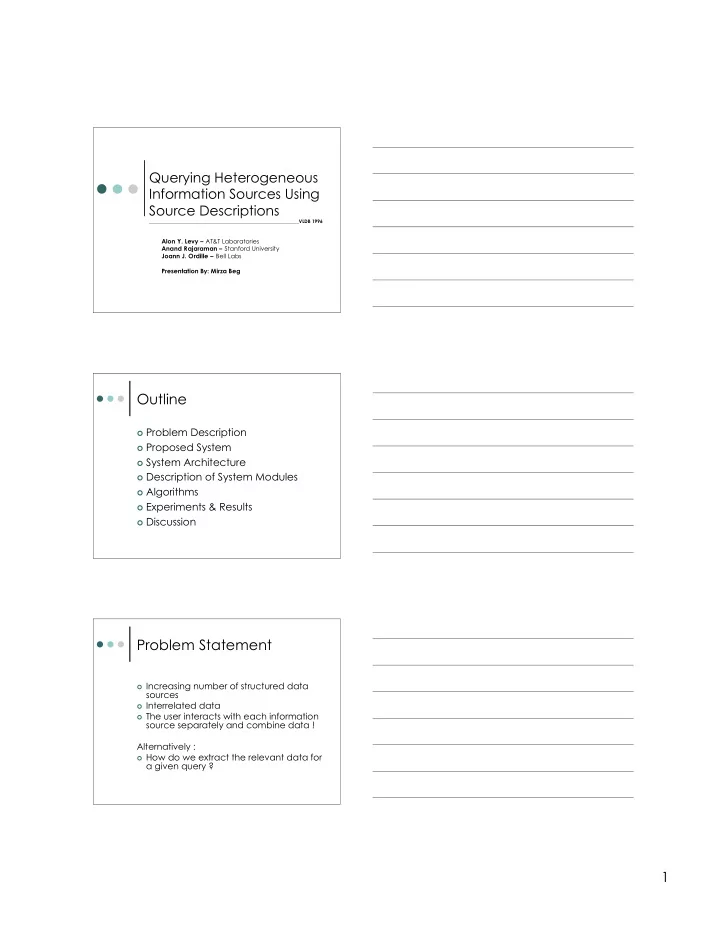
1 Querying Heterogeneous Information Sources Using Source Descriptions

______________________________________________________________VLDB 1996

Alon Y. Levy – AT&T Laboratories Anand Rajaraman – Stanford University Joann J. Ordille – Bell Labs Presentation By: Mirza Beg

Outline

 Problem Description  Proposed System  System Architecture  Description of System Modules  Algorithms  Experiments & Results  Discussion

Problem Statement

 Increasing number of structured data

sources

 Interrelated data  The user interacts with each information

source separately and combine data ! Alternatively :

 How do we extract the relevant data for

a given query ?

slide-2
SLIDE 2

2 Solution

A System that:

 Provides a uniform query interface to

distributed structured sources

 Uses source descriptions to describe

data sources

 Generates executable query plans  Returns the merged result set to the user

INFORMATION MANIFOLD

Information Manifold Architecture Information Manifold World View

 A virtual global schema on which

the user can pose queries

Product {Model} Automobile {Model, Year, Category} Car {Model, Year, Category} NewCar {Model, Year, Category} UsedCar {Model, Year, Category} CarForSale {Model, Year, Category, SellerContact} Motorcycle {Model, Year}

slide-3
SLIDE 3

3 Information Manifold Source Descriptions Source Descriptions for Auto Sources Content Records of Auto Sources

slide-4
SLIDE 4

4 Capability Records of Auto Sources

Desired Inputs Possible Outputs Selection Set

Information Manifold Plan Generator Query Reformulation Steps

 Prune irrelevant sources  Split query into sub goals  Generate conjunctive query plans  Find an executable ordering of sub

goals

slide-5
SLIDE 5

5 Step 1. Bucket Algorithm Step 1. Bucket Algorithm

Given a query Q:

 Find a relevant source  Create a bucket for this sub-goal  Check source for Satisfiability  Add information source to bucket

for this sub-goal

Example: Contents and Capabilities

slide-6
SLIDE 6

6 Bucket Algorithm: Example Step 2. Finding an Executable Ordering

 Considering all possible

combinations of information sources, enumerate semantically correct plans

Step 2. Algorithm for finding an Executable Ordering

 Maintain a list of available

parameters

 At every point add to the ordering

any sub-goal whose input requirements are satisfied

 Push as many selections as

possible to the sources

slide-7
SLIDE 7

7 Step 3. Checking Containment

 Minimize each plan by removing

redundant sub-goals

Experimental Results

Query 1: Find titles and years of movies featuring Tom Hanks Query 2: Find titles and reviews of movies featuring Tom Hanks Query 3: Find telephone number(s) for Alaska Airlines

Experimental Results (cont.)

slide-8
SLIDE 8

8 Conclusions

 A novel system that provides a DB-

like query interface to distributed structured information sources

 Frees the user from interacting with

each information source individually

 Integrates data from multiple sources

and filters information

 Information Manifold applicable to

WWW and company-wide d-DB’s

Open Questions

 How to automatically extract

contents and capabilities from sources ?

 Are there better algorithms to

determine the relevant sources ?

 Scalability ?  Overall Performance issues ?

Discussion Points

 A foundational paper in web-data

mining.

 Substantial impact on current

integration systems.

 Contents & capabilities at the core

  • f the system yet no proposed

generation algorithm.

 Experiments carried out on a very

small set of queries.

slide-9
SLIDE 9

9 Questions ?

?