Outline Markov networks (a.k.a. Markov random fields) Markov - - PDF document

outline
SMART_READER_LITE
LIVE PREVIEW

Outline Markov networks (a.k.a. Markov random fields) Markov - - PDF document

Outline Markov networks (a.k.a. Markov random fields) Markov Networks Reading: Michael Jordan, Graphical Models , Statistical Science (Special November 12, 2009 Issue on Bayesian Statistics), 19, 140- CS 486/686 155, 2004. University


slide-1
SLIDE 1

1

Markov Networks

November 12, 2009 CS 486/686 University of Waterloo

CS486/686 Lecture Slides (c) 2009 P. Poupart

2

Outline

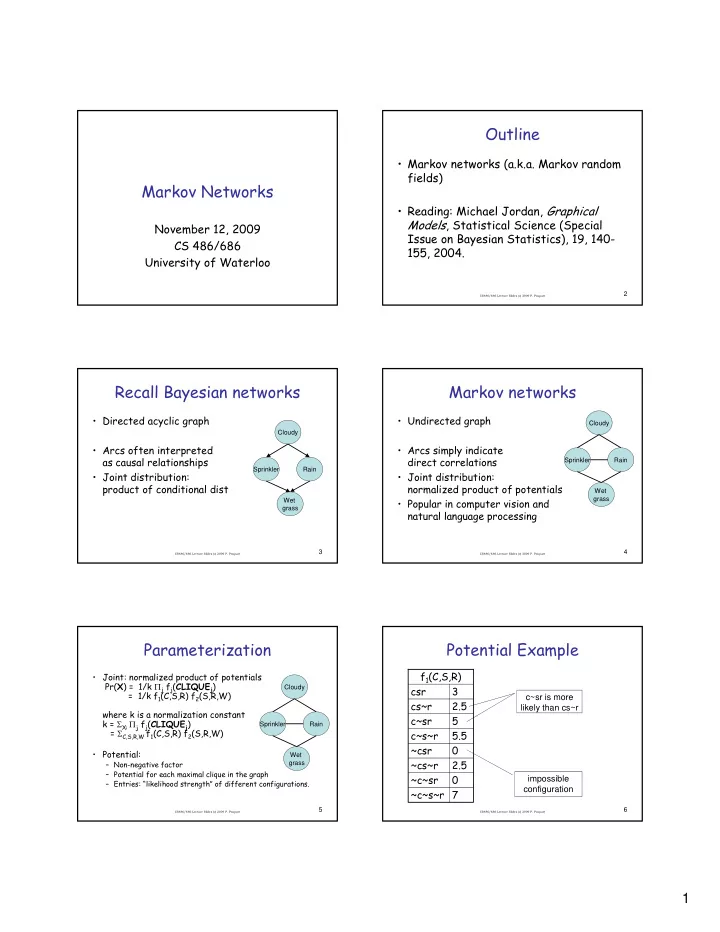
  • Markov networks (a.k.a. Markov random

fields)

  • Reading: Michael Jordan, Graphical

Models, Statistical Science (Special Issue on Bayesian Statistics), 19, 140- 155, 2004.

CS486/686 Lecture Slides (c) 2009 P. Poupart

3

Recall Bayesian networks

  • Directed acyclic graph
  • Arcs often interpreted

as causal relationships

  • Joint distribution:

product of conditional dist

Cloudy Sprinkler Rain Wet grass

CS486/686 Lecture Slides (c) 2009 P. Poupart

4

Markov networks

  • Undirected graph
  • Arcs simply indicate

direct correlations

  • Joint distribution:

normalized product of potentials

  • Popular in computer vision and

natural language processing

Cloudy Sprinkler Rain Wet grass

CS486/686 Lecture Slides (c) 2009 P. Poupart

5

Parameterization

  • Joint: normalized product of potentials

Pr(X) = 1/k Πj fj(CLIQUEj) = 1/k f1(C,S,R) f2(S,R,W) where k is a normalization constant k = ΣXi Πj fj(CLIQUEj) = ΣC,S,R,W f1(C,S,R) f2(S,R,W)

  • Potential:

– Non-negative factor – Potential for each maximal clique in the graph – Entries: “likelihood strength” of different configurations.

Cloudy Sprinkler Rain Wet grass

CS486/686 Lecture Slides (c) 2009 P. Poupart

6

Potential Example

7 ~c~s~r ~c~sr 2.5 ~cs~r ~csr 5.5 c~s~r 5 c~sr 2.5 cs~r 3 csr f1(C,S,R)

impossible configuration c~sr is more likely than cs~r

slide-2
SLIDE 2

2

CS486/686 Lecture Slides (c) 2009 P. Poupart

7

Markov property

  • Markov property: a variable is

independent of all other variables given its immediate neighbours.

  • Markov blanket:

set of direct neighbours MB(A) = {B,C,D,E}

B E A C D

CS486/686 Lecture Slides (c) 2009 P. Poupart

8

Conditional Independence

  • X and Y are independent given Z iff

there doesn’t exist any path between X and Y that doesn’t contain any of the variables in Z

  • Exercise:

– A,E? – A,E|D? – A,E|C? – A,E|B,C?

A C E D F G H B

CS486/686 Lecture Slides (c) 2009 P. Poupart

9

Interpretation

  • Markov property has a price:

– Numbers are not probabilities

  • What are potentials?

– They are indicative of local correlations

  • What do the numbers mean?

– They are indicative of the likelihood of each configuration – Numbers are usually learnt from data since it is hard to specify them by hand given their lack of a clear interpretation

CS486/686 Lecture Slides (c) 2009 P. Poupart

10

Applications

  • Natural language processing:

– Part of speech tagging

  • Computer vision

– Image segmentation

  • Any other application where there is no

clear causal relationship

CS486/686 Lecture Slides (c) 2009 P. Poupart

11

Image Segmentation

Segmentation of the Alps Kervrann, Heitz (1995) A Markov Random Field model-based Approach to Unsupervised Texture Segmentation Using Local and Global Spatial Statistics, IEEE Transactions on Image Processing, vol 4, no 6, p 856-862

CS486/686 Lecture Slides (c) 2009 P. Poupart

12

Image Segmentation

  • Variables

– Pixel features (e.g. intensities): Xij – Pixel labels: Yij

  • Correlations:

– Neighbouring pixel labels are correlated – Label and features of a pixel are correlated

  • Segmentation:

– argmaxY Pr(Y|X)?

slide-3
SLIDE 3

3

CS486/686 Lecture Slides (c) 2009 P. Poupart

13

Inference

  • Markov nets: factored representation

– Use variable elimination

  • P(X|E=e)?

– Restrict all factors that contain E to e – Sumout all variables that are not X or in E – Normalize the answer

CS486/686 Lecture Slides (c) 2009 P. Poupart

14

Parameter Learning

  • Maximum likelihood

– θ* = argmaxθ P(data|θ)

  • Complete data

– Convex optimization, but no closed form solution – Iterative techniques such as gradient descent

  • Incomplete data

– Non-convex optimization – EM algorithm

CS486/686 Lecture Slides (c) 2009 P. Poupart

15

Maximum likelihood

  • Let θ be the set of parameters and

xi be the ith instance in the dataset

  • Optimization problem:

– θ* = argmaxθ P(data|θ) = argmaxθ Πi Pr(xi|θ) = argmaxθ Πi Πj f(X[j]=xi[j]) ΣX Πj f(X[j]=xi[j]) where X[j] is the clique of variables that potential j depends on and x[j] is a variable assignment for that clique

CS486/686 Lecture Slides (c) 2009 P. Poupart

16

Maximum likelihood

  • Let θx = f(X=x)
  • Optimization continued:

– θ* = argmaxθ Πi Πj θXi[j] ΣX Πj θXi[j] = argmaxθ log Πi Πj θXi[j] ΣX Πj θXi[j] = argmaxθ Σi Σj log θXi[j] – log ΣX Πj θXi[j]

  • This is a non-concave optimization

problem

CS486/686 Lecture Slides (c) 2009 P. Poupart

17

Maximum likelihood

  • Substitute λ = log θ and the problem

becomes concave:

– λ* = argmaxλ Σi Σj λXi[j] – log ΣX e Σj λXi[j]

  • Possible algorithms:

– Gradient ascent – Conjugate gradient

CS486/686 Lecture Slides (c) 2009 P. Poupart

18

Feature-based Markov Networks

  • Generalization of Markov networks

– May not have a corresponding graph – Use features and weights instead of potentials – Use exponential representation

  • Pr(X=x) = 1/k e Σj λj φj(x[j])

where x[j] is a variable assignment for a subset of variables specific to φj

  • Feature φj: Boolean function that maps partial

variable assignments to 0 or 1

  • Weight λj: real number
slide-4
SLIDE 4

4

CS486/686 Lecture Slides (c) 2009 P. Poupart

19

Feature-based Markov Networks

  • Potential-based Markov networks can

always be converted to feature-based Markov networks Pr(x) = 1/k Πj fj(CLIQUEj = x[j]) = 1/k e Σj,cliquej λj,cliquej φj,cliquej(x[j])

  • λj,cliquej = log fj(CLIQUEj = x[j])
  • φj,cliquej(x[j])=1 if cliquej=x[j], 0 otherwise

CS486/686 Lecture Slides (c) 2009 P. Poupart

20

Example

7 ~c~s~r ~c~sr 2.5 ~cs~r ~csr 5.5 c~s~r 5 c~sr 2.5 cs~r 3 csr f1(C,S,R)

1 if CSR = c~s~r

φ1,c~s~r (CSR) = λ1,c~s~r = log 5.5

0 otherwise 1 if CSR = ~c*r

φ1,~c*r(CSR) = λ1,~c*r = log 0

0 otherwise 1 if CSR = ~c~s~r

φ~c~s~r(CSR) = λ1,~c~s~r = log 7

0 otherwise 1 if CSR = c~sr

φc~sr(CSR) = λ1,c~sr = log 5

0 otherwise 1 if CSR = *s~r

φ1,*s~r(CSR) = λ1,*s~r = log 2.5

0 otherwise 0 otherwise 1 if CSR = csr

φ1,csr (CSR) = λ1,csr = log 3 features weights

CS486/686 Lecture Slides (c) 2009 P. Poupart

21

Features

  • Features

– Any Boolean function – Provide tremendous flexibility

  • Example: text categorization

– Simplest features: presence/absence of a word in a document – More complex features

  • Presence/absence of specific expressions
  • Presence/absence of two words within a certain window
  • Presence/absence of any combination of words
  • Presence/absence of a figure of style
  • Presence/absence of any linguistic feature

CS486/686 Lecture Slides (c) 2009 P. Poupart

22

Next Class

  • Conditional random fields