Outline Outline Unreachable-Code Elimination Unreachable Code - - PowerPoint PPT Presentation

outline outline
SMART_READER_LITE
LIVE PREVIEW

Outline Outline Unreachable-Code Elimination Unreachable Code - - PowerPoint PPT Presentation

Outline Outline Unreachable-Code Elimination Unreachable Code Elimination Control-Flow and Low-Level Straightening If and Loop Simplifications If and Loop Simplifications Optimizations Optimizations Loop Inversion and


slide-1
SLIDE 1

Control-Flow and Low-Level Optimizations Optimizations Outline Outline

  • Unreachable-Code Elimination

Unreachable Code Elimination

  • Straightening
  • If and Loop Simplifications

If and Loop Simplifications

  • Loop Inversion and Unswitching
  • Branch Optimizations

Branch Optimizations

  • Tail Merging (Cross Jumping)
  • Conditional Moves

Conditional Moves

  • Dead-Code Elimination
  • Branch Prediction

Branch Prediction

  • Peephole Optimization
  • Machine Idioms & Instruction Combining

Machine Idioms & Instruction Combining

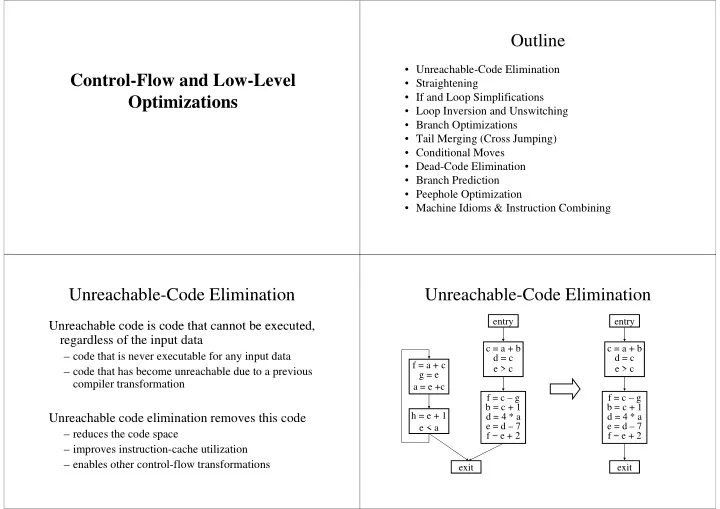
Unreachable-Code Elimination Unreachable Code Elimination

Unreachable code is code that cannot be executed Unreachable code is code that cannot be executed, regardless of the input data

d th t i t bl f i t d t – code that is never executable for any input data – code that has become unreachable due to a previous il t f ti compiler transformation

Unreachable code elimination removes this code

– reduces the code space reduces the code space – improves instruction-cache utilization enables other control-flow transformations – enables other control-flow transformations

Unreachable-Code Elimination Unreachable Code Elimination

entry entry c = a + b y c = a + b y f = a + c g = e d = c e > c d = c e > c a = e +c f = c – g b = c + 1 f = c – g b = c + 1 b c + 1 d = 4 * a e = d – 7 f = e + 2 h = e + 1 e < a b c + 1 d = 4 * a e = d – 7 f = e + 2 f e + 2 it f e + 2 it exit exit

slide-2
SLIDE 2

Straightening Straightening

Straightening is applicable to pairs of basic blocks such Straightening is applicable to pairs of basic blocks such that the first has no successors other than the second and the second has no predecessors other than the first and the second has no predecessors other than the first

… a = b + c … a = b + c b = c * 2 a = b + c b = c * 2 a = a + 1 a = a + 1 c < 0 c < 0

Straightening Example Straightening Example

Straightening in the presence of fall throughs is tricky Straightening in the presence of fall-throughs is tricky...

L1: L1: L1: … a = b + c goto L2 L1: … a = b + c b = c * 2 L6: … t L4 a = a + 1 if c < 0 goto L3 t L5 goto L4 L2: b = c * 2 goto L5 L6: L2: b c 2 a = a + 1 if c < 0 goto L3 L6: … goto L4 L5: … L5: …

If Simplifications If Simplifications

If simplifications apply to conditional constructs If simplifications apply to conditional constructs

  • ne or both of whose branches are empty:

– if either the then or the else part of an if-construct is empty, the corresponding branch can be eliminated – one branch of an if with a constant-valued condition can also be eliminated – we can also simplify ifs whose condition, C, occurs in the scope of a condition that implies C (and none in the scope of a condition that implies C (and none

  • f the condition’s operands has changed value)

If Simplification Example If Simplification Example

a > d a > d b = a

Y N

b

Y N

c = 4 * b (a >= d) or bool

Y N

b = a c = 4 * b d = b d = c

Y N

d = b e = a + b e = a + b … …

slide-3
SLIDE 3

Loop Simplifications Loop Simplifications

  • A loop whose body is empty can be eliminated
  • A loop whose body is empty can be eliminated

if the iteration-control code has no side-effects

(Side-effects might be simple enough that they can be replaced with non-looping code at compile time)

  • If number of iterations is small enough loops
  • If number of iterations is small enough, loops

can be unrolled into branchless code and the l b d b d il i loop body can be executed at compile time

Loop Simplification Example Loop Simplification Example

s = 0 s = 0 i = 0 i = i + 1 i = 0 L1: if i >= 4 goto L2 i i + 1 i i + 1 s = s + i i = i + 1 i = 4 s = 10 i = i + 1 s = s + i goto L1 s = s + i i = i + 1 s s + i s 10 L2: … goto L1 L2: … s = s + i i = i + 1 s = s + i s s i L2: …

Loop Inversion Loop Inversion

Loop inversion transforms a while loop into a Loop inversion transforms a while loop into a repeat loop (i.e. moves the loop-closing test from before the loop to after it).

– Has the advantage that only one branch instruction g y needs to be executed to close the loop. – Requires that we determine that the loop is entered Requires that we determine that the loop is entered at least once!

Loop Inversion Example 1 Loop Inversion Example 1

for (i = 0; i < 100; i++) { Loop bounds for (i = 0; i < 100; i++) { a[i] = i + 1; } Loop bounds are known } i i = 0; i = 0; do { a[i] = i + 1; i = 0; while (i < 100) { a[i] = i + 1; a[i] = i + 1; i++; } while (i < 100) a[i] i + 1; i++; } } while (i 100)

slide-4
SLIDE 4

Loop Inversion Example 2 Loop Inversion Example 2

if (k >= n) goto L if (k > n) goto L i = k; do { for (i = k; i < n; i++) { a[i] = i + 1; do { a[i] = i + 1; i++; } ; } while (i < n) L: Loop bounds are unknown

Unswitching Unswitching

Unswitching is a control flow transformation that Unswitching is a control-flow transformation that moves loop-invariant conditional branches out

  • f loops
  • f loops

for (i = 1; i < 100; i++) { if (k == 2) { for (i = 1; i < 100; i++) { if (k == 2) a[i] = a[i] + 1; for (i = 1; i < 100; i++) a[i] = a[i] + 1; } l { a[i] a[i] + 1; else a[i] = a[i] – 1; } else { for (i = 1; i < 100; i++) a[i] a[i] 1; a[i] a[i] 1; } a[i] = a[i] – 1; }

Unswitching Example Unswitching Example

if (k == 2) { for (i = 1; i < 100; i++) { if (k == 2 && a[i] > 0) for (i = 1; i < 100; i++) { if (a[i] > 0) [i] [i] + 1 if (k 2 && a[i] > 0) a[i] = a[i] + 1; } a[i] = a[i] + 1; } } else { } } else { i = 100; }

Branch Optimizations Branch Optimizations

Branches to branches are remarkably common! Branches to branches are remarkably common!

– An unconditional branch to an unconditional branch can be replaced by a branch to the latter’s target replaced by a branch to the latter s target – A conditional branch to an unconditional branch can be replaced by the corresponding conditional branch to the replaced by the corresponding conditional branch to the latter branch’s target – An unconditional branch to a conditional branch can be replaced by a copy of the conditional branch – A conditional branch to a conditional branch can be replaced by a conditional branch with the former’s test and the latter’s target as long as the latter condition is true whenever the f i former one is

slide-5
SLIDE 5

Branch Optimization Examples Branch Optimization Examples

if t L1 if t L2 if a == 0 goto L1 … L1: if a >= 0 goto L2 if a == 0 goto L2 … L1: if a >= 0 goto L2 L1: if a 0 goto L2 … L2: … L1: if a 0 goto L2 … L2: … goto L1 g L1: … L1: … if a == 0 goto L1 goto L2 L1 if a != 0 goto L2 L1: L1: … L1: …

Eliminating Useless Control-Flow Eliminating Useless Control Flow

The Problem: The Problem:

– After optimization, the CFG might contain empty blocks – “Empty” blocks still end with either a branch or jump – Produces jump to jump, which wastes time and space

The Algorithm: (Clean) The Algorithm: (Clean)

– Use four distinct transformations A l h i f ll l d d – Apply them in a carefully selected order – Iterate until done

Eliminating Useless Control-Flow Eliminating Useless Control Flow

Both sides of branch target B2 Transformation 1 Both sides of branch target B2

– Neither block must be empty R l it ith j t B1 B1 B1

Transformation 1

– Replace it with a jump to B1 – Simple rewrite of the last

  • peration in B1

B1 B1

  • peration in B1

B2 B2

B h t j

How does this happen?

– By rewriting other branches Eliminating redundant branches

Branch, not a jump

How do we recognize it?

– Check each branch

Eliminating Useless Control-Flow Eliminating Useless Control Flow

Merging an empty block Transformation 2 Merging an empty block

– Empty B1 ends with a jump – Coalesce B1 and B2

empty

Transformation 2

Coalesce B1 and B2 – Move B1’s incoming edges – Eliminates extraneous jump

empty

B1 B2 j p – Faster, smaller code B2 B2

How does this happen?

– By eliminating operations in B1 Eliminating empty blocks By eliminating operations in B1

How do we recognize it?

– Test for empty block Test for empty block

slide-6
SLIDE 6

Eliminating Useless Control-Flow Eliminating Useless Control Flow

Coalescing blocks Transformation 3 Coalescing blocks

– Neither block must be empty – B1 ends with a jump to B2 B1

Transformation 3

B1 ends with a jump to B2 – B2 has one predecessor – Combine the two blocks B1 B1 B2 – Eliminates a jump B2 B2

How does this happen?

– By simplifying edges out of B1 Eliminating non-empty blocks By simplifying edges out of B1

How do we recognize it?

– Check target of jump Check target of jump

Eliminating Useless Control-Flow Eliminating Useless Control Flow

Jump to a branch Transformation 4 Jump to a branch

– B1 ends with a jump, B2 is empty B1

Transformation 4

B1 p y – Eliminates pointless jump – Copy branch into end of B1 B1

t

B1

t

– Might make B2 unreachable

empty

B2

empty

B2

How does this happen?

– By eliminating operations in B1 Hoisting branches

How do we recognize it?

– Jump to empty block Hoisting branches from empty blocks

Eliminating Useless Control-Flow Eliminating Useless Control Flow

Putting the transformations together g g

– Process the blocks in postorder

  • Clean up Bi’s successors before Bi
  • Simplifies implementation and understanding

– At each node, apply transformations in a fixed order

  • Eliminate redundant branch
  • Eliminate empty block

M bl k ith

  • Merge block with successors
  • Hoist branch from empty successor

– May need to iterate May need to iterate

  • Postorder ⇒ unprocessed successors along back edges
  • Can bound iterations, but deriving a tight bound is hard

g g

  • Must recompute postorder between iterations

Tail Merging (Cross Jumping) Tail Merging (Cross Jumping)

Tail merging applies to basic blocks whose last few instructions are identical and that continue to the same location. It replaces the matching instructions of one block with a branch to the corresponding point in the other.

… 1 2 + 3 … 1 2 + 3 r1 = r2 + r3 r4 = r3 shl 2 r2 = r2 + 1 r1 = r2 + r3 goto L2 … r2 = r4 – r2 goto L1 … r5 = r4 – 6 L2: r4 = r3 shl 2 r2 = r2 + 1 r5 = r4 – 6 r4 = r3 shl 2 r2 = r2 + 1 r2 = r4 – r2 L1: … r2 = r4 – r2 L1: …

slide-7
SLIDE 7

Conditional Moves Conditional Moves

Conditional moves are instructions that copy a source to Conditional moves are instructions that copy a source to a target if and only if a specified condition is satisfied

il bl i l d hit t – available in several modern architectures (SPARC-V9, PentiumPro) – are used to replace simple branching code sequences with non branching code non-branching code if > b t L1 if a > b goto L1 max = b goto L2 t1 = a > b max = b goto L2 L1: max = a L2: … max b max = (t1) a

Conditional Moves Help Loop Unrolling Conditional Moves Help Loop Unrolling

for (i = 1; i <= n; i++) { for (i = 1; i <= n; i++) { for (i = 1; i <= n; i++) { x = a[i]; if (x>0) u = z * x; for (i = 1; i <= n; i++) { x = a[i]; w = z * x; u = b[i]; if (x 0) u z x; else u = b[i]; s = s + u; w z x; u b[i]; u = (x>0) w; s = s + u;

B i diti l i t ti ll

; } }

  • By using conditional move instructions, we can unroll

loops containing internal control-flow and end up with “straight-line” code straight-line code

– helps because instruction scheduling is then more effective – works if the two instruction blocks of the if are small in size works if the two instruction blocks of the if are small in size

Dead-Code Elimination Dead Code Elimination

A variable is dead if it is not used on any path from the location in A variable is dead if it is not used on any path from the location in the code where it is defined to the exit point of the routine. An instruction is dead if it computes values that are not used on An instruction is dead if it computes values that are not used on any executable path leading from the instruction.

  • Many compiler optimizations create dead code as part of the

division of labor principle: keep each optimization phase as simple as possible (to make it easy to implement and maintain) and leave it to other passes to clean up the mess…

  • Detecting dead code local to a procedure is simple
  • Interprocedural analysis is required to detect dead variables

ith id i ibilit with wider visibility

Dead-Code Elimination Example Dead Code Elimination Example

entry entry i = 1 j = 2 i = 1 j = 2 k is only used to define new l f it lf! k = 3 n = 4 j = 2 n = 4 values for itself! i = i + j l = j + 1 i = i + j l = j + 1 j = j + 2 j > n j = j + 2 j > n k = k – j print(l) return j + i print(l) return j + i print(l) j

slide-8
SLIDE 8

Branch Prediction Branch Prediction

Branch prediction refers to predicting whether a Branch prediction refers to predicting whether a conditional branch transfers flow of control or not M d hi l b h di ti t k th Modern machines rely on branch prediction to make the right guess on which instructions to fetch after a branch

Static prediction: the compiler predicts which way the

branch is likely to go and places its prediction in the branch instruction itself

Dynamic prediction: the hardware remembers for each Dynamic prediction: the hardware remembers for each

recently executed branch, which way it went the previous time and predicts that it will go the same way previous time and predicts that it will go the same way

Static Branch Prediction Static Branch Prediction

A simple rule used by many machines: A simple rule used by many machines: Backward branches are assumed to be taken, forward branches are assumed to be not-taken

  • When generating code for machines following
  • When generating code for machines following

this prediction rule, a compiler can order the b i bl k i h th t th di t d basic blocks in such a way that the predicted- taken branches go towards lower addresses

  • Several empirically validated heuristics help the

compiler predict the direction of a branch compiler predict the direction of a branch

Static vs Dynamic Branch Prediction Static vs. Dynamic Branch Prediction

Perfect static production results in a dynamic Perfect static production results in a dynamic misprediction rate of about 9% for C and about 6% for Fortran programs p g Profile-based prediction approaches the accuracy of perfect static prediction Heuristic-based static prediction results in a dynamic misprediction rate of about 20% (for C) Hardware-based prediction typically results in a misprediction rate of about 11% (for C) p ( )

Relying on heuristics that mispredict 20% of branches is better than no prediction, but does not suffice in practice! p , p

Peephole Optimization Peephole Optimization

Peephole optimization is an effective post pass Peephole optimization is an effective post-pass technique for improving assembly code Basic Idea:

– Discover local improvements by looking at a window

  • f the code (a peephole)

Peephole: a short sequence of (usually contiguous) instructions

  • slide the peephole over the code, and examine the contents

– The optimizer replaces the sequence with another equivalent one (but faster)

slide-9
SLIDE 9

Peephole Optimization (Cont ) Peephole Optimization (Cont.)

Write peephole optimizations as rewrite rules Write peephole optimizations as rewrite rules

i1, …, in → j1, …, jm where the RHS is the improved version of the LHS

  • Example:

Example:

move r1⇒r2, move r2⇒r1 → move r1⇒r2 k if i h f j – Works if move r2⇒r1 is not the target of a jump

  • Another example:

p

addiu r1, i ⇒ r1 addiu r1, j ⇒ r1 → addiu r1, i+j ⇒ r1

Peephole Optimization Examples Peephole Optimization Examples

store r1 ⇒ r0 8 store r1 ⇒ r0 8 store r1 ⇒ r0, 8 load r0, 8 ⇒ r2 store r1 ⇒ r0, 8 move r1 ⇒ r2 addiu r1, 0 ⇒ r2 mult r3, r2 ⇒ r2 mult r3, r1 ⇒ r2 jumpl L1 mult r3, r2 ⇒ r2 jumpl L2 jumpl L1 L1: jumpl L2 jumpl L2 L1: jumpl L2

Peephole Optimization (Cont ) Peephole Optimization (Cont.)

  • Many (but not all) of the basic block (i e local)
  • Many (but not all) of the basic block (i.e. local)
  • ptimizations can be cast as peephole
  • ptimizations

– Example: add r1, 0 ⇒ r2 → move r1 ⇒ r2 p , – Example: move r ⇒ r → These two together eliminate add r 0 ⇒ r – These two together eliminate add r, 0 ⇒ r

  • Just like most compiler optimizations, peephole
  • ptimizations need to be applied repeatedly to

achieve maximum effect

Machine Idioms & Instruction Combining

Machine idioms are (sequences of) instructions for a Machine idioms are (sequences of) instructions for a particular architecture that provide a more efficient way of performing a computation than one might use if way of performing a computation than one might use if compiling for a more generic architecture. Pattern matching is used to recognize opportunities where

Individual instructions can be substituted by faster and more – Individual instructions can be substituted by faster and more specialized instructions that achieve the same purpose – Groups of instructions can be combined into a shorter or – Groups of instructions can be combined into a shorter or faster sequence

slide-10
SLIDE 10

Examples of Instruction Combining Examples of Instruction Combining

If high-order 20 bits of const are all 0 add r0, const ⇒ r1 sethi %hi(const) ⇒ r1

  • r r1, %lo(const) ⇒ r1

g

  • de

0 b s o co s e , ( ) mult r1, 5 ⇒ r2 shl r1, 2 ⇒ r2 add r1, r2 ⇒ r2 b 1 2 ⇒ 3 sub r1, r2 ⇒ r3 subcc r1, r2 ⇒ r3 …. bg L1 sub , ⇒ 3 …. subcc r1, r2 ⇒ r0 bg L1 bg L1