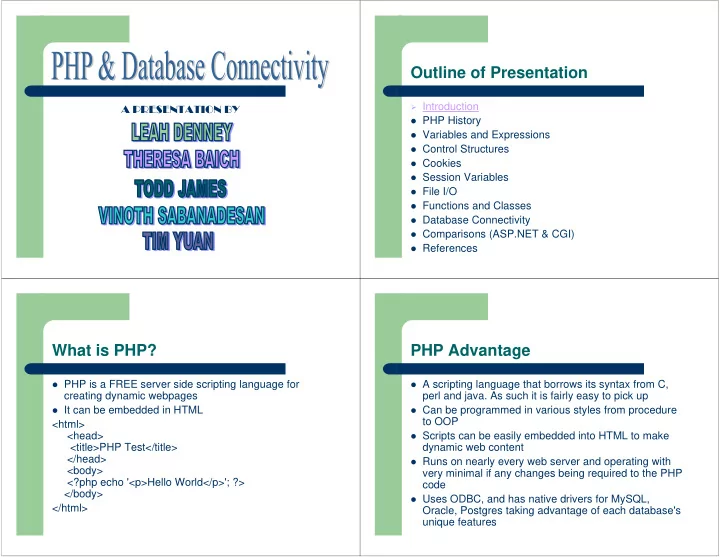
Outline of Presentation Introduction A PRESENTATION BY PHP History - - PowerPoint PPT Presentation

outline of presentation
SMART_READER_LITE
LIVE PREVIEW

Outline of Presentation Introduction A PRESENTATION BY PHP History - - PowerPoint PPT Presentation

Outline of Presentation Introduction A PRESENTATION BY PHP History Variables and Expressions Control Structures Cookies Session Variables File I/O Functions and Classes Database Connectivity Comparisons


slide-1
SLIDE 1

A PRESENTATION BY

Outline of Presentation

Introduction PHP History Variables and Expressions Control Structures Cookies Session Variables File I/O Functions and Classes Database Connectivity Comparisons (ASP.NET & CGI) References

What is PHP?

PHP is a FREE server side scripting language for

creating dynamic webpages

It can be embedded in HTML

<html> <head> <title>PHP Test</title> </head> <body> <?php echo '<p>Hello World</p>'; ?> </body> </html>

PHP Advantage

A scripting language that borrows its syntax from C,

perl and java. As such it is fairly easy to pick up

Can be programmed in various styles from procedure

to OOP

Scripts can be easily embedded into HTML to make

dynamic web content

Runs on nearly every web server and operating with

very minimal if any changes being required to the PHP code

Uses ODBC, and has native drivers for MySQL,

Oracle, Postgres taking advantage of each database's unique features

slide-2
SLIDE 2

Outline of Presentation

Introduction PHP History Variables and Expressions Control Structures Cookies Session Variables File I/O Functions and Classes Database Connectivity Comparisons (ASP.NET & CGI) References

PHP History: PHP 1 and 2

Originated in 1995 by Rasmus Lerdorf Initially a simple set of perl scripts Zeev Suraski and Andi Gutmans, working

together with Rasmus Lerdorf created PHP 3 in 1997

PHP History: PHP 3

PHP 3 was very successful for the following reasons:

– A solid infrastructure for connecting to a variety of

different databases,protocols, and APIs

– An extensibility feature that attracted developers to

add their own extension modules

– Object oriented Syntax support and a more

consistent language syntax

PHP History: PHP 4

In 2002 a complete rewrite of the PHP core,

now known as zend engine

Improved the performance of complex

applications and improved the modularity of PHP's code base

Support for many more web servers, HTTP

sessions, output buffering, more secure ways

  • f handling user input and several new

language constructs

slide-3
SLIDE 3

PHP History: PHP 5

Released recently, offers another significant

performance improvement over php 4 with the new ZEND 2 engine

Additional features such as exception handling,

and a stronger object oriented model, all the while being highly backward-compatible

Outline of Presentation

Introduction PHP History Variables and Expressions Control Structures Cookies Session Variables File I/O Functions and Classes Database Connectivity Comparisons (ASP.NET & CGI) References

Variables

Case sensitive so $Welcome_Text is not the

same as $welcome_text

Names can contain letters, numbers and

underscores but cannot begin with a number or underscore

Scalar Variables

A scalar variable can contain:

– String $myVariable = “hello”; – Integer $myVariable = 42; – Float $myVariable = 23.25;

Only strings in double quotes are evaluated

– $myString =“hello $test”;

slide-4
SLIDE 4

Arrays

Indexed from 0 to n-1 Create array by array function

– $myArray= array("Hello", "World");

Create array by array indentifier:

– $myArray[] = “Hello”; MyArray[] = “World”;

An element of an array is prefixed with $

– $myArray[3] = ‘alpha’; $myVar = $myArray[0];

Key values do not have to numeric

– $names = array("a"=>"Andy", "b"=>"Chris", "c"=>"Dave",

"d"=>"Bill");

Regular Expressions

Six functions that all take a regular expression string as

an argument

– ereg: search a string for matches of reg expression – eregi: case sensitive version – ereg_replace: replaces occurrences of string with new string – eregi_replace: case sensitive version – split: returns the matches as an array of strings – spliti: case sensitive version

eregi('^[a-zA-Z0-9._-]+@[a-zA-Z0-9-]

+\.[a-zA-Z.]{2,5}$', $email)

Outline of Presentation

Introduction PHP History Variables and Expressions Control Structures Cookies Session Variables File I/O Functions and Classes Database Connectivity Comparisons (ASP.NET & CGI) References

Control Structures - Conditionals

if(condition){statements}

– if($number) {echo “”the number is not zero!”;}

if(condition) {statements} else {statements} if(condition) { statements }

elseif (condition) {statements} else {statements}

switch(expression) {statements} variable= (condition) ? expression1: expression2;

slide-5
SLIDE 5

Control Structures - Loops

while (condition) {statements} do {statements} while (condition); for (init;condition;increment) {statements} foreach (list) { statement}

– foreach $line (array) {echo “$line\n”;}

Outline of Presentation

Introduction PHP History Variables and Expressions Control Structures Cookies Session Variables File I/O Functions and Classes Database Connectivity Comparisons (ASP.NET & CGI) References

Cookies

Setting Cookies

– setcookie(string CookieName, string CookieValue, int

CookieExpireTime, path, domain, int secure);

– <?php setcookie("uname", $name, time()+36000); ?>

Retrieving Cookies

– $_COOKIE[“cookieName”] – ?php if (isset($_COOKIE["uname"])) echo "Welcome " .

$_COOKIE["uname"] . "!<br />"; else echo "You are not logged in!<br />"; ?>

Outline of Presentation

Introduction PHP History Variables and Expressions Control Structures Cookies Session Variables File I/O Functions and Classes Database Connectivity Comparisons (ASP.NET & CGI) References

slide-6
SLIDE 6

Useful Variables

$_ENV - Contains system environment variables $_GET - Contains variables in the query string,

including from GET forms

$_POST - Contains variables submitted from POST

forms

$_COOKIE - Contains all cookie variables $_SERVER - Contains server variables, such as

HTTP_USER_AGENT

$_REQUEST - Contains everything in $_GET,

$_POST, and $_COOKIE

$_SESSION -- Contains all registered session

variables

Examples of Variable Use

Browser Example

– <? "Your Browser is:

".$_SERVER["HTTP_USER_AGENT"] ?>

Get and Post Example (after a post)

– <?php echo $_POST["variableName"]; ?>

SSI- Server Side Includes

– <?php require("header.htm"); ?>

Outline of Presentation

Introduction PHP History Variables and Expressions Control Structures Cookies Session Variables File I/O Functions and Classes Database Connectivity Comparisons (ASP.NET & CGI) References

File I/O

The fopen() function is used to open files in PHP

– If the fopen() function is unable to open the specified file, it

returns 0

– Example:

<?php $f=fopen("file.txt","r"); ?>

The fclose() function is used to close a file

– <? fclose($f); ?>

The feof() function is used to determine if the end of file

is true

– Note: You cannot read from files opened in w, a, and x mode! – if (feof($f))

echo "End of file";

slide-7
SLIDE 7

File I/O cont’d

The fgetc() function is used to read a single character

from a file

– Reading a file character by character :

<?php if (!($f=fopen("welcome.txt","r"))) exit("Unable to open file."); while (!feof($f)) { $x=fgetc($f); echo $x; } fclose($f); ?>

Outline of Presentation

Introduction PHP History Variables and Expressions Control Structures Cookies Session Variables File I/O Functions and Classes Database Connectivity Comparisons (ASP.NET & CGI) References

User-Defined Functions & Classes

Can create functions without predefining them unless

they are created conditionally

<?php function foo($arg_1, $arg_2, /* ..., */ $arg_n){ echo "Example function.\n"; return $retval; }?> Classes can also be defined <?php class Cart { var $items; // Global variable function add_item($artnr, $num) { $this->items[$artnr] += $num; }}?>

Outline of Presentation

Introduction PHP History Variables and Expressions Control Structures Cookies Session Variables File I/O Functions and Classes Database Connectivity Comparisons (ASP.NET & CGI) References

slide-8
SLIDE 8

Database Connectivity

Essential part of many web applications PHP allows for simply integration

– Connect to database once; use of includes allows

for connect/close functions to be in separate files

– Make multiple queries throughout page by

embedding PHP code

Connecting with Databases

Similar to connecting using other languages

– Open connection, run query, parse results, close

connection

Able to connect to a variety of databases

– Access, Oracle, mySQL – Each database uses slightly different functions

mySQL Connection

<?php /* declare some relevant variables */ $DBhost = "Your-MySQL-servers-IP-or-domainname"; $DBuser = "Your user name"; $DBpass = "Your Password"; $DBname = "The Name of the Database"; $table = "Table Name"; $DBconnect = mysql_connect($DBhost,$DBuser,$DBpass) or die("Unable to connect to database"); ?> Can place in dbconnect.php file that is included when needed

<?php @mysql_select_db("$DBName") or die("Unable to select database $DBName"); $sqlquery = "SELECT * FROM $table WHERE course = 'cmput410'"; $result = mysql_query($sqlquery); $number = mysql_numrows($result); $i = 0; if ($number < 1) { print "<CENTER><P>There were no results for your search.</CENTER>"; } else { while ($number > $i) { $name = mysql_result($result,$i,"first_name"); $grade = mysql_result($result,$i,"grade"); print "<p><b>Student Name:</b> $first_name<br><b>Grade:</b>$grade</p>"; $i++; }} mysql_close($Dbconnect); ?>

mySQL Connection cont’d

Execute Query Count Results Process 1 row at a time

slide-9
SLIDE 9
  • Can also use arrays to store results from queries

<?php @mysql_select_db("$DBName") or die("Unable to select database $DBName"); $sqlquery = "SELECT * FROM $table WHERE course = 'cmput410'"; $result = mysql_query($sqlquery); while($row = mysql_fetch_array($result)) { echo "<font face=arial size=-1><p><b>Student Name:</b>". $row[first_name] ."<br><b>Grade:</b>". $row[grade]. "</p>"; } if(mysql_num_rows($result)<1){ echo "<font face=Arial size=+0><b>No Results!</b></font><br>"; } mysql_free_result($result);

mysql_close($Dbconnect);

?>

Results from Queries

Free memory Store results In an array

Oracle Connection

<?php PutEnv("ORACLE_SID=ORASID"); $connection = Ora_Logon ("username","password"); $cursor = Ora_Open ($connection); $query = “SELECT * FROM table WHERE course = 'cmput410'"; $result = Ora_Parse ($cursor, $query); $result = Ora_Exec ($cursor); echo "<table border=1>"; echo "<tr><td><b>Student Name</b></td><td> <b>Grade</b></td></tr>"; while (Ora_Fetch_Into ($cursor, &$values)){ $name = $values[0]; $grade = $values[1]; echo "<tr><td>$name</td><td>$grade</td></tr>"; } echo "</table>"; Ora_Close ($cursor); Ora_Logoff ($connection); ?>

Cursor for queries Set environment variable Validates SQL Executes SQL Free memory If making changes use Ora_Commit($connection) to lock in before closing

Outline of Presentation

Introduction PHP History Variables and Expressions Control Structures Cookies Session Variables File I/O Functions and Classes Database Connectivity Comparisons (ASP.NET & CGI) References

PHP vs ASP.NET

What ASP.NET gained in robustness, it paid

for in efficiency

ASP.NET uses ODBC for integration with

databases

PHP takes advantage of a database's unique

features

While APS.NET is free, it’s platform IIS is not

slide-10
SLIDE 10

PHP vs CGI

Perl is a general purpose scripting language PHP was designed from the ground up to be

used for scripting web pages; facilities built in that simplify the process

PHP code is embedded directly into XHTML

documents

Cgi-based languages require multiple print

statements

Outline of Presentation

Introduction PHP History Variables and Expressions Control Structures Cookies Session Variables File I/O Functions and Classes Database Connectivity Comparisons (ASP.NET & CGI) References

References

www.phpbuilder.com php.resourceindex.com www.php.net www.w3schools.com/php/default.asp www.phpfreaks.com www.vend.com