
SLIDE 1
Andrew Whitley
Bread Matters
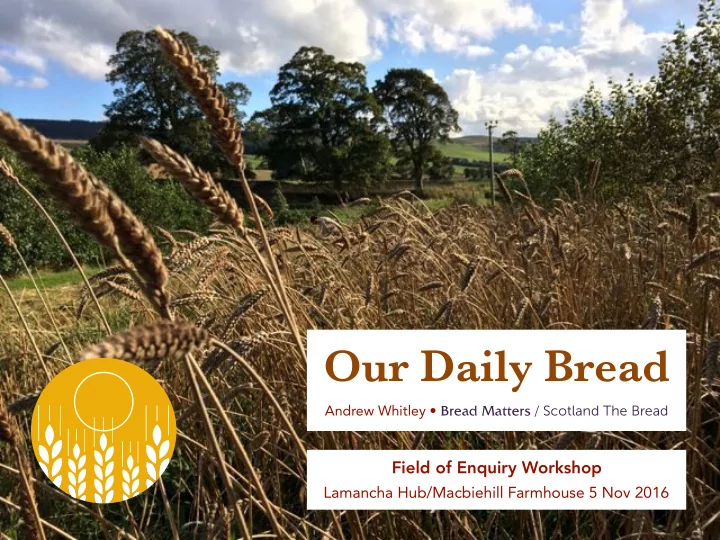
Field of Enquiry Workshop
Lamancha Hub/Macbiehill Farmhouse 5 Nov 2016
Our Daily Bread
Andrew Whitley • Bread Matters / Scotland The Bread
Our Daily Bread Andrew Whitley Bread Matters / Scotland The Bread - - PowerPoint PPT Presentation
Our Daily Bread Andrew Whitley Bread Matters / Scotland The Bread Andrew Whitley Bread Matters Field of Enquiry Workshop Lamancha Hub/Macbiehill Farmhouse 5 Nov 2016 Our Daily Bread from the Pharaohs to Fast Food Bread is a good subject
Andrew Whitley
Bread Matters
Field of Enquiry Workshop
Lamancha Hub/Macbiehill Farmhouse 5 Nov 2016
Andrew Whitley • Bread Matters / Scotland The Bread
Bread is a good subject for the kind of food policy analysis embraced by the Field of Enquiry project because
accumulation’
food category
locally) whose nature is influenced by climate, trade and political power
socio-political and epidemiological resonance not found to the same extent in foods that are more recent examples of mass consumption
from the Pharaohs to Fast Food
(Tobias Smollett, The Expedition of Humphrey Clinker, 1771)
Factory Commission report of 1833, quoted in Hammond & Hammond (1925), The Town Labourer 1760-1832: The New Civilisation.
(Nutrients per 100 grams) Stoneground Roller-milled white flour bleached white flour Protein 12.5 g 10.1 g Fat 1.4 g 0.9 g Total mineral 1.1 g 0.4 g Calcium 44.0 mg 20.0 mg Phosphorus 180.0 mg 92.0 mg Iron 3.3 mg 1.0 mg Carotene (pro-vitamin A) 0.2 mg nil Riboflavin (vitamin B2) 0.02 mg 0.01 mg Vitamin B1 (international units) 100 10-15
'From that time [1870] to the present day a large part of the population of England has been subsisting on diets containing considerably less vitamin B1 than is physiologically required.’
Drummond & Wilbraham (1939) The Englishman’s Food: A History of Five Centuries of English Diet.
Loss of mineral density in wheat – many older cultivars and landraces have higher concentrations of important minerals (Mg, Fe, Zn etc). Flour fortification (mandatory for all non-wholemeal UK flour since 1953) masks decreasing nutrient density of UK wheat flour. The iron used to fortify UK flour is almost completely non-bioavailable according to Government scientists (SACN – scientific advisory committee on nutrition). Increase of toxic proteins high molecular weight glutenin subunits alpha-, gamma- and omega-5 gliadin epitopes amylase-trypsin inhibitors (ATIs): starch digestion; immune responses Interactions with agronomy
The Chorleywood Bread Process: ‘no time dough’ + additives Time is of the essence, as are lactic acid bacteria Sourdough effects:
carbohydrates in baked loaves
>1 million tonnes – Scottish wheat crop 2015 140,000 tonnes (<14%) – would make all Scotland’s bread ~0 tonnes – Scottish wheat actually used for bread 2 inches – increase in Scottish men’s waistlines in a decade 66% of Scots are overweight or obese £3 billion p.a. – projected cost of obesity to Scotland in 2030 1 in 20 – the number of currently unemployed people in Scotland, retrained as skilled bakers, needed so that everyone in Scotland is within walking distance of fresh, additive-free and preservative-free bread.