Optimizing Compilers P ::= begin D S end D ; D | proc p ( val x ; - - PowerPoint PPT Presentation

optimizing compilers
SMART_READER_LITE
LIVE PREVIEW

Optimizing Compilers P ::= begin D S end D ; D | proc p ( val x ; - - PowerPoint PPT Presentation

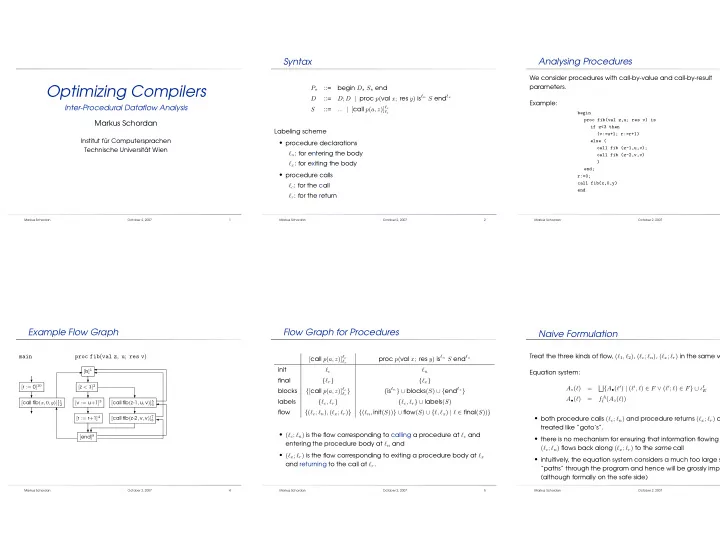
Syntax Analysing Procedures We consider procedures with call-by-value and call-by-result parameters. Optimizing Compilers P ::= begin D S end D ; D | proc p ( val x ; res y ) is n S end x D ::= Example: Inter-Procedural


slide-1
SLIDE 1

Optimizing Compilers

Inter-Procedural Dataflow Analysis Markus Schordan

Institut f¨ ur Computersprachen Technische Universit ¨ at Wien

Markus Schordan October 2, 2007 1

Syntax

P⋆ ::= begin D⋆ S⋆ end D ::= D; D | proc p(val x; res y) isℓn S endℓx S ::= ... | [call p(a, z)]ℓc

ℓr

Labeling scheme

  • procedure declarations

ℓn: for entering the body ℓx: for exiting the body

  • procedure calls

ℓc: for the call ℓr: for the return

Markus Schordan October 2, 2007 2

Analysing Procedures

We consider procedures with call-by-value and call-by-result parameters. Example:

begin proc fib(val z,u; res v) is if z<3 then (v:=u+1; r:=r+1) else ( call fib (z-1,u,v); call fib (z-2,v,v) ) end; r:=0; call fib(x,0,y) end

Markus Schordan October 2, 2007

Example Flow Graph

main proc fib(val z, u; res v)

[is]1

[z < 3]2

❄ ❄

[v := u+1]3

[r := r+1]4

❄ ❄

[end]9 [call fib(z-1, u, v)]5

6

[call fib(z-2, v, v)]7

8

✛ ✛ ✛ ✛ ❄

[r := 0]10

[call fib(x, 0, y)]11

12

❄ ✲ ✻

Markus Schordan October 2, 2007 4

Flow Graph for Procedures

[call p(a, z)]ℓc

ℓr

proc p(val x; res y) isℓn S endℓx init ℓc ℓn final {ℓr} {ℓx} blocks {[call p(a, z)]ℓc

ℓr}

{isℓn} ∪ blocks(S) ∪ {endℓx} labels {ℓc, ℓr} {ℓc, ℓr} ∪ labels(S) flow {(ℓc; ℓn), (ℓx; ℓr)} {(ℓn, init(S))} ∪ flow(S) ∪ {ℓ, ℓx) | ℓ ∈ final(S))}

  • (ℓc; ℓn) is the flow corresponding to calling a procedure at ℓc and

entering the procedure body at ℓn and

  • (ℓx; ℓr) is the flow corresponding to exiting a procedure body at ℓx

and returning to the call at ℓr.

Markus Schordan October 2, 2007 5

Naive Formulation

Treat the three kinds of flow, (ℓ1, ℓ2), (ℓc; ℓn), (ℓx; ℓr) in the same w Equation system: A◦(ℓ) = {A•(ℓ′) | (ℓ′, ℓ) ∈ F ∨ (ℓ′; ℓ) ∈ F} ⊔ ιℓ

E

A•(ℓ) = f A

ℓ (A◦(ℓ))

  • both procedure calls (ℓc; ℓn) and procedure returns (ℓx; ℓr) a

treated like “goto’s”.

  • there is no mechanism for ensuring that information flowing

(ℓc; ℓn) flows back along (ℓx; ℓr) to the same call

  • intuitively, the equation system considers a much too large s

“paths” through the program and hence will be grossly impr (although formally on the safe side)

Markus Schordan October 2, 2007

slide-2
SLIDE 2

Matching Procedure Entries and Exits

main proc fib(val z, u; res v)

[is]1

[z < 3]2

❄ ❄

[v := u+1]3

[r := r+1]4

❄ ❄

[end]9 [call fib(z-1, u, v)]5

6

[call fib(z-2, v, v)]7

8

✛ ✛ ✛ ✛ ❄

[r := 0]10

[call fib(x, 0, y)]11

12

❄ ✲ ✻ We want to overcome the shortcoming of the naive formulation by restricting attention to paths that have the proper nesting of procedure calls and exits.

Markus Schordan October 2, 2007 7

General Formulation: Calls and Returns

proc p(val x; res y) [is]ℓn

[end]ℓx

✏✏✏✏✏✏✏✏✏ ✏ ✶ P P P P P P P P P P ✐

[call p(a, z)]ℓc

ℓr

✬ ✫ ✩ ✪ ❄ ❄ ❄ ✲ ✒ ✓

X X fℓc,ℓr(X, Y ) fℓc(X) Y body

Markus Schordan October 2, 2007 8

“Meet” over Valid Paths (MVP)

A complete path from ℓ1 to ℓ2 in P⋆ has proper nesting of proce entries and exits; and a procedure returns to the point where it called: CP ℓ1,ℓ2 − → ℓ1 whenever ℓ1 = ℓ2 CP ℓ1,ℓ3 − → ℓ1, CPℓ2,ℓ3 whenever (ℓ1, ℓ2) ∈ flow⋆ CP ℓc,ℓ − → ℓc, CPℓn,ℓx, CPℓr,ℓ wheneverP⋆ contains [call p(a, z)] andproc p(val x; res y) isℓn S end Definition: (ℓc, ℓn, ℓr, ℓx) ∈ interflow⋆ if P⋆ contains [call p(a, z)]ℓc

ℓr a

as proc p(val x; res y) isℓn S endℓx

Markus Schordan October 2, 2007

Example

[is]1

[z < 3]2

❄ ❄

[v := u+1]3

[r := r+1]4

❄ ❄

[end]9 [call fib(z-1, u, v)]5

6

[call fib(z-2, v, v)]7

8

✛ ✛ ✛ ✛ ❄

[r := 0]10

[call fib(x, 0, y)]11

12

❄ ✲ ✻

CP10,12 → 10, CP11,12 CP11,12 → 11, CP1,9, CP12,12 CP1,9 → 1, CP2,9 CP2,9 → 2, CP3,9 CP2,9 → 2, CP5,9 CP3,9 → 3, CP4,9 CP4,9 → 4, CP9,9 CP5,9 → 5, CP1,9, CP6,9 CP6,9 → 6, CP7,9 CP7,9 → 7, CP1,9, CP8,9 CP8,9 → 8, CP9,9 CP12,12 → 12 CP9,9 → 9 Some valid paths: [10,11,1,2,3,4,9,12] and [10,11,1,2,5,1,2,3,4,9,6,7,1,2,3,4,9,8,9,12] A non-valid path: [10,11,1,2,5,1,2,3,4,9,12]

Markus Schordan October 2, 2007 10

Valid Paths

A valid path starts at the entry node init⋆ of P⋆, all the procedure exits match the procedure entries but some procedures might be entered but not yet exited: VP ⋆ − → VPinit⋆,ℓ whenever ℓ ∈ Lab⋆ VP ℓ1,ℓ2 − → ℓ1 whenever ℓ1 = ℓ2 VP ℓ1,ℓ3 − → ℓ1, VPℓ2,ℓ3 whenever (ℓ1, ℓ2) ∈ flow⋆ VP ℓc,ℓ − → ℓc, CPℓn,ℓx, VPℓr,ℓ wheneverP⋆ contains [call p(a, z)]ℓc

ℓr

andproc p(val x; res y) isℓn S endℓx VP ℓc,ℓ − → ℓc, VPℓn,ℓ wheneverP⋆ contains [call p(a, z)]ℓc

ℓr

andproc p(val x; res y) isℓn S endℓx

Markus Schordan October 2, 2007 11

MVP Solution

MVP ◦(ℓ) =

  • {f

ℓ (ι)|

ℓ ∈ vpath◦(ℓ)} MVP •(ℓ) =

  • {f

ℓ (ι)|

ℓ ∈ vpath•(ℓ)} where vpath◦(ℓ) = {[ℓ1, . . . , ℓn−1] | n ≥ 1 ∧ ℓn = ℓ ∧ [ℓ1, . . . , ℓn] is valid path} vpath•(ℓ) = {[ℓ1, . . . , ℓn] | n ≥ 1 ∧ ℓn = ℓ ∧ [ℓ1, . . . , ℓn] is valid path} The MVP solution may be undecidable for lattices satisfying the A ing Chain Condition, just as was the case for the MOP solution.

Markus Schordan October 2, 2007

slide-3
SLIDE 3

Making Context Explicit

  • The MVP solution may be undecidable for lattices of finite height

(as was the case for the MOP solution)

  • We have to reconsider the MFP solution and avoid taking too

many invalid paths into account

  • Encode information about the paths taken into data flow

properties themselves

  • Introduce context information

Markus Schordan October 2, 2007 13

MFP Counterpart

Context sensitive analysis: add context information

  • call strings:

– an abstraction of the sequences of procedure calls that have been performed so far – example: the program point where the call was initiated

  • assumption sets:

– an abstraction of the states in which previous calls have been performed – example: an abstraction of the actual parameters of the call Context insensitive analysis: take no context information into account.

Markus Schordan October 2, 2007 14

Call Strings as Context

  • Encode the path taken
  • Only record flows of the form (ℓc, ℓn) corresponding to a proc

call

  • we take as context = Lab∗ where the most recent label ℓ

procedure call is at the right end

  • Elements of are called call strings
  • The sequence of labels ℓ1

c, ℓ2 c, . . . , ℓn c is the call string leading t

current call which happened at ℓ1

c; the previous calls where

ℓ2

c . . . ℓn c . If n = 0 then no calls have been performed so far.

For the example program the following call strings are of interes Λ, [11], [11, 5], [11, 7], [11, 5, 5], [11, 5, 7].[11, 7, 5], [11, 7, 7], ...

Markus Schordan October 2, 2007

Abstracting Call Strings

Problem: call strings can be arbitrarily long (recursive calls) Solution: truncate the call strings to have length of at most k for some fixed number k

  • = Lab≤k
  • k = 0: context insensitive analysis

– Λ (the call string is the empty string)

  • k = 1: remember the last procedure call

– Λ, [11], [5], [7]

  • k = 2: remember the last two procedure calls

– Λ, [11], [11, 5], [11, 7], [5, 5], [5, 7], [7, 5], [7, 7]

Markus Schordan October 2, 2007 16

References

  • Material for this 4th lecture (part 2)

www.complang.tuwien.ac.at/markus/optub.html

  • Book

Flemming Nielson, Hanne Riis Nielson, Chris Hankin: Principles of Program Analysis. Springer, (450 pages, ISBN 3-540-65410-0), 1999. – Chapter 2 (Data Flow Analysis)

Markus Schordan October 2, 2007 17