Opening up the black box of entrepreneurial education - Outline of - - PowerPoint PPT Presentation

opening up the black box of entrepreneurial education
SMART_READER_LITE
LIVE PREVIEW

Opening up the black box of entrepreneurial education - Outline of - - PowerPoint PPT Presentation

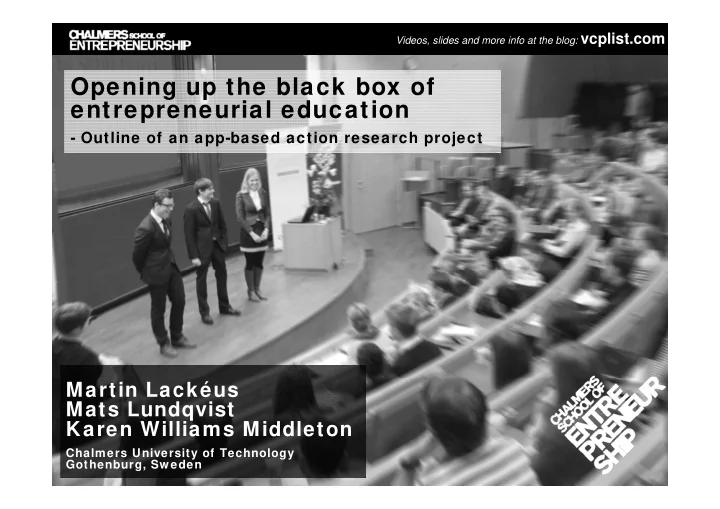
Videos, slides and more info at the blog: vcplist.com Opening up the black box of entrepreneurial education - Outline of an app-based action research project Martin Lackus Mats Lundqvist Karen Williams Middleton Chalmers University of


slide-1
SLIDE 1

Videos, slides and more info at the blog: vcplist.com

Martin Lackéus Mats Lundqvist Karen Williams Middleton

Chalmers University of Technology Gothenburg, Sw eden

Opening up the black box of entrepreneurial education

  • Outline of an app-based action research project
slide-2
SLIDE 2

Videos, slides and more info at the blog: vcplist.com

Agenda

  • Some challenges in entrepreneurial education
  • Focus on methodological challenges – how to open the black box?
  • Three different research strategies – thoughts, actions, emotions
  • Using experience sampling (ESM) to research emotional entrepreneurial experience
  • The proxy theory of assessing entrepreneurial education
  • Roots and results so far of proxy based ESM research on entrepreneurial education
  • An app-based multi-site international action research project
  • Some results to be expected

Problem Opportunity Proposition Expectations

slide-3
SLIDE 3

Videos, slides and more info at the blog: vcplist.com

”What are we doing?”

Do our students develop entrepreneurial competencies?

”What should we be doing?”

When, how and why do students develop entrepreneurial competencies?

”What are they doing?”

What is the purpose? What is the difference & impact? Is it effective & efficient?

”Should I be doing it too?”

Can it help me reach my goals? Will it work on my students? Will I be able to manage it?

Today’s entrepreneurial educators Wider community Entrepreneurial education researchers

Understanding Legitimacy Development Diffusion ”How can we study it?”

What methods can develop our understanding of entrepreneurial education?

”What have we learned?”

What research has been done that can describe and explain entrepreneurial education?

Methods Research

Problems in entrepreneurial education

slide-4
SLIDE 4

Videos, slides and more info at the blog: vcplist.com

Some methodological challenges

  • Macro level studies (Rigor)

Look at regularities in cause–effect by studying large populations (large N), but correlation does not give causation

Do not open the black box – only tell us IF entrepreneurial competencies are developed, not HOW, WHEN or WHY

Lack methodological rigor by default, a generic problem with RCTs in education

Severe self-selection bias in ent.ed

Results seldom relevant to practitioners, but easy to get published

  • Micro level studies (Relevance)

Often single case studies or very small N, aiming to explain HOW, WHEN or WHY entrepreneurial competencies are developed

Anecdotal and descriptive, frequent lack of decontextualization / categorization / contrasting

Statistical methods often not applicable, therefore trustworthiness is questioned

Methodological sloppiness often substantial

Results seldom publishable, but more often relevant to practitioners

The researcher’s dilemma: “Shall [s]he remain on the high ground where he can solve relatively unimportant problems according to his standards

  • f rigor, or shall he descend to the swamp of important

problems where he cannot be rigorous in any way he knows how to describe?”. (Schön, 1995, p.28)
slide-5
SLIDE 5

Videos, slides and more info at the blog: vcplist.com Research strategy Before education During education Directly after education Long time after education

Thoughts

Entrepreneurial knowledge, skills and attitudes (TPB) What do they think? Entrepreneurial knowledge, skills and attitudes (TPB)

  • Actions
  • What do they

do?

  • Actual entrepreneurial

behavior

Emotions

  • What do they

feel?

  • Based on tracking critical and emotional events triggering learning (i.e. links)
  • Captures the learners’ experiences, i.e. formative assessment, leans on experience sampling
  • Focus is on what happens during the educational intervention, not before / after / long after

Three research strategies

slide-6
SLIDE 6

Videos, slides and more info at the blog: vcplist.com

Experience Sampling Method (ESM)

  • Very short surveys answered in

the actual situation / environment

– Captues the subjective experience with

high validity and reliability

– A mix between diary and survey – Can be done through mobile

smartphones that most people have today

  • Has been adjusted to the

purpose of capturing learning

– The learner decides when to report

something significant

– Leans on people’s inclination to share

strong emotions socially

– Anchored in Vygotsky’s view of learning

that human activity spurs learning

slide-7
SLIDE 7

Videos, slides and more info at the blog: vcplist.com

Experience Sampling Method (ESM)

  • Very short surveys answered in

the actual situation / environment

– Captues the subjective experience with

high validity and reliability

– A mix between diary and survey – Can be done through mobile

smartphones that most people have today

  • Has been adjusted to the

purpose of capturing learning

– The learner decides when to report

something significant

– Leans on people’s inclination to share

strong emotions socially

– Anchored in Vygotsky’s view of learning

that human activity spurs learning

What teenagers do in class:

slide-8
SLIDE 8

Videos, slides and more info at the blog: vcplist.com

Experience Sampling Method (ESM)

The week of a teenager:

slide-9
SLIDE 9

Videos, slides and more info at the blog: vcplist.com

A mobile app captures learners’ emotional experiences / events

Month 1 Month 2 Month 3 Month 4 Month 5

Interviews follow up these events, connects them to learning outcomes Interviews transcribed, coded in NVIVO, link frequency counted Analysis of when / why / how competencies are developed ”Experience sampling”

  • What

happened?

  • Why?
  • What did you

learn?

  • What insights

do you take with you?

slide-10
SLIDE 10

Videos, slides and more info at the blog: vcplist.com

…which in turn develop entrepreneurial competencies …trigger emotional events … Educational interventions…

Interaction with

  • utside world

Uncertainty and ambiguity in learning environment Teamwork environment Value creation Overcoming competency gaps Presenting in front

  • f others

Increased self- efficacy Formation of entrepreneurial identity Increased uncertainty and ambiguity tolerance Increased self-insight Increased marketing skills Creation Venture creation

And others… And others…

Sustainable venture creation

The proxy theory of assessing entrepreneurial education

Novel assessment strategy – focus on emotional activities

Empirically established strong links between emotional activity and developed entrepreneurial competencies

slide-11
SLIDE 11

Videos, slides and more info at the blog: vcplist.com

Entrepreneurship as practice

Venture creation programs

Entrepreneurial education

Educating about entrepreneurship

Educating for / in entrepre- neurship Educating through entrepre- neurship

Becoming an entrepreneur by founding a real-life venture

Origin of the proxy theory

slide-12
SLIDE 12

Videos, slides and more info at the blog: vcplist.com

Some characteristics of Venture Creation Programs

Emotional roller-coaster Building air castles Strong positive emotions Strong negative emotions

”We can take over the w orld if w e w ant to” ”Everyone else needs to see a flow er w hile I see a seed” ”Free falling from an airplane w ithout a parachute” ”Crisis in my head and crisis in my stomach”

Quotes from Lackeus (2013). An emotion based approach to assessing entrepreneurial education. International Journal of Management Education, 12(3)

slide-13
SLIDE 13

Videos, slides and more info at the blog: vcplist.com

Some characteristics of Venture Creation Programs

A methodological dream

  • The data is screaming to us!

What can’t be observed here, probably can’t be observed,

  • r isn’t happening at all

The challenge comes later w hen using the developed methods in environments w ith low er signal-to-noise ratio

slide-14
SLIDE 14

Videos, slides and more info at the blog: vcplist.com

Emotional events Educational design

Frequent interaction with outside world Happiness, motivation, sense of relevancy and meaning Increased energy input Increased perseverance Increased uncertainty / ambiguity tolerance Positive feedback from externals Increased self-efficacy Increased entrepre- neurial passion Developed entrepre- neurial identity ”I can do this!” ”I want more of this!” ”This is who I am!” Requirement to create a venture Requirement to create value for other actors Requirement to create something

Entrepreneurial competencies developed

Frustration, anger, despair etc. ”I overcome!” ”I dare!”

An example of an opened black box

A new educational philosophy – surprisingly novel! It is now being tested widely in Sweden and abroad.

Lackeus (2013). An emotion based approach to assessing entrepreneurial

  • education. International Journal of Management Education, 12(3)
slide-15
SLIDE 15

Videos, slides and more info at the blog: vcplist.com

1 2 3 4 5 6

Team work

  • ver time

Value created

  • utside team /

teacher Activity based feedback / assessment Student owns process Encourage failures Subject matter connections Iterative process Interaction with world outside class / school

Value creation pedagogy profiler

slide-16
SLIDE 16

Videos, slides and more info at the blog: vcplist.com

  • Assessment of Chalmers’ own

Venture Creation Program

Confirmed previous research on what emotional events generate the most important learning

  • Assessment of an action-oriented enterprise

education concept on secondary education

Outlined how, when and why 13-year old students developed their entrepreneurial competencies

  • Assessment of the three ”best” entrepreneurial

secondary schools in Sweden

Showed that what often is pictured as very entrepreneurial environments were actually not at all that entrepreneurial

Confirmed that what was still rather entrepreneurial led to strong increase in student motivation and engagement

Three other studies applying the proxy theory

slide-17
SLIDE 17

Videos, slides and more info at the blog: vcplist.com Year 1 Year 2

Start up meeting 4 x 10 teachers learn to use & manage app Preparations for autumn term start 4 x 50-100 students start using app Students and teachers use app for 1 year App-inspired focus group meetings for teachers Transcription and analysis of teacher meetings App based selection of students to interview App-based interviews with students Transcription and analysis of student interviews Compilation of all data into common database Years of research based on collected data

Autumn term Spring term

Proposed pan-european study

Analysis and synthesis

slide-18
SLIDE 18

Videos, slides and more info at the blog: vcplist.com

The app instrument – LoopMe 2.0

(w w w.loopme.se – in Sw edish only so far)

slide-19
SLIDE 19

Videos, slides and more info at the blog: vcplist.com

The interview template

slide-20
SLIDE 20

Videos, slides and more info at the blog: vcplist.com

Coding framew orks

Entrepreneurial competencies Emotional events / sources

slide-21
SLIDE 21

Videos, slides and more info at the blog: vcplist.com

Links betw een emotional events & learning outcomes

  • Chalmers master students
slide-22
SLIDE 22

Videos, slides and more info at the blog: vcplist.com Interaction with outside world Uncertainty and ambiguity in learning environment Team-work experience Increased self-efficacy (”I can”) Increased uncertainty and ambiguity tolerance (”I dare”) Increased self-insight Increased marketing skills Formation of entrepreneurial identity (”I am / I value”)

Sources of emotion Entrepreneurial learning outcomes

Increased entrepreneurial passion (”I want”) Increased interpersonal skills Increased perseverance (”I overcome”)

Attitudes Knowledge Skills

Overcoming competency gaps Theory versus practice Individual differences Leadership and managing people

Core finding

  • f study

Links betw een emotional events & learning outcomes

  • Chalmers master students
slide-23
SLIDE 23

Videos, slides and more info at the blog: vcplist.com

1 2 3 4 5 6

Task: Talk-English

Team work

  • ver time

Value created

  • utside

team / teacher Activity based feedback / assessment Student owns process Encourage failures Subject matter connections Iterative process Interaction with world

  • utside

class / school

Example: pedagogical profile

slide-24
SLIDE 24

Videos, slides and more info at the blog: vcplist.com

What are we doing?

Value creation motivates students a lot

What should we be doing?

Make more students get to create value

What are they doing?

Those students seem damn motivated!

Should I be doing it too?

I want to try it in my classroom too!

Today’s entrepreneurial educators Wider community Entrepreneurial education researchers

Understanding Legitimacy Development Diffusion

How can we study it?

App based study of VCP emotionality

What have we learned?

A novel educational philosophy Methods Research

Example: Value creation as pedagogy

slide-25
SLIDE 25

Videos, slides and more info at the blog: vcplist.com

Generalized expectations

“…these methods allow researchers to develop understandings not easily obtained with other paradigms. For example, everyday experience studies may help establish the real-world prevalence and impact of particular processes and phenomena; may identify situational contexts in which effects are more or less likely to occur; may determine boundary conditions necessary or sufficient for the operation of basic processes; may help distinguish between-person and within-person processes; may identify patterns

  • f

cyclicity and covariation among social, cognitive, emotional and psychophysiological variables; and may clarify their interactions with other, naturally occuring processes.”

Reis, H. T., Gable, S. L. & Maniaci, M. R. 2014, p.374. Methods for studying everyday experience in its natural context. In: Reis, H. T. & Judd, C. M. (eds.) Handbook of Research Methods in Social and Personality Psychology. Cambridge University Press.

slide-26
SLIDE 26

Videos, slides and more info at the blog: vcplist.com

Possible uses beyond research

  • Teaching. An app can improve the day-to-day communication

between students and teachers in many many ways

  • Management & Development. An app can help many of the

more peripheral actors in education, such as school developers, principals, administrators, politicians, evaluators etc etc.

  • Financing. An app can make explicit what works really well in

an intervention, generating crucial evidence that can motivate investments – for both the financier and for the receiver of funds

slide-27
SLIDE 27

Videos, slides and more info at the blog: vcplist.com

Thank you for listening!

  • Some challenges in entrepreneurial education
  • Focus on methodological challenges – how to open the black box?
  • Three different research strategies – thoughts, actions, emotions
  • Using experience sampling (ESM) to research emotional entrepreneurial experience
  • The proxy theory of assessing entrepreneurial education
  • Roots and results so far of proxy based ESM research on entrepreneurial education
  • An app-based multi-site international action research project
  • Some results to be expected

Problem Opportunity Proposition Expectations