Open problem session Representation Theory XVI Dubrovnik June 28, - - PDF document

open problem session representation theory xvi dubrovnik
SMART_READER_LITE
LIVE PREVIEW

Open problem session Representation Theory XVI Dubrovnik June 28, - - PDF document

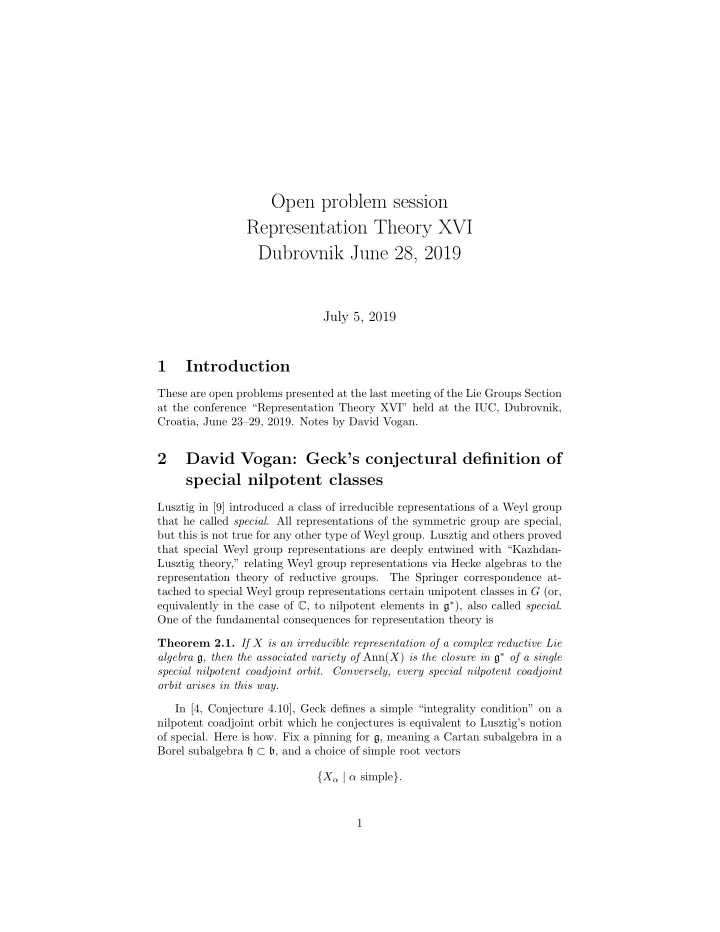
Open problem session Representation Theory XVI Dubrovnik June 28, 2019 July 5, 2019 1 Introduction These are open problems presented at the last meeting of the Lie Groups Section at the conference Representation Theory XVI held at the


slide-1
SLIDE 1

Open problem session Representation Theory XVI Dubrovnik June 28, 2019

July 5, 2019

1 Introduction

These are open problems presented at the last meeting of the Lie Groups Section at the conference “Representation Theory XVI” held at the IUC, Dubrovnik, Croatia, June 23–29, 2019. Notes by David Vogan.

2 David Vogan: Geck’s conjectural definition of special nilpotent classes

Lusztig in [9] introduced a class of irreducible representations of a Weyl group that he called special. All representations of the symmetric group are special, but this is not true for any other type of Weyl group. Lusztig and others proved that special Weyl group representations are deeply entwined with “Kazhdan- Lusztig theory,” relating Weyl group representations via Hecke algebras to the representation theory of reductive groups. The Springer correspondence at- tached to special Weyl group representations certain unipotent classes in G (or, equivalently in the case of C, to nilpotent elements in g∗), also called special. One of the fundamental consequences for representation theory is Theorem 2.1. If X is an irreducible representation of a complex reductive Lie algebra g, then the associated variety of Ann(X) is the closure in g∗ of a single special nilpotent coadjoint orbit. Conversely, every special nilpotent coadjoint

  • rbit arises in this way.

In [4, Conjecture 4.10], Geck defines a simple “integrality condition” on a nilpotent coadjoint orbit which he conjectures is equivalent to Lusztig’s notion

  • f special. Here is how. Fix a pinning for g, meaning a Cartan subalgebra in a

Borel subalgebra h ⊂ b, and a choice of simple root vectors {Xα | α simple}. 1

slide-2
SLIDE 2

This defines basis vectors X−α for the negative simple roots by the requirement that [Xα, X−α] = Hα = coroot for α. From these root vectors we can construct a Chevalley basis vector Xγ for each root space; each such vector is well-defined up to sign. The set {Xγ | γ ∈ ∆(g, h)} ∪ {Hi} is called a Chevalley basis of g. The structure constants for this basis are integers, so the basis vectors span a natural Z-form gZ of g. Each nilpotent orbit in g has a representative E so that there is an sl(2)-triple (H, E, F) with [H, E] = 2E, [H, F] = −2F, [E, F] = H H ∈ h dominant. The resulting element H is uniquely defined (given the choice of h ⊂ b) by the

  • rbit of E. Necessarily H is a nonnegative integer combination of the simple

coroots Hα, so γ(H) ∈ N (γ ∈ ∆(g, h)). This means that the eigenspaces of H define a Z-grading g =

  • i∈Z

gi. Each gi for i = 0 is spanned by roots, and therefore defined over Z; and g0 is spanned by roots and h, and therefore also defined over Z. Necessarily E ∈ g2, H ∈ g0, F ∈ g−2. Every linear functional ǫ′ ∈ g∗

2 defines a skew-symmetric bilinear form on g1 by

ωǫ′(x, y) =def ǫ′([x, y]). If ǫ′ ∈ g∗

2,Z (that is, if ǫ′ takes integer values on the Chevalley basis vectors

{Xγ}), then ωǫ′ is defined over Z; that is, we get an integer matrix ωǫ′(Xγi, Xγj) ∈ Z (γi(H) = γj(H) = 1)

  • f size the dimension of g1. If B is a nondegenerate invariant bilinear form on

g and ǫ(z) =def B(F, z) (z ∈ g2), then the Kirillov-Kostant theory of coadjoint orbits guarantees that the sym- plectic form ωǫ is nondegenerate. It follows that for “most” integral ǫ′, the form ωǫ′ has nonzero (integral) determinant. Geck’s conjecture is E is special if and only if there is an integral ǫ′ so that det(ωǫ′(Xγi, Xγj) = ±1 (γi(H) = 1). Geck’s conjecture suggests three problems. 2

slide-3
SLIDE 3
  • 1. Show that if X is a simple g-module defined over Z, then X has integral

infinitesimal character.

  • 2. Show that I is a primitive ideal of integral infinitesimal character, then

I = Ann(X) for some simple g-module defined over Z.

  • 3. Show that if X is a simple Harish-Chandra module defined over Z, then

some representative λ ∈ g∗

Z of an open orbit in the associated variety

AV(X) must satisfy Geck’s integrality condition. Perhaps (1) is not too difficult. Part (2) is probably immediate from Duflo’s theorem relating primitive ideals to highest weight modules. Part (3) is meant to be analogous to Gabber’s “integrability of characteristic” theorem [3]; it may be difficult. Here are two related problems.

  • 4. A linear functional ǫ′ on g2 as above, extended by zero on all other g1,

defines a nilpotent coadjoint orbit G · ǫ′, which carries a Kirillov-Kostant symplectic structure Ωǫ′. Show that this structure is naturally defined

  • ver Z if and only if ǫ′ takes integer values on the Chevalley basis; and in

this case the structure can be chosen nondegenerate over Z.

  • 5. Study (g, K)-modules which are defined over Z. (One possible guess is

that the irreducibles defined over Z are precisely those in the block of finite-dimensional representations.)

3 Dan Ciubotaru: counting elliptic elements of Weyl groups

Suppose W = W(g, h) is the Weyl group of a semisimple Lie algebra g. An element w ∈ W is called elliptic if it does not have the eigenvalue 1 on h. Define a class function on W ✶ell(w) =

  • 1

w elliptic w not elliptic. Suppose now that H, E, F is a Lie triple for a distinguished nilpotent element (meaning that the centralizer in g of (H, E, F) is the center of g). Then the conjecture is ✶ell, H•(BE)W = ′

α∈R(g,h) α(H)

α∈R(g,h)(α(H) − 2).

Here each product runs over all roots of h in g; the prime means that factors equal to zero are to be omitted. The Springer fiber BE consists of all Borel subalgebras containing E. 3

slide-4
SLIDE 4

Suppose for example that E is a principal nilpotent element. Then BE is a single point (carrying the trivial representation of W), so the left side of the conjecture is ✶ell, trivialW = |Well|/|W|. The right side of the conjecture is computed by Kostant’s description of the decomposition of g under a principal three-dimensional subalgebra; it is

  • i

mi mi + 1. Write n = dim h and Wj = {w ∈ W | dim hw = n − j}, the elements of W for which the eigenvalue 1 has multiplicity n − j. A formula due to Shephard and Todd says that

  • j

tj|Wj| =

  • i

(1 + mit), with mi the exponents of W. Consequences include |W| =

  • i

(mi + 1), |Well| =

  • i

mi. It follows that the conjecture is true for the principal nilpotent element.

4 David Renard: resolutions for character for- mulas for p-adic group representations

Suppose that Gn = GL(n, F), with F a p-adic field. Zelevinski in 1980 gave a classification of the irreducible representations of Gn in terms of the supercusp- idal representations of all Gn′ (for n′ ≤ n) and some combinatorial data called

  • multisegments. One can find a clear account for example in [10]. A segment is

a sequence of integers increasing by 1 ∆ = {b, b + 1, . . . , e} =def [b, e] (b ≤ e ∈ Z) The length ℓ(∆) of the segment is its cardinality e − b + 1. A multisegment is a finite multiset of segments m = (∆1, . . . , ∆t), unordered but counted with multiplicity. The length ℓ(m) of the multisegment is the sum (with multiplicities) of the lengths of its constituent segments. For example, ℓ({−4, −3, −2}, {−4, −3, −2}, {−3, −2, −1, 0, 1}) = 11. 4

slide-5
SLIDE 5

Using a pair (ρ, m) (consisting of a supercuspidal ρ of Gd and a multisegment of length ℓ) Zelevinsky defines a standard representation std(m, ρ) of Gdℓ having a unique irreducible quotient irr(m, ρ). Zelevinski proves that this construction parametrizes irreducibles of Gdℓ having supercuspidal support ρ by multiseg- ments m of length ℓ. (Other irreducible representations of Gn are obtained from these basic ones by irreducible parabolic induction.) For integers b ≤ e, the representation irr([b, e], ρ) = std([b, e], ρ) is an es- sentially square integrable modulo the center representation of G(b−e+1)d. It is convenient to define formally irr([b, b − 1], ρ) to be the one-dimensional trivial representation of the trivial group G0, and irr(ρ, [b, e]) = 0 if e ≤ b − 2. If π1, ...,πr are representation of Gn1, ..., Gnr respectively, we write as usual π1 × · · · × πr for the representation of Gn = Gn1+···+nr parabolically induced from the stan- dard parabolic subgroup of Gn of type (n1, . . . , nr) (with Levi subgroup Gn1 × · · · × Gnr. We say that the segment [b, e] precedes [b′, e′] if b < b′ ≤ e + 1 < e′ + 1. If m = ([b1, e1]), . . . , [bt, et]) is a multisegment such that [bi, ei] does not precede [bj, ej] for i < j, we say that the multisegment is presented in a standard

  • rder, and then the representation

std(m, ρ) = irr(ρ, [b1, e1) × · · · × irr(ρ, [bt, et] has a unique irreducible quotient irr(m, ρ). Of course, we can always present a multisegment in a standard order, and std(m, ρ), irr(m, ρ) do not depend on the chosen standard order. The standard representations std(m, ρ) are rather completely understand- able in terms of ρ. In order to understand irreducible representations, it is therefore of interest to express the irreducible representations in terms of stan- dard ones: irr(m, ρ) =

  • m′

a(m′, m) std(m′, ρ). This is accomplished by Kazhdan-Lusztig theory: the integers a(m′, m) are given by values at q = 1 of certain Kazhdan-Lusztig polynomials (which are depend not on the supercuspidal ρ but only on the combinatorics of multiseg- ments). This was conjectured by Zelevinski [16], [17], and proved by Chriss and Ginzburg [1]. A Speh representation corresponds to a multisegment mSpeh = ({b, b + 1, . . . , e}, {b + 1, . . . , e + 1}, . . . , {b + p − 1, . . . , e + p − 1}) consisting of p segments of the same length, each shifted one step to the right

  • f its predecessor. The symmetric group Sp “acts” on this multisegment: for

each τ ∈ Sp, τ · m is another multisegment with the same support as τ. This is not a group action. We will not give the definition of τ · m in general, but here 5

slide-6
SLIDE 6

are some examples with p = 3. First, the identity element of Sp always acts

  • trivially. Second,

σ12 · ({1}, {2}, {3}) = ({1, 2}, {3}), σ12 · ({1, 2, 3}, {2, 3, 4}, {3, 4, 5}) = ({1, 2, 3, 4}, {2, 3}, {3, 4, 5}) σ23 · ({1}, {2}, {3}) = ({1}, {2, 3}), σ23 · ({1, 2, 3}, {2, 3, 4}, {3, 4, 5}) = ({1, 2, 3}, {2, 3, 4, 5}, 3, 4) σ123 · ({1}, {2}, {3}) = ({1, 2, 3}), σ123 · ({1, 2, 3}, {2, 3, 4}, {3, 4, 5}) = ({1, 2, 3, 4}, {2, 3}, {3, 4, 5}) σ321 · ({1}, {2}, {3}) = ({1, 2, 3}), σ321 · ({1, 2, 3}, {2, 3, 4}, {3, 4, 5}) = ({1, 2, 3}, {3, 4}, {2, 3, 4, 5}). When these formulas are appropriately corrected and generalized, Tadi´ c proved in [13] that irr(mSpeh, ρ) =

  • σ∈Sp

sgn(σ) std(σ · mSpeh, ρ). Lapid and M´ ınguez in [8] generalized this formula to “ladder” multisegments: those of the form mladder = ([b, e], [b + x1, e + y1], . . . , [b + xp−1, e + yp−1]), 0 < x1 < · · · < xp−1, 0 < y1 < · · · < yp−1. The problem proposed by Renard is to find a proof of this Lapid-M´ ınguez char- acter formula along the lines of the BGG resolution: by constructing a resolution 0 ← irr(mladder, ρ) ← std(mladder, ρ) ←

  • ℓ(σ)=1

std(σ · mladder, ρ) ← · · · . Lapid and M´ ınguez construct the first one or two terms of such a resolution, then use a series of tricks to deduce the character formula. Renard also asks: for real reductive groups, when are there resolutions of irreducible Harish-Chandra modules giving rise to simple character formulas? Using Beilinson-Bernstein localisation, such resolutions can obtained from res-

  • lutions called Cousin complexes in a category of Dλ-modules. Dragan Milicic

has a set of notes about these.

5 Jeff Adams: extending atlas

The atlas software [15] does a wide variety of calculations related to the struc- ture and representation theory of G(R), with G a complex connected reductive 6

slide-7
SLIDE 7

algebraic group. Extend the software to treat (finite) nonlinear coverings of such a group. It may be necessary to find a good class of such nonlinear groups. One interesting example is all two-fold covers of G(R). David Vogan suggested along similar lines that one could try to extend either the Langlands program, or atlas, or D-modules, to cover representations of the real points of possibly disconnected complex reductive algebraic groups. The most familiar group of this sort is O(n). Many others appear in applications, for example as centralizers or normalizers of reductive subgroups of connected reductive algebraic groups.

6 David Vogan: dual pairs

Suppose G is a group. A dual pair in G is a pair of subgroups H1 and H2 with the property that H2 = CentG(H1), H1 = CentG(H2). If G is algebraic, then H1 and H2 are automatically algebraic as well. The problem is to classify dual pairs up to conjugation in G (perhaps for G complex reductive algebraic). Roger Howe’s theory of dual pairs concerns the case G = Sp(2n) and Hi reductive; he classified such pairs completely in [5]. His classification was ex- tended by Rubenthaler [12] to dual pairs of complex reductive Lie algebras in a complex reductive g. For a rather different example, suppose G is a simple complex group of type G2, H1 is the PSL(2) subgroup corresponding to a subregular orbit, and H2 = CentG(H1). Then H2 is the symmetric group on three letters, and (H1, H2) is a dual pair. If H0 is any subgroup of any group G, and H1 = CentG(H0), H2 = CentG(H1), then (H1, H2) is a dual pair.

7 Kyo Nishiyama: reducible associated varieties

Suppose that X is an irreducible (g, K)-module (with G a complex connected reductive algebraic group and K = Gθ the fixed points of an involutive auto- morphism). Then the associated variety of X is decomposed into irreducible components AV(X) = ∪r

i=1Oi;

the various Oi are K-invariant Lagrangians in a common nilpotent coadjoint

  • rbit O.

(Here N ∗ ⊂ g∗ is the nilpotent cone and g = k ⊕ s the Cartan decomposition defined by θ.) The conjecture is that “AV(X) is connected in 7

slide-8
SLIDE 8

codimension 1.” This means that if Oi and Oi′ are two of these components, then they are connected by a chain of components Oi = Oj1, Oj2, · · · , Ojr = Oi′, so that Ojk ∩ Ojk+1 has codimension one in each, 1 ≤ k ≤ r − 1. This conjecture seeks to sharpen a result of [14], which says that if AV(X) is reducible, then each irreducible component Oi must have codimension 1 bound- ary. Lucas Mason-Brown has observed that the “Hodge filtration conjecture” of Schmid and Vilonen (that the Hodge filtration sheaves for an irreducible Dλ- module attached to X have no higher cohomology) would imply that the Hodge filtration makes gr(X) Cohen-Macaulay, and therefore that the associated vari- ety is connected in codimension one ([2, page 454]). In the case G = GL(n), K = GL(p) × GL(q), it is proven in [11] that every “codimension one connected component” is in fact an associated variety of an irreducible (g, K)-module. Kashiwara has proven the analogous codimension one connectedness state- ment for characteristic cycles of irreducible regular holonomic D-modules ([6], [7, Theorem 1.2.2]). (This result is also a consequence of Saito’s Hodge filtra- tion.)

References

[1] Neil and Ginzburg Chriss Victor, Representation theory and complex geom- etry, Modern Birkh¨ auser Classics, Birkh¨ auser Boston, Inc., Boston, MA,

  • 2010. Reprint of the 1997 edition.

[2] David Eisenbud, Commutative algebra, Graduate Texts in Mathematics,

  • vol. 150, Springer-Verlag, New York, 1995. With a view toward algebraic

geometry. [3] O. Gabber, The integrability of the characteristic variety, Amer. J. Math. 103 (1981), 445–468. [4] Meinolf Geck, Generalised Gelfand-Graev representations in bad character- istic? (2018), 22 pp., available at arXiv:1810.08937v2[math.RT]. [5] R. Howe, θ-series and invariant theory, Automorphic forms, representations and L-functions (Proc. Sympos. Pure Math., Oregon State Univ., Corval- lis, Ore., 1977), Proc. Sympos. Pure Math., XXXIII, Amer. Math. Soc., Providence, R.I., 1979, pp. 275–285. [6] Masaki Kashiwara, Introduction to microlocal analysis, Enseign. Math. (2) 32 (1986), no. 3-4, 227–259. 8

slide-9
SLIDE 9

[7] Masaki Kashiwara and Takahiro Kawai, On holonomic systems of microdif- ferential equations. III. Systems with regular singularities, Publ. Res. Inst.

  • Math. Sci. 17 (1981), no. 3, 813–979.

[8] Erez Lapid and Alberto M´ ınguez, On a determinantal formula of Tadi´ c,

  • Amer. J. Math. 136 (2014), no. 1, 111–142.

[9] G. Lusztig, A class of irreducible representations of a Weyl group, Proc.

  • Kon. Nederl. Akad., A 82 (1982), 323–335.

[10] C. Mœglin and J.-L. Waldspurger, Sur l’involution de Zelevinski, J. Reine

  • Angew. Math. 372 (1986), 136–177 (French).

[11] Kyo Nishiyama, Peter Trapa, and Akihito Wachi, Codimension one con- nectedness of the graph of associated varieties, Tohoku Math. J. (2) 68 (2016), no. 2, 199–239. [12] Hubert Rubenthaler, Les paires duales dans les alg` ebres de Lie r´ eductives, Ast´ erisque 219 (1994), 121 (French, with English and French summaries). [13] M. Tadi´ c, On characters of irreducible unitary representations of general linear groups, Abh. Math. Sem. Univ. Hamburg 65 (1995), 341–363. [14] David A. Vogan Jr., Associated varieties and unipotent representations, Harmonic analysis on reductive groups (Brunswick, ME, 1989), Progr. Math., vol. 101, Birkh¨ auser Boston, Boston, MA, 1991, pp. 315–388. [15] Atlas of Lie Groups and Representations software, 2019. http://www. liegroups.org. [16] A. V. Zelevinski˘ ı, The p-adic analogue of the Kazhdan-Lusztig conjecture,

  • Funktsional. Anal. i Prilozhen. 15 (1981), no. 2, 9–21, 96 (Russian); English

transl., Functional Anal. Appl. 15, no. 2, 83-92. [17] , Two remarks on graded nilpotent classes, Uspekhi Mat. Nauk 40 (1985), no. 1(241), 199–200 (Russian); English transl., Russian Math. Sur- veys 40, no. 1, 249-250. 9