On trace-free characters and abelian knot contact homology y + - - PowerPoint PPT Presentation

on trace free characters and abelian knot contact homology
SMART_READER_LITE
LIVE PREVIEW

On trace-free characters and abelian knot contact homology y + - - PowerPoint PPT Presentation

On trace-free characters and abelian knot contact homology y + x 2 1 = 0 y S 0 (3 1 ) y 2 = 0 2 x = (meridian) -1 Fumikazu Nagasato (Meijo University, NAGOYA) 31/05/2012 RIMS Seminar @


slide-1
SLIDE 1

✓ ✏

On trace-free characters and abelian knot contact homology

✒ ✑

  • 1

2

S0(31) −y + x2 − 1 = 0 y − 2 = 0

y x = −χρ(meridian)
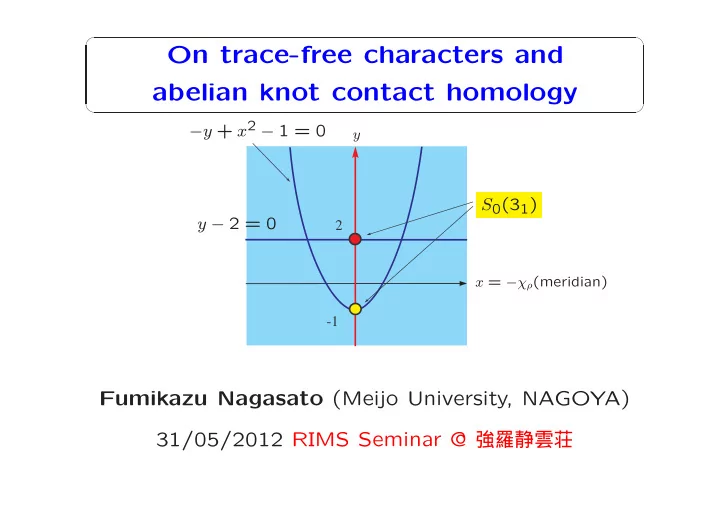
Fumikazu Nagasato (Meijo University, NAGOYA) 31/05/2012 RIMS Seminar @ 強羅静雲荘

slide-2
SLIDE 2

Notations K: a knot in S3

EK:=S3 − N(K)

G(K) := π1(EK), knot group R(K) := {ρ : G(K) → SL2(C), representation} X(K) := {χρ : G(K) → C, characters of ρ ∈ R(K)} S0(K) := X(K) ∩

  • χρ(meridian) = 0
  • trace-free characters

HCab

0 (K) : degree 0 abelian knot contact homology of K

introduced by Lenhard Ng

[Ng] Knot and braid invariants from contact homology

I and II, Geom. Topol. 9 (2005)

  • 1
slide-3
SLIDE 3

Main theorem Let G(K) = m1, · · · , mn | r1 = 1, · · · , rn = 1 be a Wirtinger

  • presentation. Then S0(K) is realized as the algebraic set

⎧ ⎪ ⎪ ⎪ ⎪ ⎪ ⎪ ⎪ ⎪ ⎪ ⎪ ⎪ ⎪ ⎪ ⎪ ⎪ ⎪ ⎪ ⎪ ⎪ ⎪ ⎪ ⎪ ⎪ ⎪ ⎪ ⎪ ⎪ ⎪ ⎨ ⎪ ⎪ ⎪ ⎪ ⎪ ⎪ ⎪ ⎪ ⎪ ⎪ ⎪ ⎪ ⎪ ⎪ ⎪ ⎪ ⎪ ⎪ ⎪ ⎪ ⎪ ⎪ ⎪ ⎪ ⎪ ⎪ ⎪ ⎪ ⎩

(xab; xpqr) ∈ C(n

2)+(n 3)

(1 ≤ a < b ≤ n) (1 ≤ p < q < r ≤ n)

  • (1) xka = xijxia − xja , xkab = xijxiab − xjab

⎛ ⎜ ⎜ ⎝a, b ∈ {1, · · · , n},

∀ Wirtinger triple (i, j, k)

i j k

⎞ ⎟ ⎟ ⎠

(2) xi1i2i3 · xj1j2j3 = 1

2

  • xi1j1

xi1j2 xi1j3 xi2j1 xi2j2 xi2j3 xi3j1 xi3j2 xi3j3

  • (1 ≤ i1 < i2 < i3 ≤ n, 1 ≤ j1 < j2 < j3 ≤ n)

(3)

  • 2

x12 x1a x1b x21 2 x2a x2b xa1 xa2 2 xab xb1 xb2 xba 2

  • = 0

(3 ≤ a < b ≤ n)

⎫ ⎪ ⎪ ⎪ ⎪ ⎪ ⎪ ⎪ ⎪ ⎪ ⎪ ⎪ ⎪ ⎪ ⎪ ⎪ ⎪ ⎪ ⎪ ⎪ ⎪ ⎪ ⎪ ⎪ ⎪ ⎪ ⎪ ⎪ ⎪ ⎬ ⎪ ⎪ ⎪ ⎪ ⎪ ⎪ ⎪ ⎪ ⎪ ⎪ ⎪ ⎪ ⎪ ⎪ ⎪ ⎪ ⎪ ⎪ ⎪ ⎪ ⎪ ⎪ ⎪ ⎪ ⎪ ⎪ ⎪ ⎪ ⎭

2

slide-4
SLIDE 4

(1) xka = xijxia − xja (F2), xkab = xijxiab − xjab (F3) the fundamental relations (F) (2) xi1i2i3 · xj1j2j3 = 1

2

  • xi1j1

xi1j2 xi1j3 xi2j1 xi2j2 xi2j3 xi3j1 xi3j2 xi3j3

  • the hexagon relations (H)

(3)

  • 2

x12 x1a x1b x21 2 x2a x2b xa1 xa2 2 xab xb1 xb2 xba 2

  • = 0

the rectangle relations (R) NOTE. xaa := 2, xba := xab (symmetric) xiσ(1)iσ(2)iσ(3) := sign(σ)xi1i2i3 (σ ∈ S3) (anti-sym) xaab = 0

3

slide-5
SLIDE 5

Plan of this talk Section 1: An observation of the main theorem Section 2: A rought sketch of proof of the main theorem Section 3: An application to abelian knot contact homology (Ng’s conjecture on abelian knot contact homology)

slide-6
SLIDE 6

Section 1: An observation of the main theorem

How to get the fundamental relations (F)

slide-7
SLIDE 7

Realizing X(K) as an algebraic set (a short review) Km =

...

  • x = m1
  • y = m1m−1

2

m1 m2

✓ ✏

x := −tr(ρ( x)) = −tr(m1) y := −tr(ρ( y)) = −tr(m1m−1

2 )

✒ ✑

Theorem [Gelca-N (JKTR)], [N (Bull. Korean Math.)]

✓ ✏

X(Km) =

  • (x, y) ∈ C2
  • (y − 2)Rm(x, −y) = 0
  • , where

Rm(x, y) := Sm(y) − Sm−1(y) + x2 m−1

i=0 Si(y)

Sn+2(z) = zSn+1(z) − Sn(z), S1(z) = z, S0(z) = 1.

✒ ✑

EX. R1(x, −y) = −y + x2 − 1 R2(x, −y) = y2 − x2y + y + x2 − 1

4

slide-8
SLIDE 8

Realizing S0(K) as an algebraic set (a short review) X(31) =

  • (x, y) ∈ C2
  • (y − 2)
  • −y + x2 − 1
  • = 0
  • x = −tr(ρ(m1))

y = −tr(ρ(m1m−1

2 ))

−1 2 y − 2 = 0 −y + x2 − 1 = 0 −1 2

x = −tr(ρ(m1)) y = −tr(ρ(m1m−1

2 ))

S0(31)

−y + x2 − 1 = 0 y − 2 = 0 X(31) ⊂ C2 S0(31) = X(31) ∩ {tr(ρ(m1)) = 0}

Definition (S0(K) as an algebraic set)

✓ ✏

S0(K) := X(K) ∩ {tr(ρ(µ)) = 0} (w/o multiplicity)

✒ ✑

We want to calculate S0(K) directly w/o the calculation of X(K).

5

slide-9
SLIDE 9

Realizing S0(K) as an algebraic set (a short review) X(41) =

  • (x, y) ∈ C2
  • (y − 2)
  • y2 + y − 1 − x2y + x2

= 0

  • 2

x = −tr(ρ(m1)) y = −tr(ρ(m1m−1

2 ))

y − 2 = 0 y2 + y − 1 − x2y + x2 = 0 S0(41) = X(41) ∩ {tr(ρ(m1)) = 0} =

  • 2, −1 ±

√ 5 2

  • This can be done because we have the defining poly. of X(Km).

We want to calculate S0(K) directly w/o the calculation of X(K).

6

slide-10
SLIDE 10

A decomposition of EK into Hn and handles

xxxxxxxxxxxxxxxx xxxxxxxxxxxxxxxx xxxxxxxxxxxxxxxx xxxxxxxxxxxxxxxx xxxxxxxxxxxxxxxx

=

2-handles 3-handle

∪ ∪ ∪ ∪ ∪

E41 H4

1 1 1 2 2 2 3 3 3 4 4 4

7

slide-11
SLIDE 11

Presenting attaching curves on a punctured disk

2 1 3 4 2 1 3 4 2 1 3 4 push inside turn upside down 4 draw the "cores"

1 2 3 4

8

slide-12
SLIDE 12

✓ ✏

2 1 3 4

⎧ ⎪ ⎪ ⎪ ⎪ ⎪ ⎪ ⎪ ⎪ ⎪ ⎨ ⎪ ⎪ ⎪ ⎪ ⎪ ⎪ ⎪ ⎪ ⎪ ⎩

x13x23 − x12 = 2 , x13 = x23 x12x24 − x14 = 2, x12 = x24 x13x14 − x34 = 2, x13 = x14 x24x34 − x23 = 2, x23 = x24

a part of (F2)

✒ ✑

  • EX. For an arbitrary trace-free character χρ :

1 = m3m1m−1

3 m−1 2

−2 = −tr

  • ρ(m3m1m−1

3 m−1 2 )

  • =

2 1 3 4

= −

2 1 3 4

2 1 3 4

−2 = −tr

  • ρ(m3m1m−1

3 )

  • tr
  • ρ(m−1

2 )

  • + tr
  • ρ(m3m1m−1

3 m2)

  • 9
slide-13
SLIDE 13

trace-free Kauffman brakcet skein relation (at t = −1)

✓ ✏

= − − , = −2 , = 0

✒ ✑

=

2 1 3 4

= −

2 1 3 4

−2 = −tr(ρ(m3m1m−1

3 m−1 2 )) = tr

  • ρ(m3m1m−1

3 m2)

  • in general

✓ ✏

a loop γ in EK ⇔ −t[γ](ρ) := −tr(ρ([γ])) (χρ ∈ S0(K)) trace-free KBSR ⇔ trace-identity

✒ ✑

10

slide-14
SLIDE 14

trace-free Kauffman brakcet skein relation (at t = −1)

✓ ✏

= − − , = −2 , = 0

✒ ✑

=

2 1 3 4

= −

2 1 3 4

−2 = −tr(ρ(m3m1m−1

3 m−1 2 )) = tr

  • ρ(m3m1m−1

3 m2)

  • Here, by skein relation, we obtain

✓ ✏

= + +

✒ ✑

10-a

slide-15
SLIDE 15

trace-free Kauffman brakcet skein relation (at t = −1)

✓ ✏

= − − , = −2 , = 0

✒ ✑

=

2 1 3 4

= −

2 1 3 4

−2 = −tr(ρ(m3m1m−1

3 m−1 2 )) = tr

  • ρ(m3m1m−1

3 m2)

  • = −

2 1 3 4

+

2 1 3 4

= tr (ρ(m1m3)) tr

  • ρ(m2m−1

3 )

  • + tr
  • ρ(m1m2

3m−1 2 )

  • · · · continued

10-b

slide-16
SLIDE 16

−2 = · · · = tr(ρ(m1m3))tr

  • ρ(m2m−1

3 )

  • + tr(ρ(m−1

2 m1m2 3))

= tr (ρ(m1m3)) {tr(ρ(m2))tr(ρ(m3)) − tr (ρ(m2m3))} +tr(ρ(m−1

2 m1m3))tr(ρ(m3)) − tr

  • ρ(m−1

2 m1)

  • =

−tr(ρ(m1m3))tr(ρ(m2m3)) + tr(ρ(m1m2)) = · · · = −

2 1 3 4

+

2 1 3 4

Set the followings: xi :=

i

= 0, xij :=

i j

, xijk :=

i j k

−tr(ρ(mi)) = 0 −tr(ρ(mimj)) −tr(ρ(m1mjmk)) − 2 = −x13x23 + x12 (the desired equation)

11

slide-17
SLIDE 17

Also we can get: x13 = x23 , x12 = x24, x13 = x14, x23 = x24 EX. x13 = slb(x13) :=

2 1 3 4

b =

2 1 3 4

= x23 Other relations: x12 = x2

13 − 2 , x24 = x2 13 − 2, x34 = x2 13 − 2

EX. x12 = slb(x12) =

2 1 3 4

b =

2 1 3 4

=

2 1 3 4

=

1 3

1 3

1 3

= x2

13 − 2

12

slide-18
SLIDE 18

Continuing this work, we obtain all the (F2):

⎧ ⎪ ⎪ ⎪ ⎪ ⎪ ⎪ ⎪ ⎪ ⎪ ⎨ ⎪ ⎪ ⎪ ⎪ ⎪ ⎪ ⎪ ⎪ ⎪ ⎩

x13x23−x12 = 2, x12x24−x14 = 2, x13x14−x34 = 2, x24x34−x23 = 2 x13 = x23, x12 = x24 , x13 = x14 , x23 = x24 x12 = x2

13 − 2 , x24 = x2 13 − 2, x34 = x2 13 − 2

x13 = x14x24 − x12 , x14 = x23x34 − x24 x13 = x23x24 − x34, x23 = x12x14 − x24

⎫ ⎪ ⎪ ⎪ ⎪ ⎪ ⎪ ⎪ ⎪ ⎪ ⎬ ⎪ ⎪ ⎪ ⎪ ⎪ ⎪ ⎪ ⎪ ⎪ ⎭

F2(41) :=

⎧ ⎪ ⎪ ⎪ ⎨ ⎪ ⎪ ⎪ ⎩

(x12, · · · , x45) ∈ C10

  • xka = xikxia − xja

(F2) for any Wirtinger triple (i, j, k) a ∈ {1, · · · , 4} (xaa = 2)

⎫ ⎪ ⎪ ⎪ ⎬ ⎪ ⎪ ⎪ ⎭

So F2(41) is parametrized by x13 and x13 = x14x24 − x12 x13 = x13(x2

13 − 2) − (x2 13 − 2)

(x13 − 2)(x2

13 + x13 − 1) = 0

Hence we get F2(41) =

  • 2, −1±

√ 5 2

  • = S0(41) .

13

slide-19
SLIDE 19

✓ ✏

2 1 3 4 ⎧ ⎪ ⎪ ⎨ ⎪ ⎪ ⎩

x123 = 0, x124 = 0 x134 = 0, x234 = 0

(F3) becomes trivial !

✒ ✑

Indeed, we can check this like... EX. xijk = slb(xijk) =

i j k

b =

i j k

=

i j k

= −xixij − xi = 0

14

slide-20
SLIDE 20

✓ ✏

2 1 3 4 ⎧ ⎪ ⎪ ⎨ ⎪ ⎪ ⎩

x123 = 0, x124 = 0 x134 = 0, x234 = 0

(F3) becomes trivial !

✒ ✑

Or we can check this by the hexagon relation: (H) xi1i2i3·xj1j2j3 = 1 2

  • xi1j1

xi1j2 xi1j3 xi2j1 xi2j2 xi2j3 xi3j1 xi3j2 xi3j3

  • (1 ≤ i1 < i2 < i3 ≤ 4)

(1 ≤ j1 < j2 < j3 ≤ 4)

EX.

3 2 1

= x2

123 = 1

2

  • 2

x12 x13 x21 2 x23 x31 x32 2

  • = x12x13x23−x2

12−x2 13−x2 23+4

= (x2

13 − 2)x2 13 − (x2 13 − 2)2 − x2 13 − x2 13 + 4 = 0

15

slide-21
SLIDE 21

Then actually all the point in F2(41) satisfy (H) and (R)

  • 2

x12 x1a x1b x21 2 x2a x2b xa1 xa2 2 xab xb1 xb2 xba 2

  • = 0

(3 ≤ a < b ≤ 4)

Hence all points in F2(41) lift to S0(41) . S0(41) = F2(41) and thus the main theorem holds for 41.

C(4

2)

C(4

2)

C(4

3)

F2(41) = S0(41) = Calculate F2(41) first, check the liftability second.

16

slide-22
SLIDE 22

The case of K = 52

1 2 3 4 5

2 1 3 4 5

S0(52) = F2(52) =

  • x14 ∈ C
  • (x14 − 2)
  • x3

14 + x2 14 − 2x14 − 1

  • = 0
  • S0(52) =

F2(52) =

C(5

2)

C(5

2)

C(5

3)

✓ ✏

All points in F2(52) also lift to S0(52)

✒ ✑

Calculate F2(52) first, check the liftability second.

17

slide-23
SLIDE 23

The case of K = 85 F2(85) = {11 points}, S0(85) = {12 points}

}

9 points

S0(85) = F2(85) =

C(8

2)

C(8

2)

C(8

3)

✓ ✏

All points in F2(85) also lift to S0(85)

✒ ✑

Calculate F2(85) first, check the liftability second. Can any point of F2(K) lift to S0(K)? We look into this property.

18

slide-24
SLIDE 24

Section 2: A rough sketch of proof of the main theorem

On liftability problem of F2(K) to S0(K)

slide-25
SLIDE 25

In a general setting, the following holds:

M: a compact orientable 3-manifold

K−1(M) :=

C [loops in M]

= − − , = −2 Kauffman bracket skein algebra (KBSA) at t = −1 of M χ(M) := C[x1, · · · , xN]/

  • polynomials vanishing on X(M)

coordinate ring of the character variety X(M) Theorem [Bullock], [Przytycki-Sikora]

✓ ✏

∃ a surjective homomrphism ϕ : K−1(M) → χ(M) defined by ϕ(γ) := −t[γ] (a loop γ ∈ M). Ker(ϕ) = √ 0 (the nilradical).

✒ ✑

19

slide-26
SLIDE 26

The sliding ideal SK and the fundamental ideal FK ”van-Kampen’s theorem-like theorem” [Przytycki]

✓ ✏

K−1,TF(EK) = K−1.TF(Hn)

  • z − slb(z)
  • z: any loop in K−1,TF (Hn)

We define two ideals in K−1,TF (Hn): sliding ideal for K SK :=

  • z − slb(z)
  • z: any loop in K−1,TF (Hn)
  • fundamental ideal of K

FK :=

xka − xijxia + xja (F2)

xkab − xijxiab + xjab (F3)

  • (i, j, k): any Wirtinger triangle

(a, b ∈ {1, · · · , n})

  • By definition, SK ⊃ FK.

We show that they coincides, i.e., SK = FK .

20

slide-27
SLIDE 27

Step1 Take an aribitrary band b for a handle sliding slb associ- ated with b along an slope. z − slb(z) = z −

resolve z by skein relations

z b = f−Σi xi fi−Σi,j xij fij−Σi,j,k xijk fijk

(resolution of z by skein relations) − b f − Σi b fi − Σi,j b fij − Σi,j,k b fijk = ( − slb() )f + Σi( xi − slb(xi) )fi + Σi,j( xij − slb(xij) )fij + Σi,j,k( xijk − slb(xijk) )fijk

SK =

  • − slb(), slb(xi), xij − slb(xij), xijk − slb(xijk) | b: any band
  • 21
slide-28
SLIDE 28

Step2 Consider slb for x∗ ∈

  • , xi(= 0), xij, xijk
  • .

If the band b is ”winding”, then we can actually ”straighten” the band b by the skein relation: x∗ − slb(x∗) = x∗− a b x∗

winding band

= x∗− a ¯ b x∗ + a b′ x∗ + a ¯ b x∗ = (x∗#xa)

  • −sl¯

b(xa)

  • x∗ − slb′(x∗)
  • − x∗
  • −2 − sl¯

b()

  • = Σ
  • −sl¯

b(xa)

  • f + Σ
  • x∗ − sl¯

b(x∗)

  • g + Σ
  • −2 − sl¯

b()

  • h

SK =

− sl¯

b(), sl¯ b(xi)

xij − sl¯

b(xij), xijk − sl¯ b(xijk)

  • ¯

b: a non-winding band

  • the fundamental relations (F)

SK = FK

22

slide-29
SLIDE 29

K−1,TF (EK) = K−1,TF(Hn) FK =

xka − xikxia + xja

xkab − xikxiab + xjab

  • (i, j, k): any Wirtinger triple

a, b ∈ {1, · · · , n}

  • K−1,TF(Hn)/

√ 0 =

C[xij; xijk | 1 ≤ i < j < k ≤ n]

  • (H), (R),
  • 2

x12 x13 x1a x21 2 x23 x2a x31 x32 2 x3a xb1 xb2 xb3 xab

  • (4 ≤ a < b ≤ n)
  • [Gonz´

alez=Acu˜ na-Montesinos] by taking (1, 2, 3) as a Wirtinger triple, the extra relation AB

= xab

  • 2

x12 x13 x21 2 x23 x31 x32 2

  • −xb3
  • 2

x12 x1a x21 2 x2a x31 x32 x3a

  • +xb2
  • 2

x13 x1a x21 x2a x2a x31 2 x3a

  • −xb1
  • x12

x13 x1a 2 x23 x2a x32 2 x3a

  • = xabx2

123 − xb3x123x12a + xb2x123x13a − xb1x123x23a

= x123(xabx123 − xb3x12a + xb2x13a − xb1x23a) = 0 trivial ! Main theorem (but (1, 2, 3) should be a Wirtinger triple)

23

slide-30
SLIDE 30

Liftability problem of F2(K): ghost characters Can any point of F2(K) lift to S0(K)? Definition (ghost characters)

✓ ✏

If ∃ a point in F2(K) which does not lift to S0(K), then we call it a ghost character.

✒ ✑

does not lift! a ghost character F2(K) = S0(K) =

C(n

2)

C(n

2)

C(n

3)

When do the ghost characters appear?

24

slide-31
SLIDE 31

For (xab) ∈ F2(K), a point (xab; xpqr) satisfying (H) in fact, satisfies (F3) xkab = xijxiab − xjab , because... (i) if all xpqr = 0, then (F3) is trivial. (ii) if ∃ a coordinate xstu = 0, then xstu(LHS) = xstuxkab = 1

2

  • xsk

xsa xsb xtk xta xtb xuk xua xub

  • = 1

2

  • xijxsi − xsj

xsa xsb xijxti − xtj xta xtb xijxui − xuj xua xub

  • = xij 1

2

  • xsi

xsa xsb xti xta xtb xui xua xub

  • − 1

2

  • xsj

xsa xsb xtj xta xtb xuj xua xub

  • = xijxstuxiab − xstuxjab = xstu(RHS)

(LHS)=(RHS) Hence, actually, we do not need (F3) if we assume (H).

25

slide-32
SLIDE 32

For (xab) ∈ F2(K), a point (xab; xpqr) satisfying (R) lifts to S0(K): EX. x124 = ±1

2

  • 2

x12 x14 x21 2 x24 x41 x42 2

  • , x125 = ±1

2

  • 2

x12 x15 x21 2 x25 x51 x52 2

  • So (H) determines x124, x125 up to ±

x2

124x2 125 = · · · (R) · · · = x124x125 · 1 4

  • x21

2 x24 2 x12 x14 2 x21 2 x24 2 x51 x52 x54 x25

  • = x124x125 · 1

2

  • x11

x12 x14 x21 x22 x24 x51 x52 x54

  • = (x124x125)2

✓ ✏

So the rectangle relations (R) give an obstruction of lifta- bility of F2(K) to S0(K).

✒ ✑

26

slide-33
SLIDE 33

Section 3: An application to abelian knot contact homology

Ng’s conjecture on abelian knot contact homology (heavily rely on [N-Yamaguchi])

slide-34
SLIDE 34

A landscape around S0(K) Σ2K: the 2-fold branched cover of S3 along K

{

1 to 1 S0(K) = F2(K) = X(Σ2K) does not lift! q a ghost character

  • Φ [N-Yamaguchi]

Im( Φ) =: X(Σ2K)τ

(2-fold branched)

C(n

2)

C(n

2)

C(n

3)

[N-Yamaguchi] On the geometry of the slice of trace-free SL2(C)-characters

  • f a knot group, Mathematische Annalen (DOI: 10.1007/s00208-011-0754-0)
  • 27
slide-35
SLIDE 35

EX. Take a Seifert surface S via the Seifert algorithm.

*

µ y1 y2 a1 a2 S + G(52) =

  • y1, y2, µ
  • µa+

1 µ−1 = a− 1 , µa+ 2 µ−1 = a− 2

  • a Lin’s presentation of a knot group G(K)

C2K: the 2-fold cyclic cover of EK

π1(C252) =

  • y1,

y2, τ y1, τ y2, µ2

  • µa+

1 µ−1 = a− 1 , µa+ 2 µ−1 = a− 2

  • 28
slide-36
SLIDE 36

* * *

y1 y2 a+

1

a+

2

τa+

1

τa+

2

µ2 τ τy1 τy2 S+ S+ S− S− S+

1

S+

1

S−

1

S−

1

29

slide-37
SLIDE 37

π1(Σ252) ∼ = π1(C2K)/µ2 =

  • y1,

y2, τ y1, τ y2

  • τa−

i = a+ i , τa+ i

= a−

i (i = 1, 2)

  • The map Φ : R0(K) := {ρ ∈ R(K) | tr(ρ(µ)) = 0} → R(Σ2K)

Φ(ρ)(γ) := √−1 p′

∗[γ]ρ(p∗γ) , γ ∈ π1(C2K)

where (1) p∗ : π1(C2K) → G(K) is induced by the projection p∗(µ2) = µ2 , p∗( yi) = yi , p∗(τ yi) = µyiµ−1 . (2) p′

∗ : H1(C2K; Z) → 2µ ⊂ µ = H1(EK; Z)

EX.

  • Φ : R0(52) → X(Σ252)

Φ(χρ)(µ2) = Φ(ρ)(µ2) = √ −1 p′

∗[µ2]ρ(p∗µ2)

= √ −12ρ(µ2) = −(−E) = E (well-defined) The map Φ gives Φ : S0(K) → X(Σ2K)τ ⊂ X(Σ2K)

(2-fold branched, branched at metabelian characters)

30

slide-38
SLIDE 38

An application to degree 0 abelian knot contact homology HCab

0 (K)

∼ =

Z[a12, · · · , ann−1]

  • akl + aijail + ajl
  • (i, j, k) range over all n crossings

l ∈ {1, · · · , n}

  • F2(K) =

⎧ ⎪ ⎪ ⎪ ⎨ ⎪ ⎪ ⎪ ⎩

(x12, · · · , xnn−1) ∈ C(n

2)

  • xka − xijxia + xja = 0 (F2)

(i, j, k): any Wirtinger triple

a ∈ {1, · · · , n}

⎫ ⎪ ⎪ ⎪ ⎬ ⎪ ⎪ ⎪ ⎭

C[V ] := C[z1, · · · , zN]

  • polynomials vanishing on V ⊂ CN

the coordinate ring of V

g : HCab

0 (K) ⊗ C → C[F2(K)], g(aij) := −xij , g(1) = 1

gives an isomorphism: Proposition

✓ ✏

  • HCab

0 (K) ⊗ C

  • /

√ 0 ∼ = C[F2(K)].

✒ ✑

31

slide-39
SLIDE 39

Corollary of the main theorem

✓ ✏

If there does not exist a ghost character in F2(K) F2(K) ∼ = X(Σ2K)τ

  • HCab

0 (K) ⊗ C

  • /

√ 0 ∼ = C[X(Σ2K)τ]

✒ ✑

This is a partial answer to Ng’s conjecture: Conjecture [Ng] (a weak version)

✓ ✏

  • HCab

0 (K) ⊗ C

  • /

√ 0 ∼ = C[X(Σ2K)].

✒ ✑

Remark [N-Yamaguchi]

✓ ✏

K: (p, q)-torus knot, 2-bridge knots and pretzel knots

  • Φ is surjective

moreover no ghost characters (the reason is omitted in this talk)

  • HCab

0 (K) ⊗ C

  • /

√ 0 ∼ = C[X(Σ2K)τ] = C[X(Σ2K)]

✒ ✑

32

slide-40
SLIDE 40

ありがとうございました (Thank you!)

slide-41
SLIDE 41

Section 4: Computer experiments on S0(K) and HCab

0 (K) Let’s calculate on Maple S0(K) and HCab

0 (K) and get a table of

them using it!