On the Many Claims and Applications of the Latent Variable Science - - PowerPoint PPT Presentation

on the many claims and applications of the latent variable
SMART_READER_LITE
LIVE PREVIEW

On the Many Claims and Applications of the Latent Variable Science - - PowerPoint PPT Presentation

On the Many Claims and Applications of the Latent Variable Science is an attempt to exploit this contact between our minds and the world, and science is also motivated by the limitations that result from our relations to the world; we need


slide-1
SLIDE 1

On the Many “Claims” and Applications

  • f the Latent Variable

Personality and Measurement Area Presentation (Sep26, 2014) – Paul F. Tremblay

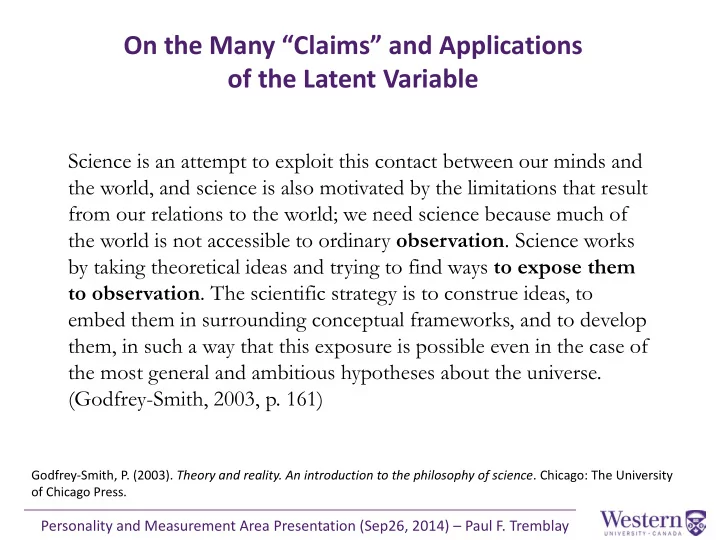
Science is an attempt to exploit this contact between our minds and the world, and science is also motivated by the limitations that result from our relations to the world; we need science because much of the world is not accessible to ordinary observation. Science works by taking theoretical ideas and trying to find ways to expose them to observation. The scientific strategy is to construe ideas, to embed them in surrounding conceptual frameworks, and to develop them, in such a way that this exposure is possible even in the case of the most general and ambitious hypotheses about the universe. (Godfrey-Smith, 2003, p. 161)

Godfrey-Smith, P. (2003). Theory and reality. An introduction to the philosophy of science. Chicago: The University

  • f Chicago Press.
slide-2
SLIDE 2

Thinking about the Latent Variable from Three Perspectives

Personality and Measurement Area Presentation (Sep26, 2014) – Paul F. Tremblay

  • Mathematical model (e.g., SEM, MLM, IRT)
  • Theoretical model
  • Classical test theory (i.e., true-score, reliability)
  • Psychological concepts (e.g., g-intelligence, traits)
  • Construct validity – nomological (stochastological*) networks
  • Philosophical connections
  • Levels/units of analysis
  • Particles, molecules, cells, organ tissues, brain/nervous

system, cognition, personality, social interaction, and culture.

  • Empiricism/positivism, operationalism, naturalism, realism
slide-3
SLIDE 3

Kinds of Mathematical Latent Variables

1. Principal component (not a latent variable) 2. Common factor model 3. Reflective measurement 4. Formative measurement 5. Various SEM (higher-order, bi-factor, MTMM) 6. Latent-class and latent profile analysis 7. IRT 8. Latent variables in longitudinal data (e.g., change) 9. Latent variables in MLM (random and contextual variables)

  • 10. Network analysis of personality (Borsboom et al.)
slide-4
SLIDE 4

Common Factor Model

( ) ( )

2 2

ˆ ˆ ˆ ˆ ˆ ˆ

i i

i X X i ii

λ φ ρ λ φ θ = +

∑ ∑ ∑

In Kline (Raykov, 1997, 2004)

Reliability of Effort = .896 Note arrows going from latent variables to indicators: Reflective measurement with effect indicators

slide-5
SLIDE 5

Formative Measurement

Note arrows going from indicators to latent variable These indicators are referred to as “causal indicators”

Residual (1 – R2)

Bollen, K. A., & Lennox, R. (1991). Conventional wisdom on measurement: A structural equation perspective. Psychological Bulletin, 110, 305–314.

slide-6
SLIDE 6

Other Examples of LVs with Causal Indicators

1. Social Interaction

  • Time spent with family, with friends, with coworkers

2. Quality of Life

  • Health, happiness, economic status

3. SES

  • Education, income, occupational prestige

4. Exposure to discrimination

  • Race, sex, age, disabilities

5. Stress

  • Job loss, divorce, death in family, injury
slide-7
SLIDE 7

Deciding to Use Formative Measurement

  • Causal indicators not necessarily correlated with other

indicators (implications for CTT and Cronbach’s alpha)

  • Effect/reflective indicator can be deleted without changing

meaning of LV, removing a causal indicator can change meaning

  • Imagine a shift in the latent variable: does it lead to a shift

in all indicators? (if yes, then effect/reflective indicators)

  • Alternatively, a shift if one causal indicator would lead to a

shift in the latent variable

  • Vanishing Tetrad test (Bollen)
slide-8
SLIDE 8

Formative Measurement

χ2

(2) = 6.638, p < .05, RMSEA = .083, CFI = .960

slide-9
SLIDE 9

Formative Measurement

slide-10
SLIDE 10

MLM of Diary Data – SEM Approach

Notice the variation in the intercepts and the slopes

slide-11
SLIDE 11

MLM of Diary Data – SEM Approach

Weekly Drink Depress

intercept Slope

WITHIN BETWEEN Slope

2 t

σ

00

τ

00

γ

10

γ

11

τ

10

τ

Trait drinking

01

γ

17.720 0.022* .189 32.614 5.386

  • .054 n.s.

0.007**

slide-12
SLIDE 12

M = -0.119 M = 5.238

Latent Growth Modeling

slide-13
SLIDE 13

LGM MLM

LGM vs. MLM of Longitudinal Data

slide-14
SLIDE 14

Principal Components Analysis

Kline, R. B. (2013). Exploratory and confirmatory factor analysis. In Y. Petscher & C. Schatsschneider (Eds.), Applied quantitative analysis in the social sciences (pp. 171-207). New York: Routledge. (Chap. 6, print proof)