
SLIDE 1
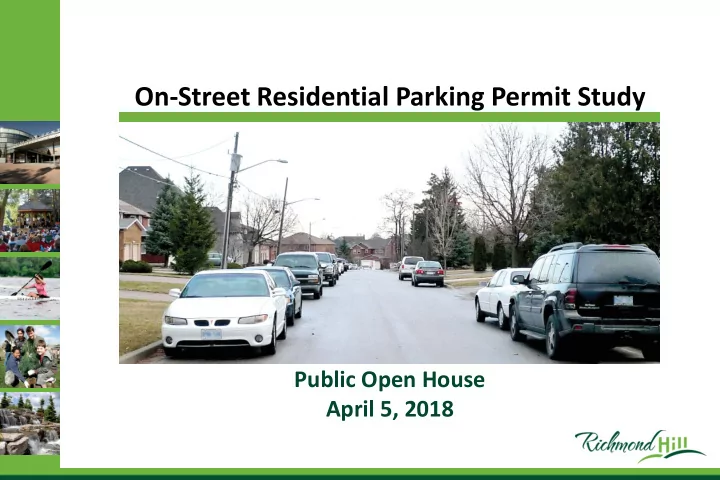
On-Street Residential Parking Permit Study Public Open House April - - PowerPoint PPT Presentation
On-Street Residential Parking Permit Study Public Open House April 5, 2018 PROJECT BACKGROUND Council Direction In Richmond Hill, parking overnight is only allowed if you obtain a temporary 24-hour parking permit. This study was initiated to
In Richmond Hill, parking overnight is only allowed if you obtain a temporary 24-hour parking permit. This study was initiated to consider alternatives for allowing residents to park on-street overnight for longer periods of time. Council directed staff to consider the following items during the study:
►Review existing regulations and Town strategies ►Review best practices of similar municipalities with on-street parking programs ►Assess feasibility of the program on a cost-recovery basis ►Develop a policy for implementing on-street parking
Project Initiation
Dec
Online Survey #1 Public Meeting Online Survey #2
Jan Feb March April May June 2018 2017
Report to Council
Primarily, streets provide for the mobility of people, whether they are pedestrians, cyclists, drivers or transit riders. To do this, streets can include facilities such as: Emergency service vehicles and waste collection vehicles require streets to access our homes in a timely manner, sometimes using larger vehicles. These include:
Streets provide space for buried or overhead infrastructure which provide services like water, gas, and electricity. Streets are sometimes disrupted to maintain and/or upgrade this infrastructure. Public and private infrastructure includes: Streets accommodate other elements that enhance the livability of our
►Sidewalks ►Vehicle travel lanes ►Transit stops ►Bike lanes ►Watermains ►Fire Hydrants ►Sewers (Storm and Sanitary) ►Gas ►Electricity/Street Lighting ►Telephone/Cable ►Ambulance ►Fire Service ►Police ►Waste Collection ►Street Trees/Landscaping ►On-Street Parking for Visitors
There is a program that allows residents to park on street for construction related activities and to accommodate
►Permits 24-hour parking (7 a.m. to 6:59 a.m. the following day) ►Personal vehicles only ►Can be purchased online or in person from Richmond Hill Parking Control ►Permits cost $5 plus HST ►Limit of 25 permits per address per year ►Permits are void on-street during snow events, but alternative locations are provided
The existing Town by-law regulations for on-street parking include the following:
►Overnight parking is not allowed on any street between ►1 a.m. and 7 a.m. from December 1 to March 31 ►3 a.m. and 6 a.m. from April 1 to November 30 ►Parking is limited to 3 hours, except between 5 p.m. and 12 a.m.
The supply of off-street parking directly impacts the demand for on-street parking. Richmond Hill’s off-street parking requirements were reviewed and compared to 13 comparative municipalities. The minimum off-street parking supply for detached homes (below left) and townhouses (below right).
6% 4% 6% 4% 5% 4% 5% 30% 35% 32% 29% 31% 32% 32% 48% 49% 49% 51% 49% 50% 48% 10% 10% 11% 12% 11% 10% 11% 6% 2% 3% 3% 3% 3% 4% 1986 1991 1996 2001 2006 2011 2016
Percent of Households 4+ 3 2 1
65% 70% 70% 70% 67% 68% 69% 15% 14% 16% 17% 17% 17% 14% 15% 13% 11% 10% 12% 12% 12% 6% 3% 3% 3% 4% 3% 5% 1986 1991 1996 2001 2006 2011 2016
Active Transit Auto Passenger Auto Driver
Source: Transportation Tomorrow Survey (TTS) Data 1986-2016 Source: Transportation Tomorrow Survey (TTS) Data 1986-2016
2 2 2 2 1 1 2 1 1 1 2 2 2 1 2 1 2 1 1 2 2 1
Richmond Hill Stouffville Newmarket Milton Aurora Orangeville Caledon Belleville Guelph Toronto Markham Vaughan Burlington Hamilton Oakville Spaces per Unit Resident Secondary Suites
2 2 2 2 1 1 2 1 1 1 2 2 2 1 2
Richmond Hill Stouffville Newmarket Milton Aurora Orangeville Caledon Belleville Guelph Toronto Markham Vaughan Burlington Hamilton Oakville Spaces per Unit Resident
Resident Parking Requirement (Detached Homes) Resident Parking Requirement (Townhouses)
►Temporary permits are available in Toronto, Burlington, Milton, Markham, Vaughan, Oakville and Caledon ►Vaughan does not allow temporary permits to be used on streets with a residential permit program ►In other municipalities, temporary permit holders use the same parking supply as resident parking permits ►All parking spaces are on a first come, first served basis ►Like Richmond Hill, permits in Burlington, Milton, Markham, Vaughan and Oakville are void on-street during snow events
Municipality How are the areas selected? What type of an area is considered? What is the approval threshold? City of Toronto Residents (Petition) Zone or Street 50% + 1 City of Burlington Municipality Zone
Residents (Petition) Street 51% City of Hamilton Residents (Petition) Street 51% City of Markham Municipality Zone
Residents (Petition) Street 66% Town of Oakville Municipality Zone
On a scale of 1 – 5, how do you feel about your car or your neighbours' cars being parked on your street /neighbourhood overnight on a daily basis?
1 - Strongly in Favour 2 - Somewhat in Favour 3 - Neutral 4 - Somewhat Opposed 5 - Strongly Opposed
0% 5% 10% 15% 20% 25% 30% 35%
Would you and/or your family members want the ability to park on-street overnight on a daily basis? If you need on-street parking for daily use, how far are you willing to walk to an on-street parking spot?
0% 10% 20% 30% 40% 50%
No more than 1-2 houses Up to 50m Up to 100m Up to 250m More than 250m
At what level should voting occur?
54% 46%
Yes No
No Yes
37% 29% 31% 2%
My whole neighbourhood My street only My street and neighbouring streets Other (please specify)
My whole neighbourhood My street only My street and neighbouring streets Other
The Town conducted an online survey to request resident feedback regarding on-street parking. Below highlights some of the survey results.
Streets with parking restrictions will be ineligible for
restrictions for on-street parking. The street classification for Richmond Hill is shown in the map below. Municipal highways, arterial streets, or collector streets will be ineligible for on-street residential parking permits.
Town-Wide Ineligibility Review Program Initiation Field Investigation Program Implementation Program Termination
On-street residential parking permits potentially presents conflicts with pedestrians where sidewalk facilities are not present. If a sidewalk is not present, the street segment will not be eligible for on-street parking permits.
Three options were considered to initiate the program. This is the method in which either the Town or residents can request a street be reviewed for parking. Town-Wide Program Town-Selected Streets Grassroots (Resident-Requested)
Description
►On-street parking is permitted
►No temporary or long-term
parking permits required
Pros
►Inexpensive to implement ►No application or approval
process necessary
Cons
►On-street parking permitted for
inappropriate streets (e.g. narrow street, arterial road, etc.)
►Greater potential for parking to
interfere with traffic, winter maintenance, and emergency vehicles
►Encourages automobile use
What method do you prefer used to initiate parking requests?
Description
►Town staff select streets based
►Residents of selected streets are
able to purchase overnight parking permits
Pros
►Provides a defined area ►On-street parking permitted
►No resident application required
Cons
►No input from residents prior to
implementation
►More Town staff resources
necessary for identification of streets
Description
►Residents identify a need for
►Town staff determine eligibility
►Residents of approved streets
are able to purchase overnight parking permits
Pros
►Provides a defined area ►On-street parking permitted
►Responds to localized demand
Cons
►Longer implementation
process/timeline due to resident application process 1 Town-Wide Program RECOMMENDED Town-Wide Ineligibility Review Program Initiation Field Investigation Program Implementation Program Termination 2 Town-Selected Streets 3 Grassroots (Resident Request)
The grassroots approach indicates where there is resident demand for overnight on-street parking. There are two steps to determining this demand.
the engineering review. As part of the resident polls, the Town will determine the appropriate threshold for resident approval.
Town-Wide Ineligibility Review Program Initiation Field Investigation Program Implementation Program Termination
►A minimum response
rate of 25% of households within the area is required
►50%+1 of respondents
must be in favour of the program City of Toronto
►No requirement for a
response rate of households
►51% of households must
be in favour of the program Town of Milton
►No requirement for a
response rate of households
►Two-thirds of households
must be in favour of the program City of Vaughan
►A minimum response
rate of 66% of households within the area is required
►51% of households must
be in favour of the program City of Hamilton
Nearby municipalities were compared for approval thresholds. Some municipalities used two steps for approving a program, first to achieve a minimum response rate and second to meet an approval threshold. Support Oppose No response Minimum Response Rate
Based on the above results, the majority of responses indicated that residents should be in agreement for a program to be implemented. Of those responses, a minimum threshold of 70% agreement was identified.
2% 4% 16% 26% 44% 7%
<30% 40% 50% 60% 70% >80% 0% 10% 20% 30% 40% 50%
Town-Wide Ineligibility Review Program Initiation Field Investigation Program Implementation Program Termination
The Town’s online survey asked for opinions as to whether residents should be required to approve of the program, and what should be the minimum approval threshold.
50% 31% 19%
Yes No Not Sure Online Survey Results: Should residents have to be in favour before introducing on-street parking on your street/neighbourhood? Online Survey Results: What percentage of residents do you think must agree in order to allow on-street parking in your neighbourhood?
Do you agree that at least 70% of residents on a street should have to agree before on-street parking is implemented? Yes, I agree with the 70% threshold No, the threshold should be 50%+1
►The number of households that must respond to the poll for the program to be approved
To implement the on-street residential permit parking program, the following response criteria must be met:
►Response from the majority of dwellings (50% +1 dwelling) ►Approval from 70% of respondents
The benefit of including a minimum sample size is ensuring thatCase Study: A street with 30 addresses is under review
►Response rate: Must have at least 16 addresses (50%+1) vote ►Approval rate: At least 70% of the votes must be supportive
Town-Wide Ineligibility Review Program Initiation Field Investigation Program Implementation Program Termination
Support Oppose No response Minimum Response Rate
Response 1 – Did not meet response rate
Should the Town require a minimum response rate? Yes, the Town should require 50%+1 responses and 70% of respondents must approve No, the town should just require a minimum approval threshold of 70%
Response 2 – Respondents support but did not meet response rate Response 3 – Met response rate but did not meet approval rate Response 4 – Both response and approval rates are met, approved for engineering review
Potential Responses:
If there are any modifications to the street after an on-street parking permit program is implemented, staff will consider if the program continues to be appropriate for the street. Some examples of modifications that could affect continued eligibility include:
►New transit routes or facilities ►New cycling facilities ►Increase in traffic volumes
If residents approve, the Town will conduct a detailed review to determine if the street is appropriate for an on-street residential parking permit program. The Town will consider various elements including:
►Geometric design of the roadway ►Conflicts with other roadworks ►Potential parking capacity ►Operations and traffic impacts ►Impacts to Emergency Services
Town-Wide Ineligibility Review Program Initiation Field Investigation Program Implementation Program Termination
If the program is implemented, additional signage will be placed to indicate the restrictions. The restrictions will include:
►Permit parking restricted to one-side of the street ►No Parking signs will be placed on the opposite side of the street
Temporary parking permits may still be available for the street. Provide your opinion on how you would like to see temporary permits accommodated below. Shall priority be given to on-street residential parking permits holders, removing ability for temporary or visitor permits to park on-street overnight? Town-Wide Ineligibility Review Program Initiation Field Investigation Program Implementation Program Termination Daytime Overnight – Option 1 Overnight – Option 2
Resident Permit Temporary Permit Other Existing on-street parking regulations apply Only resident permits are permitted All permits would be accommodated
Parking should be only for residential permits (Option 1) Parking should be available for both permits (Option 2)
Pros: Ensures residents with permits have spaces Cons: Displaces visitors to other streets Pros: Visitors can be accommodated Cons: Reduces supply available for residents
Town-Wide Ineligibility Review
►Town conducts review for key criteria ►Provides a quick reference for residents before they collect signatures from their neighbours
Program Initiation (Grassroots Request)
►Residents can request parking by collecting signatures in support of on-street parking ►On-street parking will only be implemented if there is enough interest from residents ►The Town will confirm the level of support through a confidential questionnaire
Field Investigation
►After receiving resident support, Town staff will conduct a field investigation ►The investigation will determine if the street is appropriate for on-street parking ►Town staff will consider engineering, planning, operations/maintenance and emergency services
Program Implementation The residential parking permit program may include the following:
►No overnight parking except by permit on one side of the street ►“No Parking” signs installed on the other side of the street
Program Termination
►After implementation, the program can be terminated by the Town, should the street change
and the program become in conflict with other initiatives or improvements
►Program can also be terminated at the request of the residents of the street by a majority vote
The introduction of an on-street parking permit program may change how winter maintenance activities occur, including:
►Restrictions to snow plow routes ►No longer providing curb-to-curb snow clearance ►No longer providing windrow services for seniors
The level of maintenance provided by the Town could impact the fee for parking permits. Provide your opinion on how you would like to see winter maintenance occur below.
Overnight on-street parking will impact current roadway snow clearing
reduced level of maintenance on the roadway to minimize additional costs?
Yes, I would prefer lower costs for permits No, I would prefer higher level of snow clearance Limited snow clearance Curb-to-curb clearance Pros
►Maintains street
clearing using existing plowing program Cons
►Vehicles may have
difficulty moving their vehicles due to snow Pros
►Plows return to clear snow
after cars have been moved
►Allows time for residents to
move their cars, while maintaining the street Cons
►Significant increase in labour ►No guarantee that the cars
will be removed for the second pass
Description
►Main corridor of street is
plowed, leaving snow piles along parked cars Description
►Full street width is
cleared in two passes, requiring vehicles to be moved Would you accept a lower level of snow clearance to reduce the cost of the permits?
HIGH LOW
The considerations for cost of the permit fee is based on the cost of implementation, which can be divided into three areas:
►Includes staff time to process applications and conduct field investigations 2. Implementation (ranges from 70-80% of total cost) ►Includes sign installation, equipment, and system to issue permits 3. Operating (ranges from 15-20% of total cost) ►Includes issuing the permits, as well as additional maintenance and enforcement costs
►The cost can be recovered by: ►Upfront fees (i.e. application
►Monthly permit fee ►A combination of the above
Upfront Fee Monthly Fee Combination Municipality Annual Permit Fee City of Toronto $185.28 - $649.44 City of Burlington $350 City of Hamilton $85.84 City of Markham $360 - $600 Town of Oakville $600 Town of Richmond Hill (Ransom Parkette) $170 City of Vaughan $624
What is your preferred method of cost recovery?
After the public meeting, staff will conduct the following next steps.
►Undertake second online survey (April 6 to April 22) ►Review survey results and public feedback and finalize the program ►Determine the financial implications of the program and recommend a fee ►Present a final report for Council approval
Please provide your feedback and comments on the study and program
►Comment forms available below ►Please take our online survey at: ► Richmondhill.ca/parking