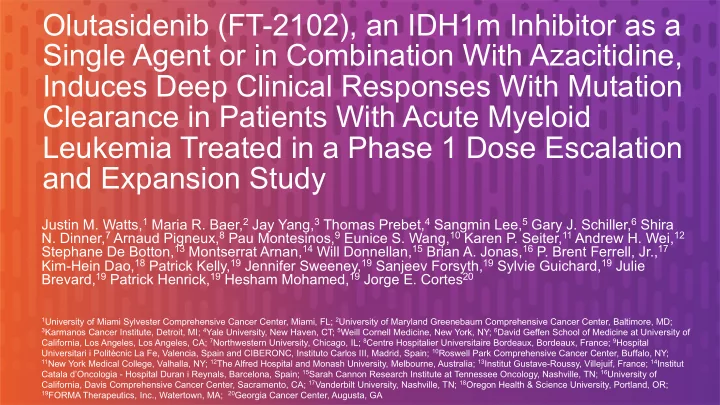
Olutasidenib (FT-2102), an IDH1m Inhibitor as a Single Agent or in - - PowerPoint PPT Presentation

olutasidenib ft 2102 an idh1m inhibitor as a single agent
SMART_READER_LITE
LIVE PREVIEW

Olutasidenib (FT-2102), an IDH1m Inhibitor as a Single Agent or in - - PowerPoint PPT Presentation

Olutasidenib (FT-2102), an IDH1m Inhibitor as a Single Agent or in Combination With Azacitidine, Induces Deep Clinical Responses With Mutation Clearance in Patients With Acute Myeloid Leukemia Treated in a Phase 1 Dose Escalation and Expansion


slide-1
SLIDE 1

Olutasidenib (FT-2102), an IDH1m Inhibitor as a Single Agent or in Combination With Azacitidine, Induces Deep Clinical Responses With Mutation Clearance in Patients With Acute Myeloid Leukemia Treated in a Phase 1 Dose Escalation and Expansion Study

Justin M. Watts,1 Maria R. Baer,2 Jay Yang,3 Thomas Prebet,4 Sangmin Lee,5 Gary J. Schiller,6 Shira

  • N. Dinner,7 Arnaud Pigneux,8 Pau Montesinos,9 Eunice S. Wang,10 Karen P. Seiter,11 Andrew H. Wei,12

Stephane De Botton,13 Montserrat Arnan,14 Will Donnellan,15 Brian A. Jonas,16 P. Brent Ferrell, Jr.,17 Kim-Hein Dao,18 Patrick Kelly,19 Jennifer Sweeney,19 Sanjeev Forsyth,19 Sylvie Guichard,19 Julie Brevard,19 Patrick Henrick,19 Hesham Mohamed,19 Jorge E. Cortes20

1University of Miami Sylvester Comprehensive Cancer Center, Miami, FL; 2University of Maryland Greenebaum Comprehensive Cancer Center, Baltimore, MD; 3Karmanos Cancer Institute, Detroit, MI; 4Yale University, New Haven, CT; 5Weill Cornell Medicine, New York, NY; 6David Geffen School of Medicine at University of

California, Los Angeles, Los Angeles, CA; 7Northwestern University, Chicago, IL; 8Centre Hospitalier Universitaire Bordeaux, Bordeaux, France; 9Hospital Universitari i Politècnic La Fe, Valencia, Spain and CIBERONC, Instituto Carlos III, Madrid, Spain; 10Roswell Park Comprehensive Cancer Center, Buffalo, NY;

11New York Medical College, Valhalla, NY; 12The Alfred Hospital and Monash University, Melbourne, Australia; 13Institut Gustave-Roussy, Villejuif, France; 14Institut

Catala d’Oncologia - Hospital Duran i Reynals, Barcelona, Spain; 15Sarah Cannon Research Institute at Tennessee Oncology, Nashville, TN; 16University of California, Davis Comprehensive Cancer Center, Sacramento, CA; 17Vanderbilt University, Nashville, TN; 18Oregon Health & Science University, Portland, OR;

19FORMA Therapeutics, Inc., Watertown, MA; 20Georgia Cancer Center, Augusta, GA

1

slide-2
SLIDE 2
  • IDH1 mutations occur in 7-14% of patients with AML and approximately 3-5% of

patients with MDS

  • Olutasidenib (FT-2102) is a highly potent, orally active, selective inhibitor of IDH1m

Introduction

Olutasidenib (FT-2102)

slide-3
SLIDE 3

Study Design

Key Inclusion Criteria Dose Expansion (RP2D) Dose Escalation

Combination therapy Monotherapy

  • AML or intermediate to very

high risk MDS with IDH1- R132 gene mutation

  • Relapsed/refractory (R/R)
  • Treatment naive (TN)

where standard therapy is contraindicated

  • Adequate cardiac, renal,

and hepatic function

  • ECOG PS 0-2
  • Prior IDH1 inhibitors,

allowed in the combination arm

Phase 1

R/R Olutasideniba 150 mg BID Olutasideniba 150 mg QD 300 mg QD 150 mg BID TN Olutasideniba 150 mg BID + AZAb 75 mg/m2 R/R Olutasideniba 150 mg BID + AZAb 75 mg/m2 Olutasideniba 150 mg QD 150 mg BID + AZAb 75 mg/m2 Primary

  • Safety and tolerability

Secondary/Exploratory

  • Antileukemic activity
  • Anti-MDS activity
  • PK
  • Biomarkers

Objectives

a Olutasidenib PO given daily over continuous 28-day cycles. b AZA IV or SC given daily on Days 1-7 of each 28-day cycle.

FPFV = September 1, 2016 ; Data Cutoff = September 12, 2019

Results of MDS cohort presented in Session 637, Monday, December 9 Abstract # 674

slide-4
SLIDE 4

Demographics and Disease Characteristics

Characteristic Olutasidenib (N = 32) Olutasidenib + AZA (N = 46) Age, median (range), years 72 (35-87) 67 (31-88) Female 16 (50) 24 (52) ECOG PS - 0 / 1 / 2, % 28/50/22 28/57/15 AML, n 26 39 Primary AML (de novo) 21 (81) 23 (59) Secondary AML 5 (19) 16 (41) Disease state TN (newly diagnosed) 4 (15) 13 (33) Relapsed 14 (54) 11 (28) Refractory 8 (31) 15 (39) Cytogenetic Risk, n Intermediate 9 22 Poor/Unknown 7/10 8/9 Prior regimens, median (range)a 2 (0-9) 2 (0-6) HMA (azacitidine/decitabine), n 12 10 IDH1m inhibitor, n 3 HSCT, n 2 3 Intensive Chemotherapy, n 17 23 MDS, n 6 7 TN (newly diagnosed) 2 (33) 5 (71) Relapsed/Refractory 4 (67) 2 (29) Prior regimens, median (range)a 1 (0-4) 0 (0-4) HMA (azacitidine/decitabine), n 4 2

All values n (%) unless otherwise specified. aNot inclusive of all types; patient could have received more than one type

slide-5
SLIDE 5

Patient Disposition

Characteristic Olutasidenib (N = 32) Olutasidenib + AZA (N = 46) Treatment ongoing, n (%) 3 (9) 10 (22) Discontinued from study treatment, n (%) 29 (91) 36 (78) Transplant (HSCT) 4 (13) 10 (22) Disease progression 12 (38) 11 (24) Investigator decision 1 (3) 5 (11) Permanent withdrawal of consent 1 (3) Death 5 (16) 4 (9) Adverse event 3 (9) 3 (7) Othera 3 (9) 3 (7) Median time on treatment, months 4.2 4.7

aOther reasons include lack of response (for monotherapy and combination therapy groups); entering hospice, and alternative treatments (for

combination therapy group)

slide-6
SLIDE 6

Nonhematologic TEAEs (> 20%) Regardless of Causality

TEAE, n (%) Olutasidenib (N = 32) Olutasidenib + AZA (N = 46) Any Grade Grade 3-4 Any Grade Grade 3-4 Nausea 15 (47) 32 (70) 4 (9) Fatigue 14 (44) 2 (6) 18 (39) 8 (17) Pyrexia 11 (34) 2 (6) 11 (24) Diarrhea 8 (25) 1 (3) 21 (46) 2 (4) Pneumonia 8 (25) 5 (16) 8 (17) 5 (11) Vomiting 8 (25) 17 (37) 1 (2) Constipation 7 (22) 1 (3) 27 (59) 1 (2) Decreased appetite 7 (22) 11 (24) 1 (2) Dizziness 7 (22) 1 (3) 11 (24) 1 (2) Dyspnea 7 (22) 14 (30) 1 (2) Hypokalemia 7 (22) 2 (6) 16 (35) 3 (7) Headache 6 (19) 15 (33) 1 (2) Cough 5 (16) 18 (39) 1 (2) Hypertension 4 (13) 3 (9) 10 (22) 8 (17) Peripheral edema 2 (6) 10 (22) Abdominal pain 1 (3) 10 (22) 1 (2) Asthenia 1 (3) 11 (24) 2 (4)

slide-7
SLIDE 7

Hematologic TEAEs (> 20%) Regardless of Causality

TEAE, n (%) Olutasidenib (N = 32) Olutasidenib + AZA (N = 46) Any Grade Grade 3-4 Any Grade Grade 3-4 Thrombocytopenia 9 (28) 9 (28) 21 (46) 19 (41) Neutropenia 3 (9) 2 (6) 14 (30) 13 (28) Leukocytosis 7 (22) 4 (13) 12 (26) 7 (15) Anemia 7 (22) 7 (22) 11 (24) 9 (20) Febrile neutropenia 7 (22) 7 (22) 15 (33) 13 (28)

slide-8
SLIDE 8
  • No DLTs observed in the dose escalation cohorts
  • IDH differentiation syndrome (IDH-DS)
  • 4 monotherapy patients (13%; grade 3, 3; grade 2, 1) and 6 combination therapy patients (13%;

grade 3, 3; grade 2, 1; grade 1, 2) experienced an IDH-DS AE

  • Most (7) were observed during cycle 1 (2 in cycle 2 and 1 in cycle 5)
  • All cases resolved with treatment interruption/reduction, dexamethasone, and/or supportive
  • treatment. No recurrences.
  • 2 of 4 monotherapy patients and 5 of 6 combination therapy patients achieved a response
  • QT prolongation
  • 3 combination therapy patients (7%) were reported to have QT prolongation; all events were

transient, and patients resumed treatment with no recurrences

  • Liver
  • 5 of 32 patients in monotherapy and 5 of 46 patients in combination therapy had grade ≥ 3 LFT

(ALT, AST, TB) abnormalities

  • 2 patients (1 monotherapy and 1 combination therapy) discontinued treatment due to these

events

DLTs and AEs of Special Interest

slide-9
SLIDE 9

Clinical Response in Patients With AML

T T T T 10 20 30 50 70 80 140 160 170

Weeks on Study

40 60 130 150 T T T T T T T T 10 20 30 50 70 80 100 110 120

Weeks on Study

40 60 90

CR/CRh PD MLFS CRi SD NE/ND First response Continuing on study Transplant T

Combination Therapy Monotherapy

Response, n (%) R/R (n=22) TN (n=4) ORR 9 (41) 1 (25) CR 4 (18) CRh 3 (14) CRi/MLFS 2 (9) 1 (25) SD 2 (9) 2 (50) Response, n (%) R/R (n=26) TN (n=13) ORR 12 (46) 10 (77) CR 3 (12) 7 (54) CRh 1 (4) CRi/MLFS 8 (31) 3 (23) SD 9 (35) 2 (15)

slide-10
SLIDE 10

Survival in AML

Time (weeks) Survival Probability 1.0 0.8 0.4 0.2 0.0 20 40 60 80 100 120 140 160 180

  • No. of Subjects at Risk

0.6 Censored Olutasidenib Monotherapy – R/R Olutasidenib + AZA Combination – R/R Median OS (95% CI), weeks Monotherapy (R/R) 37.7 (10.7 - NR) Combination (R/R) 52.6 (18.3 - NR) Combination (TN) NR (41.6 - NR) 22 13 10 3 1 1 1 1 1 Monotherapy (R/R) 26 16 11 6 Combination (R/R) 13 11 10 5 3 Combination (TN) Olutasidenib + AZA Combination – TN

slide-11
SLIDE 11
  • Of the 59 patients with AML with both local and central IDH1m results, central testing confirmed the

presence of IDH1m at study entry in 56 (95%) of patients

  • 57 of 59 patients (97%) had ≥ 1 co-mutation and 23 of 59 patients (39%) had ≥ 3 co-mutations

Mutational Analysis of AML Patients

IDH1 Variants (Central Determination) Co-mutations Frequency (Central Determination)

IDH1-R132L 1 (2%) IDH1-R132G 3 (5%) IDH1-R132S 8 (14%) IDH1-R132H 16 (29%) IDH1-R132C 28 (50%) 60 50 40 30 20 10

Patients with Mutation (%) DNMT3A NPM1 SRSF2 NRAS RUNX1 ASXL1 FLT3 STAG2 IDH2 TET2 SMC1A SF3B1 U2AF1 PHF6 JAK2 MPL NF1 ASXL2 BCOR EED WT1 CBL CSF3R ETNK1 PTPN11 ATM TP53

slide-12
SLIDE 12
  • 25 patients achieving a clinical response had available longitudinal samples for analysis

(VAF at ≥ cycle 3)

  • IDH1 mutation clearance/significant reduction (VAF to < 1%) is observed in 10 of 25 patients (40%)

with an IWG response to olutasidenib

IWG, international working group; VAF, variant allele frequency

IDH1 Mutation Clearance in AML

Reduction of IDH1 VAF in Patients with Clinical Response

40

IDH1 VAF (%)

35 30 25 20 15 10 5 2 4 6 8 10 12 14 16 18 20 22 24

Cycle

Responders Stable Disease Clearance,% 40 50 Patients with clearance, n 10 3 Total patients, n 25 6

Patients included are those showing clinical response or SD and had both pre- and post-treatment peripheral blood samples available. Clearance was defined as IDH1m VAF < 1% by ddPCR.

slide-13
SLIDE 13
  • Olutasidenib is well tolerated as monotherapy and in combination with AZA
  • No DLTs in dose escalation; 150 mg BID is the RP2D based on optimal exposure

and robust 2-HG response

  • Olutasidenib demonstrates clinical activity in a high-risk Phase 1 AML population
  • Olutasidenib induces IDH1 mutation clearance in patients with TN and R/R AML

regardless of IWG response

  • Phase 2 studies are ongoing with olutasidenib 150 mg BID as monotherapy and in

combination with AZA in multiple IDH1m AML/MDS populations

Conclusions

slide-14
SLIDE 14
  • The authors thank the patients and their families for participation in the study
  • This study was funded by FORMA Therapeutics, Inc., Watertown, MA
  • Olutasidenib (FT-2102) is an investigational drug; no efficacy or safety claim is intended or implied
  • Medical writing and editorial assistance was provided by Alex Loeb, PhD, of Chrysalis Medical

Communications, Hamilton, NJ

Acknowledgments