Novartis benchmarking initiative: making sense of AI Mark Baillie - - PDF document

novartis benchmarking initiative making sense of ai
SMART_READER_LITE
LIVE PREVIEW

Novartis benchmarking initiative: making sense of AI Mark Baillie - - PDF document

10/29/2019 AMDS Clinical Development and Analytics Novartis benchmarking initiative: making sense of AI Mark Baillie (with Conor Moloney & Janice Branson) BBS, Basel November 01, 2019


slide-1
SLIDE 1

10/29/2019 1

Novartis benchmarking initiative: making sense of AI

Mark Baillie (with Conor Moloney & Janice Branson) BBS, Basel November 01, 2019

AMDS Clinical Development and Analytics

2

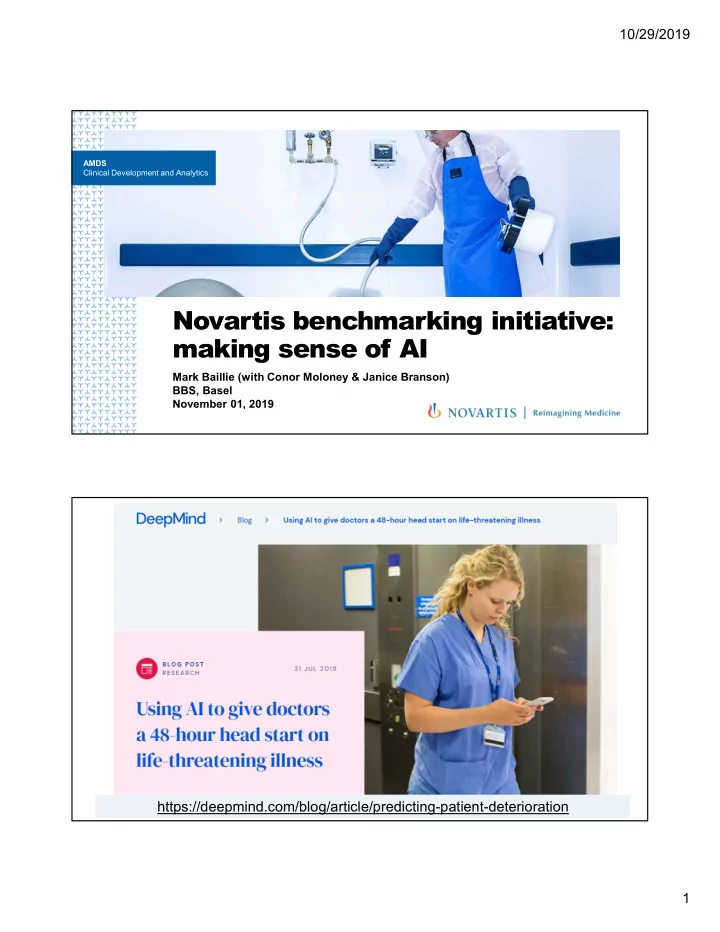
https://deepmind.com/blog/article/predicting-patient-deterioration

slide-2
SLIDE 2

10/29/2019 2

3

https://www.bbc.com/news/health-49178891

4

https://www.medicaldevice-network.com/news/dataart-launches-skincareai-app/

slide-3
SLIDE 3

10/29/2019 3

How do we know it works?

6

https://www.bmj.com/content/366/bmj.l5011/rr

slide-4
SLIDE 4

10/29/2019 4 https://jamanetwork.com/journals/jamadermatology/fullarticle/2740808

slide-5
SLIDE 5

10/29/2019 5

How do we know it works?

https://techburst.io/ai-in-healthcare-industry-landscape-c433829b320c

How do we systematically evaluate?

  • A standard process for benchmarking:

– Common task framework – Reporting guidelines

  • This process aims to:

– evaluate and compare «innovtation» on relevant tasks – de-risk engagement – reduce internal resources for evaluation

slide-6
SLIDE 6

10/29/2019 6

Why benchmarking?

  • Machine learning, statistical learning, AI, etc. are experimental fields
  • Most new methodological improvements are assessed using standard

benchmark datasets – “the common task framework”

  • Using tasks and benchmarks developed at Novartis will enable us to better

understand claims on effectiveness

  • There is also a real need to develop new benchmarks which reflect real world

problems in the biomedical space to advance understanding.

Common task framework

12

Common task Shared data Standard evaluation

https://www.tandfonline.com/doi/full/10.1080/10618600.2017.1384734

slide-7
SLIDE 7

10/29/2019 7

Common task framework

13

https://trec.nist.gov/

Common task framework

14

http://www.image-net.org/

slide-8
SLIDE 8

10/29/2019 8

Common task framework

https://precision.fda.gov

Common task framework

16

https://arxiv.org/abs/1707.02641

slide-9
SLIDE 9

10/29/2019 9

17

An approximate answer to the right question is worth a great deal more than a precise answer to the wrong question.

  • John Tukey

https://projecteuclid.org/download/pdf_1/euclid.aoms/1177704711

Reporting guidelines

18

https://www.equator-network.org/reporting-guidelines/

slide-10
SLIDE 10

10/29/2019 10

Reporting guidelines

19

https://www.tripod-statement.org/

Why reporting guidelines such as TRIPOD?

  • TRIPOD is an evidence-based, minimum set of recommendations for reporting prediction

modeling studies in biomedical sciences.

  • TRIPOD is part of a wider set of guidelines under the https://www.equator-network.org/

including CONSORT for clinical trials

  • TRIPOD includes both prognostic and diagnostic prediction models as well as prediction

model development, validation, updating or extending studies (i.e. the core of AI/ML).

  • TRIPOD offers a standard way for reporting the results of prediction modeling studies and

thus aiding their critical appraisal, interpretation and uptake by potential users.

  • TRIPOD and other related reporting guidelines have been adopted by many top tier scientific

journals
slide-11
SLIDE 11

10/29/2019 11

Task-based benchmarking

Task

  • Tasks reflect real project team requirements i.e. identify super-

responders patients with known signatures Data

  • Provide benchmark(s) mirroring real Novartis data i.e. clinical trials
  • Participants are free to use publically available data to augment

analyses (i.e. through knowledge graphs or other propriety held data) Evaluation

  • Objective evaluation based on the benchmark (e.g predictive accuracy)
  • Quality of reporting (i.e. description of methods, decision rules,

plausibility, and recommendations) leveraging reporting guidelines

Summarize and document recommedation and socialise for internal use

What is a task?

22

task noun \ ˈtask \

  • : a usually assigned piece of work often to be finished within a certain time
  • : something hard or unpleasant that has to be done

https://www.merriam-webster.com/dictionary/task

slide-12
SLIDE 12

10/29/2019 12

What is a task?

We ask you to explore the Data with the aim of identifying a signal to predict patients who will respond (as defined by the clinical outcomes) prior to treatment.

What is a task?

  • Novartis intends to explore new and complementary drug discovery and

development opportunities applying state-of-the-art clinical data science and big data analytics across their portfolio.

  • As a pilot and proof-of-value case, Novartis wants to un-tap the commercial

potential around one of its key assets by generating new insights from existing

  • data. By combining existing clinical trial data with additional data across all

disease states to explore scientific questions such as predictors of therapeutic response, and potential additional indications that NOVARTIS compound could be applied to.

  • The ultimate aim is to move towards precision medicine targeting the right

patients with the right drug at the right time.

24

slide-13
SLIDE 13

10/29/2019 13

Example Benchmark Data

An example (secure) transfer to participants:

  • Two phase 3 studies

– 2,000 randomized patients – 180 clinical and genetic predictors (anonymized) – 5 clinical outcomes (endpoints)

  • Additional supporting materials to provide context

– Data dictionary – Data specifications – Trial manuscripts

25

Evaluation is task dependent

26

slide-14
SLIDE 14

10/29/2019 14

Evaluation is task dependent

Challenge issuance Transfer data Q&A call Challenge Report and Evaluation Debrief

Putting it all together

  • We have been evaluating the approach as a proof of concept

– Issue issuance document with detailed information on challenge – Transfer data through secured service on receipt of signed document – Set up introductory call – Participant submits a short report documenting solution – Evaluation primarily based on the TRIPOD guidelines – Debrief call

slide-15
SLIDE 15

10/29/2019 15

Progress and learnings so far

  • Learnings
  • Black boxes
  • Synthetic data
slide-16
SLIDE 16

10/29/2019 16

Black boxes?

  • The advantage of benchmarking is that we define the task and the evaluation approach,

therefore allowing us to assess the output of any black box

  • Using synthetic data, we can set up tests to assess when a black box approach works or

potentially fails

  • Part of the assessment is to identify if the vendor is open to sharing methodological and

implementation details about their approach

  • Hiding algorithmic details for specific tasks such as disease progression is also considered

unethical by many in the scientific community https://academic.oup.com/jamia/advance- article/doi/10.1093/jamia/ocz130/5542900

  • Identifying early on a vendor approach to sharing information will help guide teams on future

engagement and to ameliorate potential risks

Black boxes?

https://academic.oup.com/jamia/advance-article/doi/10.1093/jamia/ocz130/5542900

slide-17
SLIDE 17

10/29/2019 17

Black boxes?

Business Use Only 33

https://www.thelancet.com/journals/lancet/article/PIIS0140-6736(19)30037-6/fulltext

Synthetic data

  • Synthetic data is generated from real data, is not real data but has the same

statistical properties.

  • Synthetic data is generated using (statistical machine learning and deep learning)

models from real data sampling pseudo patients from these models.

  • Because it is not real data, it will not have the same privacy risks as real data. We

can explicitly test that assumption.

  • We can also introduce artificial signals (plasmode simulation) for the purpose of

evaluation e.g. we introduce which patients will respond to a drug and why.

  • We have developed this internally for the initial project.
slide-18
SLIDE 18

10/29/2019 18

Next steps: scaling up

  • We have tested this approach, the next step is to scale up:

– across the wider organization (i.e. all development units, countries, etc.) – develop a centralized knowledge base accessible across Novartis of all ongoing and completed engagements – company-wide disseminate of findings – company-wide coordination to avoid rework or duplication of effort

  • Develop new challenges that will enable us to better understand claims on

effectiveness

  • Develop a plan to proactively engage scientifically community on methodology

research

– There is also a real need to develop new benchmarks which reflect real world

slide-19
SLIDE 19

10/29/2019 19 https://www.bbc.com/news/uk-scotland-edinburgh-east-fife-50139540

It’s not innovative if it doesn't work

slide-20
SLIDE 20

10/29/2019 20

Thank you

Mark Baillie (with Conor Moloney & Janice Branson) BBS, Basel November 01, 2019

AMDS Clinical Development and Analytics