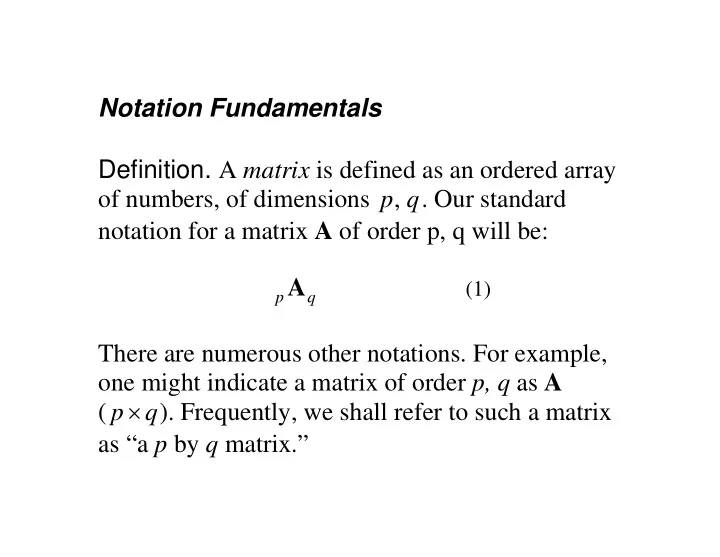
SLIDE 1 Notation Fundamentals
- Definition. A matrix is defined as an ordered array
- f numbers, of dimensions ,
p q. Our standard notation for a matrix A of order p, q will be:
p q
A
(1)
There are numerous other notations. For example,
- ne might indicate a matrix of order p, q as A
( p q × ). Frequently, we shall refer to such a matrix as “a p by q matrix.”
SLIDE 2
On occasion, we shall refer explicitly to the elements of a matrix (i.e., the numbers or random variables in the array). In this case, we use the following notation to indicate that A is a matrix with elements
ij
a .
{ }
ij
a = A (2)
SLIDE 3
11 12 13 1 21 22 23 2 31 32 33 3 1 2 3 q q q p p p pq
a a a a a a a a a a a a a a a a ⎡ ⎤ ⎢ ⎥ ⎢ ⎥ ⎢ ⎥ = ⎢ ⎥ ⎢ ⎥ ⎢ ⎥ ⎣ ⎦ A
SLIDE 4
Definition A column vector of numbers or random variables is a matrix of order 1 p× . We will, in general, indicate column vectors with the following notation:
1 pa
(3)
SLIDE 5
Definition A row vector of numbers or random variables is a matrix of order 1 q × . We will, in general, indicate row vectors with the following notation:
1 q
′ a (4) An common alternate notation is
T 1 q
a (5) A column vector with all elements equal to one will be symbolized as 1.
SLIDE 6
Special Matrices We will refer occasionally to special types of matrices by name. For any p
q
A , If p q ≠ , A is a rectangular matrix. If p q = , A is a square matrix. In a square matrix, the elements ii a , 1, i p = define the diagonal of the matrix. A square matrix is lower triangular if
ij
a = for i j < .
SLIDE 7
A square matrix is upper triangular if
ij
a = for i j > . A square matrix is a diagonal matrix if
ij
a = for i j ≠ A square matrix is a scalar matrix if it is a diagonal matrix and all diagonal elements are equal.
SLIDE 8
An identity matrix is a scalar matrix with diagonal elements equal to one. We use the notation
p
I to denote a p p × identity matrix. 0, a matrix composed entirely of zeros, is called a null matrix. A square matrix is symmetric if
ij ji
a a = for all i, j A 1 1 × matrix is a scalar.
SLIDE 9
Example Some examples follow: A rectangular matrix 1 2 3 4 5 6 7 8 ⎡ ⎤ ⎢ ⎥ ⎣ ⎦ A square matrix 1 2 3 4 ⎡ ⎤ ⎢ ⎥ ⎣ ⎦
SLIDE 10
A lower triangular matrix 1 2 3 4 5 6 7 8 9 10 ⎡ ⎤ ⎢ ⎥ ⎢ ⎥ ⎢ ⎥ ⎢ ⎥ ⎣ ⎦
SLIDE 11
An upper triangular matrix 1 2 3 4 5 6 7 8 9 10 ⎡ ⎤ ⎢ ⎥ ⎢ ⎥ ⎢ ⎥ ⎢ ⎥ ⎣ ⎦
SLIDE 12
A diagonal matrix 1 2 7 ⎡ ⎤ ⎢ ⎥ ⎢ ⎥ ⎢ ⎥ ⎣ ⎦ A scalar matrix 2 2 2 ⎡ ⎤ ⎢ ⎥ ⎢ ⎥ ⎢ ⎥ ⎣ ⎦
SLIDE 13
A symmetric matrix 1 2 3 2 2 4 3 4 2 ⎡ ⎤ ⎢ ⎥ ⎢ ⎥ ⎢ ⎥ ⎣ ⎦
SLIDE 14 Some Matrix Operations
In this section, we review the fundamental
Matrix (and Vector) Addition and Subtraction For the addition and subtraction operations to be defined for two matrices A, B, they must be conformable.
SLIDE 15
Definition (Conformability for Addition and Subtraction). Two matrices are conformable for addition and subtraction if and only if they are of the same order. Definition (Matrix Addition and Subtraction). Let
{ }
ij
a = A and
{ }
ij
b = B be two matrices that are conformable for addition. The sum = + C A B is defined as:
{ } { }
ij ij ij
c a b = + = = + C A B (6)
SLIDE 16 The difference = − D A B is defined as
{ } { }
ij ij ij
d a b = − = = − D A B (7)
- Comment. Matrix addition and subtraction are
natural, intuitive extensions to scalar addition and
- subtraction. One simply adds elements in the same
position.
SLIDE 17
Example Let 1 4 5 2 3 4 4 4 A ⎡ ⎤ ⎢ ⎥ = ⎢ ⎥ ⎢ ⎥ ⎣ ⎦ and 3 2 1 2 3 1 1 3 2 ⎡ ⎤ ⎢ ⎥ = ⎢ ⎥ ⎢ ⎥ ⎣ ⎦ B . Find = + C A B and = − D A B . Solution. 4 6 6 4 6 5 5 7 2 ⎡ ⎤ ⎢ ⎥ = ⎢ ⎥ ⎢ ⎥ ⎣ ⎦ C , 2 2 4 3 3 1 2 − ⎡ ⎤ ⎢ ⎥ = ⎢ ⎥ − ⎢ ⎥ ⎣ ⎦ D
SLIDE 18 Definition (Matrix Equality). Two matrices are equal if and only if they are of the same row and column order, and have all elements equal. Matrix addition has some important mathematical properties, which, fortunately, mimic those of scalar addition and subtraction. Consequently, there is little “negative transfer” involved in generalizing from the scalar to the matrix
SLIDE 19
For matrices A, B, and C, properties include: Associativity
( ) ( )
+ + = + + A B C A B C (8) Commutativity + = + A B B A (9)
SLIDE 20 Scalar Multiples and Scalar Products In the previous section, we examined some matrix
- perations, addition and subtraction, that operate
very much like their scalar algebraic counterparts. In this section, we begin to see a divergence between matrix algebra and scalar algebra. Definition (Scalar Multiple). Given a matrix
{ }
ij
a = A , and a scalar c. Then
{ }
ij
c ca = = B A is called a scalar multiple of A.
SLIDE 21
- Comment. Scalar multiples are not to be confused
with scalar products, which will be defined
- subsequently. Scalar multiplication is a simple idea
- -- multiply a matrix by a scalar, and you simply
multiply every element of the matrix by the scalar.
2 1 3 4 − ⎡ ⎤ = ⎢ ⎥ ⎣ ⎦ A . Then 4 2 2 6 8 − ⎡ ⎤ = ⎢ ⎥ ⎣ ⎦ A .
SLIDE 22
For matrices A and B, and scalars aand b, scalar multiplication has the following mathematical properties: ( ) a b a b + = + A A A
( )
a a a + = + A B A B
( ) ( )
a b ab = A A a a = A A
SLIDE 23
Definition (Scalar Product). Given row vector
1 p
′ a and
1 pb . Let
{ }
i
a ′ = a and
{ }
i
b = b . The scalar product ′ a b is defined as
1 p i i i
a b
=
′ =∑ a b (10) Note: This is simply the sum of cross products of the elements of the two vectors.
SLIDE 24
Example Let
[ ]
1 2 3 ′ = a . Let 4 2 1 ⎡ ⎤ ⎢ ⎥ = ⎢ ⎥ ⎢ ⎥ ⎣ ⎦ b . Then 11 ′ = a b .