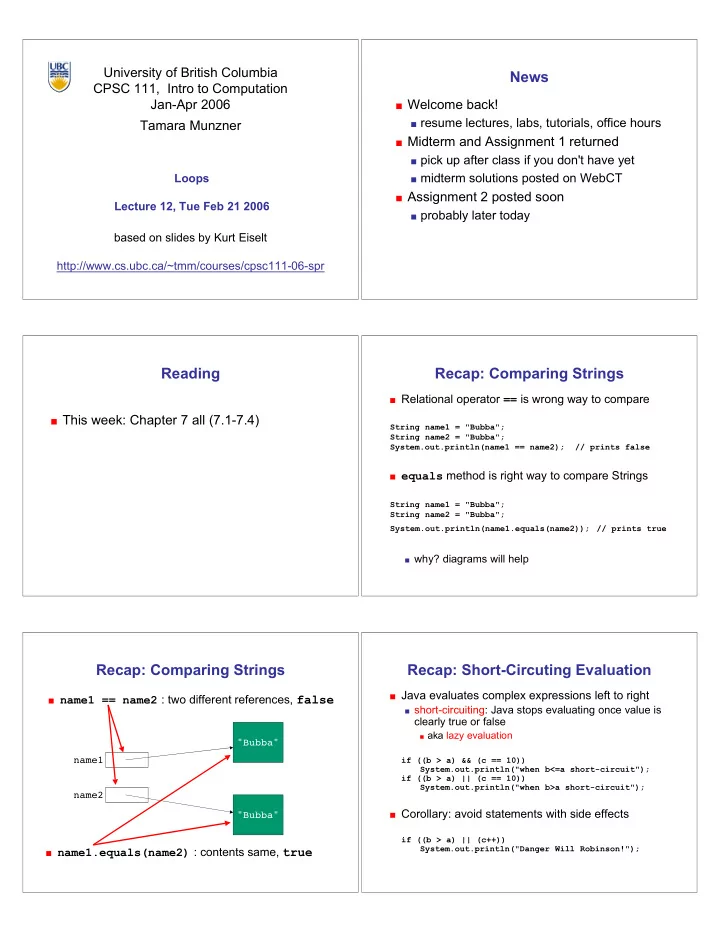

SLIDE 1
University of British Columbia CPSC 111, Intro to Computation Jan-Apr 2006 Tamara Munzner
Loops Lecture 12, Tue Feb 21 2006 http://www.cs.ubc.ca/~tmm/courses/cpsc111-06-spr based on slides by Kurt Eiselt
News
Welcome back!
resume lectures, labs, tutorials, office hours
Midterm and Assignment 1 returned
pick up after class if you don't have yet midterm solutions posted on WebCT
Assignment 2 posted soon
probably later today
Reading
This week: Chapter 7 all (7.1-7.4)
Recap: Comparing Strings
Relational operator == is wrong way to compare
String name1 = "Bubba"; String name2 = "Bubba"; System.out.println(name1 == name2); // prints false
equals method is right way to compare Strings
String name1 = "Bubba"; String name2 = "Bubba"; System.out.println(name1.equals(name2)); // prints true
why? diagrams will help
Recap: Comparing Strings
name1 == name2 : two different references, false
name1 name2 "Bubba" "Bubba"
name1.equals(name2) : contents same, true
Recap: Short-Circuting Evaluation
Java evaluates complex expressions left to right
short-circuiting: Java stops evaluating once value is
clearly true or false
aka lazy evaluation
if ((b > a) && (c == 10)) System.out.println("when b<=a short-circuit"); if ((b > a) || (c == 10)) System.out.println("when b>a short-circuit");
Corollary: avoid statements with side effects