New PCAOB Audit Risk Assessment Standards Master the Guidelines for - - PowerPoint PPT Presentation

new pcaob audit risk assessment standards
SMART_READER_LITE
LIVE PREVIEW

New PCAOB Audit Risk Assessment Standards Master the Guidelines for - - PowerPoint PPT Presentation

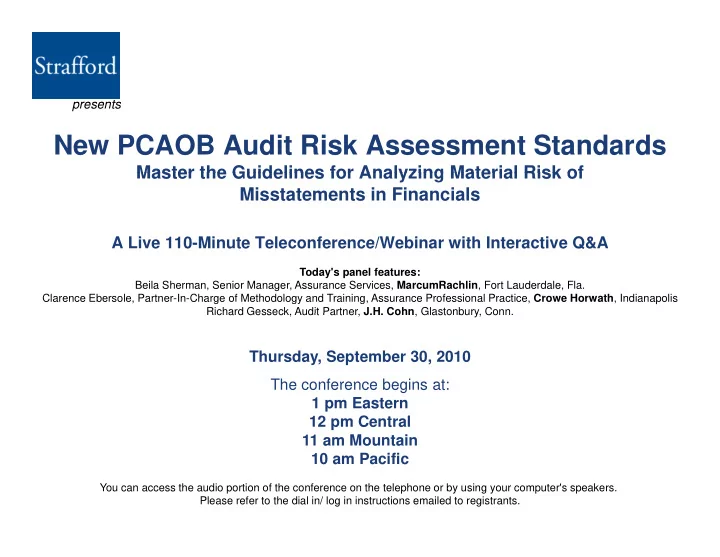
presents presents New PCAOB Audit Risk Assessment Standards Master the Guidelines for Analyzing Material Risk of Master the Guidelines for Analyzing Material Risk of Misstatements in Financials A Live 110-Minute Teleconference/Webinar with


slide-1
SLIDE 1

presents

New PCAOB Audit Risk Assessment Standards

Master the Guidelines for Analyzing Material Risk of

presents

Master the Guidelines for Analyzing Material Risk of Misstatements in Financials

A Live 110-Minute Teleconference/Webinar with Interactive Q&A

Today's panel features: Beila Sherman, Senior Manager, Assurance Services, MarcumRachlin, Fort Lauderdale, Fla. Clarence Ebersole, Partner-In-Charge of Methodology and Training, Assurance Professional Practice, Crowe Horwath, Indianapolis Richard Gesseck Audit Partner J H Cohn Glastonbury Conn

A Live 110-Minute Teleconference/Webinar with Interactive Q&A

Richard Gesseck, Audit Partner, J.H. Cohn, Glastonbury, Conn.

Thursday, September 30, 2010 The conference begins at: The conference begins at: 1 pm Eastern 12 pm Central 11 am Mountain 10 P ifi 10 am Pacific

You can access the audio portion of the conference on the telephone or by using your computer's speakers. Please refer to the dial in/ log in instructions emailed to registrants.

slide-2
SLIDE 2

For Continuing Education purposes, g please let us know how many people are listening at your location by g y y

  • closing the notification box
  • and typing in the chat box your
  • and typing in the chat box your

company name and the number of attendees attendees.

  • Then click the blue icon beside the box

to send to send.

For live event only

slide-3
SLIDE 3
  • If you are listening via your computer

If you are listening via your computer speakers, please note that the quality of your sound will vary depending on the speed and lit f i t t ti quality of your internet connection.

  • If the sound quality is not satisfactory and you

li t i i t k are listening via your computer speakers, please dial 1-866-258-2056 and enter your PIN when prompted. Otherwise, please send e p o p ed O e se, p ease se d us a chat or e-mail sound@straffordpub.com immediately so we can address the problem.

  • If you dialed in and have any difficulties

during the call, press *0 for assistance.

slide-4
SLIDE 4

New PCAOB Audit Risk Assessment Standards Webinar

  • Sept. 30, 2010
  • Sept. 30, 2010

Beila Sherman, MarcumRachlin beila.sherman@marcumrachlin.com Clarence Ebersole, Crowe Horwath clarence.ebersole@crowehorwath.com Richard Gesseck, J.H. Cohn rgesseck@jhcohn com rgesseck@jhcohn.com

slide-5
SLIDE 5

Today’s Program Today s Program

PCAOB’s Goals With New Standards Slides 6-21 (Beila Sherman) Material Terms Of New Standards Slides 22-54 (Beila Sherman, Clarence Ebersole and Richard Gesseck) ( , ) Likely Compliance Scenarios To Come Slides 55-63 (Ri h d G k d Cl Eb l ) (Richard Gesseck and Clarence Ebersole)

5

slide-6
SLIDE 6

CAO ’ G i S PCAOB’s Goals With New Standards Beila Sherman, MarcumRachlin

6

slide-7
SLIDE 7

The PCAOB

The PCAOB is a private sector, non-profit corporation.

Created by the Sarbanes-Oxley Act of 2002 to

  • versee the auditors of companies
  • versee the auditors of companies

To protect investors and the public interest by promoting informative, fair and independent audit reports audit reports

The Act required that auditors of U.S. companies be subject to external and independent oversight (f th fi t ti i hi t ) (for the first time in history).

The five members of the PCAOB Board, including the chairman, are appointed to staggered

7

pp gg five-year terms by the Securities and Exchange Commission (SEC).

slide-8
SLIDE 8

PCAOB Oversight

The SEC has oversight authority over the g y PCAOB, including the approval of the Board’s rules, standards and budget.

8

slide-9
SLIDE 9

PCAOB Mission Statement

The PCAOB mission, as derived from the S b O l A t f 2002 i t th Sarbanes-Oxley Act of 2002, is to oversee the auditors of companies in order to protect the interests of investors and further the public interest in the preparation of informative fair and in the preparation of informative, fair and independent audit reports.

9

slide-10
SLIDE 10

PCAOB Vision

The PCAOB seeks to be a model regulatory i ti U i i ti d t ff ti

  • rganization. Using innovative and cost-effective

tools, the PCAOB aims to improve audit quality, reduce the risks of auditing failures in the U.S. public securities market and promote public public securities market and promote public trust in both the financial reporting process and auditing profession.

10

slide-11
SLIDE 11

PCAOB Timeline

 July 30, 2002: Sarbanes-Oxley Act of 2002 is enacted, establishing the PCAOB.  April 16, 2003: Board adopts AICPA standards as interim auditing standards (to SAS 100).  April 25, 2003: PCAOB receives SEC determination, as required by the Sarbanes-Oxley Act, that it is appropriately organized, with the capacity to carry out the Act’s requirements.  May 6, 2003: Board adopts audit firm registration rules  Dec 17 2003: Board adopts AS No 1: References in 

  • Dec. 17, 2003: Board adopts AS No. 1: References in

Auditors’ Reports to the Standards of the Public Company Accounting Oversight Board  March 9 2004: Board adopts AS No 2: An Audit of

11

 March 9, 2004: Board adopts AS No. 2: An Audit of Internal Control over Financial Reporting Performed in Conjunction with an Audit of Financial Statements

slide-12
SLIDE 12

PCAOB Timeline (Cont.)

 May 16, 2005: Board issues Policy Statement Regarding Implementation of AS No. 2: An Audit

  • f Internal Control over Financial Reporting

Performed in Conjunction with an Audit of Fi i l St t t Financial Statements 

  • Nov. 30, 2005: Board issues Report on the Initial

Implementation of AS No.2: An Audit of Internal p Control Over Financial Reporting Performed in Conjunction with an Audit of Financial Statements  Jan 22 2007: Board issues Observations on 

  • Jan. 22, 2007: Board issues Observations on

Auditors’ Implementation of PCAOB Standards Relating to Auditors’ Responsibilities with Respect to Fraud

12

p

slide-13
SLIDE 13

PCAOB Timeline (Cont.)

April 18, 2007: Board issues Report on the Second-Year Implementation of AS No.2

May 24, 2007: Board adopts AS No. 5, superseding AS No. 2: An Audit of Internal Control superseding AS No. 2: An Audit of Internal Control Over Financial Reporting That Is Integrated with An Audit of Financial Statements (establishes requirements and provides direction when an q p auditor is engaged to perform an audit of management’s assessment of the effectiveness

  • f internal control over financial reporting).

The PCAOB initially proposed a suite of risk assessment standards on Oct. 21, 2008. Sept 24 2009 Board iss es report on first ear

13

  • Sept. 24, 2009: Board issues report on first-year

implementation of AS No. 5

slide-14
SLIDE 14

Risk Assessment Standards

December 17, 2009: PCAOB re-proposed a suite of auditing standards related to an auditor’s assessment

  • f and responses to risk, in the context of an integrated

audit of financial statements and internal control over financial reporting financial reporting.

These standards were issued as Release No. 2010-004, effective for audits of fiscal periods beginning on or after December 15 2010 December 15, 2010.

The standards supersede six interim auditing standards: AU 311, Planning and Supervision; AU 312, Audit Risk and Materiality in Conducting an Audit; AU 313, and Materiality in Conducting an Audit; AU 313, Substantive Tests Prior to the Balance Sheet Date; AU 319, Consideration of Internal Control in a Financial Statement Audit; AU 326, Evidential Matter; and AU 431, Ad f Di l i Fi i l St t t

14

Adequacy of Disclosure in Financial Statements.

slide-15
SLIDE 15

SOX 404

Under Sect. 404 of the Sarbanes-Oxley Act, public companies and their independent auditors are each required to report to the public on the effectiveness of a company’s internal controls.

Non-accelerated filers, with a public float below $75 million, were given extra time to design, implement and document their internal controls p before their auditors under Sect. 404(b) were required to attest to the effectiveness of the controls.

Congress just passed the Dodd-Frank Wall Street Reform and Consumer Protection Act, a permanent exemption from complying with Sect.

15

p p p y g 404(b) of the Sarbanes-Oxley Act of 2002 for non- accelerated filers.

slide-16
SLIDE 16

AICPA Risk Assessment Standards Risk Assessment Standards

In March 2006, AICPA issued eight SASes that provide extensive guidance on how to apply the audit risk model in the planning and performance

  • f a financial statement audit.
  • These SASes became effective for audits of

financial statements for periods beginning on

  • r after Dec. 15, 2006.

The SASes describe a process for applying the audit risk model to gather audit evidence and form an opinion about a client's financial statements an opinion about a client s financial statements.

Those concepts include the following:

  • The meaning of reasonable assurance

16

g

  • Audit risk and the risk of material misstatement
  • Audit evidence
slide-17
SLIDE 17

AICPA Risk Assessment Standards (Cont.) ( )

Concepts (Cont.)

  • Materiality and tolerable misstatement
  • Financial statement assertions
  • Internal control
  • Information technology
  • Information technology

SAS # 104, Amendment to Statement on Auditing Standards No. 1, Codification of Auditing Standards and Procedures (“Due Professional Standards and Procedures ( Due Professional Care in the Performance of Work”)

SAS # 105, Amendment to Statement on Auditing Standards No. 95, Generally Accepted Auditing Standards (expands the scope of the understanding that the auditor must obtain in the second standard of field work from “internal

17

second standard of field work from internal control” to “the entity and its environment, including its internal control”).

slide-18
SLIDE 18

AICPA Risk Assessment Standards (Cont.) Risk Assessment Standards (Cont.)

SAS # 106, Audit Evidence identifies “risk assessment procedures” as audit procedures performed on all audits to obtain an understanding of the entity and its environment, including its internal controls, to assess the risk of material misstatement at the financial statement risk of material misstatement at the financial statement and relevant assertion levels.

SAS # 107, Audit Risk and Materiality in Conducting an Audit: Must consider audit risk and determine a an Audit: Must consider audit risk and determine a materiality level for the financial statements taken as a whole for the purposes of determining the extent and nature of risk assessment procedures; identifying d i th i k f t i l i t t t and assessing the risk of material misstatements; determining the nature, timing and extent of further audit procedures; and evaluating whether the financial statements taken as a whole are presented fairly,

18

p y, in conformity with GAAP.

slide-19
SLIDE 19

AICPA Risk Assessment Standards (Cont.) Risk Assessment Standards (Cont.)

SAS # 108, Planning and Supervision: Provides guidance on:

  • Appointment of the independent auditor
  • Establishing an understanding with the client
  • Preliminary engagement activities
  • The overall audit strategy
  • The audit plan

p

  • Determining the extent of involvement of

professionals possessing specialized skills

  • Using a professional possessing information

g p p g technology (IT) skills to understand the effect of IT

  • n the audit
  • Additional considerations in initial audit

19

engagements

  • Supervision of assistants
slide-20
SLIDE 20

AICPA Risk Assessment Standards (Cont.) ( )

SAS # 109, Understanding the Entity and Its Environment and Assessing the Risks of Material Misstatement

States the auditor should assess the risk of

States the auditor should assess the risk of material misstatement at both the financial statement and relevant assertion levels

Provides directions on how to evaluate the design

Provides directions on how to evaluate the design

  • f the entity’s controls and determine whether the

controls are adequate and have been implemented implemented

Directs the auditor to consider whether any of the assessed risks are significant risks that require special a dit consideration or are risks for hich

20

special audit consideration, or are risks for which substantive procedures alone do not provide sufficient appropriate audit evidence

slide-21
SLIDE 21

AICPA Risk Assessment Standards (Cont.) Risk Assessment Standards (Cont.)

SAS # 110, Performing Audit Procedures in Response to Assessed Risks and Evaluating the Audit Evidence Obtained provides guidance on determining overall responses to address the risk f t i l i t t t t th fi i l t t t

  • f material misstatement at the financial statement

level and the nature of those responses. It also defines further audit procedures (which may include tests of controls) or substantive include tests of controls) or substantive procedures should be responsive to the assessed risk of material misstatement at the relevant assertion level Guidance is given on matters the assertion level. Guidance is given on matters the auditor should consider in determining the nature, timing and extent of such audit procedures. SAS # 111 Amendment to Statement on A diting

21

SAS # 111, Amendment to Statement on Auditing Standards No. 39, audit sampling

slide-22
SLIDE 22

Material Terms Of New Standards Material Terms Of New Standards Beila Sherman, MarcumRachlin Clarence Ebersole Crowe Horwath Clarence Ebersole, Crowe Horwath Richard Gesseck, J.H. Cohn

22

slide-23
SLIDE 23

Audit Risk Auditing Standard No 8 Auditing Standard No. 8

The objective of the auditor is to conduct an audit

  • f financial statements in a matter that reduces

audit risk to an appropriately low level.

The auditor must plan and perform the audit to

  • btain reasonable assurance about whether the

financial statements are free of material financial statements are free of material misstatement due to error or fraud.

Reasonable assurance is obtained by reducing audit risk to an appropriate low level by applying due professional care, including obtaining

23

p , g g sufficient appropriate audit evidence.

slide-24
SLIDE 24

Audit Risk Auditing Standard No 8 (Cont ) Auditing Standard No. 8 (Cont.)

Audit risk is the risk that the auditor expresses an inappropriate audit opinion such as an unqualified

  • pinion when the financial statements are in fact
  • pinion, when the financial statements are in fact

materially misstated.

24

slide-25
SLIDE 25

Audit Risk Auditing Standard No 8 (Cont ) Auditing Standard No. 8 (Cont.)

Risk of material misstatement (RMM) refers to the risk that the financial statements are misstated.

  • RMM at the financial statement level relates to the

financial statements as a whole such as an ineffective control environment, lack of financial resources to continue operations, and declining industries such as real estate in various areas of the country the country.

  • RMM at the assertion level consists of inherent risk

and control risk.

  • Inherent risk (IR) and control risk (CR) relate to the

Inherent risk (IR) and control risk (CR) relate to the company, its environment and its internal control which an auditor must assess.

  • Detection risk is the risk that the procedures

25

performed by the auditor will not detect a material misstatement that exists.

slide-26
SLIDE 26

Audit Planning Auditing Standard No 9 Auditing Standard No. 9

The objective of the auditor is to plan the audit so it is conducted effectively.

The engagement partner is responsible for the engagement and its performance. If engagement engagement and its performance. If engagement team members assist the engagement partner with planning, they should comply with this standard.

Planning the audit includes establishing an overall audit strategy for the engagement and developing an audit plan which includes planned risk an audit plan, which includes planned risk assessment procedures and planned responses to the risks of material misstatement. Planning is a contin al and iterati e process

26

Planning is a continual and iterative process.

slide-27
SLIDE 27

Audit Planning Auditing Standard No 9 (Cont ) Auditing Standard No. 9 (Cont.)

Preliminary engagement activities

  • Acceptance or continuance procedures

per firm’s guidance

  • Ensure in compliance with independence

and ethics requirements

  • Establish an understanding with the client

regarding the services to preliminary engagement activities

Planning activities

  • Consider the size and complexity of

Consider the size and complexity of the company

  • Consider previous experience with company
  • Consider internal control

27

  • Consider internal control
  • Consider matters affecting the industry,
  • perations, legal matters
slide-28
SLIDE 28

Audit Planning Auditing Standard No 9 (Cont ) Auditing Standard No. 9 (Cont.)

Audit strategy

  • The auditor should establish an overall strategy that

sets the scope, timing and direction of the audit and guides the development of the audit plan; and takes into account:

  • The reporting objectives of the engagement

and the nature of the communications required by the PCAOB

  • The factors that are significant in directing the

activities of the engagement team

  • Results of the preliminary engagement activities

(client acceptance, continuance procedures and planning activities stated previously)

  • Nature timing and resources necessary to

28

  • Nature timing and resources necessary to

perform engagement

slide-29
SLIDE 29

Audit Planning Auditing Standard No 9 (Cont ) Auditing Standard No. 9 (Cont.)

Audit plan

  • The auditor is to develop and document an

audit plan to include a description of: Th l d t ti i d t t f

  • The planned nature, timing and extent of

the risk assessment procedures (AS No. 12 Identifying and Assessing Risks of Material Misstatement) Material Misstatement)

  • The planned nature, timing and extent of

tests of controls and substantive procedures (AS No 13 Auditor’s procedures (AS No. 13 Auditor’s Responses to the RMM and AS No. 5) Other planned a dit proced res req ired

29

  • Other planned audit procedures required

to be performed to comply with OCAOB standards

slide-30
SLIDE 30

Audit Planning Auditing Standard No 9 (Cont ) Auditing Standard No. 9 (Cont.)

Other items

  • Considerations for multi-location engagements
  • Changes during the course of the audit
  • Persons with specialized skill or knowledge
  • Additional considerations in initial audits

30

slide-31
SLIDE 31

Auditing Standard No 10: Supervision Auditing Standard No. 10: Supervision Of The Audit Engagement

  • Proposed standards included a standard that combined the topic of

supervision with audit planning.

  • Final standard included significantly more content than originally

proposed: – A separate section added the responsibilities of the engagement – A separate section added the responsibilities of the engagement partner for supervision. – Additional language on the supervision responsibilities of engagement team members engagement team members

31

slide-32
SLIDE 32

Auditing Standard No 10: Supervision Auditing Standard No. 10: Supervision Of The Audit Engagement (Cont.)

  • Responsibilities of the engagement partner

– Responsible for the engagement and its performance Responsible for proper supervision of the engagement team – Responsible for proper supervision of the engagement team – Responsible for compliance with PCAOB standards (standards regarding use of work of specialists, other auditors and internal auditors are specifically mentioned auditors are specifically mentioned.

  • Engagement partner may seek assistance from engagement team

b t f lfill th i ibiliti members to fulfill their responsibilities. Comment: Specificity of engagement partner responsibilities for supervision has increased.

32

slide-33
SLIDE 33

Auditing Standard No 10: Supervision Of Auditing Standard No. 10: Supervision Of The Audit Engagement (Cont.)

  • Requirements to supervise engagement team members

Inform engagement team members of their responsibilities – Inform engagement team members of their responsibilities – Direct engagement team members to bring significant issues to the attention of supervisors R i k f t t b – Review work of engagement team members Comment: Again, requirements are more specific.

33

slide-34
SLIDE 34

Auditing Standard No 10: Supervision Of Auditing Standard No. 10: Supervision Of The Audit Engagement (Cont.)

  • Extent of supervision should be determined in consideration of:

Nature of the company including its size and complexity – Nature of the company, including its size and complexity, – Nature of the assigned work for each engagement team member, – Risks of material misstatement, and – Knowledge, skill and ability of each engagement team member Comment: Although consideration of these matters occurred in the past, their specific inclusion in this standard will necessitate additional documentation by the auditor.

34

slide-35
SLIDE 35

Auditing Standard No 10: Supervision Of Auditing Standard No. 10: Supervision Of The Audit Engagement (Cont.)

  • Supervision of specialists, whether employed by the auditor or

engaged by the auditor engaged by the auditor – The same supervisory requirements applicable to engagement team members also apply to specialists.

  • The standard also states that engagement team members have the

responsibility to bring to the attention of appropriate persons, those disagreements or concerns they have with respect to accounting and disagreements or concerns they have with respect to accounting and auditing issues.

35

slide-36
SLIDE 36

Auditing Standard No 10: Supervision Auditing Standard No. 10: Supervision Of The Audit Engagement (Cont.)

  • Background on additional emphasis on supervision

– PCAOB Release No. 2010-005: “ … execution of … supervisory processes … suffers from a lack of diligence.” processes … suffers from a lack of diligence. – This release reminds auditors that the PCAOB has the right under SOX to impose sanctions on auditing firms or its supervisory persons for a failure to reasonably supervise. persons for a failure to reasonably supervise. – This release also indicates the PCAOB’s intentions to consider additional requirements for auditing firms to document clear assignments of supervision responsibilities to: ass g e s o supe v s o espo s b es o:

  • Avoid confusion within the firm regarding this responsibility
  • Identify the person with relevant supervision responsibility

when a violation has occurred when a violation has occurred

36

slide-37
SLIDE 37

Auditing Standard No 10: Supervision Of Auditing Standard No. 10: Supervision Of The Audit Engagement (Cont.)

– PCAOB is very focused on supervision. They have commented specifically on failures that have occurred when an auditor relies specifically on failures that have occurred when an auditor relies

  • n the work of a foreign firm for a multi-national audit.

Comment: Based on comments from the PCAOB additional rulemaking Comment: Based on comments from the PCAOB, additional rulemaking in this area is very likely. Auditors are likely to reassess their supervision practices and documentation, particularly related to the use

  • f foreign firms, and make any appropriate changes.
  • e g

s, a d a e a y app op a e c a ges.

37

slide-38
SLIDE 38

Auditing Standard No 11: Auditing Standard No. 11: Consideration Of Materiality

  • Materiality will now be based on a legal standard used by the courts in

interpreting federal securities laws. The Supreme Court has held that a fact is material if there is a “substantial likelihood that the … fact would have been viewed by the reasonable investor as having significantly altered the ‘total mix’ of information made available.”

  • The Supreme Court has also noted that determinations of materiality

require “delicate assessments of the inferences a ‘reasonable shareholder’ would draw from a given set of facts and the significance

  • f those inferences to him … ”

38

slide-39
SLIDE 39

Auditing Standard No 11: Auditing Standard No. 11: Consideration Of Materiality (Cont.)

  • Net earnings are often an important factor in the total mix of

information available to a reasonable investor, but auditors are not required to use earnings as a basis for the established materiality in all cases.

  • Both quantitative and qualitative factors should be considered.

Both quantitative and qualitative factors should be considered.

  • Circumstances that might lead to establishing lower levels of

materiality for certain accounts or disclosures might include: materiality for certain accounts or disclosures might include: – Investor expectations about the measurement or disclosure of certain items, such as related party transactions and compensation

  • f senior management
  • f senior management

39

slide-40
SLIDE 40

Auditing Standard No 11: Auditing Standard No. 11: Consideration Of Materiality (Cont.)

– Significant attention on a particular aspect of the company’s business that is separately disclosed in the financial statements, business that is separately disclosed in the financial statements, such as a recent business combination – Certain disclosures that are particularly important to investors in the industry in which the company operates the industry in which the company operates

  • Lesser materiality levels may be appropriate for certain accounts or

disclosures if such amounts would influence the judgment of a disclosures, if such amounts would influence the judgment of a reasonable investor.

40

slide-41
SLIDE 41

Auditing Standard No. 11: Consideration Of Materiality (Cont.)

  • For companies with multiple locations or business units, the auditor is

required to determine materiality separately for individual locations or required to determine materiality separately for individual locations or business units, based on probability of misstatement of the consolidated financial statements. Comment: Companies need to discuss with their auditors the impact of this standard on their audits. It will take time for auditors to work with the new definition of materiality and determine its impact. e ew de

  • o

a e a y a d de e e s pac .

41

slide-42
SLIDE 42

Auditing Standard No 12: Identifying And Auditing Standard No. 12: Identifying And Assessing Risks Of Material Misstatement

  • This standard discusses the auditor’s responsibilities for performing

“risk assessment procedures,” and identifying and assessing the risks

  • f material misstatement using information obtained from performing

risk assessment procedures.

  • The auditor’s objective is to identify and appropriately assess the risks

The auditor s objective is to identify and appropriately assess the risks

  • f material misstatement, providing a basis for designing and

implementing responses to these risks in their audits.

  • Concept is similar to that in the AICPA’s risk assessment standards

that were effective for 2007.

42

slide-43
SLIDE 43

Auditing Standard No 12: Identifying And Auditing Standard No. 12: Identifying And Assessing Risks Of Material Misstatement (Cont.)

  • Risk assessment procedures include:

– Obtaining an understanding of the company and its environment Obtaining an understanding of internal control over financial – Obtaining an understanding of internal control over financial reporting – Considering client acceptance and retention evaluations, audit planning activities past audits and other engagements performed planning activities, past audits and other engagements performed for the company – Performing analytical procedures Di i th t t di i k f – Discussions among the engagement team regarding risks of material misstatement – Inquiries of the audit committee, management and others regarding risks of material misstatement risks of material misstatement

43

slide-44
SLIDE 44

Auditing Standard No 12: Identifying And Auditing Standard No. 12: Identifying And Assessing Risks Of Material Misstatement (Cont.)

  • The audit requirements include consideration of other engagements

performed for the company by the auditing firm. For example, if the auditing firm consulted with the company on tax planning issues, the auditor should discuss this engagement with those that provided the services to consider how the audit could be affected.

  • The audit requirements also emphasize consideration of matters about

the company, such as: – Information provided to the public about the company, such as from earnings calls, press releases and analyst reports – Compensation arrangements with senior management – Trading activity in the company’s securities and holdings in the company’s securities by significant holders p y y g

44

slide-45
SLIDE 45

Auditing Standard No 12: Identifying And Auditing Standard No. 12: Identifying And Assessing Risks Of Material Misstatement (Cont.)

  • The standard also emphasizes the auditor’s consideration of

disclosures in the company’s financial statements, including: – Developing expectations about necessary disclosures Developing expectations about necessary disclosures – Requirement for the engagement team to discuss how fraud might be perpetrated or concealed by omitting or presenting incomplete

  • r inaccurate disclosures
  • r inaccurate disclosures

Comment: The assessment of risk of material misstatement, although part

  • f audits in the past will likely become more thorough and
  • f audits in the past, will likely become more thorough, and

documentation will increase.

45

slide-46
SLIDE 46

Responding To Risks Of i l i ( ) Material Misstatement (AS No.13)

  • Overall response, including fraud considerations
  • Response at assertion level by significant account,

including fraud considerations

46

slide-47
SLIDE 47

Components Of Overall Response

  • Audit approach (extensive substantive procedures
  • r rely on controls to reduce substantive
  • r rely on controls to reduce substantive

procedures)

  • Team assignments (includes specialists)
  • Supervision
  • Emphasis on subjective estimates and complex

transactions transactions

  • Unpredictability – see next slide

47

slide-48
SLIDE 48

Unpredictability Unpredictability

1. Out‐of‐scope (e.g., journal entries) 2 Ti i 2. Timing 3. Items with amounts less than customary selection parameters 4. Unannounced 5. Multi‐locations: Vary location or scope

48

slide-49
SLIDE 49

Response At Assertion Level For Significant Accounts

1. Response based on combined risk assessment , which includes inherent and control risk 2. Control risk based on design effectiveness and

  • perating effectiveness

3. Nature, timing and extent of tests of controls and substantive tests 4. Response integrates fraud considerations

49

slide-50
SLIDE 50

Tests Of Controls In Financial Statement Audit

  • Test controls to assess RMM at less than maximum
  • Design effectiveness (inquire, observe, inspect

documents, walk‐throughs)

  • Operating effectiveness (inquire observe inspect
  • Operating effectiveness (inquire, observe, inspect,

re‐perform)

  • Nature of control tests
  • Extent of control tests (frequency of control,

expected deviations)

  • Timing of control tests and period covered

Timing of control tests and period covered

  • Updating (results of control and substantive tests,

changes in ICFR, length of intervening period, etc.)

50

slide-51
SLIDE 51

Substantive Tests Substantive Tests

Significant accounts and assertions Nature, timing and extent Remaining population g p p Updating (interim results, changes in ICFR, significant and unusual transactions, risk RMM will

  • ccur and not be detected by ICFR, etc.)

y ) FSCP: Agree financial statements to accounting records; examine material adjustments examine material adjustments

51

slide-52
SLIDE 52

Response To Fraud Risk Response To Fraud Risk

Nature, timing and extent Journal entries Accounting estimates (bias) Significant unusual transactions (business purpose)

52

slide-53
SLIDE 53

Evaluating Audit Results (AS No 14) Evaluating Audit Results (AS No. 14)

Misstatements

  • Understand (systemic, isolated, indicative of

fraud, response)

  • A

ti ti t ( bl bi )

  • Accounting estimates (unreasonable, bias)
  • Projecting
  • Aggregate misstatements approach PM
  • Aggregate misstatements approach PM

Uncorrected misstatements

  • Schedule format
  • Quantitative and qualitative analysis

53

slide-54
SLIDE 54

Audit Evidence (AS No 15) Audit Evidence (AS No. 15)

 All information to support opinion  Relevant and reliable  Company produced information (test underlying data or controls over data)  Procedures: Inspect observe inquire confirm  Procedures: Inspect, observe, inquire, confirm, recalculate, re‐perform, analytical  Selecting items to test: All items, specific items and audit sampling

54

slide-55
SLIDE 55

Likely Compliance Scenarios To Come Likely Compliance Scenarios To Come

Richard Gesseck, J.H. Cohn Clarence Ebersole, Crowe Horwath ,

55

slide-56
SLIDE 56

Audits Of Entities With Only 404(a) l i Control Requirements

  • Default to maximum risk, checklists ‐ inquiry only
  • Additional documentation required

Additional documentation required

  • Risk assessment (overall and assertion level for significant accounts)
  • Understanding of entity and entity level controls, risk assessment and

response response

  • FSCP, risk assessment and response
  • Significant accounts and underlying processes (routine and non‐routine

d i i ) and estimation processes)

  • Inherent, control and combined risk for assertions for significant accounts

and response

56

slide-57
SLIDE 57

Additional Emphasis On Fraud

  • The PCAOB risk assessment standards seek to emphasize the auditor’s

responsibilities for consideration of fraud.

  • The auditor’s responsibilities for assessing and responding to fraud

risks are considered by the new standards to be an integral part of the audit process, not a separate process. Previous requirements with audit process, not a separate process. Previous requirements with respect to identifying and assessing fraud risks have been incorporated into Auditing Standards Nos. 12, 13 and 14 to help accomplish this integration.

  • Auditors are prompted to “make a more thoughtful and thorough

assessment of fraud risks and to develop appropriate audit responses.” p pp p p

57

slide-58
SLIDE 58

Audit Committee Issues

  • Consistent with the audit committee’s responsibilities for oversight of

a company’s audit function, the impact of these risk assessment standards on audit quality should be considered a positive development.

  • The risk assessment standards include specific requirements affecting

The risk assessment standards include specific requirements affecting the audit committee, including: – Taking into account in developing the overall audit strategy the communications with the audit committee co u ca o s w e aud co ee – Inquiry of the audit committee about the risks of material misstatement

58

slide-59
SLIDE 59

Audit Committee Issues (Cont.)

– Understanding the policies and actions of the audit committee as part of assessing the company’s control environment, including whether the audit committee understands and exercises oversight responsibility over financial reporting and internal control – Understanding how communication takes place between management, the audit committee and the board – Inquiry about the audit committee’s whistleblower program – Asking management about their communications with the audit committee regarding how the company’s internal control serves to co ee ega d g ow e co pa y s e a co

  • se ves o

prevent and detect fraud

59

slide-60
SLIDE 60

Audit Committee Issues (Cont.)

– Asking the audit committee about:

  • Fraud risks in the company
  • Fraud risks in the company
  • Their knowledge of fraud, alleged fraud or suspected fraud
  • How the audit committee exercises oversight of the company's

t f f d i k d th t bli h t f t l t assessment of fraud risks and the establishment of controls to address fraud risks – Considering impact on assessment of fraud risk of objections by t t th dit ti i t l ith th dit management to the auditor meeting privately with the audit committee

60

slide-61
SLIDE 61

Audit Committee Issues (Cont.)

  • The proposed PCAOB standard on communications with audit

committees will also affect the extent of required communications of audit committees with the company’s external auditor. – Proposed effective date is for audits for fiscal years beginning after

  • Dec. 15, 2010.

– Among other items, requirements include communications re: Among other items, requirements include communications re:

  • Significant risks identified and timing of the audit
  • Roles, responsibilities and locations of firms participating in

the audit the audit

  • Significant accounting matters on which the auditor consulted
  • utside the engagement team (e.g., industry specialists;

national office consultations) national office consultations)

61

slide-62
SLIDE 62

Comparison To IAASB And ASB Comparison To IAASB And ASB

  • Standards similar

PCAOB id h i di li

  • PCAOB provides enhancements to improve audit quality

and effectiveness

  • Some specific differences in objectives and requirements
  • AS 11 requires auditor to “take into account” nature
  • AS 11 requires auditor to “take into account” nature,

cause and amount of misstatements in prior periods when determining TM.

  • AS 11 requires auditor to evaluate whether significant

q g changes in entity from prior periods affect RMM.

  • AS 12 requires auditor to read transcript of earnings

calls, understand compensation arrangements with senior management and obtain info about trading senior management, and obtain info about trading activity by significant holders.

  • AS 12 requires auditor to consider if control deficiency

is indicative of a fraud risk factor.

62

slide-63
SLIDE 63

Specific Differences (Cont ) Specific Differences (Cont.)

  • AS 12 requires auditor to integrate IT risk assessment

i h h f i ifi d d l i with approach for significant accounts and underlying flow of transactions.

  • AS 12 requires communication of matters affecting RMM

continuously throughout audit (i.e. updating brain storming session).

  • AS 12 requires auditor to make inquires of audit

committee about tips and complaints about entity’s financial reporting.

  • Others

63