New Partnership Debt for Equity Exchange Regulations Navigating - - PowerPoint PPT Presentation

new partnership debt for equity exchange regulations
SMART_READER_LITE
LIVE PREVIEW

New Partnership Debt for Equity Exchange Regulations Navigating - - PowerPoint PPT Presentation

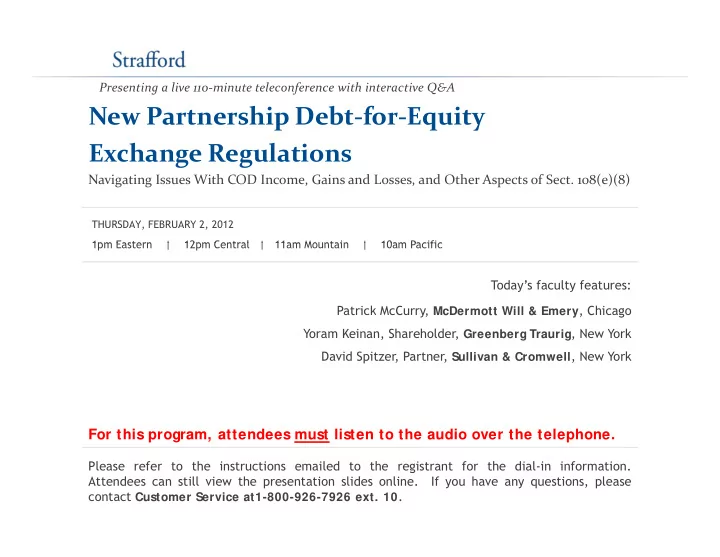
Presenting a live 110 minute teleconference with interactive Q&A New Partnership Debt for Equity Exchange Regulations Navigating Issues With COD Income, Gains and Losses, and Other Aspects of Sect. 108(e)(8) THURSDAY, FEBRUARY 2,


slide-1
SLIDE 1

Presenting a live 110‐minute teleconference with interactive Q&A

New Partnership Debt‐for‐Equity Exchange Regulations

Navigating Issues With COD Income, Gains and Losses, and Other Aspects of Sect. 108(e)(8)

1pm Eastern | 12pm Central | 11am Mountain | 10am Pacific THURSDAY, FEBRUARY 2, 2012

Today’s faculty features:

1pm Eastern | 12pm Central | 11am Mountain | 10am Pacific

Patrick McCurry McDermott Will & Emery Chicago Patrick McCurry, McDermott Will & Emery, Chicago Yoram Keinan, Shareholder, Greenberg Traurig, New York David Spitzer, Partner, Sullivan & Cromwell, New York

For this program, attendees must listen to the audio over the telephone.

Please refer to the instructions emailed to the registrant for the dial-in information. Attendees can still view the presentation slides online. If you have any questions, please contact Customer Service at1-800-926-7926 ext. 10.

slide-2
SLIDE 2

Conference Materials

If you have not printed the conference materials for this program, please complete the following steps:

  • Click on the + sign next to “Conference Materials” in the middle of the left-

hand column on your screen hand column on your screen.

  • Click on the tab labeled “Handouts” that appears, and there you will see a

PDF of the slides for today's program.

  • Double click on the PDF and a separate page will open.

Double click on the PDF and a separate page will open.

  • Print the slides by clicking on the printer icon.
slide-3
SLIDE 3

Continuing Education Credits

FOR LIVE EVENT ONLY

Attendees must listen to the audio over the telephone. Attendees can still view

the presentation slides online but there is no online audio for this program.

Attendees must stay on the line for at least 100 minutes in order to qualify for

a full 2 credits of CPE. Attendance is monitored as required by NASBA. Please refer to the instructions emailed to the registrant for additional

  • information. If you have any questions, please contact Customer Service

at 1-800-926-7926 ext. 10. at 1 800 926 7926 ext. 10.

slide-4
SLIDE 4

Tips for Optimal Quality

S d Q lit S

  • und Qualit y

For this program, you must listen via the telephone by dialing 1-866-873-1442 and entering your PIN when prompted. There will be no sound over the web connection. co ect o . If you dialed in and have any difficulties during the call, press *0 for assistance. You may also send us a chat or e-mail sound@

straffordpub.com immediately so

we can address the problem.

Viewing Qualit y

To maximize your screen, press the F11 key on your keyboard. To exit full screen, press the F11 key again press the F11 key again.

slide-5
SLIDE 5

N P t hi D bt f E it New Partnership Debt‐for‐Equity Exchange Regulations Seminar

  • Feb. 2, 2012

Yoram Keinan, Greenberg Traurig

keinany@ gtlaw.com

Patrick McCurry, McDermott Will & Emery

pmccurry@ mwe.com

David Spitzer, Sullivan & Cromwell

spitzerd@ sullcrom.com

slide-6
SLIDE 6

Today’s Program

Background

[Pat rick McCurry]

Slide 7 – Slide 9 Overview Of Proposed Regs

[Pat rick McCurry]

Slide 10 – Slide 12 Final Sect. 108(e)(8) Regs

[Pat rick McCurry, Y

  • ram Keinan and David S

pit zer]

Slide 13 – Slide 29 Practical Strategies To Consider

[David S pit zer]

Slide 30 – Slide 37

slide-7
SLIDE 7

BACKGROUND

Patrick McCurry, McDermott Will & Emery

BACKGROUND

slide-8
SLIDE 8

B k d Background

I.

  • Sect. 61(a)(12) provides that gross income includes “income

from discharge of indebtedness” (COD income). II Prior to 2004 Sect 108(e)(8) provided that for purposes of

  • II. Prior to 2004, Sect. 108(e)(8) provided that for purposes of

determining COD income, if a debtor corporation transferred stock to a creditor in satisfaction of its recourse or non- recourse indebtedness such corporation was treated as having recourse indebtedness, such corporation was treated as having satisfied the indebtedness with an amount of money equal to the fair market value of the stock.

  • III. Sect. 108(e)(8) was amended by Sect. 896 of the American

Jobs Creation Act of 2004 to include discharges of partnership indebtedness occurring on or after Oct. 22, 2004.

8

g

slide-9
SLIDE 9

C S 8( )(8) Current Sect. 108(e)(8)

I.

  • Sect. 108(e)(8) currently provides that for purposes of

determining COD income, if a debtor corporation transfers stock, or a debtor partnership transfers a capital or profits interest in such partnership to a creditor in satisfaction of its recourse or non-recourse indebtedness, such corporation or partnership is treated as having satisfied the indebtedness p p g with an amount of money equal to the fair market value of the stock or interest. II I th f t hi COD i g i d

  • II. In the case of a partnership, any COD income recognized

under Sect. 108(e)(8) is included in the distributive shares of the partners in the partnership immediately before such d h

9

discharge.

slide-10
SLIDE 10

OVERVIEW OF PROPOSED

Patrick McCurry, McDermott Will & Emery

OVERVIEW OF PROPOSED REGS

slide-11
SLIDE 11

8 P d R l i 2008 Proposed Regulations

I O t b 2008 T i d d l ti di In October 2008, Treasury issued proposed regulations regarding the application of Sect. 108(e)(8) to partnerships and their

  • partners. The proposed regulations addressed the following

issues: issues:

  • A. General rule
  • B. Valuation of the partnership interest issued
  • C. Application of Sect. 721;exception for ordinary income

indebtedness indebtedness

  • D. Creditor’s basis in the partnership interest received; no

loss recognized

11

  • E. Holding period in the partnership interest received
slide-12
SLIDE 12

8 P d R l i (C ) 2008 Proposed Regulations (Cont.)

Th d l ti did t dd d ht t The proposed regulations did not address and sought comments

  • n the following issues:
  • A. Whether any special allocation rules of COD income should

apply where partnership indebtedness owed to a pre- existing partner is satisfied with the transfer of a partnership interest

  • B. Whether COD income arising from a debt-for-equity

exchange should be treated as a first-tier item under Treas Reg § 1 704-2(f)(6) for purposes of the minimum

  • Treas. Reg. § 1.704 2(f)(6), for purposes of the minimum

gain chargeback rules

  • C. How rules in the non-compensatory partnership options

12

regulations relating to convertible debt interact with the rules in these proposed regulations under Sect. 108(e)(8)

slide-13
SLIDE 13

Patrick McCurry, McDermott Will & Emery Yoram Keinan, Greenberg Traurig

FINAL SECT. 108(e)(8) REGS

Yoram Keinan, Greenberg Traurig David Spitzer, Sullivan & Cromwell

( )( )

slide-14
SLIDE 14

Fi l R l i Final Regulations

I. On Nov. 15, 2011, Treasury issued final regulations under sections 108, 704 and 721 S T R §§ 1 108 8 1 704 2 d 1 721 1

  • 721. S

ee Treas. Reg. §§ 1.108-8, 1.704-2 and 1.721-1

II. The final regulations follow the proposed regulations, with some helpful clarifications and additions. III Th f ll i g i dd d b th fi l g l ti th bl t th III. The following issues are addressed by the final regulations or the preamble to the final regulations: A. General rule B Valuation of the partnership interest issued B. Valuation of the partnership interest issued C. Application of Sect. 721; basis; holding period D. Exception to Sect. 721 treatment E. Treatment under minimum gain charge-back rules (new in final regulations) F. Treatment of installment obligations (new in final regulations) G. Whether COD income is subject to special allocation rules (new in the

14

preamble)

slide-15
SLIDE 15

Fi l R l i G l R l Final Regulations: General Rule

  • Treas. Reg. §1.108-8(a) provides that, for purposes of

determining COD income, if a debtor partnership transfers a capital or profits interest in the partnership to a creditor in satisfaction of its recourse or non-recourse indebtedness (a “debt-for-equity exchange”), the partnership is treated as having satisfied the indebtedness with an amount of money g y equal to the fair market value of the partnership interest.

15

slide-16
SLIDE 16

Final Regulations: Valuation Of Partnership Interest Received

I. Facts and circumstances test: All the facts and circumstances are considered in determining the fair market value of a partnership interest transferred by a debtor partnership to a partnership interest transferred by a debtor partnership to a creditor in satisfaction of the debtor partnership's indebtedness (a “debt-for-equity interest”). Treas. Reg. §1 108 8(b)(1) Note: The order of the r le and e ception §1.108-8(b)(1). Note: The order of the rule and exception were reversed in the 2008 proposed regulations.

  • II. Reference to general tax principles: If the fair market value of

g p p the debt-for-equity interest does not equal the fair market value of the indebtedness exchanged, then general tax law principles apply to account for the difference. Id.

16

p p pp y

slide-17
SLIDE 17

Final Regulations: Valuation Of Partnership Interest Received (Cont.)

Liquidation value safe harbor: Treas. Reg. §1.108-1(b)(2)(i) provides that the fair market value q g § ( )( )( ) p

  • f a debt-for-equity interest is deemed to be equal to the “liquidation value” of the debt-for-equity

Interest, if the following requirements are satisfied (the first two are consistency requirements and latter are essentially anti-abuse rules): 1. The creditor, debtor partnership and its partners treat the fair market value of the indebtedness as being equal to the liquidation value of the debt-for-equity interest, for purposes of as being equal to the liquidation value of the debt for equity interest, for purposes of determining the tax consequences of the debt-for-equity exchange. 2. If, as part of the same overall transaction, the debtor partnership transfers more than one debt- for-equity interest to one or more creditors, then each creditor, debtor partnership, and its partners treat the fair market value of each debt-for-equity interest transferred by the debtor t hi t h dit l t it li id ti l partnership to such creditors as equal to its liquidation value. 3. The debt-for-equity exchange is a transaction that has terms that are comparable to terms that would be agreed to by unrelated parties negotiating with adverse interests. 4. Subsequent to the debt-for-equity exchange, the debtor partnership does not redeem the debt- for-equity interest, and no person bearing a relationship to the debtor partnership or its partners for equity interest, and no person bearing a relationship to the debtor partnership or its partners that is specified in Sect. 267(b) or Sect. 707(b) purchases the debt- for-equity interest, as part of a plan at the time of the debt-for-equity exchange that has as a principal purpose the avoidance

  • f COD income by the debtor partnership.

N t

U lik ith th d l ti th i i t th t th d bt t hi li id t

17

Note: Unlike with the proposed regulations, there is no requirement that the debtor partnership liquidate

in accordance with positive capital account balances.

slide-18
SLIDE 18

Final Regulations: Valuation Of Partnership Interest Received (Cont.)

Definition of “liquidation value”

  • The liquidation value of a debt-for-equity interest equals the amount of cash that

the creditor would receive with respect to the debt-for-equity interest if, immediately after the debt-for-equity exchange, the partnership sold all of its assets (including goodwill, going concern value and any other intangibles) for cash ( g g , g g y g ) equal to the fair market value of those assets and then liquidated. Treas. Reg. §1.108-1(b)(2)(iii)

  • This is a taxpayer-friendly rule: It avoids the need to take liquidity, minority or

k t bilit di t i t t th t if li d ld d th FMV f marketability discounts into account that, if applied, would decrease the FMV of the interest received by the creditor and therefore increase the amount of any COD income recognized by the debtor partnership. Application to tiered partnerships Application to tiered partnerships

  • The liquidation value of a debt-for-equity interest in a partnership (upper-tier

partnership) that directly or indirectly owns an interest in one or more partnerships (lower-tier partnership(s)) is determined by taking into account the

18

p p ( p p( )) y g liquidation value of such lower- tier partnership interests. Treas. Reg. §1.108- 1(b)(2)(ii).

slide-19
SLIDE 19

E l F Th R l i Example From The Regulations

  • A partnership has outstanding debt of $1,000.
  • Presumably, the example assumes that all interest was paid, so this

amount reflects principal only amount reflects principal only.

  • The liquidation value of the partnership interest to be exchanged

is $700.

  • If the safe harbor’s four requirements are met, the debt is being

$ q , g treated as satisfied for $700.

  • The amount by which the outstanding balance of the debt ($1,000)

exceeds the FMV of the transferred partnership interest ($700) is the amount of COD income required to be included in the the amount of COD income required to be included in the distributive shares of the partners in the debtor partnership immediately before the discharge.

  • As discussed later, however, the amount of outstanding debt most

likely will include significant accrued and unpaid interest which

19

likely will include significant accrued and unpaid interest, which will have modified consequences.

slide-20
SLIDE 20

Final Regulations: Application Of S B i H ldi P i d

  • Sect. 721; Basis; Holding Period

Application of Sect. 721 T R §1 721 1(d)(1) id th t t th i id d i S t 721 d th l ti

  • Treas. Reg. §1.721-1(d)(1) provides that, except as otherwise provided in Sect. 721 and the regulations

under Sect. 721, Sect. 721 applies to a contribution of a partnership’s indebtedness by a creditor to the debtor partnership in exchange for a capital or profits interest in the partnership. Basis in debt-for-equity interest received; rejection of bifurcation approach l h h l l h f l l h bl h f l l h h

  • Although not explicitly in the final regulations, the preamble to the final regulations states that the

creditor’s tax basis in the debt-for-equity interest received is increased under Sect. 722 by the adjusted basis of the indebtedness.

  • Note: In commenting on the 2008 proposed regulations, certain commenters suggested that the final

regulations adopt a “bifurcation approach” that would allow a creditor to take a partial loss on the g p pp p debt-to-equity conversion and a fair market value basis in the debt-for-equity received. The preamble to the final regulations expressly rejected this approach and, therefore, a creditor’s basis in the debt- for-equity conversion resulting in COD income results in the creditor’s debt-for-equity interest being built-in loss property. Many practitioners view this rule as resulting in a whipsaw to taxpayers (COD income to the debtor partnership without a corresponding loss to the creditor) However the preamble income to the debtor partnership without a corresponding loss to the creditor). However, the preamble also indicates that a creditor might validly take a bad debt deduction under Sect. 166 prior to the debt- for-equity exchange, if such action is independent from the debt-for-equity exchange. Holding period in debt-for-equity interest

  • A creditor’s holding period in the debt-for-equity interest includes the creditor’s holding period in the

20

g p q y g p debt instrument.

slide-21
SLIDE 21

d b d h d Bad Debt Deduction To The Creditor

  • In the previous example, under the “bifurcation approach” that

was not accepted by Treasury, the creditor would take the view that the $300 portion of the debt was cancelled (thereby giving rise to an ordinary bad debt deduction under Sect. 166 upon the y p exchange), and the remaining $700 was exchanged for the equity.

  • Such treatment would mirror the $300 of ordinary COD income to

be recognized by the partnership be recognized by the partnership.

  • The regulations did not adopt this approach and do not allow bad

debt deduction to the creditor upon the exchange. p g

21

slide-22
SLIDE 22

Bad Debt Deduction To The Creditor (Cont.)

  • In the preamble Treasury indicated that to the extent that prior to the exchange
  • In the preamble, Treasury indicated that to the extent that prior to the exchange

the creditor was able to satisfy the requirements of Sect. 166 to obtain a bad debt deduction, the creditor could take such deduction upon establishing the partial worthlessness.

  • There are two major obstacles to this very limited relief.

There are two major obstacles to this very limited relief. ― First, the creditor must establish the worthlessness of the debt prior to the exchange and satisfy all the requirements of Sect. 166 to obtain the deduction. ― Second, unless the creditor is in a trade or business of lending money (usually a bank), the deduction can be obtained only if the debt is completely worthless. bank), the deduction can be obtained only if the debt is completely worthless. Partial worthlessness can give rise to bad debt deduction only for “business debt.”

  • Thus, as a practical matter, creditors that cannot establish partial worthlessness

prior to the exchange and will generally not be able to obtain a current deduction p g g y for bad debt upon the exchange, while the $300 of COD income must be recognized by the partnership.

  • The creditor's basis in the debt-for-equity interest is increased under Sect. 722 by

the adjusted basis of the debt, the result of which is that the deduction may be ll d i l t t lik l it l l

22

allowed in later years, most likely as a capital loss.

slide-23
SLIDE 23

Final Regulations: E i T S T Exception To Sect. 721 Treatment

Exception for ordinary income items

  • Treas. Reg. §1.721-1(d)(2) provides that Sect. 721 does not apply to a debt-

for-equity exchange, to the extent the transfer of the partnership interest to the creditor is in exchange for the partnership's indebtedness for unpaid rent royalties or interest (including accrued original issue discount) that rent, royalties or interest (including accrued original issue discount) that accrued on or after the beginning of the creditor's holding period for the

  • indebtedness. The debtor partnership will not recognize gain or loss upon the

transfer of a partnership interest to a creditor in a debt-for-equity exchange for unpaid rent, royalties or interest (including accrued original issue discount).

  • The final regulations reject the “deemed sale” approach, which would treat

the partnership as selling a pro rata share of its assets to the creditor in the partnership as selling a pro rata share of its assets to the creditor in satisfaction of any “ordinary income” indebtedness.

  • Treas. Reg. §1.721-1(d)(3) provides that, for rules in determining whether a

partnership interest transferred to a creditor in a debt-for-equity exchange is

23

p p q y g treated as payment of interest or accrued original issue discount. S

ee Treas.

  • Reg. §§1.446-2 and 1.1275-2, respectively
slide-24
SLIDE 24

I O d i R l Interest‐Ordering Rules

  • A debtor partnership will not recognize gain or loss upon the transfer of a

partnership interest to a creditor in a debt-for-equity exchange for unpaid rent, royalties or interest (including OID).

  • The purpose of the exception is to ensure that the creditor will not convert
  • rdinary income (from the rent royalty or interest) into capital gain
  • rdinary income (from the rent, royalty or interest) into capital gain.
  • In the absence of this rule, a creditor that has yet to pick up income for interest on

the partnership debt could simply contribute it to the partnership in the exchange and later recognize the gain as capital.

  • To address this concern, the final regulations incorporate the general interest-
  • rdering rules of Treas. Reg. §§1.446-2 and 1.1275-2, pursuant to which any

payment received in a debt workout be applied first against interest as opposed to principal principal.

  • However, consistent with the more general criticism on the interest-ordering rules

as they apply to distressed debt, this rule may result in harsh consequences in cases where the FMV of the equity is low and the debt has accumulated significant

24

q y g unpaid interest and OID (which is expected if the debt has not paid interest for a long time).

slide-25
SLIDE 25

I O d i R l E l Interest‐Ordering Rules: Example

  • A partnership has an outstanding debt liability of $1,200.
  • Of this amount, $200 is unpaid interest.
  • In the debt for equity exchange the creditor receives a
  • In the debt-for-equity exchange, the creditor receives a

partnership interest with liquidation value of $700.

  • The exchange satisfies the safe harbor.
  • Under the interest ordering rules, the $700 of deemed payment is

g , $ p y treated as first satisfying the $200 of unpaid interest.

  • The rest of the $500 is treated as partially repaying the principal.
  • If the creditor has not included any accrued and unpaid interest, it

would have to recognize the $200 as ordinary income on the year would have to recognize the $200 as ordinary income on the year

  • f exchange.

25

slide-26
SLIDE 26

Interest Ordering Rules Example (Cont.)

Wh th d bt h d i ifi t id i t t d OID d

  • When the debt has accrued significant unpaid interest and OID and

the FMV of the partnership’s interest is low, there may be situations where the entire equity payment will be made to cover interest.

  • For example, in the previous example, if the liquidation value of

the partnership interest is $125, the entire transaction is treated as payment of the unpaid interest. as payment of the unpaid interest.

  • While it is clear that at this point the creditor will have to

recognize the $125 as ordinary income (to the extent it has not b i d l d ) it i l if d h th been recognized already), it remains unclear if and when the creditor can deduct the remaining loss of $75 for the interest.

  • It is also questionable if the creditor will be able to later obtain a

26

It is also questionable if the creditor will be able to later obtain a bad debt deduction for the unpaid principal.

slide-27
SLIDE 27

Final Regulations: Mi i G i Ch b k R l Minimum Gain Chargeback Rules

  • Sect. 1.704-2(f)(6) provides that any minimum gain charge-back required for a
  • Sect. 1.704 2(f)(6) provides that any minimum gain charge back required for a

partnership taxable year consists first of certain gains recognized from the disposition of partnership property subject to one or more partnership non- recourse liabilities and then, if necessary, of a pro rata portion of the partnership's

  • ther items of income and gain for that year A similar rule applies to charge-backs
  • ther items of income and gain for that year. A similar rule applies to charge-backs
  • f partner non-recourse debt minimum gain. S

ee Treas. Reg. § 1.704-2(i)(4)

  • Commenters recommended that, when a minimum gain chargeback results from

the discharge of partnership or partner non-recourse debt, the first-tier of the minimum gain chargeback should include COD income relating to such debt.

  • The IRS and the Treasury Department agreed with this comment, and therefore

the final regulations provide that COD income arising from a discharge of a partnership or partner non-recourse indebtedness is treated as a first-tier item, p p p , for minimum gain chargeback purposes under Treas. Reg. §§1.704-2(f)(6), 1.704- 2(j)(2)(i)(A), and 1.704-2(j)(2)(ii)(A).

  • This provision is generally viewed as ratifying common practice rather than
  • ffering new guidance

27

  • ffering new guidance.
slide-28
SLIDE 28

Final Regulations: Treatment Of Installment Obligations

  • Sect 453B provides rules regarding dispositions of installment obligations
  • Sect. 453B provides rules regarding dispositions of installment obligations.
  • Generally, if an installment obligation of a taxpayer is satisfied at other than

face value or the taxpayer distributes, transmits, sells or otherwise disposes of an installment obligation, the taxpayer recognizes any deferred gain or loss.

  • However, Treas. Reg. §1.453-9(c)(2) provides that the contribution of an

installment obligation to a partnership under Sect. 721, for example, does not constitute a disposition. Th bl t th fi l l ti t t th t th IRS d th T

  • The preamble to the final regulations states that the IRS and the Treasury

Department believe that the exception in Treas. Reg. §1.453-9(c)(2) should not apply to a creditor that disposes of an installment obligation of a partnership by contributing it to the debtor partnership, even if the transaction qualifies y g p p, q under Sect. 721. In that case, the creditor would recognize gain or loss under

  • Sect. 453B. This treatment is consistent with the analogous corporate rules.

S ee Rev. Rul. 73-423 and Treas. Reg. § 601.601(d)(2)(ii)(b). The IRS and the

Treasury Department intend to issue proposed regulations under Sect 453B to

28

Treasury Department intend to issue proposed regulations under Sect. 453B to clarify this issue.

slide-29
SLIDE 29

Final Regulations: No Special Allocation Rule For COD Income

  • As stated previously the 2008 proposed regulations requested comments on

As stated previously, the 2008 proposed regulations requested comments on whether any special allocation rules of COD income should apply where partnership indebtedness owed to a pre-existing partner is satisfied with the transfer of a partnership interest.

  • Commenters recommended that the final regulations not impose any special

allocation rules regarding COD income realized under Sect. 108(e)(8) from the cancellation of a partnership indebtedness owed to a pre-existing partner Commenters suggested that Rev Rul 92-97 and Rev Rul 99-43

  • partner. Commenters suggested that Rev. Rul. 92 97 and Rev. Rul. 99 43

provide an appropriate framework for determining how COD income should be allocated, regardless of whether the creditor is a partner in the partnership.

  • The preamble to the final regulations states that the IRS and the Treasury

Department agree that existing guidance provides an adequate framework for allocating COD income, and thus the final regulations do not contain any guidance regarding the allocation of COD income among partners in a debt-

29

guidance regarding the allocation of COD income among partners in a debt for-equity exchange.

slide-30
SLIDE 30

PRACTICAL STRATEGIES TO

David Spitzer, Sullivan & Cromwell

CONSIDER

slide-31
SLIDE 31

Potential Strategy No. 1: Adjust Liquidation Value

h h d h

  • Partnerships may structure the equity interest issued in the

debt-for-equity exchange to alter the amount of COD income required to be recognized required to be recognized.

  • Requires trade-off of tax benefits for some economic risk

q

31

slide-32
SLIDE 32

E l (S N ) Example (Strategy No. 1)

FMV of partnership assets = $100 x FMV of partnership assets = $100 x Debt outstanding = $150 x Proposed exchange Proposed exchange All outstanding debt for an 80% interest in partnership COD calculation: Debt exchanged $150 x

  • Liquidation value

$ 80 x

  • COD

$ 70 x

32

slide-33
SLIDE 33

Al i (S N ) Alternative (Strategy No. 1)

FMV of partnership assets = $100 x FMV of partnership assets = $100 x Debt outstanding = $150 x Proposed exchange Proposed exchange All outstanding debt exchanged for a partnership interest that would get $90x upon liquidation; old partners are allocated first $12.5x of income; income thereafter allocated 80/20. Debt exchanged $150 x Liquidation value $ 90 x

  • Liquidation value

$ 90 x = COD 60 x

33

slide-34
SLIDE 34

P i l S N Ch k Th B Potential Strategy No.2: Check The Box

d CO f h h k h b h

  • Partners may avoid COD income if they check the box on the

debtor prior to a debt-for-equity exchange. COD d b i i f b F

  • COD does not appear to be passive income, for subpart-F

purposes M b l f f i hi

  • May be more relevant for foreign partnerships
  • Issues

― 351 ― 367 (if gain)

34

― 267 (if loss)

slide-35
SLIDE 35

R l d P A i i i Related‐Party Acquisition

  • May be relevant to pre-exchange purchases of debt, or post-

exchange purchases of equity

  • A corporation and a partnership, or two partnerships, are

related if the same persons own more than 50% in value of the related if the same persons own more than 50% in value of the

  • utstanding stock of the corporation, and more than 50% of the

capital interest or the profits interest in the partnership or in capital interest, or the profits interest, in the partnership or in each partnership. Sections 267(b)(10) or 707(b)(1)(B)

35

35

slide-36
SLIDE 36

R l d P i E C Related Parties: Easy Case

Fund P h Purchaser Partnership Purchaser Corporation Debtor Partnership

36

Partnership

slide-37
SLIDE 37

R l d P A i i i Of D b Related‐Party Acquisitions Of Debt

  • In calculating whether the 50% threshold is met,

you must include the full interest owned by each partner or shareholder that owns any interest in

David Yoram

both entities.

  • Most of the constructive ownership rules of

Sect.267(c) also apply. Accordingly, stock owned by a corporation or partnership is considered owned

10 10 90 90

a corporation or partnership is considered owned proportionately by or for its shareholders or partners and individuals are treated as owning the stock owned by their family. §267(c)(1), (3), (4)

Purchaser

Debtor

37

37