Never-Below-the-Horizon Off-Shoring Decision Call Center in Mexico - - PDF document

never below the horizon
SMART_READER_LITE
LIVE PREVIEW

Never-Below-the-Horizon Off-Shoring Decision Call Center in Mexico - - PDF document

Never-Below-the-Horizon Off-Shoring Decision Call Center in Mexico Presented to: Professor Karen Roberts LIR 809 By: Lindsay Bedard Chris Klokkenga Stacey Lesmeister Katie Purcell Overview Off-shoring Call Center Latin American


slide-1
SLIDE 1

1

Never-Below-the-Horizon

Off-Shoring Decision Call Center in Mexico

Presented to: Professor Karen Roberts LIR 809 By:

Lindsay Bedard Chris Klokkenga Stacey Lesmeister Katie Purcell

Overview

Off-shoring Call Center Latin American Region

– Mexico

Is it cost effective? What are the considerations?

– Labor Supply, IR Climate, Labor Constraints, Cultural Differences – Advantages and Disadvantages

Recommendation

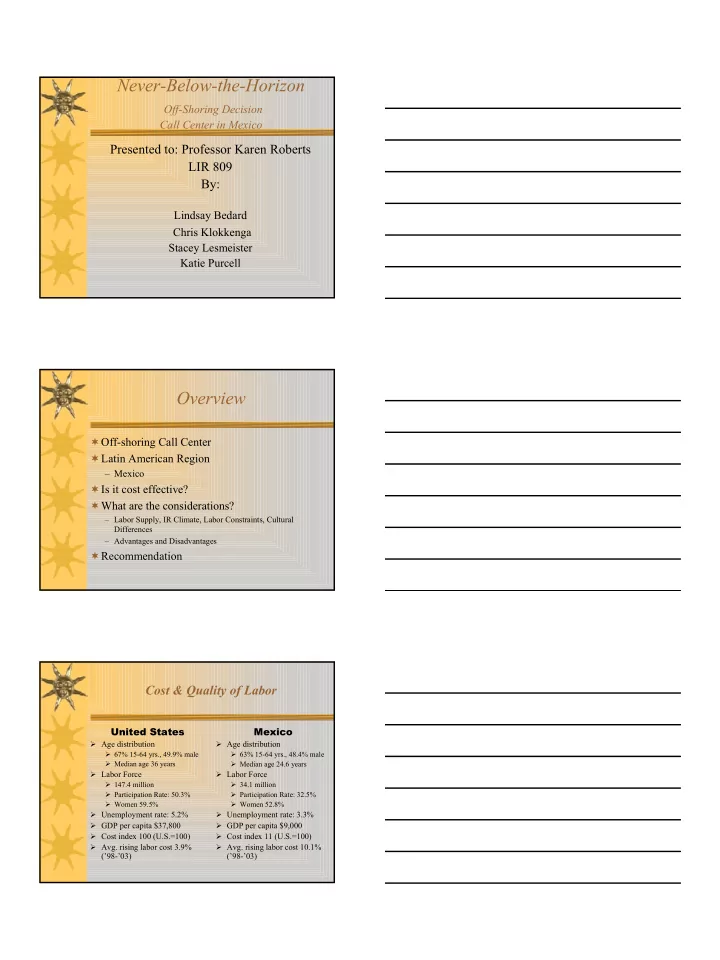
Cost & Quality of Labor

United States

Age distribution 67% 15-64 yrs., 49.9% male Median age 36 years Labor Force 147.4 million Participation Rate: 50.3% Women 59.5% Unemployment rate: 5.2% GDP per capita $37,800 Cost index 100 (U.S.=100)

  • Avg. rising labor cost 3.9%

(’98-’03)

Mexico

Age distribution 63% 15-64 yrs., 48.4% male Median age 24.6 years Labor Force 34.1 million Participation Rate: 32.5% Women 52.8% Unemployment rate: 3.3% GDP per capita $9,000 Cost index 11 (U.S.=100)

  • Avg. rising labor cost 10.1%

(’98-’03)

slide-2
SLIDE 2

2

Cost & Quality of Labor

United States

Literacy rate 97.0% Average yrs. education 12.8

  • Avg. Labor productivity

growth

3.8% / year (’93-02) Minimum wage $5.15/hour (most states) Telecommunications industry $2,650 / month Hourly compensation $21.97 Average rates

Mexico

Literacy rate 92.2% Average yrs. education 7.2

  • Avg. Labor productivity

growth

4.9% / year (’94-’02) National Minimum Wage

Commission

$4.50/day Telecommunications industry $360 / month (4003 pesos) Hourly compensation $2.48 Average rates

Industrial Relations Environment

Ministry of Labor and Social Welfare

(STPS)

– Monitors compliance and implementation of FLL – Deals with employment and social protections

  • f workers, conditions of employment, and

labor relations – Social Security Policy – ILO

Industrial Relations Environment

Mexico is highly Unionized

– With about 20% of the workforce – The Unionization rate is nearly twice as high

slide-3
SLIDE 3

3

Industrial Relations Environment

Congress of Labor (CT)

– CTM (Confederation of Mexican Workers)- claims to have 5.5 million members, but realistically about 4 to 4.5 million – CROC (Revolutionary Workers and Peasants Confederation)- claims 2 to 4 million members, but in actuality 1 to 1.5 million

National Union of Workers (UNT)

– Alternative to the CT

Industrial Relations Environment

Many other small federations and unions

with in the country

Corruption still occurs

Anti-Discrimination

  • Employers can not discriminate on the

basis of race, sex, age, religious or political beliefs, or social standing

slide-4
SLIDE 4

4

Safety and Health

  • Employer responsibility to have hire labor

inspectors to make sure hazard regulations are complied with

  • Employee entitled to all necessary medical

care, regardless of fault

  • Employers obligated to modify work place

for the safety and health of their employees

Overtime

  • Standard work week is six-days/48 hours
  • Overtime that is paid for first 9 hours over

48, for working on a legal holiday, Saturday, or Sunday is twice the hourly wage

  • Overtime for beyond 9 hours over 48 is

triple the hourly wage

Child Labor

  • Minimum legal working age is 16, but only

with parental consent and a permit from the Secretary of Labor and Social Welfare

  • Minors (under 18) are not allowed to work

in areas of potential health risk, after 10:00 pm, or any overtime

slide-5
SLIDE 5

5

Minimum Wage

  • About $4.50/day
  • Set annually by The National Minimum

Wage Commission

  • Varies by region and sometimes industry
  • It is supposed to be able to sustain a person

with a basic standard of living

  • Many employers pay above the minimum

wage

Enforcement of Labor Laws

  • Laws are supposedly more strictly enforced

than in the U.S.

  • Constitution and the Federal Labor Law

(FFL) favor unionization

Cultural Issues To Consider

Is there a cultural fit?

– Large cities in Mexico have similar infrastructure as large cities in the United States – Many large cities in Mexico have become “Americanized” – Large spread of income distribution among Mexican citizens

slide-6
SLIDE 6

6

Composition of Workforce

The call center will employ English-speaking Mexican workers

– English is a valuable skill, thus employees with this skill will be compensated higher – Inability to take advantage of cheap labor

Call center employees will be mostly part-time workers

– Students – Rotation of workers – High turnover

Cost-Benefit Analysis

Costs

– Minimum wage rate set each year nationally, may vary by regions – Minimum wage currently set at $4.50/day in Mexico versus $5.15/hr in US – Standard work week in Mexico is 48 hours versus 40 hours in US

Associated Benefits

– Ability to take advantage

  • f lower wage rates

– Costs of employing workers is less due to lower Minimum Wage – Reduction in costs of

  • vertime pay

Offshore Call Center in Mexico

Advantages

– NBH will realize cost savings – Similar infrastructure – Cultural fit – Americanization of large Mexican cities – NAFTA – Government incentives due to job creation – Enforcement of labor laws – are they really enforced?

Disadvantages

– Possible language barriers – US customers do not like dealing with offshore call center representatives – Inability to take advantage

  • f cheap labor due to

required skill set

slide-7
SLIDE 7

7

Off-shore Call Center Recommendation and Decision

Off-shore call center in a large Mexican

city

Take advantage of cheaper labor and

government incentives

Recruit and select qualified English

speaking candidates