Network Programming - I Tevfik Ko ar Louisiana State University - - PDF document

network programming i
SMART_READER_LITE
LIVE PREVIEW

Network Programming - I Tevfik Ko ar Louisiana State University - - PDF document

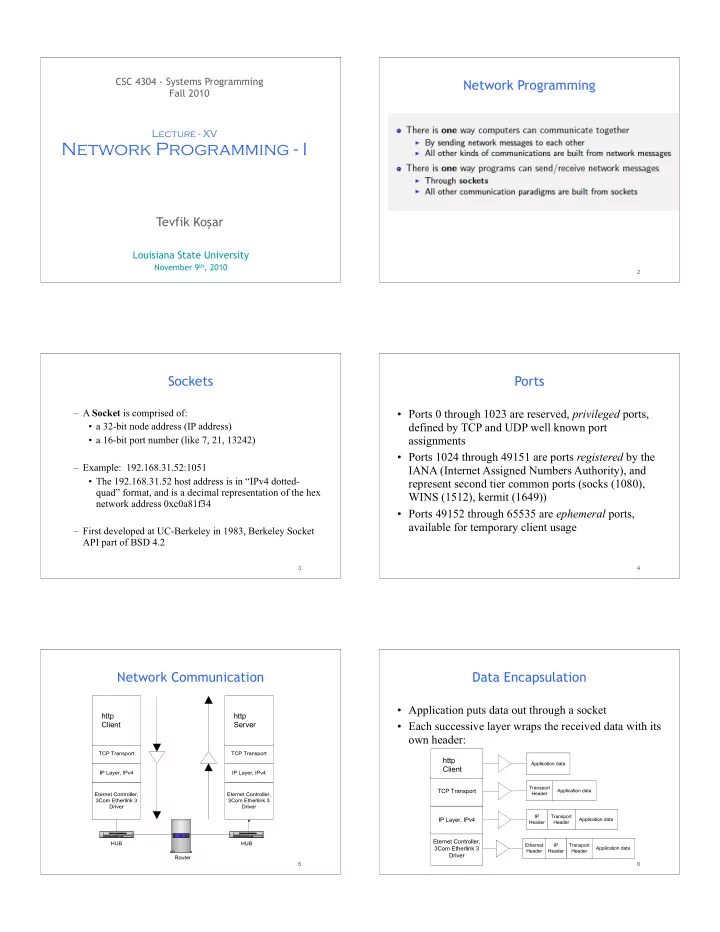
CSC 4304 - Systems Programming Network Programming Fall 2010 Lecture - XV Network Programming - I Tevfik Ko ar Louisiana State University November 9 th , 2010 1 2 Sockets Ports A Socket is comprised of: Ports 0 through 1023 are


slide-1
SLIDE 1

1

CSC 4304 - Systems Programming Fall 2010

Tevfik Koar

Louisiana State University

November 9th, 2010

Lecture - XV

Network Programming - I

Network Programming

2

Sockets

– A Socket is comprised of:

  • a 32-bit node address (IP address)
  • a 16-bit port number (like 7, 21, 13242)

– Example: 192.168.31.52:1051

  • The 192.168.31.52 host address is in “IPv4 dotted-

quad” format, and is a decimal representation of the hex network address 0xc0a81f34 – First developed at UC-Berkeley in 1983, Berkeley Socket API part of BSD 4.2

3

Ports

  • Ports 0 through 1023 are reserved, privileged ports,

defined by TCP and UDP well known port assignments

  • Ports 1024 through 49151 are ports registered by the

IANA (Internet Assigned Numbers Authority), and represent second tier common ports (socks (1080), WINS (1512), kermit (1649))

  • Ports 49152 through 65535 are ephemeral ports,

available for temporary client usage

4

Network Communication

5

http Client http Server

Data Encapsulation

  • Application puts data out through a socket
  • Each successive layer wraps the received data with its
  • wn header:

6

http Client

slide-2
SLIDE 2

TCP Header Format

  • Source and Destination ports
  • Sequence Number tells what byte offset within the
  • verall data stream this segment applies
  • Acknowledgement number lets the recipient set what

packet in the sequence was received OK.

7

IP Header Format

  • Packets may be broken up, or fragmented, if original

data is too large for a single packet (Maximum Transmission Unit is currently 12k bits, or 1500 Bytes)

  • Packets have a Time To Live, number of seconds/

rounds it can bounce around aimlessly among routers until it’s killed

8

Common Network Applications

9

Well Known Services & Ports

10

TCP & UDP

11

An HTTP Request

  • <command> <argument> <HTTP version>
  • <optional arguments>
  • <blank line>
  • GET /index.html HTTP/1.0

12

slide-3
SLIDE 3

Server Response

  • <HTTP version> <status code> <status message>
  • <aditional information>
  • <a blank line>
  • <content>
  • HTTP/1.1 200 OK

Date: Thu, 06 Nov 2008 18:27:13 GMT Server: Apache <HTML><HEAD><BODY> ....

13

Example

$ telnet www.cnn.com 80 Trying 64.236.90.21... Connected to www.cnn.com. Escape character is '^]'. GET /index.html HTTP/1.0 HTTP/1.1 200 OK Date: Thu, 06 Nov 2008 18:27:13 GMT Server: Apache Accept-Ranges: bytes Cache-Control: max-age=60, private Expires: Thu, 06 Nov 2008 18:28:14 GMT Content-Type: text/html Vary: Accept-Encoding,User-Agent Connection: close <!DOCTYPE HTML PUBLIC "-//W3C//DTD HTML 4.01 Transitional//EN""http:// www.w3.org/TR/html4/loose.dtd"><html lang="en"><head><title>CNN.com -

14

Basics of a Server (Web, FTP ..etc)

  • 1. Listen to a Network port
  • 2. Interpret incoming messages (requests)
  • 3. Serve requests
  • a. Read requested files
  • b. Send them over network
  • 4. Run consistently in the background (daemon process)

15

TCP Connection: Initial State

16

TCP Connection: Passive Open

17

TCP Connection: Active Open

18

slide-4
SLIDE 4

TCP Connection: Randezvous

19

TCP Connection: more..

20

  • TCP Client-Server view
  • Connection-oriented

socket connections

21

Server Side Socket Details

22

Client Side Socket Details

23

Example: A Time Server

#include <stdio.h> #include <sys/types.h> #include <sys/socket.h> #include <netinet/in.h> #include <netdb.h> #define PORTNUM 8824 #define oops(msg) { perror(msg) ; exit(1) ; } 24

slide-5
SLIDE 5

void main(int ac, char **av) { struct sockaddr_in saddr; /* build our address here */

  • struct

hostent *hp; /* this is part of our */

  • char

hostname[256]; /* address */

  • int slen,sock_id,sock_fd; /* line id, file desc */
  • FILE

*sock_fp; /* use socket as stream */ char *ctime(); /* convert secs to string */ long time(), thetime; /* time and the val */ gethostname( hostname , 256); /* where am I ? */ hp = gethostbyname( hostname ); /* get info about host */ bzero( &saddr, sizeof(saddr) ); /* zero struct */ /* fill in hostaddr */ bcopy( hp->h_addr, &saddr.sin_addr, hp->h_length); saddr.sin_family = AF_INET ; /* fill in socket type */ saddr.sin_port = htons(PORTNUM); /* fill in socket port */ sock_id = socket( AF_INET, SOCK_STREAM, 0 ); /* get a socket */ if ( sock_id == -1 ) oops( "socket" ); if ( bind(sock_id, &saddr, sizeof(saddr)) != 0 )/* bind it to */

  • ops( "bind" ); /* an address */

if ( listen(sock_id, 1) != 0 ) oops( "listen" ); 25 while ( 1 ){ sock_fd = accept(sock_id, NULL, NULL); /* wait for call */

  • printf("** Server: A new client connected!");

if ( sock_fd == -1 )

  • ops( "accept" ); /* error getting calls */

sock_fp = fdopen(sock_fd,"w"); /* we'll write to the */ if ( sock_fp == NULL ) /* socket as a stream */

  • ops( "fdopen" ); /* unless we can't */

thetime = time(NULL); /* get time */ /* and convert to strng */ fprintf( sock_fp, "**************************************\n"); fprintf( sock_fp, "** From Server: The current time is: "); fprintf( sock_fp, "%s", ctime(&thetime) ); fprintf( sock_fp, "**************************************\n"); fclose( sock_fp ); /* release connection */

  • fflush(stdout);
  • /* force output */

} } 26 27

Acknowledgments

  • Advanced Programming in the Unix Environment by R.

Stevens

  • The C Programming Language by B. Kernighan and D.

Ritchie

  • Understanding Unix/Linux Programming by B. Molay
  • Lecture notes from B. Molay (Harvard), T

. Kuo (UT- Austin), G. Pierre (Vrije), M. Matthews (SC), B. Knicki (WPI), M. Shacklette (UChicago), J. Kim (KAIST), A. Dix (Hiraeth), and J. Schaumann (SIT).