Natural Language Processing Learning PCFGs Parsing II Dan Klein UC - - PDF document

natural language processing learning pcfgs
SMART_READER_LITE
LIVE PREVIEW

Natural Language Processing Learning PCFGs Parsing II Dan Klein UC - - PDF document

Natural Language Processing Learning PCFGs Parsing II Dan Klein UC Berkeley Treebank PCFGs Conditional Independence? [Charniak 96] Use PCFGs for broad coverage parsing Can take a grammar right off the trees (doesnt work well): ROOT


slide-1
SLIDE 1

1

Natural Language Processing

Parsing II

Dan Klein – UC Berkeley

Learning PCFGs

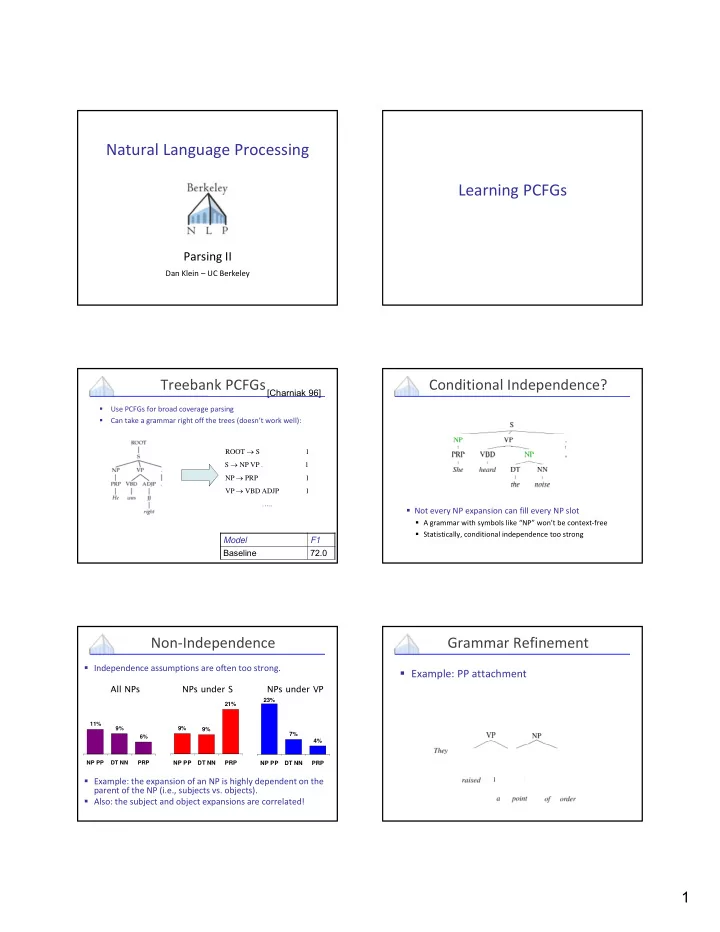
Treebank PCFGs

  • Use PCFGs for broad coverage parsing
  • Can take a grammar right off the trees (doesn’t work well):

ROOT  S 1 S  NP VP . 1 NP  PRP 1 VP  VBD ADJP 1 …..

Model F1 Baseline 72.0 [Charniak 96]

Conditional Independence?

  • Not every NP expansion can fill every NP slot
  • A grammar with symbols like “NP” won’t be context‐free
  • Statistically, conditional independence too strong

Non‐Independence

  • Independence assumptions are often too strong.
  • Example: the expansion of an NP is highly dependent on the

parent of the NP (i.e., subjects vs. objects).

  • Also: the subject and object expansions are correlated!

11% 9% 6% NP PP DT NN PRP 9% 9% 21% NP PP DT NN PRP 7% 4% 23% NP PP DT NN PRP

All NPs NPs under S NPs under VP

Grammar Refinement

  • Example: PP attachment
slide-2
SLIDE 2

2

Grammar Refinement

  • Structure Annotation [Johnson ’98, Klein&Manning ’03]
  • Lexicalization [Collins ’99, Charniak ’00]
  • Latent Variables [Matsuzaki et al. 05, Petrov et al. ’06]

Structural Annotation

The Game of Designing a Grammar

  • Annotation refines base treebank symbols to

improve statistical fit of the grammar

  • Structural annotation

Typical Experimental Setup

  • Corpus: Penn Treebank, WSJ
  • Accuracy – F1: harmonic mean of per‐node labeled

precision and recall.

  • Here: also size – number of symbols in grammar.

Training: sections 02-21 Development: section 22 (here, first 20 files) Test: section 23

Vertical Markovization

  • Vertical Markov
  • rder: rewrites

depend on past k ancestor nodes. (cf. parent annotation)

Order 1 Order 2

72% 73% 74% 75% 76% 77% 78% 79% 1 2v 2 3v 3 Vertical Markov Order 5000 10000 15000 20000 25000 1 2v 2 3v 3 Vertical Markov Order Symbols

Horizontal Markovization

70% 71% 72% 73% 74% 1 2v 2 inf Horizontal Markov Order 3000 6000 9000 12000 1 2v 2 inf Horizontal Markov Order Symbols

Order 1 Order 

slide-3
SLIDE 3

3

Unary Splits

  • Problem: unary

rewrites used to transmute categories so a high‐probability rule can be used.

Annotation F1 Size Base 77.8 7.5K UNARY 78.3 8.0K

 Solution: Mark

unary rewrite sites with -U

Tag Splits

  • Problem: Treebank tags

are too coarse.

  • Example: Sentential, PP,

and other prepositions are all marked IN.

  • Partial Solution:
  • Subdivide the IN tag.

Annotation F1 Size Previous 78.3 8.0K SPLIT-IN 80.3 8.1K

A Fully Annotated (Unlex) Tree Some Test Set Results

  • Beats “first generation” lexicalized parsers.
  • Lots of room to improve – more complex models next.

Parser LP LR F1 CB 0 CB Magerman 95 84.9 84.6 84.7 1.26 56.6 Collins 96 86.3 85.8 86.0 1.14 59.9 Unlexicalized 86.9 85.7 86.3 1.10 60.3 Charniak 97 87.4 87.5 87.4 1.00 62.1 Collins 99 88.7 88.6 88.6 0.90 67.1

Efficient Parsing for Structural Annotation

Grammar Projections

NP^S → DT^NP N’[…DT]^NP NP → DT N’ Coarse Grammar Fine Grammar

Note: X‐Bar Grammars are projecons with rules like XP → Y X’ or XP → X’ Y or X’ → X

slide-4
SLIDE 4

4

Coarse‐to‐Fine Pruning

For each coarse chart item X[i,j], compute posterior probability:

… QP NP VP …

coarse: refined: E.g. consider the span 5 to 12:

< threshold

Computing (Max‐)Marginals Inside and Outside Scores Pruning with A*

  • You can also speed up the

search without sacrificing

  • ptimality
  • For agenda‐based parsers:
  • Can select which items to

process first

  • Can do with any “figure of

merit” [Charniak 98]

  • If your figure‐of‐merit is a

valid A* heuristic, no loss of

  • ptimiality [Klein and

Manning 03]

X n i j

A* Parsing

Lexicalization

slide-5
SLIDE 5

5

  • Annotation refines base treebank symbols to improve

statistical fit of the grammar

  • Structural annotation [Johnson ’98, Klein and Manning 03]
  • Head lexicalization [Collins ’99, Charniak ’00]

The Game of Designing a Grammar

Problems with PCFGs

  • If we do no annotation, these trees differ only in one rule:
  • VP  VP PP
  • NP  NP PP
  • Parse will go one way or the other, regardless of words
  • We addressed this in one way with unlexicalized grammars (how?)
  • Lexicalization allows us to be sensitive to specific words

Problems with PCFGs

  • What’s different between basic PCFG scores here?
  • What (lexical) correlations need to be scored?

Lexicalized Trees

  • Add “head words” to

each phrasal node

  • Syntactic vs. semantic

heads

  • Headship not in (most)

treebanks

  • Usually use head rules,

e.g.:

  • NP:
  • Take leftmost NP
  • Take rightmost N*
  • Take rightmost JJ
  • Take right child
  • VP:
  • Take leftmost VB*
  • Take leftmost VP
  • Take left child

Lexicalized PCFGs?

  • Problem: we now have to estimate probabilities like
  • Never going to get these atomically off of a treebank
  • Solution: break up derivation into smaller steps

Lexical Derivation Steps

  • A derivation of a local tree [Collins 99]

Choose a head tag and word Choose a complement bag Generate children (incl. adjuncts) Recursively derive children

slide-6
SLIDE 6

6

Lexicalized CKY

bestScore(X,i,j,h) if (j = i+1) return tagScore(X,s[i]) else return max max score(X[h]->Y[h] Z[h’]) * bestScore(Y,i,k,h) * bestScore(Z,k,j,h’) max score(X[h]->Y[h’] Z[h]) * bestScore(Y,i,k,h’) * bestScore(Z,k,j,h) Y[h] Z[h’] X[h] i h k h’ j

k,h’,X->YZ

(VP->VBD )[saw] NP[her] (VP->VBD...NP )[saw]

k,h’,X->YZ

Efficient Parsing for Lexical Grammars

Quartic Parsing

  • Turns out, you can do (a little) better [Eisner 99]
  • Gives an O(n4) algorithm
  • Still prohibitive in practice if not pruned

Y[h] Z[h’] X[h] i h k h’ j Y[h] Z X[h] i h k j

Pruning with Beams

  • The Collins parser prunes with per‐

cell beams [Collins 99]

  • Essentially, run the O(n5) CKY
  • Remember only a few hypotheses for

each span <i,j>.

  • If we keep K hypotheses at each span,

then we do at most O(nK2) work per span (why?)

  • Keeps things more or less cubic (and in

practice is more like linear!)

  • Also: certain spans are forbidden

entirely on the basis of punctuation (crucial for speed)

Y[h] Z[h’] X[h] i h k h’ j

Pruning with a PCFG

  • The Charniak parser prunes using a two‐pass, coarse‐

to‐fine approach [Charniak 97+]

  • First, parse with the base grammar
  • For each X:[i,j] calculate P(X|i,j,s)
  • This isn’t trivial, and there are clever speed ups
  • Second, do the full O(n5) CKY
  • Skip any X :[i,j] which had low (say, < 0.0001) posterior
  • Avoids almost all work in the second phase!
  • Charniak et al 06: can use more passes
  • Petrov et al 07: can use many more passes

Results

  • Some results
  • Collins 99 – 88.6 F1 (generative lexical)
  • Charniak and Johnson 05 – 89.7 / 91.3 F1 (generative

lexical / reranked)

  • Petrov et al 06 – 90.7 F1 (generative unlexical)
  • McClosky et al 06 – 92.1 F1 (gen + rerank + self‐train)
  • However
  • Bilexical counts rarely make a difference (why?)
  • Gildea 01 – Removing bilexical counts costs < 0.5 F1
slide-7
SLIDE 7

7

Latent Variable PCFGs

  • Annotation refines base treebank symbols to improve

statistical fit of the grammar

  • Parent annotation [Johnson ’98]
  • Head lexicalization [Collins ’99, Charniak ’00]
  • Automatic clustering?

The Game of Designing a Grammar

Latent Variable Grammars

Parse Tree Sentence Parameters ... Derivations

Forward

Learning Latent Annotations

EM algorithm: X1 X2 X7 X4 X5 X6 X3

He was right .

  • Brackets are known
  • Base categories are known
  • Only induce subcategories

Just like Forward‐Backward for HMMs.

Backward

Refinement of the DT tag

DT DT-1 DT-2 DT-3 DT-4

Hierarchical refinement

slide-8
SLIDE 8

8

Hierarchical Estimation Results

74 76 78 80 82 84 86 88 90 100 300 500 700 900 1100 1300 1500 1700 Total Number of grammar symbols Parsing accuracy (F1)

Model F1 Flat Training 87.3 Hierarchical Training 88.4

Refinement of the , tag

  • Splitting all categories equally is wasteful:

Adaptive Splitting

  • Want to split complex categories more
  • Idea: split everything, roll back splits which

were least useful

Adaptive Splitting Results

Model F1 Previous 88.4 With 50% Merging 89.5

5 10 15 20 25 30 35 40 NP VP PP ADVP S ADJP SBAR QP WHNP PRN NX SINV PRT WHPP SQ CONJP FRAG NAC UCP WHADVP INTJ SBARQ RRC WHADJP X ROOT LST

Number of Phrasal Subcategories Number of Lexical Subcategories

10 20 30 40 50 60 70 NNP JJ NNS NN VBN RB VBG VB VBD CD IN VBZ VBP DT NNPS CC JJR JJS : PRP PRP$ MD RBR WP POS PDT WRB

  • LRB-

. EX WP$ WDT

  • RRB-

'' FW RBS TO $ UH , `` SYM RP LS #

slide-9
SLIDE 9

9

Learned Splits

  • Proper Nouns (NNP):
  • Personal pronouns (PRP):

NNP-14 Oct. Nov. Sept. NNP-12 John Robert James NNP-2 J. E. L. NNP-1 Bush Noriega Peters NNP-15 New San Wall NNP-3 York Francisco Street PRP-0 It He I PRP-1 it he they PRP-2 it them him

  • Relative adverbs (RBR):
  • Cardinal Numbers (CD):

RBR-0 further lower higher RBR-1 more less More RBR-2 earlier Earlier later CD-7

  • ne

two Three CD-4 1989 1990 1988 CD-11 million billion trillion CD-0 1 50 100 CD-3 1 30 31 CD-9 78 58 34

Learned Splits

Final Results (Accuracy)

≤ 40 words F1 all F1 ENG Charniak&Johnson ‘05 (generative) 90.1 89.6 Split / Merge 90.6 90.1 GER Dubey ‘05 76.3

  • Split / Merge

80.8 80.1 CHN Chiang et al. ‘02 80.0 76.6 Split / Merge 86.3 83.4 Still higher numbers from reranking / self-training methods

Efficient Parsing for Hierarchical Grammars

Coarse‐to‐Fine Inference

  • Example: PP attachment

?????????

Hierarchical Pruning

… QP NP VP …

coarse: split in two:

… QP1 QP2 NP1 NP2 VP1 VP2 … … QP1 QP1 QP3 QP4 NP1 NP2 NP3 NP4 VP1 VP2 VP3 VP4 …

split in four: split in eight: …

… … … … … … … … … … … … … … … …

slide-10
SLIDE 10

10

Bracket Posteriors

1621 min 111 min 35 min

15 min

(no search error)